
GREECE
 GLOSSARY
| A | B | C | D |
| E | F | G | H |
| I | J | K | L |
| M | N | O | P |
| Q | R | S | T |
| U | V | W | X |
| Y | Z |
2026-01-18
color code:  = mythology;
 = history & culture;
  = geography;
  = archaeology &
architecture
= archaeology &
architecture
Palace of Nestor
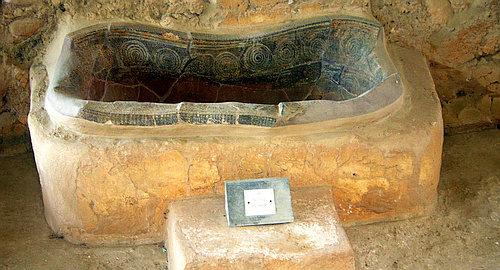
The so-called "Palace of Nestor" is the primary structure within a
larger settlement of the Late Helladic period. The palace, identified with
Mycenaean Pylos, lies at Ano Englianos, ca. 17 km north of modern
Pylos. It was excavated by Carl Blegen since 1939, who unearthed around 1,000
Linear B tablets, confirming that the palace served as the administrative, political and
financial centre of Mycenaean Messenia. The palace was a two-storey building with
anterooms, throne room, store rooms, workshops, baths, light wells, reception rooms and a sewage system, and is the
best preserved Mycenaean Greek palace discovered. It was long occupied with most artefacts discovered dating from 1300
BC, and was destroyed by fire around 1200 BC. - Near the palace are two tholos tombs, and
an extraordinarily rich find uncovered in 2015, the undisturbed burial of a Mycenaean warrior, called the "griffin
warrior". - After the former roof over the site was replaced by a modern structure with raised walkways for visitors the
site re-opened in June 2016. - See also: site
page.
Palaimon
1) ("the wrestler") A surname of Herakles. - A school in ancient Greece where young boys were taught wrestling and gymnastics. - The proper name of several mythical personages.
2) A son of Athamas and Ino, was originally called Melikertes. When his mother, inflicted with madness by Hera, had thrown herself with her boy into the sea, both became marine divinities, viz. Ino became Leukothea, and Melikertes became Palaimon. According to common tradition, his body was washed by the waves, or carried by dolphins to the Corinthian isthmus, or to that place where subsequently the altar of Palaimon stood. There the body was found by his uncle Sisyphos, who ordered it to be carried to Corinth, and on the command of the Nereids instituted the Isthmian games.
3) A son of Hephaistos, or Aitolos, or Lenus. He was one of the Argonauts.
4) A son of Herakles by Autonoë, or by Iphinoe.
5) One of the sons of Priam.
palaistra
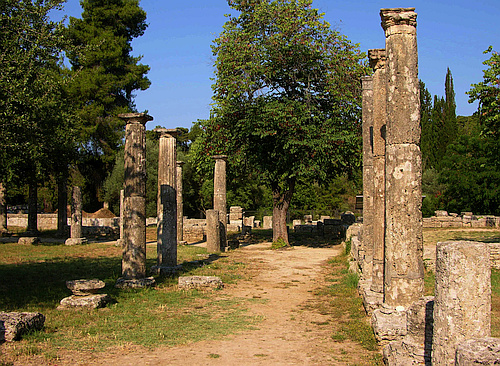
A purpose designed building for athletics in ancient Greece with dressing rooms and a sand covered
courtyard where boys practiced. It was especially used for events requiring little space, such as boxing and wrestling.
Larger events took place in the gymnasium.
Palamedes
A son of Nauplios and Klymene. Later, tragic poets and sophists describe him as a sage who invented light-houses, measures, scales, discus, dice, and the alphabet. - He joined the Greeks in their expedition against Troy; but Agamemnon, Diomedes, and Odysseus (or Odysseus alone) hated and persecuted him, although the reason for this remained unclear. As a consequence, a letter from Priam was faked and placed in his tent. Thereupon, they accused Palamedes of treachery, searched his tent, found the letter which they themselves had dictated, and so Palamedes was sentenced to death. When he was led to his execution, he exclaimed, "Truth, I lament thee, for thou hast died even before me."
Pallas
1) A Titan. His children with Styx were Nike (Victory), Zelos (Rivalry), Kratos (Strength), and Bia (Force).
2) The father of Selene.
3) One of the Giants. In the fight with the gods, he was killed and flayed by Athena.
4) A son of Lykaon, and grandfather of Euandros.
5) A son of Herakles by Dyna, the daughter of Euandros.
6) A son of Euandros. According to Virgil's Aeneid, an ally of Aeneas, who treated him like his own son.
7) A son of the Athenian king Pandion, and brother of Aigeus, Nisos, and Lykos. He was slain by Theseus.
8) An epithet of Athena with uncertain meaning and derivation.
 Pallene
1) The ancient name of the westernmost of the three headlands of Chalkidike. Its modern name is Kassandra.
2) A beautiful daughter of Sithon.
3) A daughter of the giant
Alkyoneus, and thus one of the Alkyonides.
palmette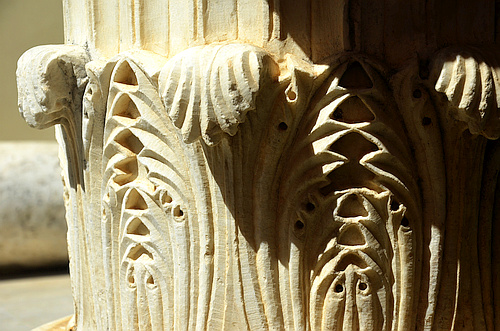
A palmette, or anthemion, is a schematic floral ornament or decorative motif.
Pamphylia
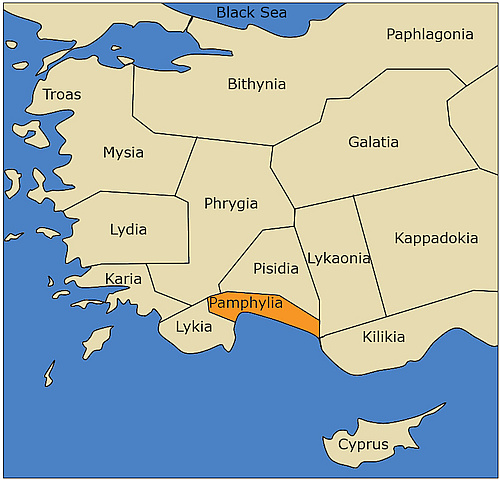
An ancient region on the southern shore of Asia Minor between
Lykia and Kilikia. Bordered by Pisidia in the North it was
only some 50 km wide. According to tradition, the Pamphylians were descendants of Greeks who settled here after the
Trojan War.
Pan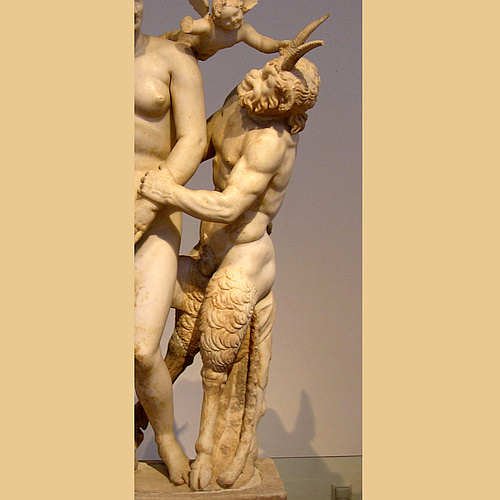
In Greek mythology, god of the woodland and patron god of the shepherds, son of
Hermes. He is described as a satyr-like being with a human
body except for the legs of a goat and goat horns on his head. He usually lived in the forests and mountains of
Arcadia. A wide-spread myth relates that Pan was struck with passion for the
nymph Syrinx. She fled until she arrived at a river where there was no further escape. She
prayed to the gods whereupon she was turned into weed in the river marsh. Pan broke off some of the reeds, tied them
together and thus made a music instrument, called syrinx.
Panakeia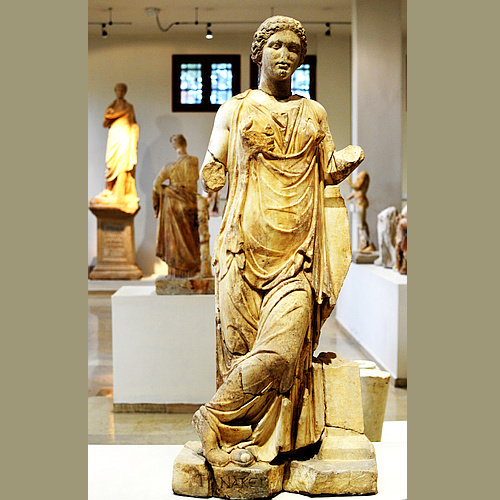
I.e. "the all-healing," a daughter of Asklepios.
Panathenaia
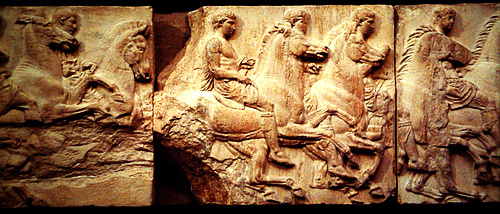
The major festival in ancient Athens held in honour of the
patron-goddess Athena. The Lesser Panathenaia were celebrated annually, while the Greater
Panathenaia were celebrated every fourth year. They included athletic contests, musical and dramatic competitions,
culminating in a procession along the Panathenaic Way up to the Parthenon on the
acropolis, where the statue of Athena was presented with a new, elaborately embroidered
peplos.
Panathenaic amphora
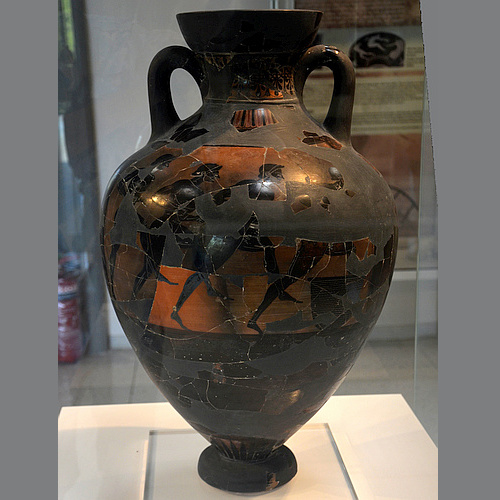
The amphora that contained the olive oil given as prize in the
competitions held every four years at the Greater Panathenaia. Traditionally, the amphora had
the distinctive form of tight handles, narrow neck and feet, decorated with consistent symbols in the
black-figure technique, even after that style had fallen out of fashion. The olive
oil in the amphora came from the sacred grove of Athena at Akademia.
Pandaros
A Lykian, known as a distiguished archer in the Trojan forces during the Trojan War. It is said that after ten years of the siege a truce was declared between the Greeks and the Trojans with the agreement that only Menelaos and Paris should fight over Helena. However, the gods did not want the war to end so easily and so Athena, disguised as Pandaros, shot an arrow at Menelaos and thus broke the truce. Later, Pandaros was killed by Diomedes, or in other accounts by Sthenelos.
Pandion
1) A son of Aigyptos and Hephaestine.
2) A son of Phineus and Kleopatra.
3) A companion of Teukros.
4) A son of Erichthonios, the king of Athens, by the Naiad Pasithea. By his wife Zeuxippe he became the father of Prokne and Philomela, and of the twins Erechtheus and Boutes. In a war against the Theban king Labdakos, Pandion was supported by Tereus, who afterwards received the hand of Prokne. It is said that, during the reign of Pandion, Dionysos and Demeter came to Attica.
5) A son of Kekrops and Metiadusa, also a king of Athens. When he was expelled from Athens, he fled to Megara, where he later obtained the government. He became the father of Aigeus, Pallas, Nisos, Lykos, and a natural son, Oineus, and also of a daughter. His tomb was shown in the territory of Megara, and at Megara he was honoured with a heroon.
Pandora
1) ("endowed with everything") The name of the first woman on earth. When Prometheus had stolen the fire and brought it to earth, Zeus planned revenge and made Hephaistos form a woman out of earth who should bring misery upon the humans. Aphrodite adorned her with beauty, Hermes gave her boldness and cunning, and in the end all Olmpians had given her something to ruin mankind. When Hermes brought her to Epimetheus, he forgot all the warnings of his brother Prometheus to be suspicious of gifts of Zeus, and so all miseries came down upon men. - It is only in later myths that a vessel of Pandora is noted. It contained, according to this narrative, blessings that the gods had reserve for mankind. However, when Pandora opened the vessel, all the blessings flew away and only the evil remained that Pandora ha brought. In yet another version the vessel contained all the evils which might torment mortals in life and when Pandora lifted the lid of the vessel all kind of diseases and sufferings were set free and only hope remained.
2) A daughter of Deukalion, by Zeus mother of Graecus.
3) There is another mythical personage of this name.
Pandrosos
(Greek: "the all-bedewing," or "refreshing") A daughter of Kekrops and Agraulos, and a sister of Erysichthon, Herse, and Agraulos. Some accounts call her the mother of Keryx by Hermes.
panhellenism

Panhellenism was a political idea in ancient Greece, aimed at a unification of the Greek
poleis. Institutions like the Olympic games or the
Amphictyonic League of Delphi are evidence that the Greeks already of the
Archaic period felt themselves as culturally connected. An important element were the
panhellenic games not only in Olympia, but also the Pythian
Games at Delphi, the Nemean Games and the
Isthmian Games. - Later, panhellenism was most prominently propagated by
Isokrates, Aischines, and others. It was first
directed against the Persian empire, and later against
Macedonia when it strived for hegemony. - In modern times, panhellenism, or Greek nationalism, became again a major
political movement in the 18th century, culminating in the Greek War of
Independence (1821-1829) against the Ottoman Empire.
pankration
A type of wrestling / boxing with almost no rules. Pankration was a very popular contest in the Olympic Games and other panhellenic games.
Panopeus
1) A very ancient town of Phokis, on the road from Daulis to Chaironeia. Its king was the leader of the Phokians in the Trojan War. Panopeus was destroyed by Xerxes, and again by Philip II of Macedon, taken by the Romans in 198 BC, and destroyed for the third time in the 1st century BC.
2) A son of Phokos and Asteropaia. He accompanied Amphitryon on his expedition against the Taphians or Teleboans, and also took part in the Kalydonian Hunt.
pantheon
A temple dedicated to all gods.
Panthoos
One of the elders at Troy. He was married to Phrontis, and the father of Euphorbos, Polydamas, and Hyperenor. According to Virgil, he was a priest of Apollo. Originally he came from Delphi, from where Antenor carried him off to Troy because of his beauty.
Paphos
A son of Pygmalion. The Cyprian town of Paphus is said to have derived its name from him. - The father of Kinyras, the founder of the temple of Aphrodite at Paphus, is also called Paphos.
paraskenion
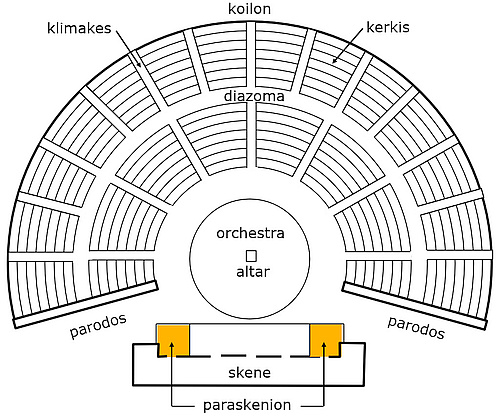
A paraskenion (plural: paraskenia) in Greek theatres of the
Hellenistic period were projecting stages on the sides of the
skene. These side wings of the proskenion could be one or two
levels high, sometimes decorated with columns or pillars.
parerga
("Incidentals") A term under which the additional adventures of Herakles during the completion of the Twelve Labors (athloi) are subsumed. The parerga include: the deaths of the centaurs Cheiron and Pholos; saving the Trojan princess Hesione from a sea-monster; fighting the sea god Nereus; fighting the giant Antaios; killing the Egyptian king Busiris; freeing Prometheus from his bonds.
Paris
Son of king Priam of Troy, and the main figure in the "Judgement of Paris". Homer relates that he later kidnapped Helena und thereby caused the Trojan War. He killed Achilles with an arrow-shot and was later himself killed by the poisoned arrow of Philoktetes. In the Iliad he appears as an effeminate figure, hiding behind his brother Hektor, with not much left of his former bravery.
Parmenides
Parmenides of Elea (late 6th / early 5th century BC) was a pre-Socratic Greek philosopher from Elea in Magna Graecia. Only one of his works has survived, and only in fragmentary form: the poem On Nature. Herein, he explains that reality ("what-is") is one, changeless, timeless, and necessary. The experiences, on the other hand, lead to false and deceitful conceptions.
Parnassos
1) One of the largest mountainous regions of mainland Greece. Its highest peak is Liakouras with an altitude of 2,547 meters. Towering above Delphi, the mountain range was sacred to Dionysos and his mysteries, but also to Apollo and the korykian nymphs, and it was the home of the muses.
2) A son of Kleopompos or Poseidon and the nymph Kleodora. According to ancient Greek tradition he founded Delphi and foretold the future from the flight of birds.
parodos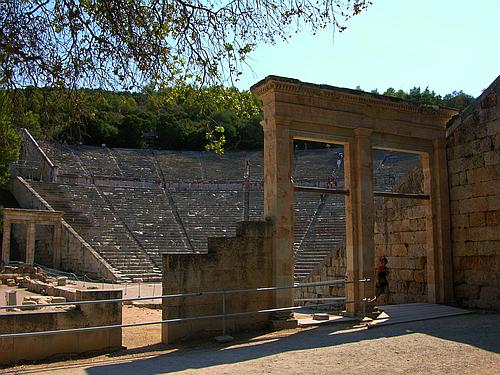
(Greek = "passageway"; plural: parodoi) The side entrance into the
orchestra of a later Greek theatre, on either side of
the skene. It was used by the chorus and the audience for
entrance and exit from the theatre.
Parthenon
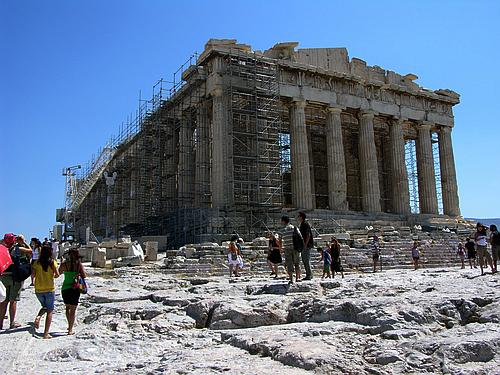
On the Athenian acropolis, the
temple dedicated to Athena, patron goddess of the city. It
was built between 447 BC and 438 BC, during the heyday of Athenian power, with decorations of the building continuing
until 432 BC. The Parthenon is the most important building that survives from Classical
Greece and is certainly the culmination of Doric architecture. It replaced an older
temple dedicated to Athena that was destroyed during the Persion invasion of 480 BC. - See
also: site page.
Parthenopaios
One of the seven heroes that marched against Thebes and were killed in this campaign. His ancestry is given differently, as well as the name of his son, probably Promachos, who was one of the Epigoni.
Parthenope
1) A daughter of Stymphalos, and by Herakles the mother of Eueres.
2) A daughter of Ankaios and Samia, became by Apollo the mother of Lykomedes.
3) One of the Seirens. Her tomb was shown at Naples.
4) The wife of Okeanos, by whom she became the mother of Europa and Thrake.
Parthenos
1) ("the virgin") In Athens used as a surname of Athena. There, where the famous temple Parthenon was dedicated to her.
2) The daughter of Apollo and Chrysothemis, who after her premature death was placed by her father among the stars as the constellation Virgo.
3) A daughter of Staphylos.
Parysatis
Parysatis (fl. 5th century BC) was the illegitimate daughter of Artaxerxes I, and the half-sister of Xerxes II, Sogdianus, and Darius II. She married her half-brother Darius and had four sons: Artaxerxes II, Cyrus the Younger, Ostanes, and Oxathres.
Pasiphaë
1) A daughter of Helios and Perseis, and a sister of Kirke and Aietes. She was the wife of Minos, by whom she became the mother of Androgeos, Akcalle, Ariadne, Deukalion, Glaukos, Katreos, Phaidra, and Xenodike. According to tradition, she was also the mother of Minotauros.
2) An oracular goddess at Thalamae in Lakonia, believed to be a daughter of Atlas.
Patras
Greece's third largest city (population 216,000) and the regional capital of Western Greece, in
Achaia, Peloponnese. Called "Gate to the West", Patras is a
commercial hub especially due to its busy port promoting trade and communication with Italy and the rest of Western
Europe. With its three public universities, Patras hosts a large student population and has developped into an important
scientific centre. Remarkable is also the modern Archaeological Museum, one of the most eminent in Greece. - Patras
has an impressive history of four thousand years since the prehistoric age. In the Roman period it had become a
cosmopolitan center of the eastern Mediterranean whilst, according to Christian tradition, it was also the place of
Saint Andrew's martyrdom. - See also: site page.
Patroklos
Companion and lover of Achilles, who accompanied him in the Trojan War. When Achilles, after a quarrel with Agamemnon, withdrew from the battles Patroklos fought in the magical armour of Achilles, hoping to mislead the Trojans, but was killed by Hektor.
Pausanias
1) Pausanias (ca. AD 110 - ca. 180) was a Greek traveler and geographer of the 2nd century AD, who lived in the time of Roman emperors Hadrian, Antoninus Pius and Marcus Aurelius. Based on his travels, talks and first-hand observations, Pausanias wrote the voluminous Description of Greece (Hellados Periegesis). Today, this work provides crucial information for linking classical literature with findings of modern archaeology. Andrew Stewart assesses him as: "A careful, pedestrian writer ... interested not only in the grandiose or the exquisite but in unusual sights and obscure ritual. He is occasionally careless, or makes unwarranted inferences, and his guides or even his own notes sometimes mislead him; yet his honesty is unquestionable, and his value without par."
2) A Spartan general of the 5th century BC. He was the nephew of Leonidas I, and father of Pleistoanax, who later became king. Pausanias was leader at the Greek victory at the battle of Plataiai in 479 BC, and was the leader of the Hellenic League during the Greco-Persian Wars. Later, he allegedly sent a letter to King Xerxes, saying that he wished to help him and bring Sparta and the rest of Greece under Persian control. In return, he wished to marry the king's daughter, and Xerxes agreed. The Spartans recalled him and Pausanias returned as he did not wish to be suspected of Persian sympathies. On his arrival in Sparta, he fled to the temple of Athena, but the ephors walled up the doors and proceeded to starve him out. When Pausanias was on the brink of death they carried him out, and he died soon afterwards. Thus Pausanias did not die within the temple, which would have been an act of ritual pollution.
3) King of Sparta 445 - 426 BC and then 408 - 395 BC.
4) Pausanias the Pretender, was a Macedonian who claimed the right of the Macedonian throne in the 360's BC, during the time of Philip II of Macedon.
pediment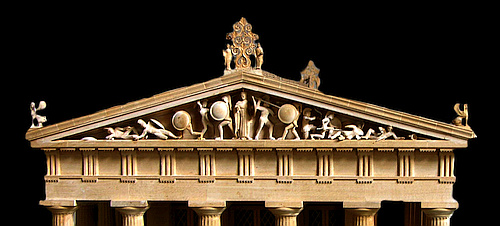
The triangular space between the horizontal cornice and the gable roof
on the narrow sides of an ancient Greek temple. It was often decorated with sculptures.
Pegasus
The famous winged horse of which very different traditions and stories exist. In the most ancient
view, Poseidon in the form of a horse had intercourse with Medusa,
and when Perseus struck off her head, there sprang forth Chrysaor
and the horse Pegasus. Pegasus then rose up to the seat of the Olympian Gods and
henceforth carried thunder and lightning of Zeus. Later writers describe him as the horse of
Eos, placing him among the stars. - A well known story is that the
Corinthian hero Bellerophontes had tried much to
obtain possession of Pegasus and that he finally had the horse with the help of Athena (or
Poseidon). With Pegasus he then conquered the Chimaira and after that made the
presumptuous attempt to reach Olympos but he fell off the horse which continued the
flight alone. - In still another tradition, Pegasus is the horse of the muses, which created
the inspiring well of Hippokrene by kicking the ground with its hooves. Also other wells like that of
Peirene in Corinth were said to have been called forth by Pegasus.
Peirene
The nymph of the well Peirene in Corinth, which was believed by some to have arisen out of the tears which she shed in her grief at the death of her son Kenchrias.
Peirithoos
A son of Ixion (or Zeus) by Dia. He was one of the Lapiths in Thessaly and became the father of Polypoetes by Hippodameia. When Peirithoos married Hippodameia the centaurs were invited to the feast, but when the drunk centaur Eurytion tried to carry her off, a bloody fight broke out between the Lapiths and the centaurs.
 Peisistratos
1) Athenian politician who ruled as tyrant during most of the period between 561 and 527 BC. He instituted the Panathenaic Festival in 566 BC and also also funded other religious and artistic programs. In his populistic policy he confronted the aristocracy by confiscating land and giving it to members of the Hyperakrioi, the lower class in Athens. - Peisistratos was the much older brother-in-law of Kleisthenes. He and his two sons, Hipparchos and Hippias are known as Peisistratids, the three tyrants who ruled Athens from 546 to 510 BC.
2) A friend of Telemachos, who accompanied him on his journey from Pylos to Menelaos at Sparta.
Peitho
1) The personification of persuasion. She was worshipped as a divinity at Sikyon, but Peitho also occurs as a surname of other divinities, especially Aphrodite.
2) One of the Charites.
3) One of the daughters of Okeanos and Tethys.
4) The wife of Phoroneus, and the mother of Aigialeus and Apia.
Peithon
A Macedonian high-ranking military officer, one of the bodyguards of Alexander the Great in 335 BC. After Alexander's death in 323 BC, Peithon was made the satrap of Media, an important region that controlled all roads between east and west.
Pelasgians
In ancient Greek literature the name under which various prehellenic tribes were subsumed that inhabited Greece as early as the third millennium BC. They were said to have introduced the worship of the Dodonaean Zeus, of Hephaistos, the Kabeiroi, and other divinities.
Pelasgos
The mythical ancestor of the earliest inhabitants of Greece, the Pelasgians. Regarding his origin and descendants there were different traditions in the different parts of the country once occupied by Pelasgians, especially the Peloponnese, Attica, and Thessaly.
Peleus
A son of Aiakos, a Greek hero, king in Thessaly, and one of the Argonauts. - Before he could marry the Nereid Thetis, he had to capture her in her cave. Like all sea-deities, Thetis had the ability to change her shape, and so she appeared to Peleus as a fire, water, lioness, wolf and other shapes, until she finally gave in. For their wedding, all Olympian Gods were invited, except Eris, the goddess of discord. In her anger, Eris threw a golden apple with the inscription "To the Fairest" into the middle of the party. Three mighty goddesses claimed to be the fairest and wanted the prize - Hera, Aphrodite, and Athena. Therefore, Zeus ordered the Trojan prince Paris to be the judge of the dispute, and this lead to the Judgement of Paris and ultimately to the Trojan War. - Peleus and Thetis had many sons, the most celebrated being Achilles.
Pelias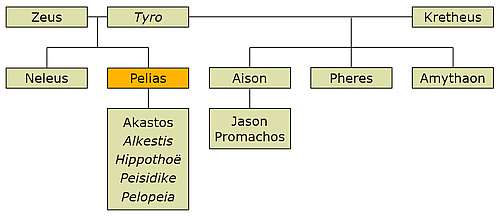
A son of Zeus and Tyro, a daughter of
Salmoneus. In her youth, Tyro was in love with the river-god
Enipeus, so Zeus took on his appearance when visiting her and
became by her the father of the twins Pelias and Neleus. Tyro exposed the two boys on a
mountain, but they were found and raised by a maid. Tyro meanwhile married Kretheus, her
father's brother, and became by him the mother of Aison,
Pheres, and Amythaon. Pelias married Anaxibia, and became by her the father of
Akastos, Alkestis, Hippothoë, Peisidike, and
Pelopeia. In other traditions he also had more children. - When king Kretheus had died, Pelias
prevented that his half-brother Aison took over the government of the kingdom, expelled his brother Neleus, and ruled
himself over Iolkos. When he had thus seized power, he sent Jason, son of Aison, to
Kolchis to get the Golden Fleece, not expecting that
he returned, and killed Aison and Jason's brother Promachos. This conduct led
Hesiod to call Pelias hubristês. When Jason luckily
returned, Pelias was was cut to pieces and boiled by his own daughters, who had been told by
Medea that in this way they could restore their father to vigour and youth. His son, Akastos, held solemn funeral
games in his honour, and expelled Jason and Medea from Iolkos.
Pelopeia
1) Daughter of Thyestes, whom she bore Aigisthos. Thereafter she married her uncle Atreus.
2) A daughter of Pelias.
3) A daughter of Amphion and Niobe.
4) The mother of Kyknos by Ares.
Pelopidas
Pelopidas (ca. 410 - 364 BC) was a general from Thebes. Being a member of a distinguished family, he lead the life of an athlete in his younger years. When the Spartans conquered the citadel of Thebes in 383 or 382 BC, he fled to Athens and organized a conspiracy to liberate Thebes. This was successful and Pelopidas became the commander of the "Sacred Band of Thebes". Three years later Pelopidas was taken prisoner by Alexander of Pherae in an unsuccessful expedition in Thessaly and Epaminondas had to rescue him. After this, he served as Theban ambassador in Persia and was killed in another battle against Alexander of Pherae.
Peloponnese
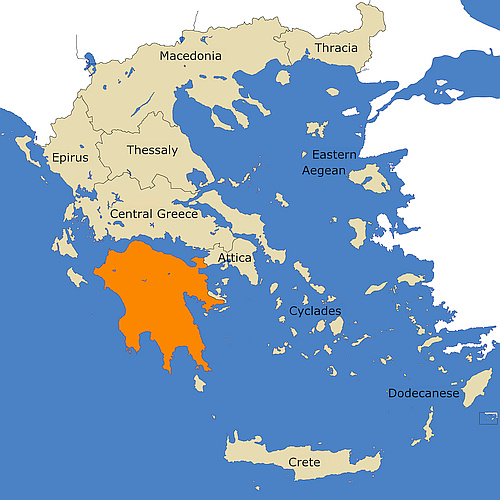
(Greek: "island of Pelops") Peninsula in southern Greece connected by the
Isthmus of Corinth to the mainland. It has a population of ca. 1,200,000 and an area of 21,550 km2, which
is mostly mountaineous. Especially central Arcadia is quite rough, whereas the regions
around show a more mediterranean character: Korinthia and
Achaia in the North, Eleia and Messenia in the West,
and Argolis and Lakonia in the East.
Peloponnesian League
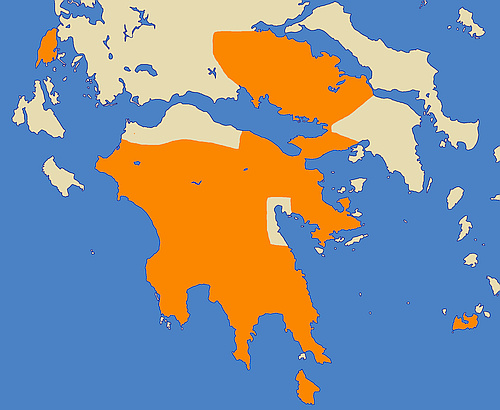
An alliance of ancient Greek city-states, dominated by
Sparta and centred on the Peloponnese, which lasted from ca.
550 to 366 BC. It is known mainly for being one of the two rivals in the Peloponnesian
War (431-404 BC). - By the end of the 7th century BC, Sparta had become the political and military hegemon over the
Peloponnese and continued using a combination of foreign policy and military intervention to gain more allies. The
powerful polis of Corinth was gained as an ally by liberating it of its
tyranny, Elis was won by helping to secure its control of the
Olympic Games, while Tegea was defeated in a war and offered a defensive alliance.
At this point, many other states inside and outside the Peloponnese joined the League.
Peloponnesian War
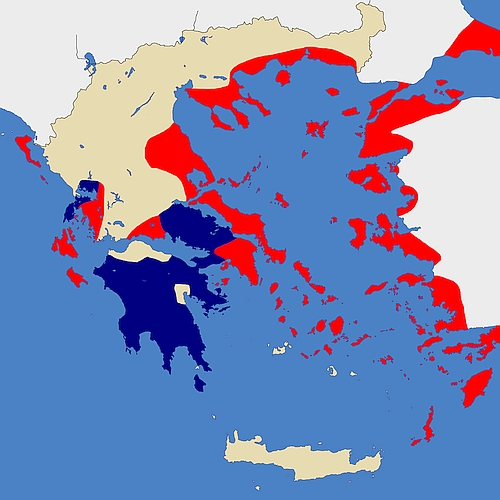
The Peloponnesian War (431 - 404 BC) was fought between Athens and
Sparta and their respective allies, the Delian League
on the Athenian side, and the Peloponnesian League on the Spartan side. The actual
cause of the war was the resentment at the growing hegemony of Athens and the aggresive foreign policy of Sparta. A
number of incidents then led to the outbreak of the war in 431 BC. It lasted 27 years partly because the naval power of
Athens found it difficult to come to grips with the land-based military power of Sparta. - Sparta initially tried to
overrun Attica, but the Athenians could retreat behind their Long Walls and the superior
navy of the Delian League raided the Peloponnesian coast. A serious drawback was the
outbreak of plague in the city during the siege, causing heavy losses, including Perikles. At
the same time the Athenian fleet won battles at Navpaktos (429 BC) and
Pylos (425 BC). Still, neither side achieved a decisive victory and after years of inconclusive
battles, the moderate Athenian politician and general Nikias arranged the Peace of Nikias
in 421 BC. - In 418 BC, however, hostilities between Sparta and Argos, now allied with
Athens, led to a resumption of the war. In Athens, this brought Alkibiades back to
power, who advocated an aggressive foreign policy. In 415 BC Alkibiades persuaded the Athenian Assembly to launch a
major expedition against Syracuse, a
Spartan ally in Sicily. Although Nikias was skeptical about this Sicilian Expedition, he was appointed as its leader. In
the meantime Alkibiades was accused of sacrilege by his political opponents and feld to Sparta. He served there as a
strategic adviser, proposing several major campaigns against Athens, including massive aid to be sent to Syracuse. As a
result, the Sicilian Expedition was a complete desaster for Athens, the whole expedition force being lost and Nikias
executed by his captors. - The Persian Empire, opposed to the Ionic cities in
Asia Minor, members of the Delian League, now financially supported Sparta to build a
fleet to challenge Athenian naval supremacy. With this background, Sparta's brilliant military leader
Lysandroso seized the strategic initiative by occupying the
Dardanelles from where Athens' grain imports came. Threatened with starvation, Athens
sent its last remaining fleet, which Lysandros decisively defeated at Aigospotamoi
(405 BC). In the following year Athens capitulated, and Sparta dictated stern conditions: Athens lost her city walls and
all overseas possessions. Lysandros imposed puppet oligarchies on the former members of
the Delian League, including Athens, where the regime was known as the Thirty Tyrants. - The upheavals brought by the
Peloponnesian War were immense. Not only did aristocratic Sparta emerge as the
leading power of Greece, crushing democratic Athens and reducing it to a state of
near-complete subjection. Athens was devastated and never regained its pre-war prosperity, while poverty became
widespread in the Peloponnese. And there were also more fundamental changes: in former times, Greek warfare had been a
limited and formalized form of conflict, and was now turned into an all-out fight between city-states, with mass
atrocities on both sides, shattering religious and cultural taboos, completely destroying whole cities and devastating
vast stretches of the country.
Pelops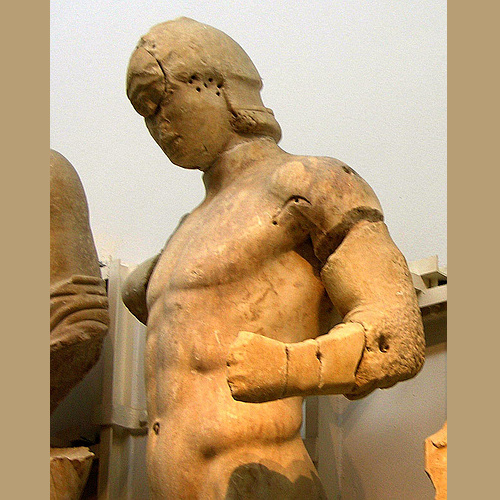
1) Mythical son of Tantalos. He was killed by his father and served as a meal to the Olympian Gods to test their omniscience. Tantalos received his fair punishment, and Pelops was brought back to life. Unfortunately Demeter had already eaten from the meal, so that Pelops then had to live with an artificial ivory shoulder. - Later, he wished to marry Hippodameia, the daughter of king Oinomaos of Pisa. But since the king felt a passion for his own daughter, he challenged her suitors to compete with him in a fixed chariot race in which they all were killed. One of them was Pelops, who bribed Myrtilos, the charioteer of Oinomaos, to loosen the lynchpins of Oinomaos' chariot. This then led to the death of Oinomaos in the race. Being a dangerous witness, Myrtilos was later killed by Pelops. - Pelops and Hippodameia had two sons: Thyestes and Atreus. - The Peloponnese was named after Pelops.
2) King of Sparta, born around 210 BC, son of
Lykurgos. In 199 BC, Pelops was assassinated by Nabis, who assumed the throne. He was
the last of the Eurypontid kings.
peltast
In ancient Greece a type of light infantry who often served as skirmishers, acting as a vanguard, flank guard, or rearguard, or screening a tactical position. They carried a usually crescent-shaped shield, the pelte, from which their name is derived. Their weapons were a set of javelins.
Peneios
1) A Thessalian river god, a son of Okeanos and Tethys. By the naiad Kreusa he was the father of Daphne, Hypseus, and Stilbe.
2) The main river of Thessaly with a length of 205 km, flowing from the Pindos montains to the Gulf of Thérmai. - Not to be confused with the Pineios.
Penelope
A daughter of Ikarios and Periboia of Sparta. She was married to Odysseus, the legendary king of Ithaka, by whom she had an only child, Telemachos, who was still an infant at the time when her husband went with the Greeks against Troy. During the long absence of Odysseus, she was beleaguered by numerous importunate suitors. In the end, she deceived them by pretending that she had to finish a large shroud which she was making for Laërtes, her old father-in-law, before she could decide. But what she worked on the shroud during daytime, she undid at night. This worked until unfaithful servants betrayed her. When she was pressed more and more by the impatient suitors, Odysseus at length returned after an absence of 20 years. When she recognised him by several signs, she heartily welcomed him. - The most chaste and faithful wife described by Homer, was challanged by later writers, charging her with opposite vices.
pentakosiomedimnoi
In the political reforms of Solon (circa 594 BC) the top class of citizens in ancient Athens. They were eligible for all top positions of government in Athens and could also serve as generals (strategoi) in the Athenian army. - The four classes were: pentakosiomedimnoi, hippeis, zeugitai, and thetes.
pentameter

Dactylic pentameter is a form of meter in poetry. It repeats the
daktylos, which is made of a stressed (or long) syllable followed by two unstressed (or short) syllables.
"Pentameter" may seem a strange term for this meter with apparently six parts, but actually each half of the line has
two and a half feet, the two together thus making up five. In classical literature, it is usually found in the second
line of the elegiac couplet.
pentekontor
A pentekontor (Greek: pentekontoros = "fifty-oared") was an ancient Greek galley in use since the Archaic period, in an era when there was no distinction between merchant and war ships. A pentekontor was rowed by fifty oarsmen, arranged in two rows of twenty-five on each side of the ship with a midship mast for a sail that could propel the ship under favourable wind. Pentekontors were versatile, long-range ships used for maritime trade, piracy and warfare, capable of transporting freight or troops.
Penthesilea
Queen of the Amazons. In the Trojan War, she and her people came to the aid of the Troians after Hektor's death, but she was killed by Achilles.
Pentheus
A son of Echion and Agaue, the daughter of Kadmos whom he succeeded as king of Thebes. He opposed the orgiastic worship of Dionysos in his kingdom. The god therefore arranged that he was torn to pieces by his own mother and two other mainades, Ino and Autonoë, who in their Bacchic frenzy believed him to be a wild beast.
peplos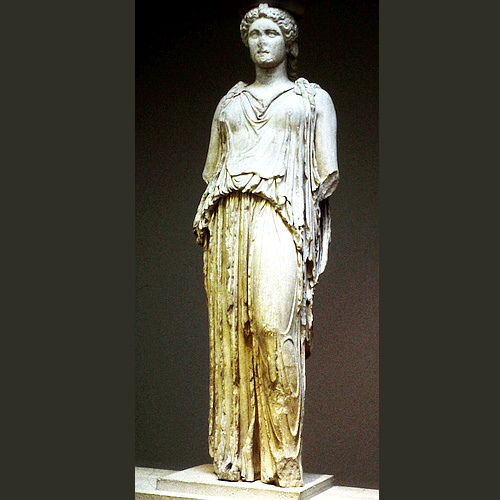
A body-length garment typically worn by women in ancient Greece by 500 BC, the
Classical period. It was a long, tubular cloth with the top edge folded down about
halfway, so that what was the top of the tube was now draped below the waist, and the bottom of the tube was at the
ankle. The garment was then gathered about the waist and the folded top edge pinned over the shoulders, open on one
side of the body.
Perdikkas
A general (ca. 355 - 321/320 BC) of Alexander the Great. He took part in the campaign against Persia, and after Alexander's death in 323 BC became the supreme commander of the imperial army and regent as first of the diadochi. His attempt to control all of Alexander's empire met with the resistance of other key generals and Antipater, Krateros and Antigonos Monophtalmos started a revolt against the regent. After a provocation by Ptolemaios, he marched against Egypt, but the invasion failed and he was killed by his revolting soldiers.
Perdikkas III
King of the ancient Greek kingdom of Macedonia from 368 to 359 BC. He was the son of Amyntas III and Eurydike. He succeeded his brother Alexander II, who was killed by Ptolemaios of Aloros. Since Perdikkas was a child at this time, Ptolemaios ruled as regent, but was killed by Perdikkas in 365 BC. There is very little information about his reign that followed, but in a failed expedition against the Illyrians he was killed.
Periandros
Periandros ruled Corinth as a tyrant in the 6th century BC. Due to his administrative skill he made Corinth one of the wealthiest poleis in ancient Greece. Ensuring that the wealth was more or less fairly distributed, Periandros was considered as one of the Seven Sages of Greece.
Periboia
1) The wife of Ikarios, and mother of Penelope.
2) A daughter of Alkathoos, and the wife of Telamon, by whom she became the mother of Aias and Teukros. In some accounts she is called Eriboia.
3) A daughter of Hipponoos, and the wife of Oineus, by whom she became the mother of Tydeus.
4) The wife of king Polybos of Corinth.
5) A daughter of Okeanos.
6) There are two other mythical personages of this name.
peribolos
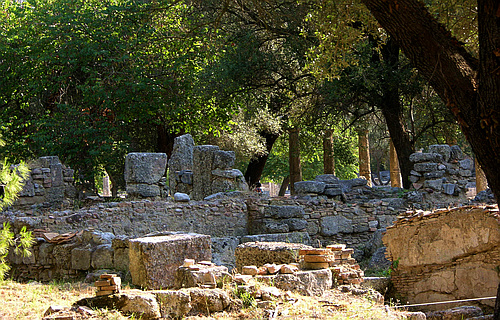
The enclosure wall of a sacred precinct.
Perieres
1) A son of Aiolos and Enarete. He was king of Messene, and by Gorgophone the father of Aphareus and Leukippos. Other traditions mention additional children. After the death of Perieres, Gorgophone is said to have married Oibalos, and to have been the first widow in Greece that married a second husband.
2) The charioteer of king Menoikeus of Thebes.
3) There is another mythical personage of this name.
Perikles
Perikles (ca. 495 - 429 BC) was a very prominent and influential Athenian statesman, orator and general. The time during which he led Athens, roughly from 461 to 429 BC, is known as the "Golden Age of Perikles", although the period is also apllied to the time between the Persian and Peloponnesian wars. Through his mother, he was a descendent of the powerful and historically influential Alkmaeonid family and fostered the Athenian democracy in a degree that the contemporary historian Thukydides called him "the first citizen of Athens". He turned the Delian League into an Athenian empire, promoted arts and literature, started an ambitious building program on the acropolis (including the Parthenon) - a process from which Athens emerged as the educational and cultural center of the ancient Greek world. In the second year of the Peloponnesian war, he died of the plague that had struck the overcrowded and undernourished city and that killed also his two sons. - His opponents, who did not dare to attack Perikles directly because of his great popularity, turned against his friends, accusing the sculptor Phidias of embezzlement and accusing the philosopher Anaxagoras of impiety.
Periklymenos
1) A son of Neleus, king of Pylos, and Chloris. He was a brother of Nestor and was mentioned as one of the Argonauts. Although Poseidon gave him the power to change himself into different forms, he was nevertheless slain by Herakles when he took Pylos. In some tradition, Periklymenos escaped in the form of an eagle.
2) A son of Poseidon and Chloris. In the war of the Seven against Thebes he killed Parthenopaios, and when he pursued Amphiaraos, the latter was swallowed up by the earth.
perioikoi
1) Prehellenic tribes conquered by the Greeks and living as vasalls on the periphery of major centres.
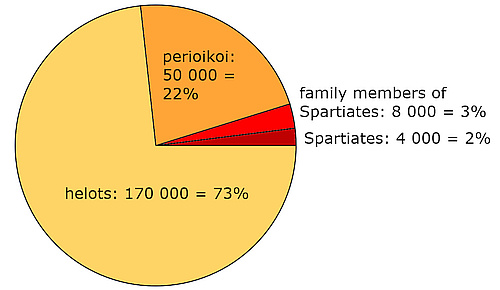 2)
Members of an autonomous group of free but non-citizen inhabitants of Sparta. They lived
in the coastal and highland areas of Lakonia and
Messenia, their name being derived from peri = "around", and oikos = "dwelling, house". They were the
only inhabitants of Sparta allowd to travel freely to other cities.
2)
Members of an autonomous group of free but non-citizen inhabitants of Sparta. They lived
in the coastal and highland areas of Lakonia and
Messenia, their name being derived from peri = "around", and oikos = "dwelling, house". They were the
only inhabitants of Sparta allowd to travel freely to other cities.
 Peripatos
The shady arcade around the Acropolis in Athens where Aristotle and his students used to walk around while discussing. See also: Lykeion.
Periphetes
1) A robber at Epidaurus, son of Hephaistos and Antikleia. His surname was Korynetes (Club-bearer), because he slew the travellers he met with an iron club. Finally, Theseus slew him and took his club for his own use.
2) A son of Kopreus of Mycenae, was slain at Troy by Hektor.
3) A Trojan, who was slain by Teukros.
peripteros
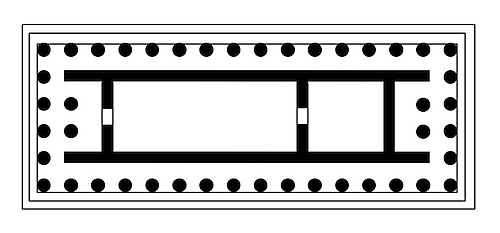
A classical Greek temple surrounded on all four sides by a
portico of columns. It thus creates a
peristasis, a four-sided arcade surrounding the cella.
peristasis
A four-sided hall of columns surrounding the cella in an ancient Greek peripteros temple. If the columns surround a patio or a garden it is called a peristyle.
peristyle
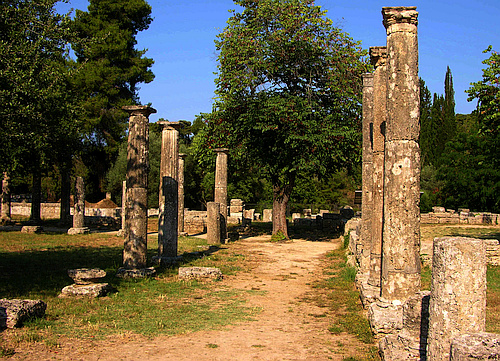
In Hellenistic Greek architecture a peristyle is a continuous
rectangular porch formed by a row of columns surrounding an open courtyard or a garden.
Pero
1) The mother of the river-god Asopos by Poseidon.
2) The beautiful daughter of Neleus and Chloris. She was married to Bias.
Perse
Daughter of Okeanos and Tethys. By her husband Helios she became the mother of Aietes, Kirke, and Pasiphaë.
Persephone
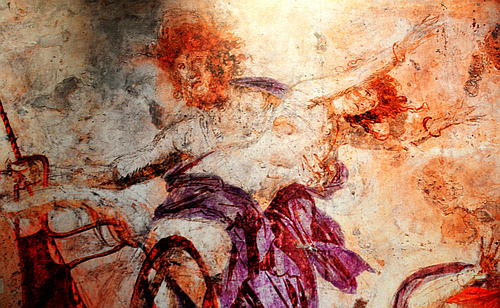
1) In ancient Greek mythology the daughter of Demeter and (perhaps)
Zeus. She was also known as Kore, the maiden, sometimes called "the maiden of the beautiful
ankles". Being a young maiden of exceptional beauty, Hades wanted her as his queen in the
underworld. To lure her into his realm he planted a narcissus in a meadow, and when
Persephone pulled on the flower to pluck it, the underworld opened up, and Hades sprang out to carry her off. Eating a
few pomegranate seeds in the underworld, she was doomed. Meanwhile Demeter searched in all the countries for her
daughter, and when she could not find her, stopped all life on earth from growing. To end this disaster, Zeus arbitrated
that Persephone should stay with Hades for three months every year, but with her mother for the rest of the year. - The
ancient site at Nekromanteion was a place where she was worshipped.
2) A daughter of Minyas, who became by Amphion the mother of Chloris.
Perses
1) A son of the Titan Krios and Eurybia, and husband of Asteria, by whom he became the father of Hekate.
2) A son of Perseus and Andromeda, to whom the founding of the Persian nation is ascribed.
3) A son of Helios and Perse, and brother of Aietes and Kirke.
Perseus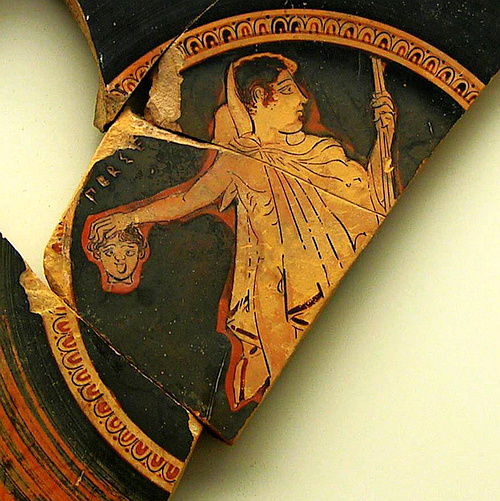
Famous Argive hero, son of Zeus and
Danaë, of whom many partly differing mythological stories exist. - When
Akrisios, grandfather of Perseus consulted the Pythian
oracle at Delphi, he was told that if his daughter Danaë should give birth to a son,
he would kill his father. Therefore, Akrisios shut up his daughter in a subterranean brass cage, but Zeus came to her in
the form of a golden shower and so Perseus was perceived. When Akrisios discovered that Danaë had given birth to a son,
he threw both into a chest, and put them out to sea. However, Zeus caused the chest to land in an island of the
Cyclades where a fisherman found mother and child and brought them to king
Polydektes. Polydektes lusted for Perseus' mother and thought that by sending Perseus
on a suicidal mission, the quest for the head of the Gorgo
Medusa, he could possess Danaë. But Perseus had mighty supporters: Athena advised him
how to proceed and not to worry about the two immortal gorgons, Stheno and
Euryale. So Perseus first went to the Graiae, sisters of
the gorgons, and forced them to show him the way to the nymphs. They provided Perseus with
winged sandals and a special bag, Hades gave him a helmet which could render him invisible,
Hermes provided a magical sickle, and Athena gave him a sickle. Thus armed Perseus went to
the gorgons, found them asleep, and cut off the head of Medusa. To do this, he had to look at her through the mirror
because a direct look would have changed him into stone. Perseus put her head into the bag and, although pursued by the
other two winged grogons, managed to escape. On his return trip he visited Atlas, whom he, by the head of Medusa,
transformed into the montain of the same name. He also saved and married Andromeda
before he returned to the Cyclades. There, Polydektes had died, and during the funeral games the wind carried a disk
thrown by Perseus against the head of Akrisios, and killed him. Athena received the head of Medusa, which was put on the
shield or breast-plate of the goddess, and Perseus, accompanied by Cyclopes, Danae, and
Andromeda, returned to Argos and took possession of the kingdom of his grandfather. By
Andromeda he became the father of Alkaios, Sthenelos, Heleios, Mestor,
Elektryon, Gorgophone, and Autochthe. Perseus is said
to have founded the towns of Midea and Mycenae.
 Persia
The area of modern-day Iran was first unified by the Iranian Medes in 625 BC. It reached its greatest extent during the Achaemenid Empire, ancient Persia, founded by Cyrus the Great in 550 BC, which at one time stretched from parts of Eastern Europe in the west, to the Indus Valley in the east, making it the largest world empire until that time. The empire collapsed in 330 BC in the course of the conquests by Alexander the Great.
Persian Wars
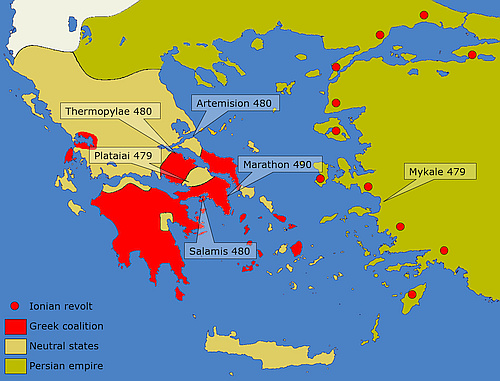
The Persian Wars, or Greco-Persian Wars, were a series of conflicts between the Achaemenid Empire of
Persia and Greek city-states between 499 BC and 449 BC. The collision began when Cyrus the Great
conquered the Greek-inhabited region of Ionia in 547 BC and installed
tyrants to rule each of the independent-minded cities of Ionia. This lead to the
Ionian Revolt, drawing more regions of Asia Minor
into the conflict, with the military support from Athens and
Eretria. After these forces burned the Persian regional capital, the revolt was crushed in 494 BC, but the
Persian king Darius the Great wanted revenge and in 492 BC started a campaign under the
direction of the Persian general Mardonios not only to to punish Athens and Eretria,
but to conquer Greece as a whole. Thracia and Macedonia
were conquered, but in the end the campaign failed. In 490 BC, a second expedition was sent again Greece, this time by
sea. After conquering the Cyclades, Eretria was razed to the ground. However, when the
Persian troops approached Athens, they were decisively defeated in the Battle of
Marathon. - Darius now planned a major campaign to subjugate all of Greece, but he died in 486 BC. His son,
Xerxes, continued with this ambitious plan, and in 480 BC personally led the largest
ancient army ever assembled across the Hellespont, accompanied by a large fleet.
Against the Persians - according to the historian Herodotus 1,700,000 soldiers - stood
an alliance of Greek city-states, including Athens, Sparta,
Corinth and others. The famous Battle of Thermopylae meant only a short delay of
the Persian advance, and in the simultaneous battle of Cape Artemision the heavily
outnumbered Greek fleet had to retreat. The Persians were now free to overrun much of Greece and devastate the meanwhile
evacuated Athens. However, their attempt to destroy the Greek fleet ended in a severe defeat in the
Battle of Salamis. The Greek coalition was now in the offensive, and in the following
year thoroughly defeated the Persian army in the Battle of Plataiai. The final blow was also in
479 BC, when the Greeks destroyed the rest of the Persian navy at the Battle of Mykale. -
In 477 BC, the anti-Persian alliance was reconstituted as Delian League under
Athenian leadership without Sparta. Their campaigns against Persia in the following decades ended with the freedom of
the Ionian cities in 466 BC.
Phaëton
Son of the god Helios and the Okeanid Klymene. He persuaded his father to let him drive the sun chariot for a single day. However, he lost control of the horses, causing havoc in the sky. When the Earth was on the brink of catching fire, Zeus had to destroy him with his thunderbolt. - The Heliades, who kept weeping at their brother's death, were changed into poplar trees.
Phaëtusa
A daughter of Helios by the nymph Neaira. After her birth she and her sister Lampetie were carried to Sicily to guard the flocks of their father.
Phaiakians
The people who lived on an island that was the last destination of Odysseus in his 10-year journey before returning home to Ithaka after the Trojan War. The island, called Scheria in the Odyssey, is usually identified with Kerkyra, although there are some inconsistencies. - The name Phaiakians is associated with Phaiax.
Phaiax
A son of Poseidon and Kerkyra, father of king Alkinoos. The Phaiakians derived their name from him.
Phaidra
A daughter of Minos by Pasiphaë or Crete, and the wife of Theseus. She fell in love with her stepson, Hippolytos, but as he did not reciprocate her feelings she took revenge and told Theseus that Hippolytos had made improper advances to her. Theseus cursed him cursed his son and asked Poseidon to destroy him. When Hippolytos then rode in his chariot near the coast Poseidon sent a bull from the sea to frighten the horses which then dragged Hippolytos to death. Later, Theseus came to know about the innocence of his son, whereupon Phaidra took her life.
phalanx
The phalanx (plural: phalanxes or phalanges) was a rectangular mass military formation of heavy infantry in ancient Greece. Developped since the 8th or 7th century BC, the phalanx consisted of several rows of densely packed hoplites, armed with shields and spears, who marched forward as one entity. This tactic proved successful in the Battle of Marathon in 490 BC, where the Athenians decisively defeated the Persian invaders. This outcome was partly ascribed to the Persian archers and light infantry shooting arrows that could not penetrate the Greek shields and armours, and on the other side their own armour could not withstand the longer spears and swords of the Greeks. In 480 BC, the Greeks employed the phalanx again successfully at the Battle of Thermopylae, and in 479 BC at the Battle of Plataiai.
Phanothea
The wife of the Athenian Ikarios, to whom the invention of the hexameter is ascribed. She is also mentioned as a Delphic priestess of Apollo.
Pheidippos
A son of Thessalos and brother of Antiphos. He and his brother joined the Greeks with thirty ships from the Sporades in the Trojan War.
Pherai
One of the oldest Thessalian cities. According to Homer it was the home of king Admetos and his wife Alkestis as well as their son Eumelos. - Thukydides lists Pherai among the early Thessalian supporters of Athens at the beginning of the Peloponnesian War. In 359 BC, Pherai was conquered by Thebes and in 352 BC by Philip II, who subjected Thessaly to Macedonian rule.
Pheres
1) A son of Kretheus and Tyro, and brother of Aison and Amythaon. By his wife Periklymene he became the father of Admetos, Lykurgos, Eidomene, and Periapis. He was the alleged founder of Pherai.
Phidias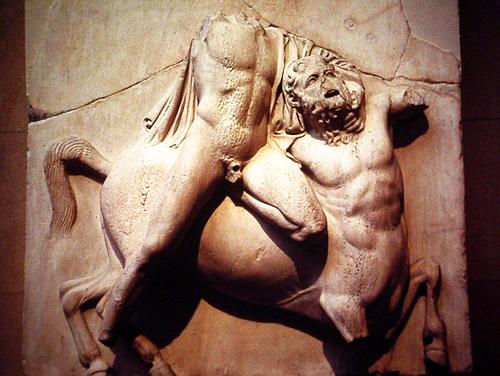
Greek sculptor and architect (ca. 480 - ca. 430 BC), perhaps trained by Hegias and
Ageladas. He initiated the Classical Greek sculpture
and is as (one of) the greatest of all ancient Greek sculptors, although no original works exist that can be attributed
to Phidias with certainty. He shares this fate with allmost all Greek artists of this time, whose works have been
destroyed and survived only as more or less faithful Roman copies. - According to Plutarch,
Phidias superintended the great works ordered by Perikles on the
Athenian Acropolis in the 5th century BC. There he designed two famous statues of
the goddess Athena: the chryselephantine sculpture
of the 'Athena Parthenos' inside the Parthenon, and the 'Athena Promachos', a colossal bronze
which stood between it and the Propylaea. Plutarch also recounts that enemies of Perikles tried
to attack him through his friend Phidias - who was accused of stealing gold intended for the Parthenon sculpture. This
proved to be untrue, but Phidias went to Olympia, where he created around 435 BC the
giant chryselephantine statue of the Olympian Zeus, which was one of the
Seven Wonders of the Ancient World.
Philammon
A mythical poet and musician, a the son of Apollo. By the nymph Argiope, he became the father of Thamyris and Eumolpos. He is closely associated with the worship of Apollo at Delphi, and with the music of the kithara. The Delphic hymns which were ascribed to him.
Philip II
Philip II of Macedon (382 - 336 BC) was the king of the ancient Greek kingdom of
Macedonia from 359 BC until his assassination in 336 BC. He was a member of the Argead
dynasty, the third son of King Amyntas III, and father of Alexander the Great and
Philip III.
Philip III
Philip III Arridaios (ca. 359 - 317 BC) reigned as king of Macedonia from after 323 BC until his death. He was a son of king Philip II of Macedonia by Philinna of Larissa, and thus an elder half-brother of Alexander the Great. In his youth, he had learning difficulties and was perhaps mentally disabled. Alexander was fond of Arridaios and took him on his campaigns, both to protect his life and to prevent his use as a pawn in any prospective challenge for the throne.
Philip V
Philip V (238 - 179 BC) was king of the ancient Greek kingdom of Macedonia from 221 to 179 BC. As a young man, he was charismatic and known as a courageous warrior, inevitably compared to Alexander the Great. His reign saw an unsuccessful insurgency against the rising power of Rome.
Philoitios
The celebrated cowherd of Odysseus, who is frequently mentioned in the Odyssey.
Philoktetes
A celebrated archer, son of Poias and Demonassa. He led seven ships against Troy, but was left behind on the island of Lemnos after he was bitten by a snake. - This account of Homer was amended by later writers, adding that he was a friend and armour-bearer of Herakles, who instructed him in the art of using the bow, and who bequeathed to him his bow for setting fire to the pile on mount Oeta, where Herakles burnt himself. In common tradition, Odysseus and Diomedes came to him on Lemnos and informed him that, according to an oracle, without the arrows of Herakles Troy could not be taken. After his arrival before Troy, he slew Paris, whereupon Troy fell into the hands of the Greeks.
Philomela
1) A daughter of king Pandion and a sister of Prokne. Being persecuted by her brother-in-law Tereus, she was metamorphosed into a nightingale.
2) A daughter of Aktor, and the wife of Peleus.
3) One of the daughters of Priam.
4) --> Polymele
Philonome
1) A companion of Artemis, became by Ares the mother of Lykastos and Parrasios.
2) Wife of Kyknos, who fell in love with her stepson Tennes.
philosophy
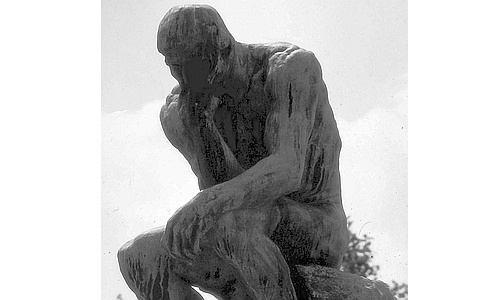
Philosophy (from Greek philosophia = "love of wisdom") emerged in ancient Greece as the study
of general and fundamental problems concerning topics such as existence, knowledge, values, reason, mind, and language.
Its development was one of the greatest achievements of Greek civilisation, covering subjects like
metaphysics, atomism,
monism, cosmology, the nature of the well-lived life
(eudaimonia), the possibility of knowledge and the nature of reason
(logos). - Western philosophy goes back to Pre-Socratic
thinkers who were active in Ancient Greece in the 6th century BC such as Thales and
Pythagoras. In the next generation of philosophers, Sokrates
was highly influential with his statement that he possessed no wisdom but was a pursuer of wisdom. Various
philosophical schools were initiated by his students, the most renowned being Plato who founded the
Academy and who left a profound impact on Western thought. Ancient Greek philosophy then
culminated in Aristotle, a student of Plato and the founder of the
Peripatetic school. His influence was so long-running, that in the Middle Ages he was
referred to as "the philosopher". But there were also other traditions like
cynicism, stoicism, skepticism and
epikureanism.
Philostratos
1) A sophist, father of (2).
2) Lucius Flavius Philostratus or Philostratos (ca. 171 - ca. 250 AD), "the Athenian", was a Greek sophist of the Roman imperial period.
3) Philostratos of Lemnos (ca. 190 - ca. 230 AD), a son-in-law and probably nephew of (2).
4) Philostratos the Younger (3rd century AD), grandson of (3).
Phineus
1) Phineus was a blind soothsayer, who had received his prophetic powers from Apollo. It is said that he was blinded by the gods because he communicated to mortals the divine counsels of Zeus about the future. Another harm he had to suffer were the Harpies. Whenever Phineus wanted to take a meal the Harpies came, took away a portion of his food, and spoiled the rest, so that it could not be eaten. This was the situation in which the Argonauts found him, and he promised to provide them with information about their further voyage if they would deliver him from the monsters. So a table with food was laid out, and when the Harpies appeared they were attacked by Zetes and Kalais, the winged sons of Boreas and Oreithyia, and chased them away. Zeus prevented that the Harpies were harmed, provided that they would no longer molest Phineus. Phineus now explained to the Argonauts the further course they had to take to Kolchis.
2) A son of Belos and Achiroe, and brother of Aigyptos, Danaos, and Kepheus.
3) A son of Lykaon.
Phlegethon
In ancient Greek mythology, the river Phlegethon ("flaming") or Pyriphlegethon ("fire-flaming") was one of the five rivers in the underworld. Plato describes it as "a stream of fire, which coils round the earth and flows into the depths of tartaros".
Phobos
In Greek mythology the personification of all-consuming panic that could possess entire armies and cause their defeat. He was a son of Ares and Aphrodite. He and his brother Deimos used to accompany their father in his chariot when he appeared during battles. - One of the moons of the planet Mars is called Phobos.
Phoibe
1) One of the Titanides, daughter of Gaia and Uranos. She became by her brother Koios the mother of Asteria and Leto.
2) A daughter of Tyndareos and Leda, and a sister of Klytaimnestra.
3) A tree nymph, married to Danaos.
4) a priestess of Athena, was carried off with her sister by the Dioskouroi, and became by Polydeukes the mother of Mnesileos.
5) An Amazon, slain by Herakles.
Phoinix
1) According to one tradition, a son of Agenor. He was sent out by his father in search of his sister Europa, who had been carried off by Zeus. The search was not successful, but brought him to a region in northern Africa, where he settled and whose people were later called Phoenices after his name.
2) A son of Amyntor, was king of the Dolopes. Among the various traditions about him, the most common is that he took part in the Kalydonian Hunt, that he was a friend of Peleus, and that he accompanied Achilles in the campaign against Troy.
3) A fabulous bird, of which Herodotus heard in Egypt, that once in every five hundred years it comes from Arabia to Heliopolis to bury his father, enclosed in a large egg of myrrh, in the sanctuary of Helios. In another of many versions the Phoinix, when his life drew to an end, built a nest for himself, so that after his death a new Phoinix rose out of it.
Phokion
Phokion (ca. 402 - ca. 318 BC) was an Athenian statesman and strategos. He believed that extreme frugality was the condition for virtue and lived according to this and was consequently nicknamed "the Good." He was regarded as the most honest member of the Athenian Assembly, but his tendency to strong opposition resulted in a solitary stand against the entire political class. Nevertheless, his reputation and military expertise guaranteed him the record of being elected as strategos in 45 terms. In the late 320s, when Macedon under Antipater gained complete control of Athens, he refused to comply with some dishonorable requests of the enemy. This brought Phokion into conflict with most free Athenians, but especially with Polyperchon, the next ruler of Macedonia, who arranged his execution in Athens.
Phokis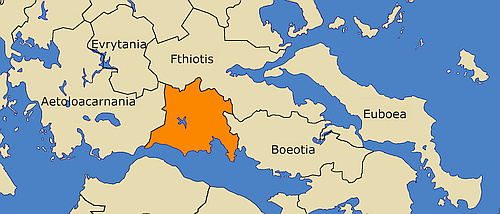
Regional unit in central Greece (2100 km2, 36,000 inhabitants), north of the
Gulf of Corinth, with Mount Parnassos and
Delphi. - See also: site page.
Phokos
1) Son of king Aiakos of Aegina and the nymph Psamathe. His achievements in athletics and fighting were so superior that his half-brothers Telamon and Peleus became so jealous that they killed him. As a consequence, Aiakos exiled his sons from Aegina.
2) A son of Poseidon or of Ornytion of Corinth. He is said to have colonized the territory that was named Phokis after him.
Pholos
A centaur, son of Silenos and the nymph Melia. He was accidentally killed by Herakles during the completion of his fourth labour (athloi).
Phorkys
1) Following Homer, an old man ruling over the sea to whom a harbour in Ithaka was dedicated. He is mentioned as the father of the nymph Thoosa and later writers call him a son of Pontos and Gaia. By his sister Keto he became the father of the Graiae and Gorgones, the dragon Ladon, and the Hesperides; and by Hekate or Krataiis, he was the father of Skylla.
2) Commander of the Phrygians, who assisted Priam in the Trojan war, but was slain by Aias.
Phoroneus
A son of Inachos and the Okeanid Melia, was a brother of Aigialeus and ruler of the Peloponnese. By his wife, the nymph Laodike, he became the father of Niobe, Apis, and Kar. According to tradition he united the people, who until then had lived in scattered habitations, into a city, and was the first to offer sacrifices to Hera at Argos.
phratria
A phratria (Greek: "brotherhood", "kinfolk") was a social division of the ancient Greek tribe (phyle). Phratriai existed since the Dark Ages, but their significance decreased until the reforms of Kleisthenes in 508 BC and the institution of phylai.
Phrixos
Son of Athamas and Nephele. He and his twin-sister Helle were persecuted by their stepmother, Ino, who devised a devious plan to get rid of the twins. In a period of misfortunes and famines the oracle of Delphi was consulted. Ino bribed the messengers so that they brought back the oracle that Phrixos must be sacrificed. Before he was killed, Phrixos and Helle escaped on a golden ram sent by Nephele. Helle fell off the ram and drowned, but Phrixos safely came all the way to Kolchis where king Aietes took him up friendly and gave him his daughter Chalkiope to marry.
Phrontis
1) A son of Phrixos and Chalkiope. After the death of his father, he and his brothers set out to avenge her father's ill treatment by Athamas. They stranded on an island in the Euxine (Black Sea), from where they were rescued by the Argonauts and returned with them to Kolchis.
2) The helmsman of Menelaos.
3) According to Homer the wife of Panthoos.
Phrygia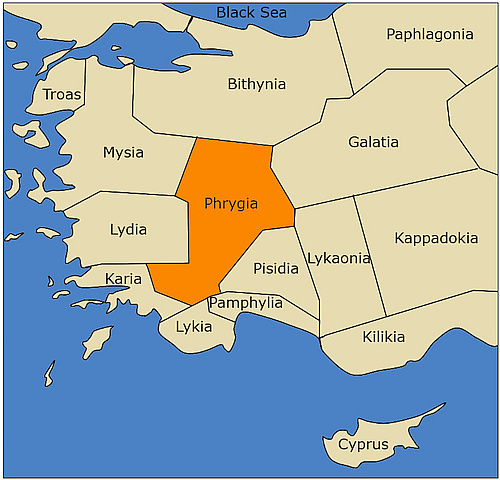
An ancient region and kingdom in modern-day central Anatolia. In the
Iliad, Homer describes them as close allies of Troy,
fighting on their side in the Trojan War. In Greek mythology, several legendary kings
were Phrygians: Gordios with the Gordian knot, Midas with
the golden touch, and Mygdon who fought against the Amazons. - In the 8th century BC,
Phrygia reached its greatest extent under the reign of the historical king Midas.
Phryne
A Thespian hetaira (born ca. 371 BC), model of Praxiteles, perhaps also for the lost statue Aphrodite of Knidos. When she was accused of impiety, she was defended by the orator Hypereides, one of her lovers. When a verdiction seemed inevitable, Hypereides removed her robe, and in the face of her naked body the judges were not possible to condemn her.
Phthia
1) The country in Thessaly between the rivers Peneios and Asopos, home of the Myrmidones, who were led by Achilles in the Trojan War. The mythological city of Phthia was founded by Aiakos, grandfather of Achilles, and was the home of his father Peleus, his mother Thetis, and his son Neoptolemos, who reigned as king after the Trojan War.
2) A daughter of Amphion and Niobe.
3) By Apollo, the mother of Doros, Laodokos, and Polypoetes.
Phthios
1) A son of Poseidon by Larissa. Phthia in Thessaly was named after him.
2) A son of Lykaon.
Phthiotis
--> Fthiotis
Phylas
1) A king of the Dryopes. He desecrated the sanctuary at Delphi and was therefore attacked and slain by Herakles. By his daughter Mideia, Herakles became the father of Antiochos.
2) A son of Antiochos, and grandson of Herakles and Mideia.
3) A king of Ephyra in Thesprotia. He was the father of Polymele and Astyocheia, who became by Herakles the mother of Tlepolemos.
phyle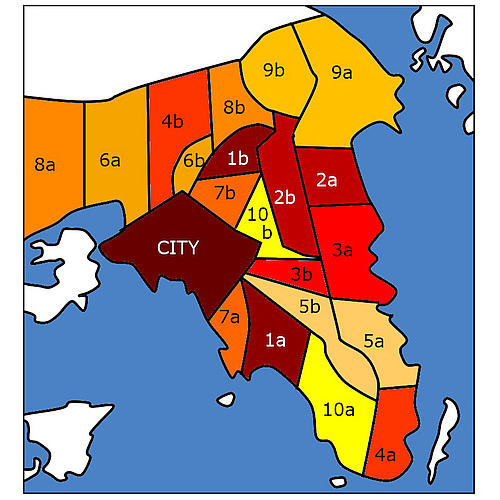
Phyle (from ancient Greek "to descend, to originate") is an ancient Greek term for tribe or clan,
originally ruled by a basileus. Best known is the system introduced by
Kleisthenes in or just after 508 BC by which he divided
Attica into ten phylai.
pillar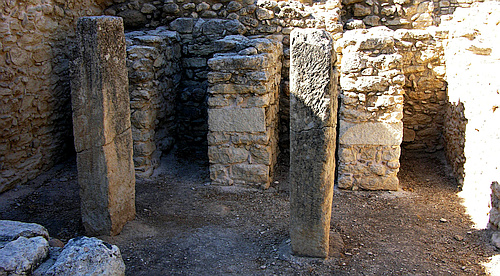
An architectural element like the column, but with a rectangular (or
polygonal) cross-section.
Pillars of
Herakles
The name applied in antiquity to the promontories that flank the Strait of Gibraltar, connecting the Mediterranean Sea with the Atlantic Ocean. On the northern side this is the Rock of Gibraltar, ancient Kalpe, and on the African side probably Jebel Musa in Marocco.
Pindar
An ancient Greek lyric poet (ca. 522 - ca. 443 BC) from Thebes, whose work is quite well preserved. Quintilian remarks: "Of the nine lyric poets, Pindar is by far the greatest, in virtue of his inspired magnificence, the beauty of his thoughts and figures, the rich exuberance of his language and matter, and his rolling flood of eloquence, characteristics which, as Horace rightly held, make him inimitable." His poems, however, peculiar and perplexing as they seem today, are typical of archaic genres.
Pineios
A river in the Peloponnese, flowing westward from mount Erymanthus to the Ionian Sea. - Not to be confused with the Peneios.
piriform jar
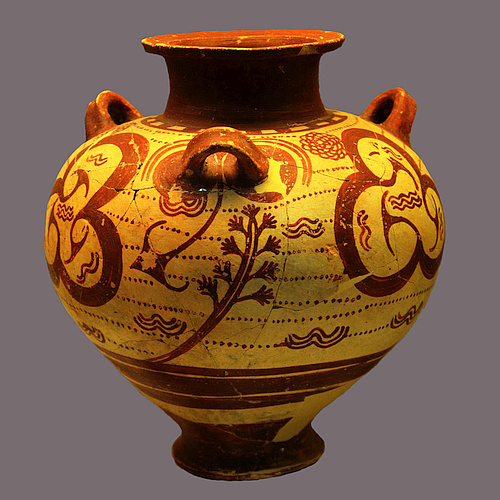
A type of ancient Greek pottery. It is a vessel somehow in the shape
of an inverted pear, typically with four handles, a small neck and broad shoulder running down to a smaller base.
pithos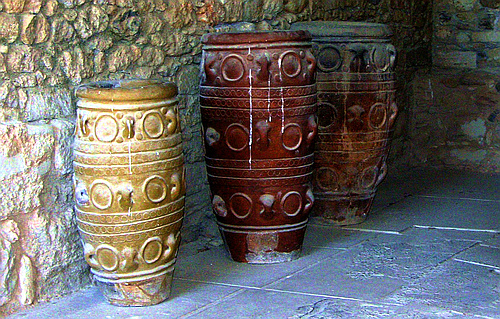
A large ceramic container used for the storage of fluids or grain. The jar could be as high as a man,
had a base for standing, straight or slightly curved sides, a large mouth with a lid and could contain one to two tons.
They were used since the Neolithic, but especially in the
Bronze Age. In Minoan and Mycenaean
palaces they served the storage and distribution of supplies to the populace. - In the
Middle Helladic period pithoi were also used for burials, placing the bones of the interred in them. - In times of
warfare pithoi were filled with flammable olive oil which could be used to start a major conflagration.
Pittakis
Kyriakos S. Pittakis (1798 - 1863) was a Greek archaeologist. He fought in the Greek War of Independence and besieged the Ottoman troops in the acropolis. When the ammunition of the Ottomans shrinked, they began to dismantle sections of the acropolis to use the lead clamps for manufacturing bullets. Pittakis heard of this and sent bullets to the opposing army to stop the further destruction of antique buildings. After independence, Pittakis became Greece's first General Keeper of Antiquities and from 1837 to 1840 supervised the reassembly of the Erechtheion. His incompetence in this project caused much criticism from architecture historians, but he earned more credit for his preservation of epigraphical material in Athens. He also started excavations in Mycenae and restored the Lion Gate.
Pittakos
Pittakos (ca. 640 - 568 BC) was a military general from Mytilene on the island of Lesbos and one of the Seven Sages of Greece.
Pittheus
A son of Pelops and Dia. He was king of Troizen, father of Aithra, and grandfather and instructor of Theseus. Later, he took Hippolytos into his house when Theseus married Phaidra.
Plataiai
An ancient city in Boeotia, south of Thebes. In 427 BC it was destroyed by Thebes and Sparta during the Peloponnesian war, and rebuilt in 386 BC. - Plataiai is especially known as the site of the battle of 479 BC in the Persian Wars. After the Persian fleet was decisively defeated in the battle of Salamis in 480 BC, Xerxes retreated to Asia with much of his army, leaving general Mardonios behind to complete the conquest of Greece. Mardonios and his troops spent the winter in Plataiai and were attacked by an allied force led by the Spartan general Pausanias in the following summer. Although the Greeks were vastly outnumbered, they were able to kill Mardonios, causing a massive rout of the Persians. In the end, many Persians were dead and a still larger number dispersed in their flight. This marked the final failure of the last Persian invasion of Greece.
Plato
Plato (428/427 or 424/423 - 348/347 BC) was one of the greatest philosophers of Classical Greece. Along with his teacher, Sokrates, and his most famous student, Aristotle, Plato laid the very foundations of Western philosophy and science. Apart from Sokrates, his philosophical influences are thought to have been Parmenides, Herakleitos and Pythagoras, although few of his predecessors' works remain extant and much of what we know about these figures today derives from Plato himself. Plato's own entire oeuvre is believed to have survived intact for over 2,400 years. He founded the Academy in Athens, the first institution of higher learning in the Western world. He innovated the written dialogue and introduced dialectic forms in philosophy. His works Republic and Laws stand as the beginnings of Western political philosophy. One of his famous philosophical contributions is the Theory of Forms or Theory of Ideas, now known as the problem of universals. Altogether, Plato's impetus on philosophy was so ground-breaking that in modern times Alfred North Whitehead once noted: "the safest general characterization of the European philosophical tradition is that it consists of a series of footnotes to Plato."
platonism
The philosophy of Plato or other philosophical systems closely derived from it. In essence, it affirms the existence of abstract objects (such as ideas or numbers) in a "third realm" distinct both from the sensible external world and from the internal world of consciousness, and thereby contrasting nominalism.
Pleiades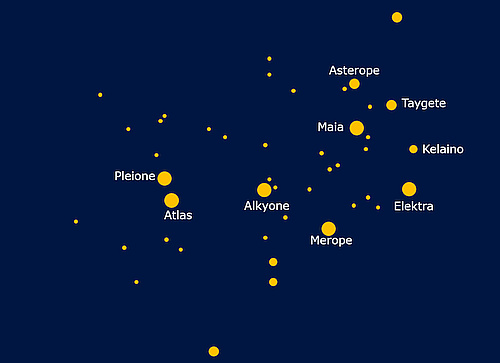
The seven daughters of Atlas and Pleione:
Alkyone, Asterope, Elektra,
Kelaino, Maia, Merope and Taygete. Relentlessly pursued by
Orion, Zeus changed the maidens into pigeons. Later they were
put into the night sky as a star cluster.
Pleione
A daughter of Okeanos, and by Atlas mother of the Pleiades.
Pleisthenes
1) A son of Atreus, and husband of Aerope, by whom he became the father of Agamemnon, Menelaos, and Anaxibia.
2) A son of Thyestes, who was killed by Atreus.
Pleuron
1) A son of Aitolos and Pronoe, and brother of Kalydon. He was the father of Agenor, Sterope, Stratonike, and Laophonte.
2) An ancient city in Aetolia. Its remains lie just west of the ancient city of Kalydon, with which it is often associated.
Pliny
Pliny (Plinius) the Elder, Gaius Plinius Secundus (AD 23 - 79), was a Roman author, naturalist, and natural philosopher. He died during the eruption of Mount Vesuvius.
Plutarch
Plutarch (ca. AD 46 - 120) was a Greek biographer and essayist who wrote for a Greek and Roman audience.
plutocracy
Plutocracy (from Greek ploutos = "wealth", and -kratia = "rule") is an extreme form of oligarchy and defines a society ruled or controlled by the small minority of the wealthiest citizens.
Pnyx
A small, rocky hill in central Athens, within sight of the acropolis. It features a large flat platform of eroded stone - the bema - set into its side, and steps carved on its slope. It is one of the most important monuments of the formation of democracy because it is the site of the popular assemblies since the reforms of Kleisthenes in 507 BC. It is the material embodiment of the principle of isegoría, "equal speech", i.e. the equal right of every citizen to debate political matters. On the Pnyx, all the great political struggles of Athens of the "Golden Age" were fought out: Perikles, Aristides and Alkibiades all spoke here.
Podaleirios
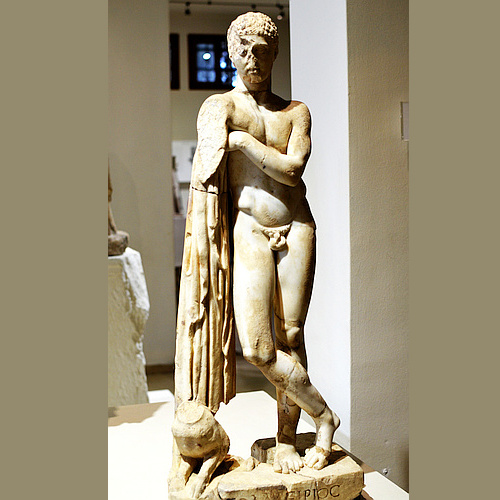
1) A son of Asklepios. Together with his brother
Machaon he went to the Trojan War with thirty ships,
where he was noted as a physician.
2) Virgil mentions another mythical personage of this name.
Podarkes
A son of Iphikles and younger brother of Protesilaos. He led a detachment of the Thessalians against Troy.
polemarchos
(Greek: polemos = war and archon = ruler/leader) A senior military title in various ancient Greek city-states. In Classical Athens, he was one of the nine archontes appointed for ten years, since 683 BC elected for one year. His role evolved from that of the former king as head of the armed forces. Eventually military command was transferred to the strategoi, but the date and stages of the transfer are not clear.
Polemon
Polemon (died 270/269 BC) of Athens was an eminent philosopher and Plato's third successor as head (scholarch) of the Academy from 314/313 until his death in 270/269 BC, himself succeeding his teacher Xenokrates. He taught that philosophy should be practiced rather than just studied, and placed the highest good in living according to nature. Among his students were Krates of Athens, who also was his eromenos, Krantor, Zenon of Kitieus, and Arkesilaos.
polis
A polis (plural: poleis) was an ancient Greek city-state, the independent political unit consisting of a city with surrounding rural areas. Usually, a polis had only some thousand citizens, but a much larger number of residents with restricted rights. Being an independent social and political unit, each polis had its own government, laws, and army, but often joined formal or informal leagues for mutual protection.
Pollux
--> Polydeukes
Polybios
A Greek historian (ca. 200 - ca. 118 BC), especially noted for his work The Histories, which describes the rise of the Roman Republic to the dominant power in the ancient Mediterranean world.
Polybos
1) In the Iliad a son of Antenor. In the Trojan War he was killed by Neoptolemos.
2) In the Odyssey, father of the suitor Eurymachos. He was slain by the swine-herd Eumaios.
3) One of the Phaiakians in the Odyssey.
4) King of Corinth, by whom Oedipus was brought up. - When Oedipus was a young man, the oracle at Delphi proclaimed that he would kill his father so Oedipus fled Corinth to insure that Polybos would not die at his hands. Years later, after Oedipus had been made king of Thebes, a messenger brought him news that Polybos was dead. Oedipus then realized that his flight from Corinth was part of the oracle's prophecy and that his adopted father, Polybos, had never been in danger of being killed by "his son".
Polydamas
A son of Panthoos and Phrontis, brother of Euphorbos. He was a Trojan hero, friend of Hektor.
Polydektes
1) King of the island of Seriphos. His brother Diktys found Danaë and her infant Perseus when they were washed ashore on the island. Polydektes wanted Danaë to become his queen but she rejected. To win her hand, Polydektes sent Perseus on the suicidal mission to retrieve the head of the Gorgon, Medusa, and threatened Danaë with violence. So, when Perseus returned with the head of Medusa, he used the magical power of the head to turn Polydektes to stone.
2) The third Eurypontid king of Sparta who ruled circa 835-805 BC.
Polydeukes
Brother of Kastor, one of the Dioskouroi.
Polydoros
1) A son of Kadmos and Harmonia, was king of Thebes and husband of Antiope, by whom he became the father of Labdakos.
2) Son of Harmonia; one of the Epigoni.
3) The youngest son of Priam. In one tradition he was slain by Achilles. In another tradition, Priam entrusted his son Polydoros and a large sum of money to Polymestor, but after the fall of Troy Polymestor killed Polydoros to get possession of his treasures.
4) There is another mythical personage of this name.
5) The ninth Agiad king of Sparta, ruling ca. 700-665 BC.
6) A sculptor working in the first century.
Polygnotos
1) Polygnotos of Thassos (fl. middle of the 5th century BC) was an ancient Greek painter, granted citizenship in Athens. His most important paintings were the frescoes in the Lesche of the Knidians at Delphi, meticulously described by Pausanias.
2) Polygnotos of Athens (fl. ca. 450 - 420 BC) was a vase-painter, considered one of the most important artists of the red-figure style of the high-classical period.
3) There are two more vase-painters of the name Polygnotos. They became known as the Lewis Painter and the Nausikaa Painter.
Polyhymnia
One of the nine muses, associated with lyric poetry, and was believed to have invented the lyre.
Polykaste
1) A daughter of Nestor and Anaxibia, became by Telemachos the mother of Perseptolis.
2) A daughter of Lygaios, was married to Ikarios, by whom she became the mother of Penelope and others.
Polykleitos
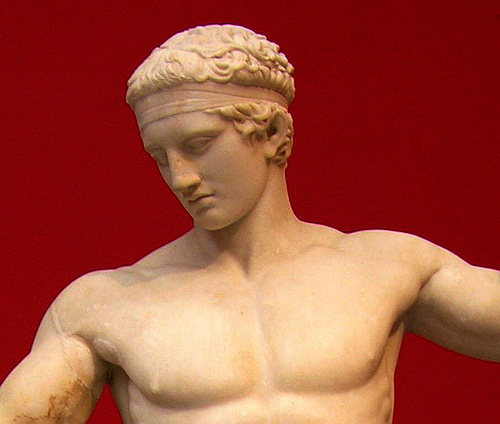
("much-renowned") A Greek sculptor of the 5th century BC. Along with Phidias,
Myron and Praxiteles, he is considered one of the most important
sculptors of Classical antiquity. He worked exclusively in bronze, but none of his
famed works survived. What we do have are Roman copies of some of his sculptures, the best known being the
Diadoumenos (Youth tying a headband). Polykleitos is also known as the author of a Kanon, in which he
formulated his theory of artistic perfection.
Polykrates
Polykrates was the tyrant of Samos from ca. 538 BC to 522 BC. He seized power together with his brothers, but soon had one killed and the other exiled. Polykrates allied with the Egyptian pharao and with a navy of 100 pentekontors and an army of 1,000 archers, he plundered the islands of the Aegean Sea and the cities on the coast of Asia Minor. - Herodotus relates that the pharao thought Polykrates was too successful and advised him to throw away whatever he valued most in order to avoid bad luck. Polykrates followed the advice and threw a precious ring into the sea; however, a few days later, a fisherman caught a large fish that he wished to give to the tyrant. When Polykrates' cooks were preparing the fish, they discovered the ring inside of it. Polykrates told the pharao of his good fortune, and the latter immediately broke off their alliance, convinced that such a lucky man would eventually come to a disastrous end. - This end is also reported by Herodotus. The governor of Sardis planned to kill Polykrates, perhaps because he had been unable to add Samos to Persia's territory, and invited Polykrates. Despite the prophetic warnings of his daughter, Polykrates followed the invitation and was assassinated. Herodotus does not mention the manner, but he may have been impaled and his dead body crucified.
Polymele
1) A daughter of Peleus. She was married to Menoitios, by whom she became the mother of Patroklos. Sometimes she is called Philomela.
2) A daughter of Phylas. By Hermes she became the mother of Eudoros.
3) A daughter of Aiolos, was beloved by Odysseus.
4) Mythology mentions another personage of this name.
Polyneikos
The youngest son of king Oedipus and Iokaste of Thebes. - Before Oedipus was born, the oracle at Delphi predicted that he would kill his father and marry his mother. The prophecy came true and the children of this incestuous relation were also cursed. After Oedipus blinded himself and went into exile Eteokles, the older brother of Polyneikos, seized the power in Thebes and Polyneikos was expelled. He found refuge in Argos where he married Argeia, the daughter of king Adrastos. He then formed with six friends ("Seven against Thebes") seven armies to attack Thebes, the City of Seven Gates. During the unsuccessful attack the two brothers killed each other in personal combat. Their uncle Kreon now became king of Thebes and ordered a heroe's funeral for Eteokles and that the body of Polyneikos was to be left unburied. Antigone defied Kreon and covered the body of her brother Polyneikos, which still laid on the battlefield, with a thin layer of dirt.
Polypemon
--> Prokrustes
Polyperchon
Polyperchon (died after 304 BC) was a Macedonian general who served both Philip II and Alexander the Great and then was actively involved in the wars of the Diadochi.
Polyphemos
1) In the Odyssey the famous one-eyed Cyclops living on the island of Thrinacia. He was a son of Poseidon, and the Nereid Thoosa.
2) A son of Elatos or Poseidon, was married to Laonome, a sister of Herakles. He was one of the Lapiths at Larissa in Thessaly, and took part in the expedition of the Argonauts, but they left him behind in Mysia.
Polyphonte
A daughter of Hipponoos, king of the Triballi. She was a companion of Artemis, but because she despised Aphrodite the goddess made her fall in love with a bear whom she bore two gigantic creatures, Agrios and Oreios.
Polypoetes
1) A son of Apollo and Phthia.
2) A son of Peirithoos and Hippodameia. He was one of the Lapiths, who joined the Greeks in the Trojan War.
Polyxena
A daughter of Priam and Hekabe. She was beloved by Achilles, and there are various traditions about her death. In one version, when the Greeks gathered for their voyage home after the fall of Troy, the shade of Achilles appeared to them demanding that Polyxena should be sacrificed to him. Neoptolemos accordingly sacrificed her on the tomb of his father.
Pontos
1) A personification of the sea. In ancient cosmogony, Pontos is described as a son of Gaia, and as the father of Nereus, Thaumas, Phorkys, Keto, and Eurybia, by his own mother.
2) Pontos or Pontus was the ancient Greek designation for the region they had colonized around the southern coast of the Black Sea. It was derived from the Greek name of the Black Sea: Pontus Euxeinos ("Hospitable Sea").
porch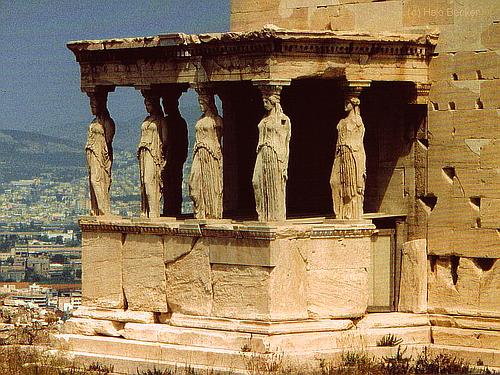
An open or enclosed gallery or room on the outside of a building.
pornai
(Greek: pernemi = "to sell") In ancient Greece the lowest class of prostitutes, as contrasted to hetairai. In the classical era they were slaves from barbarian countries, later also young girls abandoned by their citizen fathers. Pornai were the property of pimps who took a part of their earnings as their regular income. They worked in the streets of "red-light" districts or in brothels, introduced as legal public institutions under the Athenian statesman Solon as a public health measure.
Porthaon
1) A son of Agenor and Epikaste, was king of Pleuron and Kalydon in Aetolia. By his wife Euryte, he became the father of Agrios, Alkathoos, Leukopeos, Oineus, Melas, and Sterope. His name is sometimes given as Portheus.
2) A son of Periphetes.
Portheus
--> Porthaon
portico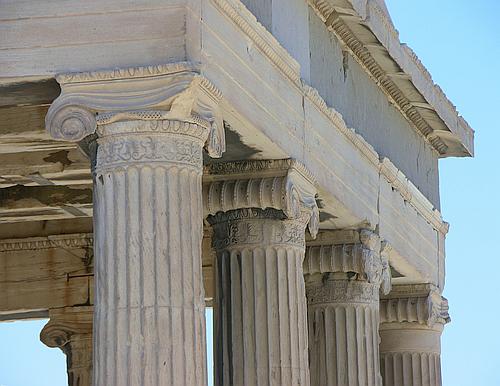
A series of columns, pillars or arches in front
of a building, usually creating a covered walkway.
Poseidon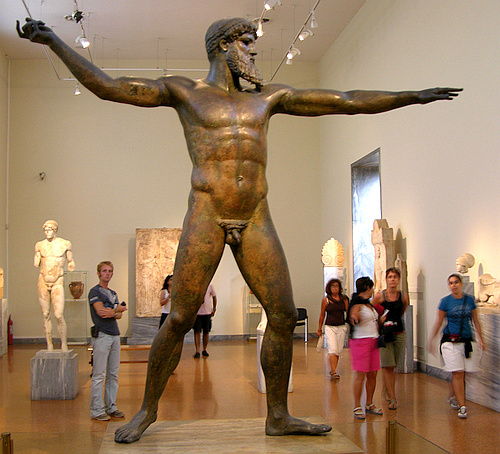
In ancient Greek mythology the god of the sea. He is usually represented as an old beared man, with
the three-pronged trident as his attribute. Apart from the sea he is associated with horses, seen in the crashing
of waves on the shore, but also with earthquakes. Poseidon is described as moody, unpredictable and revengeful. In Greek
mythology, he is a son of Kronos and Rhea, and thus a brother
of Zeus and Hades. With his wife
Amphitrite he fathered Triton and with his sister
Demeter he fathered Orion. His numerous affairs include
Medusa, resulting in the birth of the flying horse Pegasus. His temples stand near
the shore, overlooking the sea. The most famous one is at Cape Sounion (see:
site page).
post and lintel
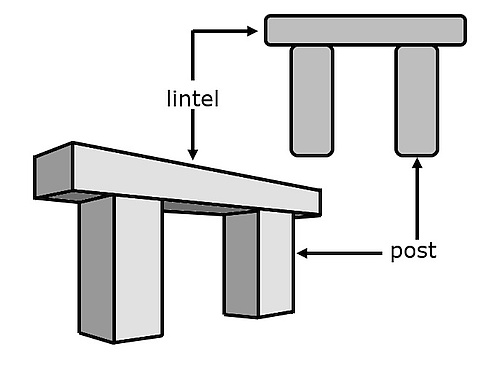
In architecture, a building system (also called trabeated system) where strong horizontal elements
are held up by strong vertical elements. This system appears in Neolithic times, but
especially in the Mycenaean period, where large upright blocks of stone hold a massive
stone lintel like in the famous Lion Gate. In classical Greek architecture the posts
appear in the form of columns.
pottery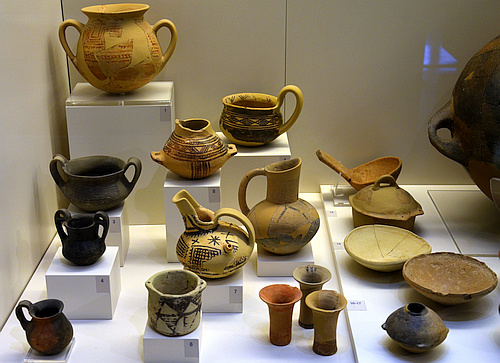
Ancient Greek pottery comprises a considerable part of the archaeological record of ancient Greece.
Much of our understanding of ancient Greek society, customary life and mind is derived from shards of pots discarded or
buried in the 1st millennium BC. Many vases were produced for everyday and kitchen use, but others were of high artistic
value, especially from Attica and Corinth, and were
imported by other civilizations throughout the Mediterranean. Various types and shapes of vases were developped, some
not for purely utilitarian use: large Geometric
amphorae were used as grave markers, kraters as tomb offerings and
Panathenaic amphorae as prizes for victors. - Apart from regional differences in
pottery, there is moreover a chronological development. Following Neolithic pottery,
Aegean pottery evolved in the Bronze Age: Cycladic
pottery, Minoan pottery, Minyan ware and then
Mycenaean pottery. After the cultural disruption of the
Dark Ages, pottery recovered with the Protogeometric style. The rise of
vase painting was seen in the Geometric
period and the Orientalizing style in the early
Archaic period. In Archaic and Classical Greece,
black-figure pottery was followed by red-figure
pottery and the white-ground technique before vase painting declined in the
Hellenistic period.
praxeis
("Deeds") A term under which the adventures of Herakles in the latter part of his life are subsumed. This includes: the encounter with the Kerkopes; the encounter with Syleus; the murder of his and Megara's children in an act of madness; the competition for the marriage of Iole; the killing of the centaur, Nessos, with whose blood Herakles was accidentally poisoned.
Praxiteles
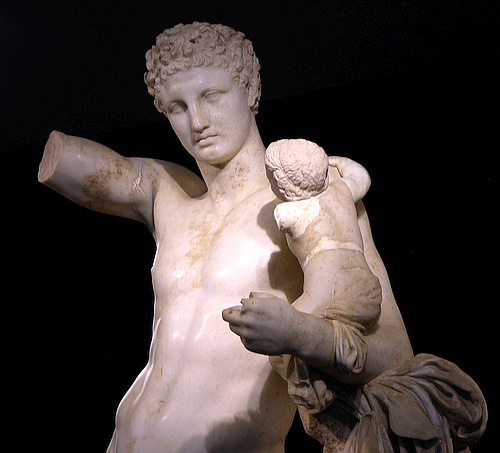
("He who finishes his works") Athenian sculptor of the 4th century BC,
probably son of Kephisodotos the Elder. He was the most renowned of the Attic
sculptors of this period, and it is said that he created the first life-size statue of a nude woman, the Aphrodite of
Knidos. The statue of Hermes with the Infant Dionysos is ascribed to him, but there are also speculations
that it may be a Roman copy. No other work can be reliably ascribed to him, but there are descriptions by ancient
authors and a number of later copies. - An assumed relationships between him and his favourite model, the beautiful
Thespian courtesan Phryne, has inspired some works of art. - It has been suggested that there were
two sculptors of the name Praxiteles. The one would have been a contemporary of Phidias, and the
other his famous and celebrated grandson. Although it is not uncommon in Greece that the same name is repeated in every
other generation, there is no certain evidence for this position.
Prehistoric Period
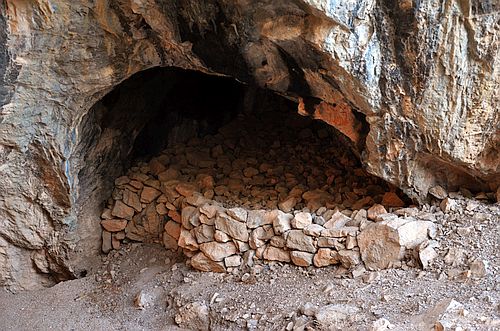
Prehistory literally means "before history", i.e. the period from the time when humans first appear,
i.e. about 2.6 millions of years ago until the appearance of recorded history following the invention of writing
systems. Therefore, it is only documented by archaeological and anthropological evidence. In Greece, this period
encompasses the time from the Paleolithic, ca. 28,000 BP, to the Bronze Age arriving
around 3000 BC, which includes the Cycladic, Minoan, and
Mycenaean cultures. However, according to the definition, the Minoan and Mycenaean eras
are no longer "prehistoric", since both have developed their own writing systems,
Linear A and Linear B.
Pre-Socratics
Philosophers of ancient Greece in the time before Sokrates, but also the philosophical schools contemporary to Sokrates that were not influenced by him. Aristotle called them physikoi ("physicists") because they sought rational, natural explanations for phenomena, as opposed to the earlier theologoi ("theologians"), whose philosophical basis was mythological and supernatural. Although many of the Pre-Socratics wrote significant treatises, none of their texts has completely survived.
Pre-Titans
The most ancient Greek Gods. Depending on the respective tradition, they are born from primordial Chaos or from Chronos and Ananke (Atropos). Hesiod mentions as Pre-Titans: Chaos, Gaia, Tartaros, Eros, Erebos and Nyx.
Priam
Priam, or Priamos, was the last king of Troy, whose lineage goes back to Dardanos and Zeus. With his wife Hekabe, he was father of 50 sons (among them Hektor and Paris) and several daughters (among them Kassandra). During the Trojan War he was already an old man, and when the city fell he was killed by Neoptolemos.
Priapos
A divinity not mentioned by Homer or Hesiod, while later writers give very differing accounts of his descent. Irrespective of these different traditions, he was regarded as the promoter of fertility both of the vegetation and of all animals connected with an agricultural life. In art, he was represented, mostly on hermae, with extremely large genitals, often carrying fruit in his garment.
Proitos
A son of Abas and Okaleia, and a twin-brother of Akrisios. In the quarrel of the two brothers about who should rule the kingdom of Argos, Proitos was expelled and fled to Iobates in Lykia who gave him his daughter, Anteia to marry. Then, Iobates invaded Argos and forced Akrisios to share the kingdom with his brother. Proitos received Tiryns, which was fortified by the Cyclopes, along with the Heraion, Midea and the coast of Argolis. - Proitos became by his wife the father of a son, Megapenthes, and of three daughters, Lysippe, Iphinoë, and Iphianassa. When they had grown up, they were stricken with madness because of their irreverence towards the Immortals. Melampus offered to cure them, if Proitos would give him one third of his kingdom. When Proitos refused, the madness of his daughters infected also the other Argive women, running around and murdering their children. Melampus renewed his offer but now also demanded for his brother Bias an equal share of the kingdom. Proitos agreed, and after gathering a group of young courageous men, Melampus and his crew chased the women as far as Sikyon. During the flight, Iphinoë died, but the other two daughters of Proitos were cured and married to Melampus and Bias. - One day, Bellerophontes came to Proitos to be purified of a murder which he had committed. The king's wife, Anteia, was impressed by the hero and made seductive advances that he refused. Thereupon Anteia told her husband the lie that Bellerophontes had tried to seduce her and that he must die for this. The king was too scrupulous to kill Bellerophontes, but sent Bellerophontes to his father-in-law Iobates, with a letter to kill the messenger.
Prokles
In ancient Greek mythology one of the Heraklids, a great-great-great-grandson of Herakles, and a son of Aristodemos. Together with his twin brother Eurysthenes, he received the land of Lakedaimonia after Kresphontes, Temenos and Oxylos captured the Peloponnese. He is the mythic founder of the Eurypontid dynasty of the kings of Sparta.
Prokne
A daughter of king Pandion of Athens. She was the wife of Tereus, and was metamorphorsed into a swallow.
Prokris
1) A daughter of Erechtheus in Athens. She was married to Kephalos.
2) A daughter of Thespios.
Prokrustes
Prokrustes ("the Stretcher") is a surname of the famous robber Polypemon or Damastes. He forced all the strangers that fell into his hands into a bed which was either too short or too large. In a short bed, he used to cut off their limbs, and in a large bed he stretched them until they were dead. He was killed by Theseus.
Promachos
(Greek: Promachos = "who leads in battle")
1) Son of Aison. He and his father were killed by Pelias while Jason was on the quest for the Golden Fleece.
2) A son of Parthenopaios and one of the Epigoni, who attacked the city of Thebes to avenge their fathers, the Seven Against Thebes. Promachos died in the attack.
3) In the Iliad a Greek warrior who was killed in the Trojan War by Akamas.
4) A son of Herakles and Psophis.
5) The thirty foot statue of the goddess Athena atop the acropolis of Athens was called Athena Promachos. Designed by the sculptor Phidias, sailors approaching from sea could see Athena's upraised golden sword before they could see any other landmark.
Prometheus
("forethought") A son of the Titan Iapetos by Klymene; brother of Atlas, Menoitios, and Epimetheus. However, there are also other, contradictory accounts of his ancestry. And there are various narratives about his paternity. Hence, he was father of Deukalion by Pandora or Hesione, of Hellen by Pyrrha or Klymene, and father of Lykos by Kelaino. - Once in the reign of Zeus, when gods and men were disputing with one another, Prometheus became an opponent of Zeus and in all accounts a benefactor of the mortals. To test the omniscience of Zeus, Prometheus once cut up a bull, dividing it in two part: the best parts were wrapped up in the bull's skin with the stomach, regarded as the worst part, put on top. The other part contained only bones and fat. Zeus figured out the deception and avenged himself by refusing fire to mortals. But Prometheus stole the fire and brought it to the earth stirring more anger in Zeus. He ordered Hephaistos to form a woman of earth, Pandora, and equipped with all evils of the world she was sent as a present to Epimetheus. Prometheus himself was put in chains, and fastened to a rock, where an eagle sent by Zeus consumed in the daytime his liver, which, in every succeeding night, was restored again. Prometheus was thus doomed to eternal torture, but later Herakles killed the eagle and delivered the sufferer.
pronaos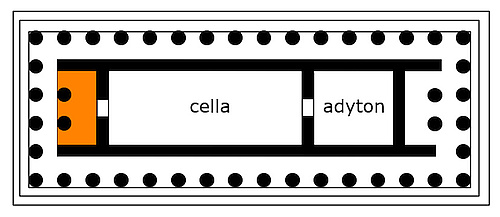
The front section of an ancient Greek temple. Typically it has two
columns in antis (distyle) and an axially aligned
door at the back leading into the cella. Its symmetrical counterpart is the
opisthodomos.
Pronoe
1) One of the Nereids.
2) A Naiad of a river in Lykia.
3) Daughter of the river god Asopos, mother of Phokos by Poseidon.
4) A nymph. She was the mother of the Trojan Lassus, who was killed by Podaleirios during the TrojanWar.
5) Daughter of Phorbus. She married Aitolos and bore him Pleuron and Kalydon.
6) Daughter of Melampus, king of Argos, and Iphianeira, daughter of Megapenthes. She was considered to be a seer like her father.
propylaea
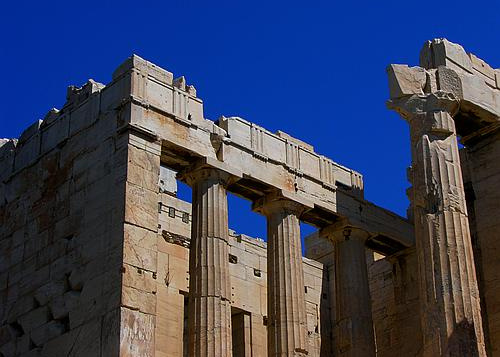
Any monumental gateway in Greek architecture. The best known example is the propylaea that serves as
the entrance to the Acropolis in Athens. See also:
site page.
proskenion
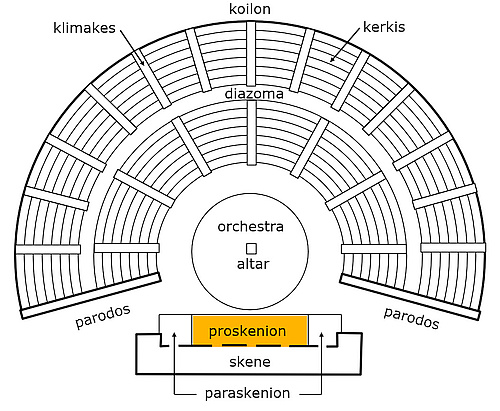
The stage in front of the skene in late Greek
theatres. In Hellenistic times it became a raised
platform, eventually with two levels. The front and sides of the stage were usually adorned with columns and statues.
proskynesis

Proskynesis was the act of bowing or prostrating oneself before a person of higher social rank in
Persian tradition. Alexander the Great temporarily adopted this
custom at his court in Persia. To the Greeks, this seemed to be a barbaric practice because they reserved such
submissions for the gods only.
prostyle
An architectural term referring to free standing columns across the
front of a building, i.e. the antae of a distyle are replaced
by columns. It originated in the 8th century BC in the eastern Aegean and is often used for
porticoes projecting from a classical building. It may have four (tetrastyle), six
(hexastyle) or eight (octastyle) columns.
Protesilaos
A son of Iphikles and Astyocheia, and a brother of Podarkes. He led the warriors of several Thessalian cities in the campaign against Troy, where he was the first to leap from the ships upon the Trojan coast and was the first of all the Greeks who was killed by the Trojans. - In ancient tradition, Protesilaos is most celebrated for the strong affection between him and his wife Laodameia, the daughter of Akastos. When she heard of the death of her husband, she prayed to the gods to be allowed to converse with him for only three hours. The wish was granted, Hermes led Protesilaos to the upper world, and when he died a second time, Laodameia expired with him.
Proteus
According to ancient Greek mythology, a minor sea-god, the "Old Man of the Sea". Protheus was the eldest son of the Titans Okeanos and Tethys. Except himself, all of Proteus' 2999 brothers were river gods. Protheus had oracular power and the ability to change his shape.
Protogeneia
1) A daughter of Deukalion and Pyrrha. She became by Zeus the mother of Opous. In other traditions she was a daughter of Opous. She is also called a mother of Endymion.
2) A daughter of Kalydon.
Protogeometric style
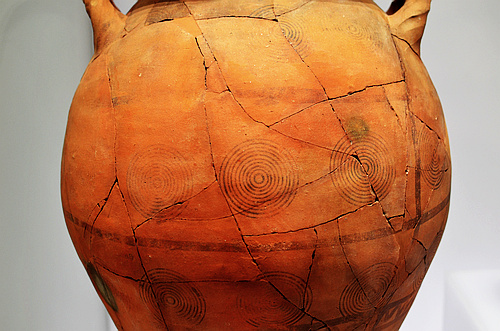
A style of ancient Greek pottery in the
Dark Ages. After the collapse of Mycenean civilization a new style of
vase painting evolved in Athens around 1050 BC. It is
characterized by a purely abstract decoration, mostly concentric circles applied by compass and brush. Often broad
horizontal bands appear on the neck and belly of the vases while the rest of the surface is left plain. - This style,
traceable until about 900 BC, is a precursor of the Geometric style.
Psamathe
1) One of the Nereids. She was the wife of the sea-god Proteus and the mother of Phokos by Aiakos.
2) The mother of Linos by the god Apollo.
 Psychro cave

The Psychro cave, also called Diktaion Andron, is an ancient Minoan
sacred cave at an altitude of 1025 meters on the Lasithi plateau in eastern Crete. Cult
practices began here in the Early Minoan period (2800-2300 BC) attested by the innumerable votive offerings found here.
It is one of the putative sites where in Greek mythology Rhea, escaping the infanticidal
intentions of Kronos, gave birth to Zeus (the other possible
birthplace of Zeus is the Idaion Andron. - See also:
site page.
Ptolemaios
1) Ptolemaios of Aloros was a Macedonian envoy in Athens around 375 BC. After the death of Amyntas III of Macedon in 370 BC, he began a liaison with his widow, Eurydike, and in 368 BC assassinated her son, Alexander II, to gain control of the throne. Thebes intervened, and Ptolemaios ruled as regent for Perdikkas III until Perdikkas killed him in 365 BC.
2) Ptolemaios Soter ("Ptolemaios the Savior") (ca. 367 - 283/2 BC), was a Macedonian general under Alexander the Great, one of the diadochi who succeeded him. He became ruler of Egypt (323 - 283/2 BC) and founder of a dynasty ruling for the next three centuries. Under his reign, Egypt became a Hellenistic kingdom and Alexandria a major center of Greek culture.
3) Claudius Ptolemy or Claudius Ptolemaeus (ca. AD 100 - ca. 170) was a Greek writer and astronomer living in Alexandria in the Roman province of Egypt. Three of his works had much influence on later science, of which the Almagest is the best known, an astronomical treatise elaborating on the geocentric model of the universe.
4) There are also two mythological personages of this name.
Pygmalion
1) A king of Cyprus and father of Metharme. According to tradition, he fell in love with the ivory image of a maiden which he himself had made, and therefore he prayed to Aphrodite to breathe life into it. When the request was granted, Pygmalion married his beloved, and became by her the father of Paphos.
2) There is another mythical personage of this name.
pyknostyle
Columns set at narrow intervals, where the space between columns corresponds to one-and-a-half column diameters. See: intercolumniation.
Pylades
A friend of Orestes, who received him like a brother in Phokis. Pylades afterwards married Elektra, the sister of Orestes.
Pylos
A town, historically also known under its Italian name Navarino, in
Messenia. It is the main harbour on the Bay of Navarino, having about 3000 inhabitants. The region of Pylos has a
long history, having been inhabited since Neolithic times. When Pylos is mentioned in
ancient context, it refers to the significant Mycenaean kingdom with the
Palace of Nestor in Ano Englianos, about 17 km to the north of modern Pylos. - See also:
site page.
Pyrrha
1) A daughter of Epimetheus and Pandora. She was the wife of Deukalion, with whom she escaped the Great Deluge.
2) A daughter of Kreon, king of Thebes.
3) The name of Achilles when he was disguised as a girl.
Pyrrho
Pyrrho (ca. 360 BC - ca. 270 BC) was a Greek philosopher of Classical Antiquity. He studied Eastern philosophy, was the first representative of philosophical skepticism and founded the school of pyrrhonism.
pyrrhonism
Pyrrhonism was a short-lived philosophical school of skepticism founded by Pyrrho in the 4th century BC. It was revived by Ainesidemos in the first century BC.
Pythagoras
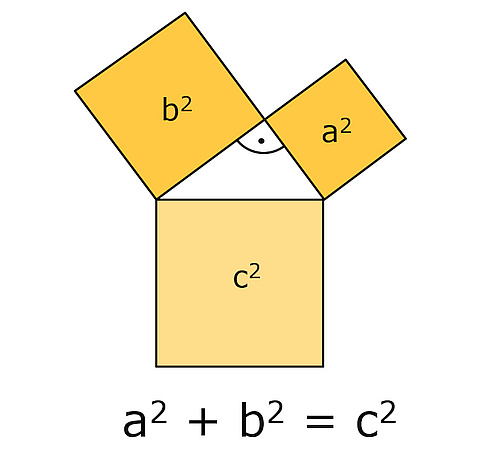
Pythagoras of Samos (ca. 570 - ca. 495 BC) was an Ionian Greek
philosopher and mathematician. The few information we have about him is not very
reliable because it was only written down centuries later. Born on the island of Samos, he travelled to mainland Greece
and Egypt, perhaps also to India. Around 530 BC he settled in Crotone in Magna
Graecia and founded a philosophical school there, before he returned to Samos in 520 BC. Little is known about his
teachings which were related to mathematics and number mysticism. He is best known for the "Pythagorean theorem", but it
is unclear if it was his own contribution or that of colleagues or successors (actually, it was already used in the Old
Babylonian period, 20th to 16th centuries BC). Nevertheless, his philosophical ideas were quite influential.
Pythia
The title of the prophetic priestess of the oracle of Apollo at Delphi. This institution existed at least since the 8th century BC (probably even much earlier) and was used until the late 4th century AD. During this period the oracle of Delphi was the most important and renowned in the Greek world. Surviving reports about how the Pythia operated are not very clear, but it seems that the priestess delivered prophecies in an ecstatic state induced by vapours rising from an opening in the rock underneath the temple. Her mostly unintelligible utterances were then interpreted by priests and transferred into dactylic hexameter verse.
Pythian Games
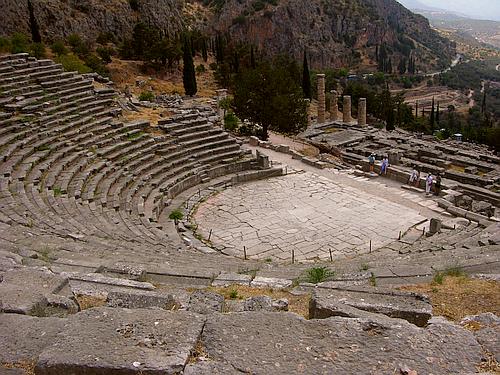
The Pythian Games in honour of Apollo at his sanctuary at
Delphi were one of the four great panhellenic games of ancient
Greece. They were held every four years, two years after each Olympic Games, and
between each Nemean and Isthmian Games.
The Pythian Games go back to art and dance competitions at Delphi which according to tradition were inaugurated by
Apollo himself after he had killed Python and set up the oracle at
Delphi. Sometime in the 6th century BC, athletic competitions like those in the Olympic Games were added.
Python
The famous dragon, a reputed son of Gaia, who lived in the caves of mount Parnassos and guarded the oracle of Delphi. He was killed by Apollo, who then took over the oracle.
pyxis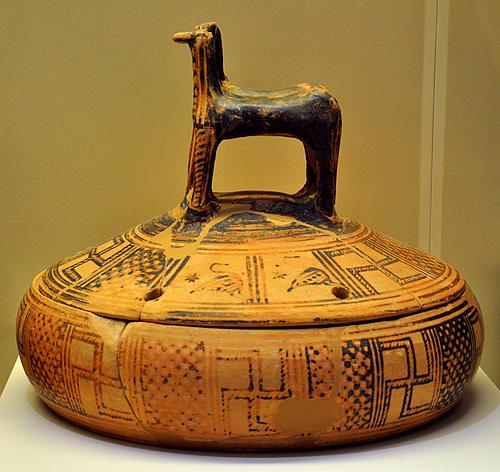
In ancient Greek pottery a vessel in the shape of a cylindrical box with a
separate lid. It was mainly used by women to keep jewellery or perfumes. Its origin are Corinthian wooden boxes, but its
equivalent in pottery appears already in the Protogeometric period. The cover often has
elaborately sculpted handles.

