
GREECE
 GLOSSARY
| A | B | C | D |
| E | F | G | H |
| I | J | K | L |
| M | N | O | P |
| Q | R | S | T |
| U | V | W | X |
| Y | Z |
2026-01-22
color code:  = mythology;
 = history & culture;
  = geography;
  = archaeology &
architecture
= archaeology &
architecture
 Babylon
Babylon was the most magnificent and richest city of the ancient world. Situated on the Euphrates River, it was the capital of an ancient empire and dominated western Asia from circa 2000-1000 BC.
Bacchylides
A Greek lyric poet (5th century BC). The elegance and polished style of his lyrics have been praised, while others judged these as superficial charm. He has often been compared unfavourably with his contemporary, Pindar, yet their styles are utterly different.
balustrade
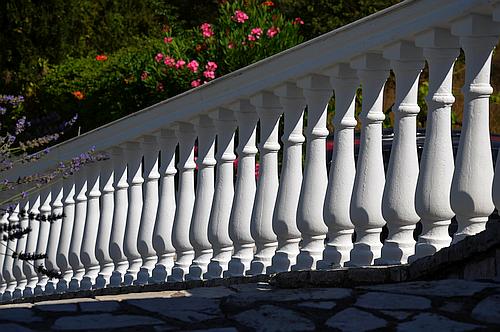
A row of balusters, surmounted by a rail, forming a barrier along the edge of a terrace or
balcony.
barbaros
It meant "not Greek" and is the root of our word barbarian. While the term originally was used by the Greeks to denote all foreigners, later writers used it only to refer to the Persians.
barbitos
A multi-stringed musical instrument similar to the lyre.
barbotine
A ceramic slip, i.e. a mixture of clay and water, used for moulding or decorating pottery, piped onto the object. It was used in ancient Egypt, in Minoan Knossos, and in Ancient Roman pottery.
barrel vault
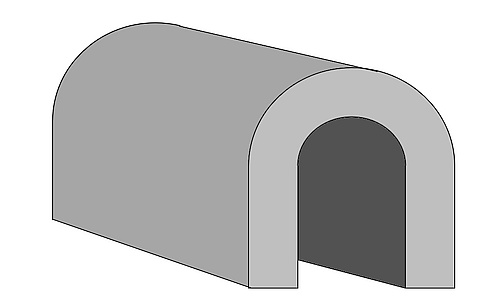
The simplest form of a vault. It consists of a continuous surface of semicircular or pointed
sections, resembling a covered wagon, or a barrel, which has been cut in half length-wise.
base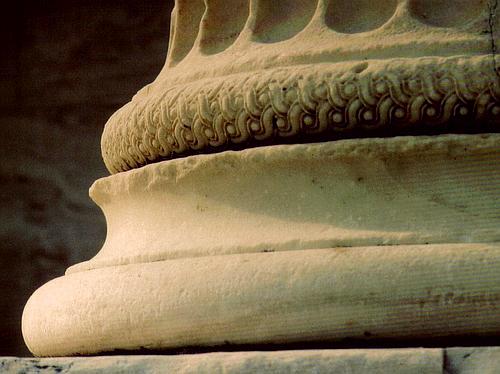
The lowest part of a column. Doric
columns stand directly on the stylobate without a special base, whereas in the
Ionic or Corinthian order the base is more or less
elaboratey decorated.
basileus
An ancient Greek title for monarchs. It is used in Mycenaean Greek and usually translated as "king", but a better translation would be "chieftain". See also wanax for comparison.
basilica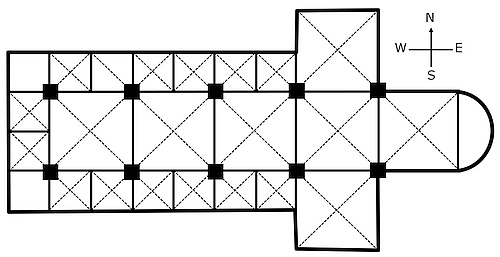
In Roman architecture a large rectangular hall to accommodate large assemblies, the interior divided
lengthwise by a collonade or a row of pillars. This was the basis for the early Christian
churches with three or more aisles, where the central aisle is wider and higher, and has a
row of windows in the upper section. The entrance is at one of the narrow sides, at the opposite end is an
apse (or apses). The cruciform domed basilica has a cross-shaped plan and a dome over the
centre.
bas-relief
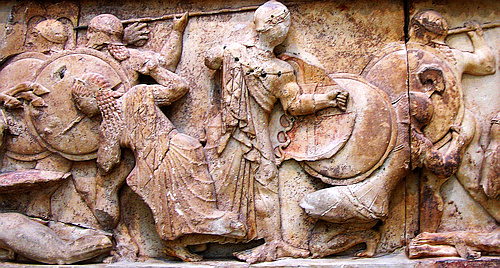
A method in relief sculpturing where the image stands raised above the flat background.
bastion
A solid masonry projection of a fortification. It often consists of an exterior stone surface filled
with rubble and earthwork.
battered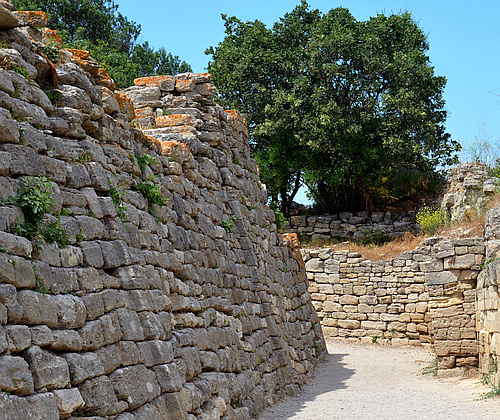
An architectural term referring to a wall that is deliberately built not to rise vertically but
leaning inward.
Battle of xxx
--> xxx
beam
A horizontal load-bearing element, in antiquity made of timber.
Becker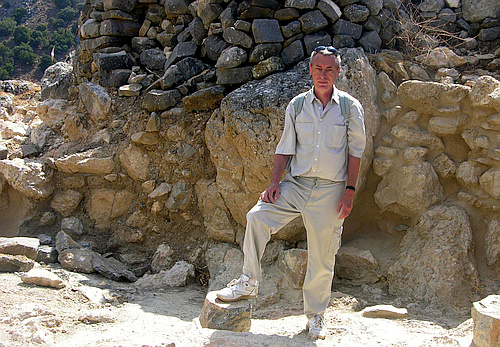
Hajo Becker is a German scholar with a wide variety of interests. This includes archaeology, history,
and mythology of ancient Greece, especially the Bronze Age of the Aegean, but also art and
astrophysics.
Bellerophontes
Mythical hero of Corinth, son of king Glaukos. He was a strong, noble and beautiful man, blessed by the gods. With the help of Athena he tamed the winged horse Pegasus. Once, when Bellerophontes was in Argos, the king's wife Anteia made seductive advances that he refused. Thereupon Anteia told her husband Proitos the lie that Bellerophontes had tried to seduce her and that he must die for this. The king was too scrupulous to kill Bellerophontes, but sent him to his father-in-law Iobates in Lykia with a letter to kill the messenger. But also Iobates, afraid of the gods, did not do it. Instead, he sent Bellerophontes on suicide missions, first to kill the fire-breathing Chimaira, then to fight the fierce Solymoi, and finally to defeat the Amazons. When Bellerophontes had survived all these challenges, Iobates laid an ambush, but this also failed. - At last, Bellerophontes lost the benevolence of the gods when he made the presumptuous attempt to reach Olympos with Pegasus.
bema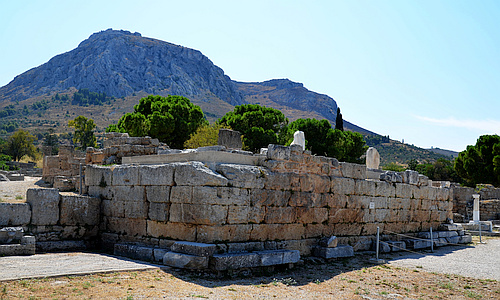
Bema (Greek: "platform", "step") designates a tribunal from which orators addressed the
citizens as well as the courts of law. Its best known example is on the
Pnyx.
Berlin Painter
Pseudonym of an anonymous Attic vase-painter (fl. ca. 490 - ca. 460 BC). He was one of the most celebrated vase-painters of the early 5th century BC and a rival of the Kleophrades Painter.
 Bias
Bias
1) Brother of the seer Melampus, with whose help he married Pero, daughter of Neleus. Three of their sons are mentioned among the Argonauts: Talaos, Arëios, and Leodokus. Also with the help of Melampus he gained one third of the kingdom of Argos where he and his descendants ruled for four generations.
2) Bias of Priene (6th century BC) was a renowned advocate, defending the right. He is widely accepted as one of the Seven Sages of Greece.
bilingual vase
A vase with one side painted in the red-figure style and the other side in the black-figure style.
Bion
Bion (fl. ca. 100 BC) was a Greek bucolic poet, born in Smyrna (present Turkey). Only fragments of his work survived.
Bithynia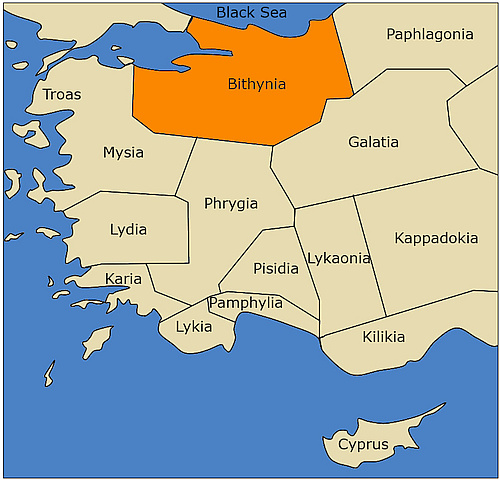
An ancient region in the northwest of Asia Minor. It lies south of
the Black Sea and borders Mysia and Phrygia. Bithynia was an
independent kingdom since the 4th century BC.
black-figure painting
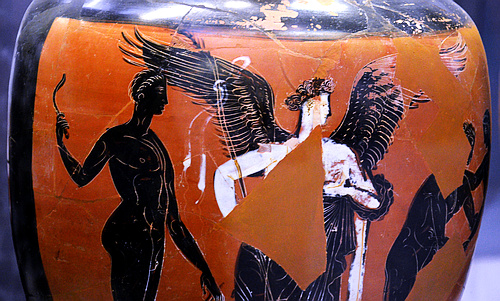
A style of vase painting used in Greece in the 7th and 6th
century BC, where the figures were painted on an unfired vase and the details incised with a sharp tool. After firing,
the figures appear in black on a red background. Sometimes also red and white paints were added for more details. This
style was superseded by the red-figure style around 530 BC.
Black Sea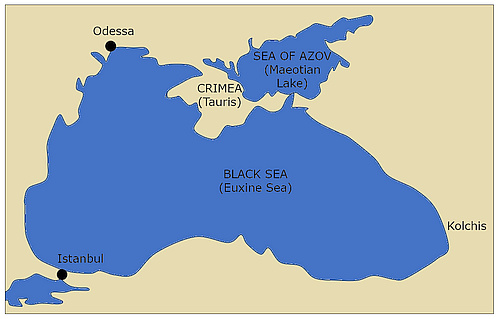
A body of water between Eastern Europe and Western Asia. It is bounded by Bulgaria, Georgia, Russia,
Ukraine, Romania, and Turkey. The longest east-west extent is about 1,200 km. The ancient Greeks originally called it
Axenos, then later Euxine. In Greek mythology, Kolchis and
Tauris lay here.
Blegen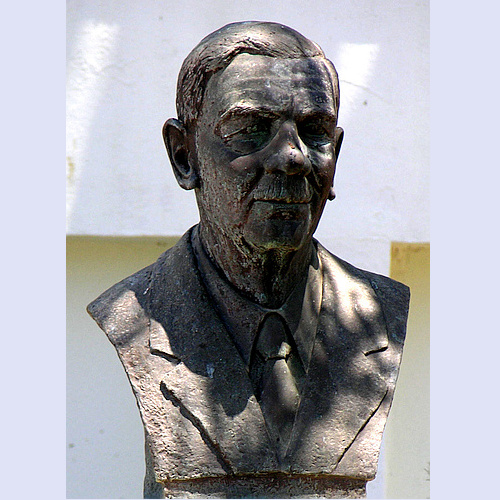
Carl Blegen (1887 - 1971) was a renowned American archaeologist, professor of classical archaeology
at the University of Cincinnati from 1927 to 1957. He is best known for his excavations at
Troy (1932 - 38) and the discovery and excavation of the Palace of Nestor in
Pylos (1939 - 66), with many of his findings exhibited in the Archaeological Museum of Chora. He also located and
identified an incredible number of other Bronze Age sites in the
Peloponnese and made excavations in Corinth, Korakou,
Zygouries, Phlius, Prosymna, and Hymettos. For his ground-breaking work he received many honorary degrees.
Boeotia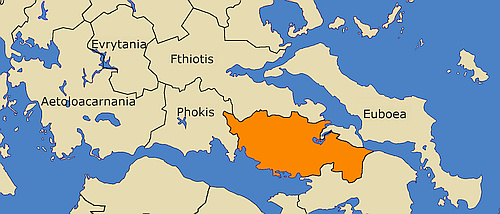
(Voiotia) Region in Greece, 106,000 inhabitants, 3200 km2, between the Gulf of Corinth and
Euboea. In antiquity, Thebes was the dominant city-state of
this district (--> site page).
Boeotian League
A confederation of Boeotians, established after the end of the Peloponnesian War. In 395 BC the Boeotian League comprised eleven groups of sovereign cities and associated townships.
Boreas
In Greek mythology the god who personified the north wind, son of Eos and Astraios. His brothers are Zephyros (West Wind) and Notos (South Wind). According to Athenian tradition he married Oreithyia, daughter of Erechtheus. During the Persian invasion of 480 BC the Athenians sacrificed to Boreas and his wife, whereupon a heavy storm destroyed 400 of the Persian ships.
bothros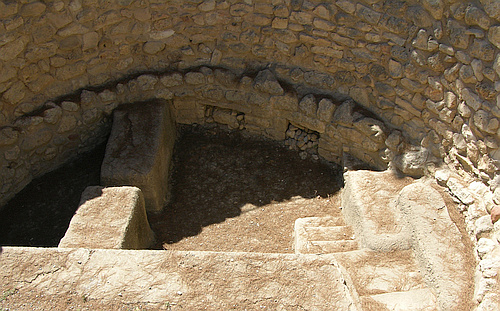
A bothros is a pit in the ground. Bothroi were used for the disposal of waste, sometimes also for
chthonic offerings.
boule
A council of citizens appointed to run the daily affairs of a polis. Originally these were nobles advising the king, but boules in the course of time evolved according to the constitution of the city. In oligarchies, boule positions typically were hereditary, while in democracies members of the boule usually were appointed by lot and served for a limited period.
bouleuterion
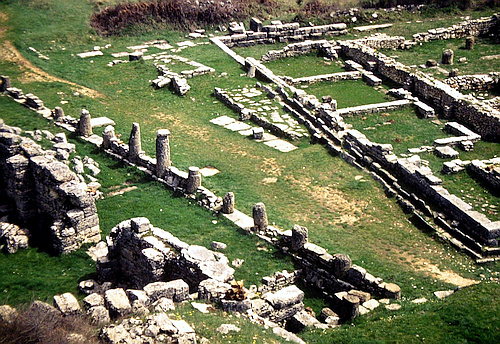
Building for members of the council, the place where the boule held its
meetings.
Boutes
1) A son of Boreas. Because he was hostile to his step-brother Lykurgos, Boutes was expelled by his father. He went with some companions as colonists to Naxos. Since they had no women they carried off devotees of Dionysos in Thessaly. Dionysos struck him with madness and he threw himself into a well.
2) Athenian shepherd, ploughman, and an Argonaut. Some accounts see him as a son of Pandion. When he died, Boutes was appointed priest of Athena in the Erechtheion.
3) There are several other mythological personages of this name.
bowl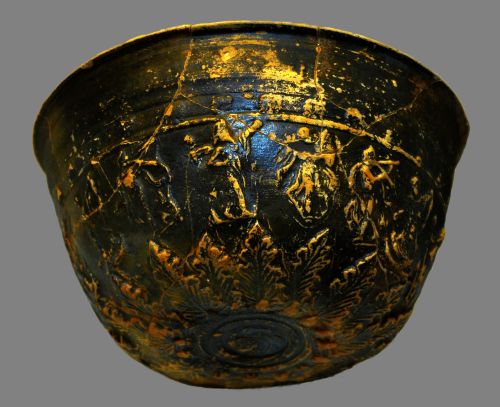
An open vessel whose height is less than the diameter of the mouth.
Brasidas
A Spartan general (died 422 BC) during the first decade of the Peloponnesian War. According to Thukydides, he had not only the typical Spartan courage but was also quick in forming his plans and carried them out without hesitation. His greatest victory was in the battle of Amphipolis in 422 BC, where he defeated Kleon's Athenian army. Both Brasidas and Kleon were killed during the battle, though.
brick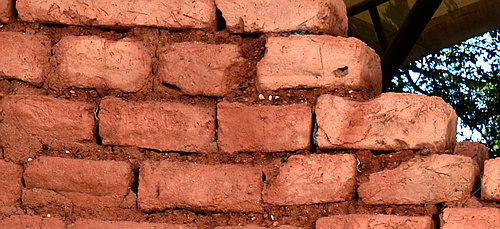
Bricks are one of the oldest building material. They consist of a mixture of clay, silt and sand,
which is pressed in moulds and then burned in a kiln. - Since about 9000 BC, mudbricks were used, i.e. unfired,
air-dried bricks made of mud mixed with a binding material such as straw. Although still in use, from around 5000-4000
BC, mudbricks were replaced by fired bricks to increase strength and durability.
Briseis
The real name of Hippodameia, the daughter of Briseus of Lyrnessos. During the Trojan War she was abducted by Achilles, who then developped tender feelings for her. After an oracle forced Agamemnon to give up Chryseis, a woman he had captured, the king ordered his heralds to take Briseis from Achilles as compensation. Achilles was offended by this seizure and, as a result, withdrew from the fighting, the first scene of Homer's Iliad. In the following, the Greeks suffered heavy losses until Achilles returned to the fight after the death of Patroklos. Agamemnon restored Briseis to Achilles, swearing that he has never slept with Briseis.
Brontes
("thunderer") One of the Cyclopes, son of Gaia and Uranos, mentioned by Hesiod.
 Bronze Age
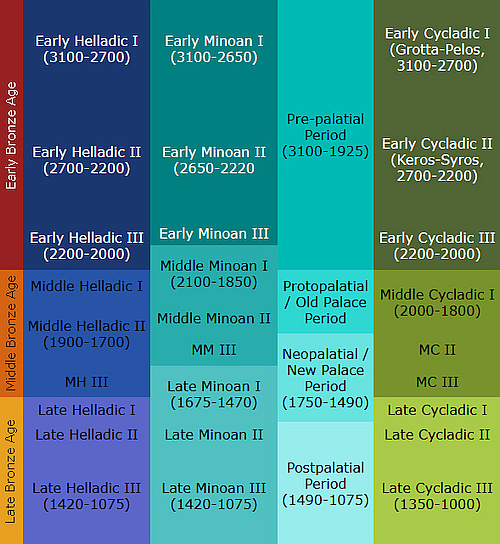
The period from ca. 3100 - 1100 BC. It was characterized by the epochal change in metallurgy that
came with the introduction of bronze, which not only required very hot furnaces. Bronze consists of 80% copper,
relatively easy to obtain in Greece, and 20% tin, which had to be imported from so far away as the British Isles or from
islands in the Indian Ocean. - The civilizations of the Aegean in that period are geographically divided into three
groups: the Cycladic civilization on the Cyclades, the
Minoan civilization on Crete, and the
Helladic civilization on the Greek mainland.
Bryaxis
Bryaxis (fl. 4th century BC) was one of the Greek sculptors working on the Mausoleum in Halikarnassos.
burnish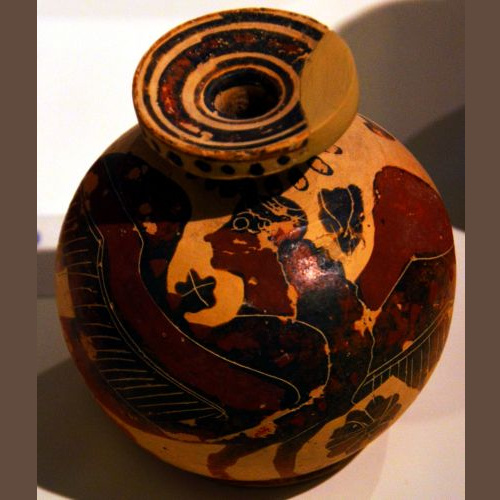
The rubbing or polishing of the surface of a pot with a smooth piece of wood, bone or other
material after it had dried. This produced an attractive glossy surface after firing in the kiln.
Busiris
Mythical king of Egypt, son of Poseidon. He used to sacrifice all travellers coming to his land until he was killed by Herakles.
bustrophedon inscription
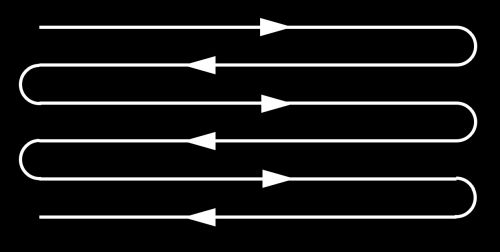
Writing "as the ox ploughs" (Greek: bous = "ox"), i.e. an inscription in which the direction
of the writing changes in each line.
buttress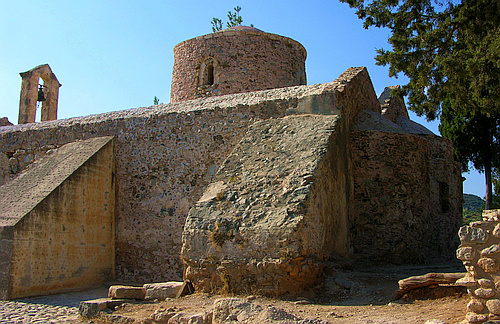
In architecture, a masonry structure built against the exterior side of a wall to reinforce it. To
oppose the load or thrust on a wall, it is more economic to buttress it at certain intervals than to make the entire
wall thicker.
Byron
George Gordon Byron, 6th Baron Byron (1788 - 1824), commonly just known as Lord Byron, was an Anglo-Scottish poet and prominent figure of the Romantics. His work was highly influential and he is still regarded as one of the greatest British poets. He travelled extensively across Europe, lived seven years in Italy, and being a philhellene, joined the Greek War of Independence in the fight against the Ottoman Empire. He died in 1824 at the age of only 36 from a fever in Mesolongi. Revered by many Greeks as a national hero, he was a celebrated poet, but also criticized as a flamboyant romantic with aristocratic excesses, including huge debts, numerous love affairs with men and women, a scandalous affair with his half-sister, and his self-imposed exile.
Byzantine period
In 324 AD, the Roman Emperor Constantine I moved the capital of the Roman Empire from Rome to Byzantium, modern Istanbul, heralding the decline of Rome in the 4th century. In consequence, christianity was declared the official religion in Greece in 394 AD, ancient Greek gods were branded as pagan, Greek cults forbidden. The Byzantine period lasted until 1453 AD, when Constantinople fell to the Ottomans.
Byzantium
A city on the European side of the Bosporus Strait, founded in 657 BC by colonists from Megara. It became later Constantinople, and still later Istanbul.

