
GREECE
 GLOSSARY
| A | B | C | D |
| E | F | G | H |
| I | J | K | L |
| M | N | O | P |
| Q | R | S | T |
| U | V | W | X |
| Y | Z |
2026-01-15
color code:  = mythology;
 = history & culture;
  = geography;
  = archaeology &
architecture
= archaeology &
architecture
obol
("spit") An ancient Greek currency unit. Originally spits of copper or bronze traded by weight and used since 1100 BC, later replaced by coins. One obol was the prize for a light meal, six oboloí make a drachma.
octastyle
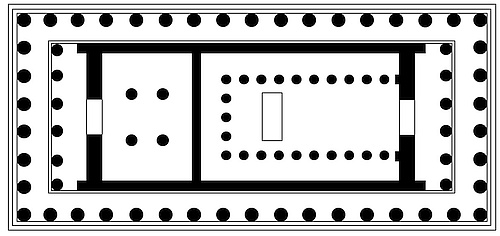
Octastyle buildings in Classical Greek architecture had eight
columns on the small sides; a style much rarer than
hexastyle. The most famous example that survived from antiquity is the Parthenon on
the acropolis of Athens.
Octavian
--> Augustus
Odysseus
One of the most prominent Greek heroes in the Trojan War. According to Homer, he was the grandson of Arkeisios, and a son of Laërtes and Antikleia, the daughter of Autolykos. He was married to Penelope, the daughter of Ikarios, by whom he became the father of Telemachos. Later traditions give numerous other genealogies. - When Odysseus was a young man, he went to see his grandfather Autolykos near the foot of Mount Parnassos. There, during a hunt, he was wounded by a boar in his knee, by the scar of which he was later recognized by Eurykleia. Even at this young age, he was famed for his courage, his knowledge of navigation, his eloquence and skill as a negotiator. It is said that he went to Sparta as one of the suitors of Helena, and that he advised Tyndareos to make the suitors swear, that they would defend the chosen bridegroom against anyone that should insult him on Helena's account.
Homer mentions nothing of all this, but states that it was only with difficulty that Odysseus could be moved to join the Greeks in their campaign against Troy. In one tradition, it was Palamedes who achieved this. When Palamedes visited Odysseus, he had yoked an ass and an ox to a plough, and began to sow salt, pretending to be mad. To try him, Palamedes placed the infant Telemachos before the plough, whereupon the father could not continue to play his part. He stopped the plough, and had to fulfill the promise he had made when he was one of the suitors of Helena. Now being part of the undertaking, he helped to find Achilles, who was hiding among the daughters of king Lykomedes, and without whom, according to a prophecy of Kalchas, the expedition against Troy could not be undertaken. - Odysseus joined the Greeks gathered at Aulis with twelve ships, and when Agamemnon had insulted Artemis, he went to Mycenae and brought Iphigeneia under various pretences to Aulis. - During the siege of Troy he was a distinguished warrior, but especially praised as a cunning, prudent, and eloquent spy and negotiator in numerous situations. He is also said to have conceived the Wooden Horse and to have been one of the warriors hidden in it.
However, none of his adventures is so much celebrated as his ten years of voyage after the taking of Troy, which is treated in the Odyssey (see below). - In the Homeric poems, Odysseus appears as a prudent, cunning, inventive and eloquent man, whose courage no misfortune or calamity could subdue, whereas later writers describe him as a deceitful and intriguing personage. Concerning the last periods of his life, we only have the prophesy of Teiresias, who promised him a painless death in a happy old age.
 Odyssey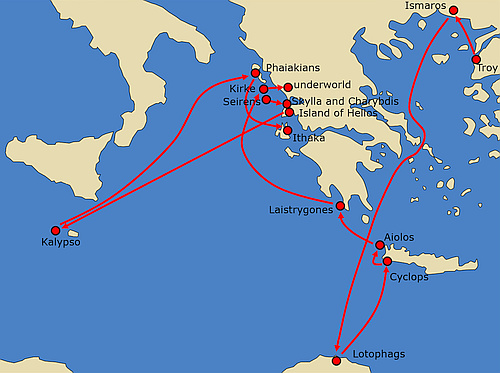
The Odyssey is one of the two major works ascribed to Homer, fundamental to the canon of Western literature. It was probably composed near the end of the 8th century BC, somewhere in Ionia, being to a certain extent a sequel to the Iliad. The 24 books of the Odyssey describe the adventures during the ten-years-voyage of Odysseus before he reaches his home in Ithaka after the fall of Troy.
When the war ended, Odysseus decided to take the northern route home and sail along the coast of Thracia. There he landed at Ismaros, a town of the Kikonians, allies of the Trojans. He ravaged and plundered the town, but when the Kikonians could bring reinforcements, Odysseus and his men had to flee.
He then led his ships to the south along the coast of Euboea and Attica, when they came into a terrible storm lasting for nine days and carrying them to the Lotophagi on the coast of Libya. Some of his companions were so much delighted with the taste of the intoxicating lotus fruit that they forgot about reaching home. Odysseus compelled them to embank again, sailed north and after one day reached the island of the Cyclops.
When Odysseus entered the cave of Polyphemos, the giant devoured one after another six of the companions of Odysseus, and kept the others as prisoners in his cave. Odysseus, deceptively calling himself "Nobody", intoxicated the Cyclops with wine, deprived him of his one eye with a burning pole, and then he and his friends escaped by concealing themselves under the bodies of the sheep which the Cyclops let out of his cave. However, Odysseus boastfully revealed his true identity while escaping, and Polyphemos asked his father Poseidon to take revenge, and henceforth the god of the sea pursued the wandering king with implacable enmity.
On his further voyage Odysseus arrived at the island of Aiolos, probably the small island of Gramvousa northwest of Crete. There Aiolos gave him a leather bag filled with winds which were to carry him home. Without asking Odysseus, his companions opened the bag, all the winds escaped and they were driven back to the island of Aiolos, who now refused further help.
After six days of sailing, they arrived at the city of the cannibalistic Laistrygones. Only Odysseus escaped from them with just one ship, all the rest was destroyed, the men killed.
The journey carried Odysseus now to the island Aiaia of the sorceress Kirke. The people that were sent to explore the island were turned by Kirke into swine. With the assistance of Hermes, Odysseus managed to get his friends free and turned back into men. However, Kirke kept Odysseus as her lover for one year on the island before she allowed him to leave.
Following Kirke's advice, Odysseus then descended into hades to consult the seer Teiresias. The specifications given in the Odyssey at this point are quite clear, indicating that the Nekromanteion was Odysseus' destination. There, Teiresias informed him of the difficulties arising from the anger of Poseidon and warned him, not to touch the herds of Helios.
Back on Aiaia, Kirke gave him more hints for his homecoming journey which first led him to the Seirens, who sat on the shore, attracting everyone who passed by their sweet voices and then destroying them. Odysseus filled the ears of his companions with wax, and fastened himself to the mast of his ship, until he was out of the reach of the Seirens' song.
Odysseus then came to the strait between Skylla and Charybdis (which is probably not the wide passage between Sicily and the Italian mainland but the strait between Lefkada and mainland Greece). He passed it successfully although losing six of his men to Skylla.
Sailing south, they came to Thrinacia, the island where Helios kept his sacred herds of oxen. Thinking of the warnings by Kirke and Teiresias, Odysseus wanted to pass, but was compelled by his companions to land. Unfavorable storms prevent their departure, and when their supplies were exhausted after one month on the island, some of the crew killed the finest of the oxen while Odysseus was asleep. This offense was avenged by Zeus, because when they departed a few days later another storm came and the ship was destroyed with a flash of lightning. All men drowned except Odysseus, clinging to the mast and planks of the sunken ship.
After floating in the water for nine days, Odysseus reached the island of Ogygia, inhabited by the nymph Kalypso. She received him friendly and promised immortality and eternal youth, if he would marry her. But Odysseus could not forget his own home and his desire for Ithaka. He had already stayed on the island for seven years when Athena intervened and made Zeus promise that Odysseus should one day return home. Hermes brought Kalypso the command of the gods to let Odysseus go, who then left Ogygia on a raft and sailed eastward.
On the eighteenth day Odysseus saw the land of the Phaiakians, the island of Scheria, but Poseidon, in a last effort, sent another storm that swept him off the raft. Swimming, he reached the shore, where Nausikaa found him and brought him to the house of her father, king Alkinoos. He and his wife Arete welcomed the stranger friendly, and when he revealed his identity, gave him presents and brought him on a ship home to Ithaka.
During the twenty years of his absence, his father Laërtes, bowed down
by grief and old age, had withdrawn into the country, his mother Antikleia had died of
sorrow, his son Telemachos had grown up to manhood, and his wife
Penelope had rejected all the offers made to her by the importunate suitors. Meanwhile
more than a hundred of them had sued for Penelope's hand, and during their visits to her house had treated all that it
contained as if it were their own. To be able to take vengeance upon them, Athena metamorphosed him into an ugly beggar.
Also in this disguise he was treated friendly by the faithful swine-herd Eumaios, and
when he went to town, he was only recognized by his old dog Argos and his nurse
Eurykleia. In the palace, it was difficult to make Penelope promise her hand to him who
should conquer the others in shooting with the bow of Odysseus. But when none of the suitors was able to bend the bow,
Odysseus started the shooting and with the assistance of his son Telemachos and Athena
killed all the suitors. Odysseus then made himself known to Penelope, and went to see his aged father. - When reports of
the death of the suitors became known, their relatives marched against Odysseus, but were reconciled by Athena.
Oidipodeia
The Oidipodeia is a lost poem of which only three fragments survived, a part of the Epic Cycle. Ancient sources attributed it to the barely known poet Kinaithon. The Oidipodeia told the story of the Sphinx and Oedipus, presenting an alternative view of the myth. According to Pausanias, Kinaithon states that the marriage between Oedipus and his own mother, Iokaste was childless and that his children had been born from another engagement.
Oedipus
The son of Laios and Iokaste of Thebes. His tragic fate has frequently been used by Aischylos and other tragic poets. - Laios, king of Thebes, and his wife Iokaste had no children so Laios consulted the oracle at Delphi. He was told that if a son should be born to him he would lose his life by the hand of his own child. So, when Iokaste later gave birth to a son, they pierced his feet, bound them together, and exposed the child on Mount Kithairon. A shepherd of king Polybos of Corinth found him there and brought him to the palace. Polybos and his wife Merope brought up the boy as their own son and called him Oedipus because of his swollen feet. One day, a Corinthian mocked him with not being the king's son, whereupon Oedipus went to the oracle and was told that he would kill his father and marry his own mother. To avoid this, Oedipus did not return to Corinth, but on his way from Delphi to Daulis he met a chariot with his real father Laios. When the charioteer tried to push him out of the way, a brawl developped, in the course of which Oedipus killed Laios. Meanwhile, the Sphinx had settled on a rock near Thebes, putting a riddle to all who passed by and killing those that could not solve it. Because of this calamity the Thebans announced that whoever should deliver the country of it should be made king, and receive Iokaste as his wife. When Oedipus came to the Sphinx, he received the riddle: "A being with four feet has two feet and three feet, and only one voice; but its feet vary, and when it has most it is weakest." When Oedipus solved the riddle by saying that it was man, and the Sphinx thereupon threw herself from the rock. Oedipus now became king of Thebes, and married his mother, by whom he became the father of Eteokles, Polyneikos, Antigone, and Ismene. As a consequence of the incestuous alliance of which no one was aware, the country of Thebes was visited by a plague, and to avert this, the oracle ordered that the murderer of Laios should he expelled. When Oedipus endeavoured to discover him, he was told by the seer Teiresias that he himself was both the patricide and the husband of his mother. As a consequence, Iokaste hung herself and Oedipus put out his own eyes. According to one tradition, Oedipus was expelled by Kreon and Antigone accompanied her blind father into his exile in Attica.
 Ogygia
The island of the nymph Kalypso. In the Odyssey, Odysseus is thrown on the coast of this island, where Kalypso detained him for seven years. - Traditionally, Ogygia is identified with the island of Gozo, next to Malta, which would match the distances indicated by Homer. Still today, there is a "Calypso Cave" on Gozo.
Oiagros
A river-god or king in Thracia, possibly father of Orpheus.
Oibalos
1) A son of Kynortas, and husband of Gorgophone, by whom he became the father of Tyndareos, Peirene, and Arene. He was king of Sparta, where he was afterwards honoured with a heroon.
2) Another personage of this name settled in Campania.
Oineus
1) A son of Aigyptos.
2) A son of Pandion.
3) A son of Porthaon, brother of Agrios and Melas and husband of Althaia, by whom he became the father of Tydeus and Meleagros, and was thus the grandfather of Diomedes. However, other genealogies are also given. He was king of Pleuron and Kalydon in Aetolia. According to one tradition, Oineus was deprived of his kingdom by the sons of Agrios, but was avenged by Diomedes. - According to Homer, Oineus one year forgot to make the usual sacrifice to Artemis. The goddess of the hunt was infuriated and as a punishment, she sent the Kalydonian Boar.
 oinochoe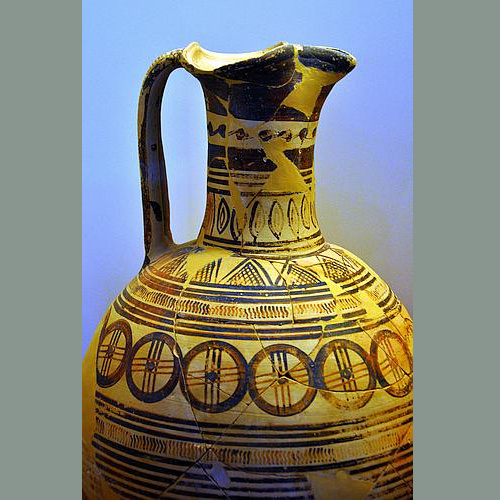
(Greek: oînos = "wine" and khéo = "I pour") A wine jug, one of the key forms of ancient
Greek pottery. In the course of time many different types of oinochoai have been
developped. Characteristic is a single handle rising above the lip, no distinct shoulder and heights up to ca. 25 cm so
that they could be comfortably held and poured with one hand. Larger examples were sometimes used as grave markers.
Oinomaos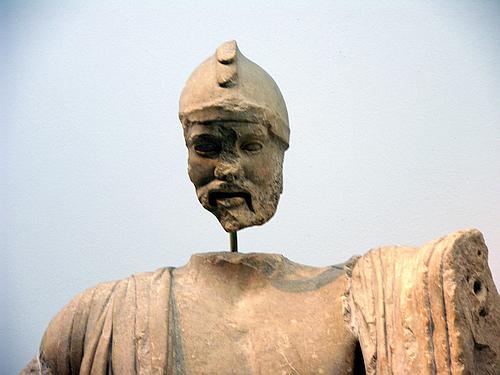
Mythical king of Pisa in Eleia,
Peloponnese. Feeling a passion for his own daughter, Hippodameia, he challenged
her suitors to compete with him in a fixed chariot race in which they all were killed. One of them was
Pelops, who bribed Myrtilos, the charioteer of Oinomaos, to
loosen the lynchpins of Oinomaos' chariot. This then led to the death of Oinomaos in the race.
Oinopion
Mythological son of Dionysos and husband of the nymph Helike, but there are also other tales of his parentage. From Crete he emigrated to Chios, which Rhadamanthys had assigned to him and his sons. There he was visited by Orion, who wanted to marry Oinopion's daughter Merope. When once Orion violated the maiden, Oinopion blinded and banished him. Later, when Orion was cured from his blindness and returned to take revenge, Oinopion was hidden by his friends in the earth.
Okeanid
Okeanids were water deities or sea nymphs, the three thousand daughters of Okeanos and Tethys.
Okeanos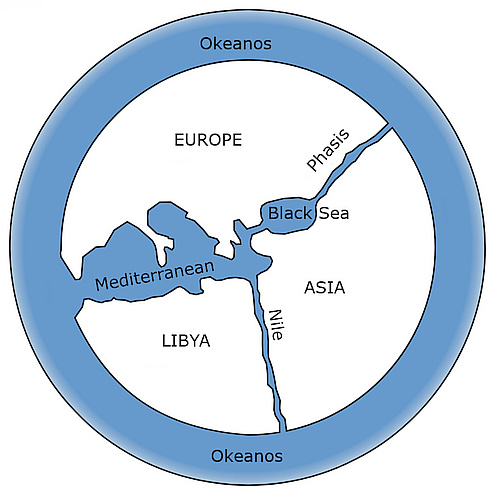
The river which, according to ancient belief, encircles all of the world. Personified, he is seen as
one of the Titans, son of Gaia and
Uranos. According to Hesiod the eldest of the Titans, married to his sister
Tethys by whom he begot father of Thetis,
Eurynome, Perse, many rivers and the Okeanids. His palace was
assumed somewhere in the West, and there Okeanos and Tethys brought up Hera, who was
brought to them during the titanomachy.
Okypete
("Swift-flying") One of the Harpies.
oligarchy
(Greek: oligarkhía = "rule by few) A system of government in which a small group of people has all the power.
Olympia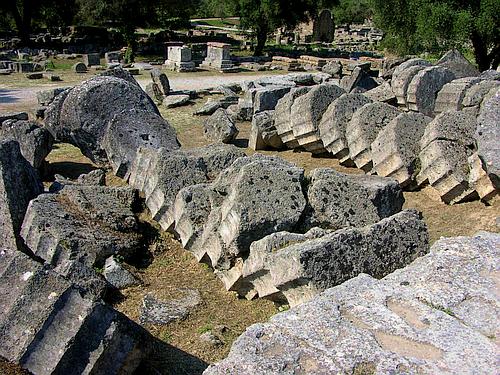
An archaeological site and sanctuary, known as the altis, of ancient
Greece in Eleia on the Peloponnese. Within the
temenos are the Heraion (temple of
Hera), the temple of Zeus, the Pelopeion (the alleged tomb of
Pelops), and the area of the altar. Outside the sanctuary proper are the Prytaneion (housing the officials of the
sanctuary), the Philippeion (celebrating Philip II of Macedon), the treasuries
representing the various city-states, the Metroon, the Echo Stoa, the
hippodrome and stadion, the South Stoa, the
Bouleuterion, the Palaistra, the workshop of
Phidias, the Gymnasium, and the Leonidaion. - The statue
of Zeus in Olympia was one of the Seven Wonders of the ancient world. Olympia is
especially known as site of the Olympic Games in antiquity. - See also:
site page.
Olympian Gods
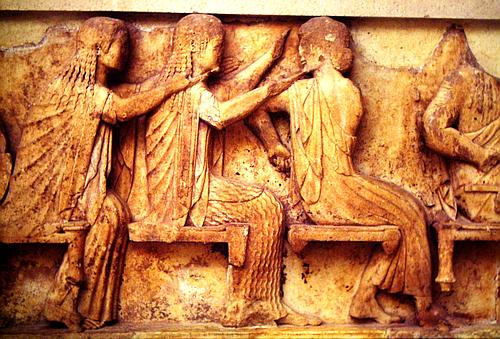
A group of gods who ruled after the titanomachy atop
Olympos, for which they are named. They are children of Kronos and
Thea, the rest are mostly children of Zeus. Originally, twelve
Olympian Gods were known: Zeus, Poseidon,
Hades, Hera, Hestia,
Ares, Athena, Apollo,
Aphrodite, Hermes, Artemis
and Hephaistos. Later, Demeter and
Dionysos were added.
Olympias
Olympias (ca. 375 - 316 BC) was the fourth wife of the king of Macedonia, Philip II, and mother of Alexander the Great. She was a devout member of the orgiastic snake-worshiping cult associated with Dionysos. The 1st century AD biographer, Plutarch, suggested that she even may have slept with snakes. She had extremely much influence on her son, and during Alexander's campaign in Asia, she was the de facto leader of Macedonia. After Alexander's death she fought on behalf of Alexander's son Alexander IV, but in the end was defeated by Kassandros. Since his soldiers refused to execute Olympias, Kassandros had to summon family members of those, whom Olympias had previously killed, to end her life.
Olympic Games
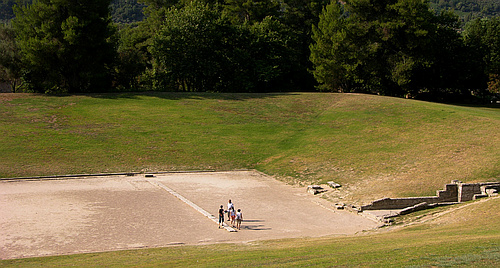
The Olympic Games ("the Olympics") were a series of athletic competitions among representatives of
Greek city-states and one of the panhellenic games of
ancient Greece, where Greeks from all over the Greek world gathered in the sanctuary of Olympia.
The games were celebrated in honour of Zeus and were thought to have a mythological origin.
According to tradition, the first Olympics were held in 776 BC. They were held every four years, or olympiad, which
became a unit of time in historical chronologies. The ancient Olympics had fewer events than the modern games, and only
freeborn Greek men were allowed to participate, although there were victorious female chariot owners. During the
celebration of the games, an Olympic Truce (ekecheria) was enacted so that
athletes could travel from their cities to the games in safety. The prizes for the victors were olive leaf wreaths
(kotinoi), and they were highly honoured in their home cities, their feats chronicled for future generations. The
games were also used as a political tool, finding new alliances and spreading Hellenistic culture throughout the
Mediterranean. -
Olympos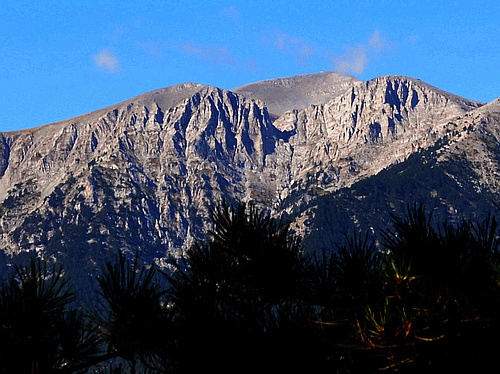
Mountaineous region in Thessaly with mountains up to 2917 m high.
In ancient belief it was the abode of the Olympian Gods after the
titanomachy, where they resided and held court.
omphalos
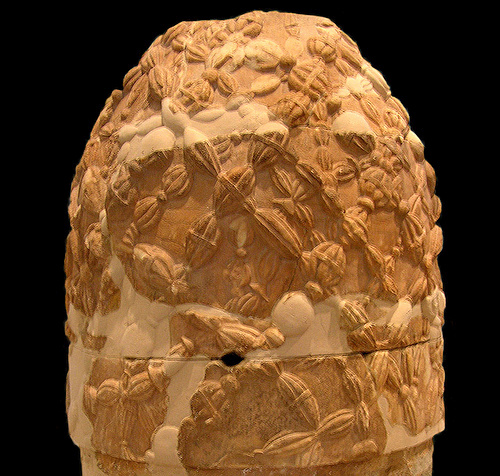
("navel") A religious stone artefact in Delphi that, in ancient belief,
marks the center of the world. The stone sculpture, perhaps a copy of the original one, is decorated with a carving of a
knotted net covering its surface and has a hollow center. - Zeus had two eagles fly from the
two ends of the world. They met above Delphi and thus determined where the center of the world is. - Omphalos stones are
also known from other sites.
Opheltes
1) A son of the Nemean king Lykurgos, and Eurydike. When the "Seven against Thebes" stopped at Nemea to take in water, they met Hypsipyle, the nurse of Opheltes. To show them the way, she left the child alone and it was killed by a snake. The Seven buried the child and instituted the Nemean Games in honour of him.
2) There are two other mythological personages of this name.
Ophion
1) The consort of the Okeanid, Eurynome. He and Eurynome had ruled in Olympos over the Titans, but Kronos and Rhea forced them off the mountain back into the sea.
2) There are two other mythological personages of this name.
opisthodomos
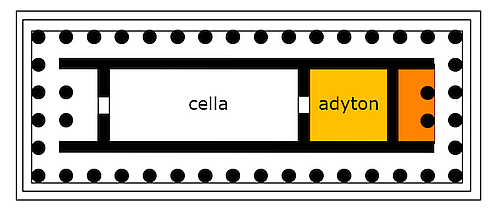
An opisthodomos ("back room") refers to the rear room of an ancient
temple, which may have been used as a treasury. Because of the secrecy of the rites it is not known what exactly
took place in this room. Architecturally, the opisthodomos is the symmetrical counterpart of the
pronaos. - Since ancient sources are somewhat contradictory in this point, opisthodomos
may also refer to the inner shrine, the adyton.
oracle
1) In ancient Greece a sacred place where citizens, through the mediation of a priestess, could ask the gods for advice or a prophecy. The oldest Greek oracle is that of Zeus at Dodona, the most famous was that of Apollo at Delphi.
2) It is also the message that an oracle provided. This could be a prediction or a commandment thought to come from the invoked god, and therefore could guide political decisions or battles. However, the messages were often ambiguous and incomplete. The blind seer Phineus explained this to the Argonauts: "For he [Zeus] himself wishes to deliver to men the utterances of the prophetic art incomplete, in order that they may still have some need to know the will of heaven."
orchestra
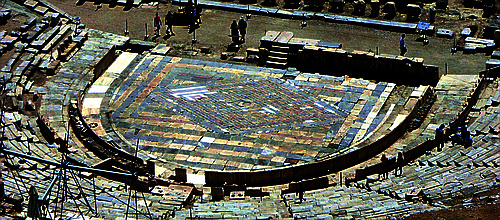
(Greek = "dancing place") The circular, in later constructions semi-circular, space in the center of
an ancient Greek theatre where the chorus performed.
Orchomenos
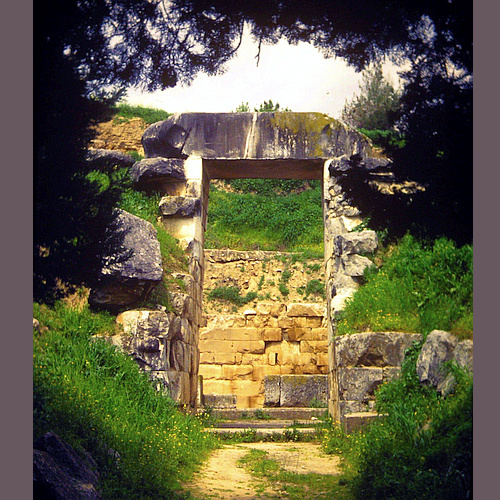
1) An eminent archaeological site in Boeotia, the setting for many
early Greek myths. It was inhabited from the Neolithic through the
Hellenistic periods and is best known for one of the greatest
tholos tombs, the "Treasury of Minyas", dated to the 14th century BC. It was excavated by
Heinrich Schliemann, who attributed it to the legendary king
Minyas. - See also: site
page.
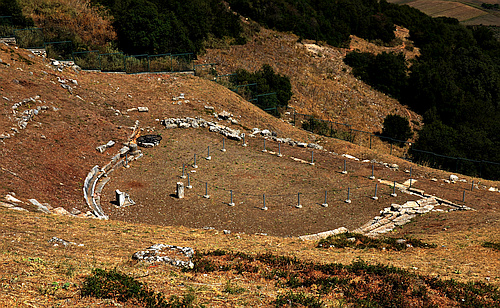 2)
An ancient city of Arcadia, called by Thukydides and
others the "Arcadian Orchomenus", to distinguish it from the Boeotian settlement (see above). Orchomenos was a
prehistoric settlement with important remains of the
Mycenaean period. Its heyday was between the 7th-6th century BC when it became one of the powerful cities in West
Arcadia that minted its own currency. - See also: site
page.
2)
An ancient city of Arcadia, called by Thukydides and
others the "Arcadian Orchomenus", to distinguish it from the Boeotian settlement (see above). Orchomenos was a
prehistoric settlement with important remains of the
Mycenaean period. Its heyday was between the 7th-6th century BC when it became one of the powerful cities in West
Arcadia that minted its own currency. - See also: site
page.
3) A son of Lykaon and the reputed founder of the Arcadian Orchomenos.
4) A son of Athamas and Themisto.
5) A son of Zeus or Eteokles and Hesione, the daughter of Danaos. He was the husband of Hermippe, by whom he became the father of Minyas. He is called a king of Orchomenos (1).
Oreithyia
1) One of the Nereids.
2) A daughter of Erechtheus and Praxithea. One day she was carried off by Boreas, by whom she became the mother of Chione, Kalais, Kleopatra, and Zetes.
3) A nymph of Mount Lebanon.
Orestes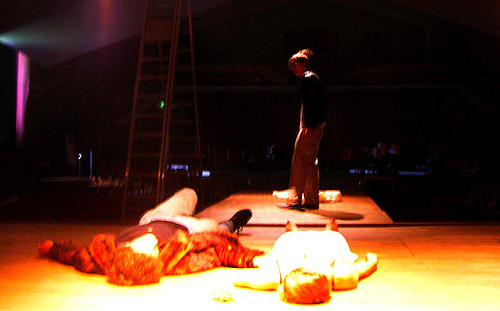
Son of Agamemnon and
Klytaimnestra. Sent away by his mother, he grew up in the house of king Strophios, whose son
Pylades became his close friend. After his father, upon returning from the
Trojan War, had been murdered by Klytaimnestra and her lover
Aigisthos, Orestes, on request of Apollo, returned home
together with his sister Elektra to take revenge, and killed his mother and Aigisthos.
Because of the matricide, Orestes was haunted by the Erinyes and driven to madness.
Athena was called for arbitration, and she applied to to a human court, the
Areopagus in Athens. The jurors were split, so Athena
herself cast the deciding vote in favor of Orestes. - His story was immortalized in the seminal trilogy of the
'Oresteia' by Aischylos.
Orientalizing
period
An art historical period in the Archaic phase of ancient Greek art. It is characterised by a shift starting in the late 8th century BC from the dominant Geometric style to a freer expression, based on heavy influences from the Eastern Mediterranean and Near East, especially Syria. In monumental sculpture the new style is more often called Daedalic.
Orion
A handsome giant and hunter whose parentage is variously reported. Some call him a son of
Poseidon, others a son of Hyrieus, and again others say
that he was born of the earth. Once, when he visited Chios, he fell in love with Merope,
daughter of Oinopion, but Oinopion kept deferring the marriage. Once, when Orion was
drunk and violated Merope, he was blinded by Oinopion and expelled from Chios. Following the advice of an
oracle and with the help of Hephaistos Orion was cured of his blindness. He then
wnt back to Chios to take revenge, but could not find Oinopion, who had been concealed by his friends. The tales about
Orion's end are as conflicting as those of his birth. In most of them Artemis in one way
or another. After his death Orion was placed among the stars as a constellation.
Ormenos
1) A son of Kerkaphos, grandson of Aiolos and father of Amyntor.
2) The name of two Trojans mentioned in the Iliad.
Orpheus
In ancient Greek mythology a semi-divine musician, son of Apollo (or of Oiagros) and the muse Kalliope. According to tradition, he was brought up by the muses, who taught him singing, and Apollo taught him the lyre. He then had the ability to charm all living things and even stones with his music. He was one of the Argonauts and tried to retrieve his wife Eurydike from the underworld. When the mainades got tired of his mourning for Eurydike, they tore him to pieces.
Orthos
In ancient Greek mythology, the two-headed dog of Geryon. He was the oldest offspring of Echidna and Typhon; the other monsters were Kerberos and the Hydra. Together with his mother, Orthos fathered the Sphinx and the Nemean Lion. Orthos was slain by Herakles during his Tenth Labor.
orthostat
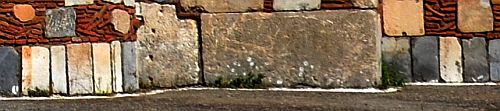
An upright slab used with others to face the lower section of a wall. Orthostats usually had the
height of two or three of the horizontal courses of the wall.
Ortygia
A small island which is the historical centre of the city of Syracuse, Sicily.
ostracism
Ostracism, or ostrakismos, was a procedure in the Athenian democracy in which any citizen could be expelled from the city-state of Athens for ten years. It was used as a way of neutralizing someone thought to be a potential tyrant or a threat to the state or to resolve a political stalemate. - Each year the Athenians were asked in the assembly whether they wished to hold an ostracism. If they voted "yes", an ostracism would be held two months later in a section of the agora. The citizens then scratched the name of those they wished to be ostracised on a pottery shard, the ostrakon, and deposited it in an urn. (Since most of them were illiterate, they could also give the name to a scribe.) The presiding officials counted the ostraka and the person who was named most often was banished. It has been called an "honourable exile" because the property of the man banished was not confiscated and he could return after ten years without loss of status. - In a few cases, ostracised persons were recalled earlier ahead of their time in cases of emergency. This included Perikles' father Xanthippus, Aristides 'the Just', and Kimon.
Otto
Otto Friedrich Ludwig von Wittelsbach (1815 - 1867) was the second son of King Ludwig I of Bavaria, and the first modern King of Greece under the Convention of London. - In 1832, at the age of 17, he arrived in Nafplion, the first capital of modern Greece, to ascended the newly created throne. Initially he was welcomed enthusiastically by the Greek people as an end of the previous chaos (Kapodistrias had been assassinated just the year before) and he endeared himself by adopting the Greek national costume and hellenizing his name to "Othon". His government was initially run by a coucil of three Bavarian court officials, whom he dismissed upon reaching his majority. He then ruled as an absolute monarch. Popular heroes, such as Theodoros Kolokotronis and Yannis Makrygiannis, who opposed the Bavarian-dominated regency, were charged with treason, put in jail and sentenced to death (later pardoned under popular pressure). In 1834, the capital was moved from Nafplion to Athens, which at that time had only 4,000-5,000 inhabitants, mainly for historical and sentimental reasons. Greek politics in this era was greatly dependent on the three Great Powers (Great Britain, France, Russia) and their support was crucial for Otto to remain in power. When the demands of his subjects for a constitution grew and mounted in an armed (but bloodless) insurrection, Otto granted a constitution in 1843. He tried to introduce significant reforms to modernize Greece, but throughout his reign he was unable to overcome the poverty and drastic economic problems of the country. In 1862, a coup was launched, setting up a provisional government and the king returned to Bavaria, where he died 1867 in exile.
Ottoman period
For nearly 400 years (1453 - 1829 AD) the Ottoman Empire controlled Greece although they continually struggled with Venice for control. In one of these battle with the Venetians in 1627 a shell struck a gunpowder storage in the Parthenon on the Athenian Acropolis and blew it up. The Ottomans were seen as ruthless subjugators. Although Greeks were given some freedom in the Ottoman Empire, they suffered under the tyranny deriving from malpractices of regional administrative personnel, over which the central government had only remote and incomplete control. On 25 March 1821 the Greeks began their War of Independence and the Ottoman Empire finally fell in 1829.
Ovid
Publius Ovidius Naso (43 BC - AD 17/18), known as Ovid, was a Roman poet in the times of Augustus. Together with Virgil and Horace, he is one of the three canonical poets of Latin literature. He is best known for the Metamorphoses, a 15-book continuous mythological narrative. Although extremely popular, Augustus exiled him for unknown reasons to a remote province on the Black Sea, where he remained until his death.
oxhide ingot
--> ingot
Oxylos
1) According to Apollodorus a son of Ares and Protogeneia.
2) A one-eyed man from Aetolia. He was exiled from his home-country and on his wanderings met Temenos, the son of Aristomachos, who had been told by an oracle to look for a man with three eyes. Oxylos had one eye himself and rode a mule with two eyes, so this met the description. Consequently, Oxylos joined Temenos and his brother Kresphontes in their conquest of the Peloponnese. As a reward for his aid, Oxylos received the fertile land of Eleia as his own.

