
GREECE
 GLOSSARY
| A | B | C | D |
| E | F | G | H |
| I | J | K | L |
| M | N | O | P |
| Q | R | S | T |
| U | V | W | X |
| Y | Z |
2026-01-19
color code:  = mythology;
 = history & culture;
  = geography;
  = archaeology &
architecture
= archaeology &
architecture
 red-figure painting

A style of vase painting used in Greece between ca. 530 and 300
BC. Here, due to firing conditions, the figures appear red on a black background. This style supplanted the
black-figure painting used earlier.
regula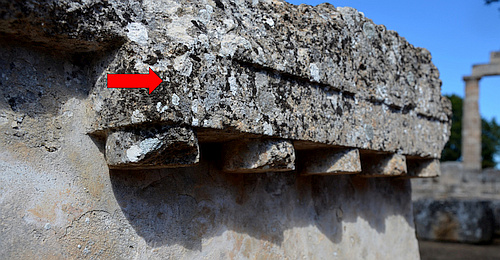
In ancient Greek temple architecture an element with six
guttae at the top of the Doric
architrave. Regulae were always aligned with the
triglyphs above them.
Rhadamanthys
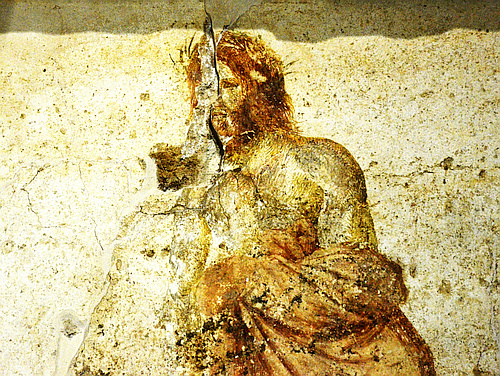
In one mythical tradition a son of Zeus and
Europa and brother of king Minos of Crete. He was married
to Alkmene. Because of his justice throughout his life he became, after his death, one of
the judges in the lower world.
Rhea
One of the most mysterious and complex personages in Greek mythology. According to Hesiod, she was one of the Titanides, daughter of Gaia and Uranos. By Kronos she became the mother of Demeter, Hades, Hera, Hestia, and Zeus. Kronos is said to have devoured all his children by Rhea, but when she was on the point of giving birth to Zeus, Rhea followed an advice of her parents and went to Crete. When Zeus was born she gave to Kronos a stone wrapped up like an infant, and the god swallowed it as he had swallowed his other children. - Rhea, like Demeter, was regarded as a goddess of the earth. Sometimes she was identified with the Phrygian mother of the gods, Kybele, and said to have purified Dionysos, and to have taught him the mysteries. She was also the great goddess of the Eastern world, worshipped there in many forms and names.
rhetoric
(Greek: rhetor = "public speaker") The art of discourse, wherein a speaker (or writer) strives to inform, persuade or motivate a particular audience in specific situations. However, the definition of rhetoric is a controversial subject. Along with grammar and logic, rhetoric is one of the three ancient arts of discourse and has played a central role in the European tradition since the Classical period in Greece. Its best known definition comes from Aristotle, who considers it a counterpart of both logic and politics, and calls it "the faculty of observing in any given case the available means of persuasion."
Roxana
Roxana (ca. 340 - 309 BC) was a Persian princess, whom Alexander the Great married in 327 BC despite the strong opposition from all his companions and generals. After the sudden death of Alexander in Babylon in 327 BC, she bore him a son, named Alexander IV after his father. Antipater brought both of them to Macedonia, where they were protected by Olympias, the mother of Alexander the Great, but in 316 BC Olympias was assassinated. Kassandros, who now controlled Macedonia and sought kingship, had Alexander IV and Roxana imprisoned in the citadel of Amphipolis and secretly poisoned in 309 BC.
rubble masonry

A type of masonry construction that uses stones of irregular shape and size.

