
GREECE
 GLOSSARY
| A | B | C | D |
| E | F | G | H |
| I | J | K | L |
| M | N | O | P |
| Q | R | S | T |
| U | V | W | X |
| Y | Z |
2025-12-08
color code:  = mythology;
 = history & culture;
  = geography;
  = archaeology &
architecture
= archaeology &
architecture
Wace
Alan John Bayard Wace (1879 - 1957) was an English archaeologist, director of the British School at Athens (1914 - 1923), professor at the University of Cambridge and at the Farouk I University in Egypt. He excavated at the sites of Sparta, Mycenae, Troy, Corinth, and Alexandria. Along with Carl Blegen he made important contributions to the decipherment of Linear B tablets.
wanax
An ancient Greek word for "(tribal) king, lord, (military) leader". It is inherited from Mycenaean Greek and is used by Homer to describe the role of Agamemnon in the Trojan War. For other Greek leaders Homer uses the term basileus. This is usually rendered as "king", just like wanax, but a better translation would be "prince" or "chieftain". When Agamemnon gives orders to the basileis they are not to be obeyed automatically. Rather, the wanax in Mycenaean Greece is expected to rule over the other basileis by consensus rather than by coercion. When Agamemnon offends this tradition, Achilles feels treated unjustly and revolts - the central theme of the Iliad.
War of Independence
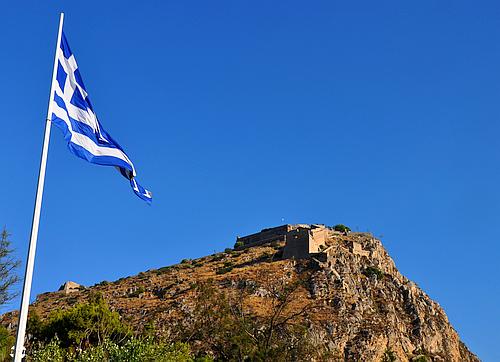
On 25 March 1821, Greek revolutionaries started the uprising against the
Ottoman empire, a war that lasted until 1827 and led to the formation of modern Greece. - All Greek regions, with
very few exceptions, came under Ottoman rule in the 15th century. Kindled by the French Revolution of 1798 and ideas of
the European Enlightenment, Greek nationalism grew and in 1814 the secret Filiki Eteria ("Friendly Society") was
founded in Odessa (although their original objective was not the formation of a national state). In Europe, there was
tremendous sympathy for the Greek cause, and some philhellenes like the renowned poet Lord
Byron and the American physician Samuel Howe even took up arms to join the Greek revolutionaries. After the fights
had begun by the Maniots in the Peloponnese, the Greeks under the leadership of
Theodoros Kolokotronis captured Tripolis. The Ottoman sultan called on Egypt for
assistance, and by the end of 1825 Ibrahim Pasha had brought most of the Peloponnese under Egyptian control. Now the
three great powers - Russia, Britain, and France - intervened, sending their naval forces to Greece. In 1827 they
destroyed the Ottoman-Egyptian fleet at the Battle of Navarino, and Greece declared its
independence with Ioannis Kapodistrias as its first head of state. In the London
Protocol of 1830, France, Russia, and Great Britain recognized Greece as a fully sovereign and independent state. In the
aftermath, the assasination of Kapodistrias resulted in a power vacuum so that Britain, France, and Russia stepped in
and declared the new country a monarchy and placed 17 year old
Prince Otto of Bavaria on the throne. - In modern Greece, the War of Independence is still fresh in the collective
mind and the independence day on 25 March is celebrated by Greeks all over the world.
white-ground painting
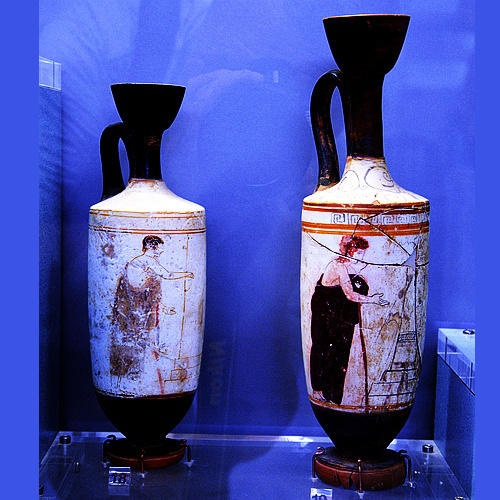
A style of vase painting used in Greece where the figures are
rendered on a white background. It appears in Attica around 500 BC. This technique allowed
more artistic freedom than the black-figure or
red-figure painting, but has a more fragile surface. It was therefore not suitable for vases in everyday use and
mainly used for ritual and funerary ceramics.
Wooden Horse
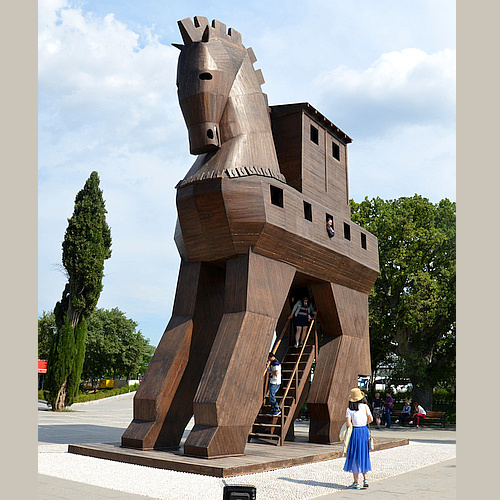
After ten years of an unsuccessful siege of Troy,
Odysseus devised the plan to build a large hollow wooden horse in which a small group of
warriors could be concealed. Epaios manufactured this horse which was left on the shore
when the other Greeks apparently sailed home. Despite the warnings of Kassandra and
Laokoon, the Trojans pulled it into the city walls. At night the Greeks returned; their
companions crept out of the horse and opened the city gates, and Troy was doomed. - The
photo shows a modern tourist versiob set up at Troy.

