
GREECE
 GLOSSARY
| A | B | C | D |
| E | F | G | H |
| I | J | K | L |
| M | N | O | P |
| Q | R | S | T |
| U | V | W | X |
| Y | Z |
2025-06-06
color code:  = mythology;
 = history & culture;
  = geography;
  = archaeology &
architecture
= archaeology &
architecture
vase painting
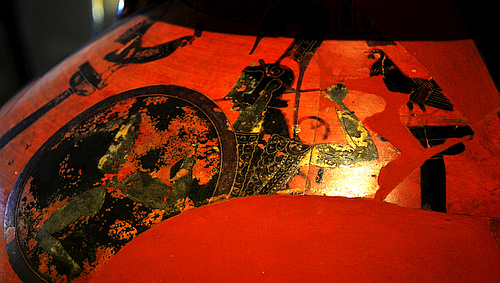
Finely painted vessels of all sorts are called "vases", and since more than 100,000 of these have
survived they form an important basis for our understanding of ancient Greece. Artistically, vase painting is also of
vital interest since nothing of the famed Greek panel painting is extant. - The distinctive style of Greek vase-painting
is characterised by strong outlines of the depicted figures, with thin lines within showing the details. The culmination
of this art was between 600 and 350 BC, when two main variations have evolved: the
black-figure and the red-figure painting, the other colour forming the background
in each case. Other colours were very limited, sometimes small areas of white are applied or areas with a different red.
A third style is the white-ground technique, which allowed more artistic freedom but
was less durable and therefore mostly limited to burial purposes. - Painted pottery was affordable even for ordinary
people, and a piece "decently decorated with about five or six figures cost about two or three days' wages". In earlier
periods even small Greek cities produced pottery of their own local colour, but in the later
Archaic and early Classical period two centers dominated the market:
Corinth and Athens. Their pottery was exported all over the
Greek world, and by the 5th century BC it became a mass-industry and pottery painting ceased to be an important art
form. - Greek pottery is frequently signed, sometimes by the potter or the master of the pottery, but only occasionally
by the painter.
Ventris
Michael George Francis Ventris (1922 - 1956) was an English linguist and architect. Since his time as student of languages he devoted himself to the decipherment of ancient script. Based on the work of Alice Kober and with some inspired guesses he, along with John Chadwick, deciphered Linear B in 1952. A few weeks before the publication of his ground-breaking work Documents in Mycenaean Greek Ventris died in a car accident.
Virgil
Publius Vergilius Maro (70 BC - 19 BC), usually called Virgil or Vergil, was one of ancient Rome's greatest poets. He is the author of three major works of Latin literature: the Eclogues (or Bucolics), the Georgics, and especially the national epic of ancient Rome, the Aeneid. - In Dante's Divine Comedy, Virgil appears as Dante's guide through hell and purgatory.
Vitruvius
Marcus Vitruvius Pollio (born c. 80-70 BC, died after c. 15 BC), commonly known as Vitruvius, was a Roman author, architect and engineer, especially known for his multi-volume work De architectura.
Voiotia
--> Boeotia
volute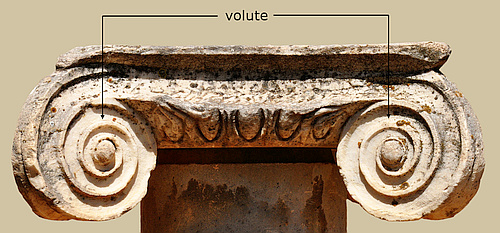
A spiral, scroll-like ornament that is the central feature of an
Ionic capital.

