
GREECE
 GLOSSARY
| A | B | C | D |
| E | F | G | H |
| I | J | K | L |
| M | N | O | P |
| Q | R | S | T |
| U | V | W | X |
| Y | Z |
2026-01-11
color code:  = mythology;
 = history & culture;
  = geography;
  = archaeology &
architecture
= archaeology &
architecture
jamb
A base, usually made of stone, for a door frame.
 jar
jar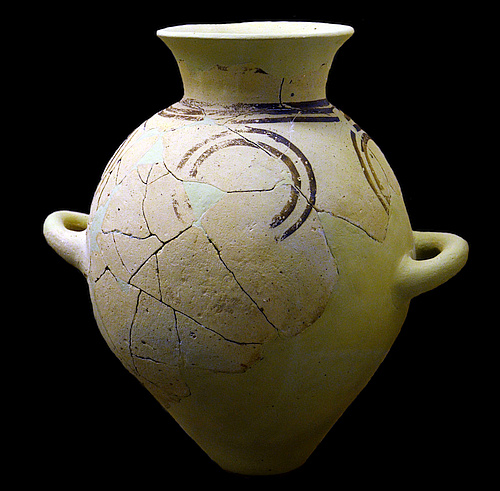
A vessel whose height is greater than the diameter of the mouth.
Jason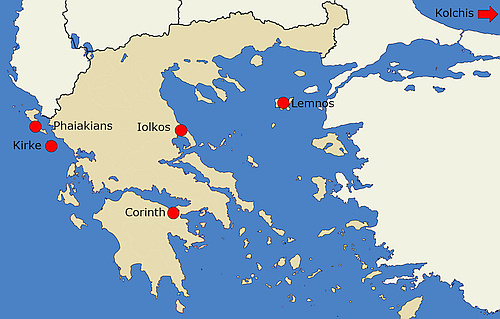
Son of Aison and Alkimede; great-grandson of
Minyas. After Pelias had cheated his father and usurped the throne of
Iolkos, Jason was put in the care of the centaur
Cheiron. Years later, when Jason was a young man, he helped
Hera, who was disguised as an old woman, across a surging river, and thereby earned the eternal protection of the
goddess. Meanwhile Pelias had received an oracle that he would lose his reign to a youth arriving on one sandal. So,
when Jason, who had lost one sandal in the river, arrived at the palace of Iolkos and demanded his father's inheritance,
Pelias thought of a way to escape his doom. Therefore he sent Jason on the seemingly hopeless quest to retrieve the
Golden Fleece, which was kept by king Aietes in
far-off Kolchis at the Black Sea. Athena now helped with
the construction of an appropriate ship, the Argo, and Jason gathered the most illustrious
group of heroes ever assembled in the ancient world, the Argonauts. On their dangerous
voyage they first landed on the island of Lemnos and were delighted that it was only inhabited by women, not knowing
that they had killed all the males. The Argonauts remained on Lemnos for two summers and two winters, and during that
time, Jason fathered two children by the princess Hypsipyle. After more adventures, the
Argonauts finally reached Kolchis, where Jason asked king Aietes for the Golden Fleece. Not willing to give this away,
he demanded of Jason, to first fight two fire-breathing, brass-footed bulls, Khalkotauroi, who sowed the teeth of a
dragon, from which arouse more fighters. Jason survive this only with the help of Medea,
the witch-crafted daughter of Aietes. She joined the Argonauts on their escape from Kolchis with the Golden Fleece, and
killed her half-brother Absyrtos to delay the pursuit. On their further voyage, they
were first welcomed by Medea's niece Kirke, but had to proceed to the island of the
Phaiakians. When Jason and Medea finally reached Iolkos with the Golden Fleece, they
learned that king Pelias was responsible for the death of Jason's father Aison. Medea then caused Pelias to be killed by
his own daughters, but Jason and Medea had to flee to Corinth, where king
Kreon welcomed them. Many years and two children later, Jason fell in love with Kreon's
daughter Glauke. Raging Medea was cruel: she killed Kreon, Glauke, even her own children,
and fled to Athens. It is not known what happened with Jason after this.
Judgement of Paris
All the Olympian Gods were invited to the wedding of Peleus and Thetis, but not Eris, the goddess of discord. In anger, she threw a golden apple with the inscription "to the fairest" into the midst of the party. Three powerful goddesses - Hera, Athena and Aphrodite - each claimed to be the fairest and wanted the prize, so that Zeus ordered the Trojan prince Paris to be the judge of the dispute. To bribe Paris, Hera offered to make him king of Europe and Asia, Athena offered wisdom and skill in war, and Aphrodite promised him the world's most beautiful woman. Paris chose Aphrodite and gave her the apple. To Paris, the fairest mortal was Helena, the wife of king Menelaos of Sparta. When Paris kidnapped her (or perhaps she came willingly), this was the mythological basis of the Trojan War.
jug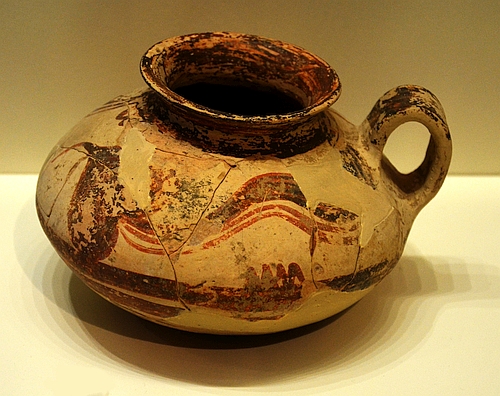
A type of vessel used to hold and serve liquids, but not normally to drink from directly. It has a
handle, an opening, sometimes narrow, from which to pour, sometimes with a pouring lip.
Justinian
Justinian I (Latin: Flavius Petrus Sabbatius Iustinianus Augustus; ca. 482 - 565 AD), traditionally known as Justinian the Great, was an East Roman emperor. During his reign from 527 to 565 AD he sought to revive the empire's greatness and reconquer the lost western half of the historical Roman Empire. This "restoration of the Empire" was only partially successful, but he was convicted that the unity of the Empire presupposed unity of faith, i.e. the orthodox christianity. Those of a different belief were subjected to persecution, and paganism even in private life was relentlessly persecuted.

