
GREECE
 GLOSSARY
| A | B | C | D |
| E | F | G | H |
| I | J | K | L |
| M | N | O | P |
| Q | R | S | T |
| U | V | W | X |
| Y | Z |
2026-01-04
color code:  = mythology;
 = history & culture;
  = geography;
  = archaeology &
architecture
= archaeology &
architecture
façade
One of the exterior walls (faces) of a building.
faience
Fine tin-glazed pottery. The white pottery glaze suitable for painted decoration requires a kiln that produces temperatures exceeding 1000°C. Such pottery was produced in the Middle East at least since the 9th century.
Fates
--> Moirai
festoon
A chain or garland of flowers and leaves, suspended in a curved form between two points. It is also
applied to a relief representation of such a garland.
fibula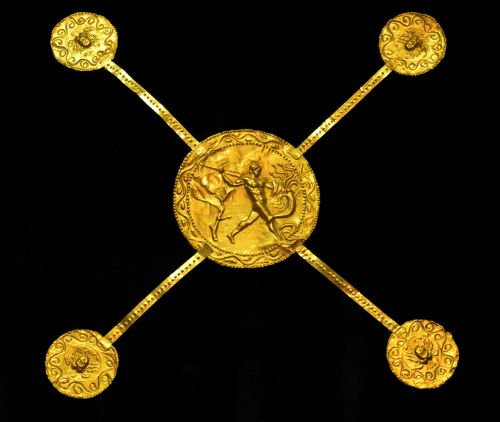
A brooch or pin for fastening garments. The Latin term, fibulae, originally refers to Roman
brooches; however, it is generally used for brooches from the entire ancient world. They come in a variety of shapes,
but all were based on the principle of the safety-pin.
fieldstone

A stone used for construction in its natural shape.
figure-of-eight shield
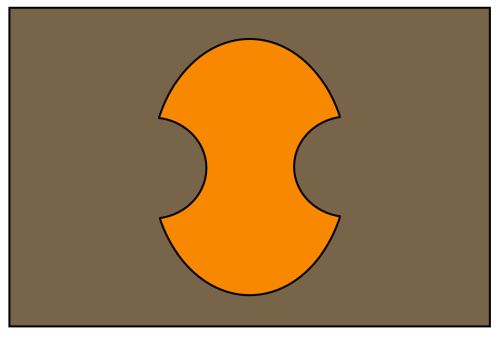
A form of Mycenaean shields that came into use with the introduction
of bronze armor. They were made of several layers of bull-hide, sometimes reinforced with bronze plates, and widely
replaced the earlier "tower shields" that covered almost the entire body.
figurine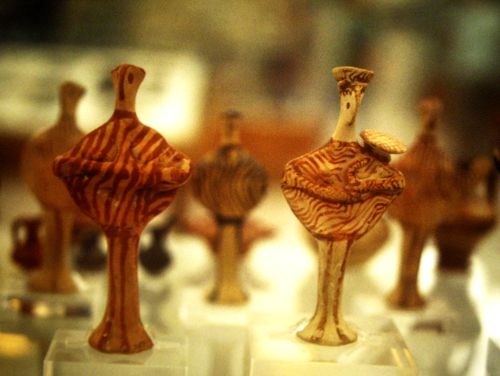
A small anthropomorphic or zoomorphic statuette of various materials (clay, stone, bone, shell, metal
etc.). Especially noteworthy are the Neolithic,
Cycladic, and Mycenaean figurines.
Filiki Eteria
The Filiki Eteria, "Society of Friends", was a secret organization, formed on 14 September 1814, to overthrow the Ottoman rule of Greece and establish an independent Greek state. Members were mainly young Greeks from Russia, Serbia, and local chieftains from Greece, Alexandros Ypsilantis being one of their leaders. The Society initiated the Greek War of Independence in the spring of 1821.
fillet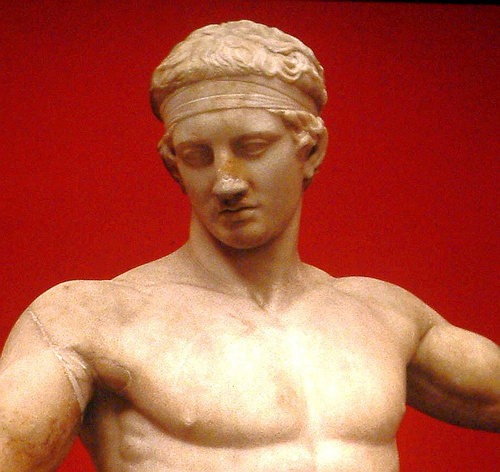
In classical Greece a narrow head-band of cloth or leather. They were especially worn by athletes,
seen on depictions of victors at athletic games. But such head-bands could also be worn by women in ancient Greece to
tie up their hair.
flint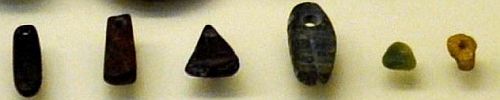
A variety of hard stone, used in the Neolithic period for tools, spearheads and ornaments.
flute
Vertical indentations that were used in all columns of classical Greek
architecture. Doric columns have about 20 flutes with sharp blendings, whereas
Ionic columns have 24 flutes separated by flat ridges.
Fokis
--> Phokis
folded-arms figurine
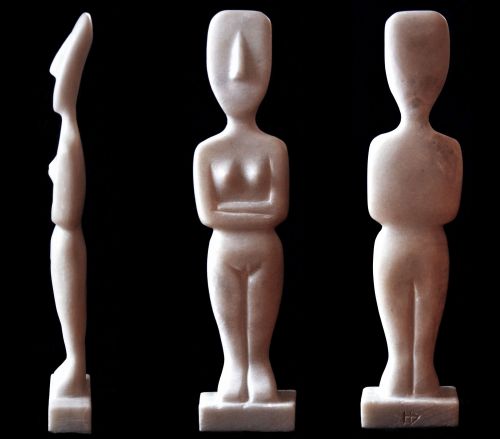
A variety of highly stylized marble idols in
Early Cycladic culture with arms folded across the chest, the right arm always below the left, and short legs (here
my modern reproduction). They are small and flat, highly prone to breakage due to their delicate build.
fresco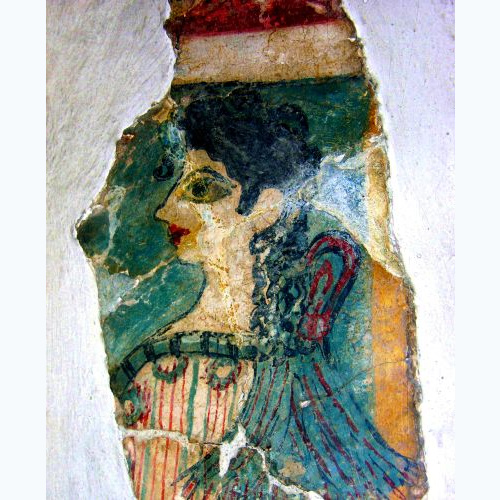
Wall painting applied to plaster when it is wet. Frescoes were popular all around the Mediterranean
already in the Bronze Age civilisations.
frieze
In Greek temple architecture, the decorative band above the
architrave. In the Doric Order, the frieze consists
of alternating triglyphs and metopes; the
Ionic frieze is either unadorned or has a continuous decoration with sculptures.
frying pan
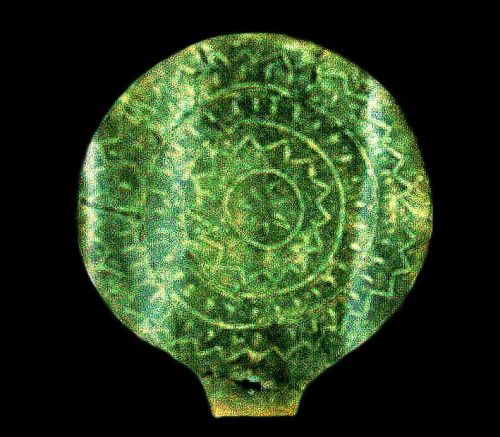
Among Cycladic pottery the so-called "frying pans" are
remarkable and mysterious. They first emerged on the island of Syros in the Early Cycladic
II period, but lacking written records its useage is utterly unclear. They were very probably not used for cooking,
but could have been some sort of talisman or, filled with water, as a mirror.
Fthiotis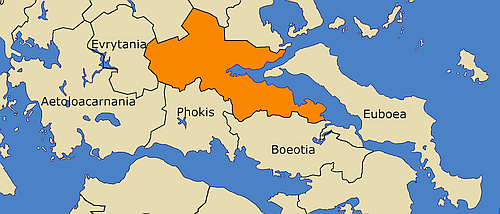
One of the regional units of Greece, part of the administrative region of Central Greece. The capital
is the city of Lamia. It is best known as the homeland of Achilles.
funerary monument
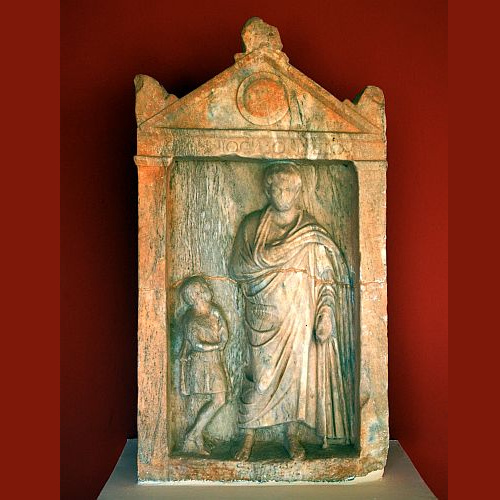
A funerary monument in ancient Greece could be a vase, a sculpture or an architectural element set up
on the grave as a marker and to perpetuate the memory of the dead buried there.
Furtwängler
Adolf Furtwängler (1853 - 1907) was a German archaeologist. He conducted excavations in Aegina and Orchomenos. His son was the conductor Wilhelm Furtwängler.

