
GREECE
 GLOSSARY
| A | B | C | D |
| E | F | G | H |
| I | J | K | L |
| M | N | O | P |
| Q | R | S | T |
| U | V | W | X |
| Y | Z |
2026-01-16
color code:  = mythology;
 = history & culture;
  = geography;
  = archaeology &
architecture
= archaeology &
architecture
 Xanthippe
1) Xanthippe (5th century - 4th century BC) was an Athenian, the wife of Sokrates and mother of their three sons. Probably she was much younger than Sokrates, perhaps by as much as 40 years. In his Phaedo, Plato describes her as devoted wife and mother. Xenophon, in his Memorabilia, portrays her in much the same light, but also mentions her harshness. Only in Xenophon's Symposium we have Sokrates agree that she is "the hardest to get along with of all the women there are."
2) In mythology, daughter of Doros. She was the wife of Pleuron and became by him mother of Agenor, Sterope, Stratonike and Laophonte.
3) An Amazon.
Xeniades
1) A Greek philosopher from Corinth who lived around 400 BC. Although little is known about his life, he obviously held a most ultrasceptical opinions, maintaining that all notions are false, and that there is absolutely nothing true in the universe.
2) A Corinthian who lived ca. 350 BC. When the philosopher Diogenes of Sinope was captured by pirates and sold as a slave, Xeniades bought him. Diogenes commented: "You must obey me, although I am a slave, for a physician or a steersman would find men to obey them even though they might be slaves." In the following, Diogenes educated Xeniades' sons.
Xenodoros
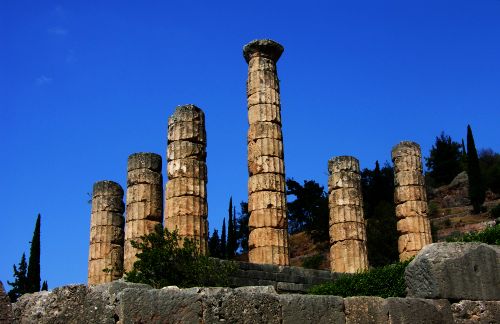
An ancient Greek architect (fl. 4th century BC). Together with Agathon
he constructed the temple of Apollo at Delphi.
Xenokrates
Xenokrates of Chalkedon (ca. 396/5 - 314/3 BC) was a Greek philosopher, mathematician, and leader (scholarch) of the Platonic Academy from 339/8 to 314/3 BC. In his teachings, he followed Plato, attempting more clarification, often with mathematical aspects. Unlike Plato, he held that mathematical objects and the Platonic Ideas are identical. He distinguished three forms of being, the sensible, the intelligible, and a third compounded of the two. These would correspond sense, intellect and opinion.
Xenophanes
Xenophanes of Kolophon (ca. 570 - ca. 475 BC) was a Greek philosopher, theologian, and poet, who lived a life of travel in the Greek world. Judging from quotations of his works by later Greek writers, he criticized and satirized a wide range of ideas, including Homer and Hesiod, the belief in the pantheon of gods and the Greeks' veneration of athleticism.
Xenophon
Xenophon of Athens (ca. 430 - 354 BC) was an ancient Greek philosopher, historian, soldier and mercenary, and a student of Sokrates. As an historian, his Hellenica about the final seven years and the aftermath of the Peloponnesian War is a thematic continuation of the History of the Peloponnesian War by Thukydides. - He is an authority on Sokrates, about whom he wrote the dialogue Apology of Sokrates to the Jury, which recounts the trial of Sokrates (399 BC). - Despite being an Athenian, Xenophon was also associated with Sparta, propagated pro-oligarchic politics and was a friend of the Spartan king Agesilaos II.
Xerxes I
Xerxes I ("ruling over heroes"; 518 - 465 BC), called Xerxes the Great, was the fourth king of the Achaemenid dynasty of Persia. He ruled from 486 BC until 465 BC, when he was assassinated by Artabanus, the commander of the royal bodyguard. At this time the Persian empire reached its greatest extent. In Western history he is noted for the second invasion of Greece in 480 BC. His troops conquered all of mainland Greece north of the Isthmus of Corinth but were decisively defeated in the Battle of Salamis and in the following year at Plataiai.
Xerxes II
The only legitimate son of Artaxerxes I and his successor on the Persian throne. In 424 BC, after a reign of only forty-five days, he was assassinated by his brother Sogdianus, who in turn was murdered by Darius II.
 xoanon
(Greek: xeein = to carve or scrape [wood]) In archaic Greece a wooden cult image, later often associated with the legendary Daidalos. Pausanias decribed many of the xoana in his Description of Greece, but only a few have survived as copies in stone or marble.
Xuthos
A son of Hellen by the nymph Orseis, and a brother of Doros and Aiolos. He was the husband of Kreusa, the daughter of Erechtheus, by whom he became the father of Achaios and Ion.

