
GREECE
 GLOSSARY
| A | B | C | D |
| E | F | G | H |
| I | J | K | L |
| M | N | O | P |
| Q | R | S | T |
| U | V | W | X |
| Y | Z |
2026-01-11
color code:  = mythology;
 = history & culture;
  = geography;
  = archaeology &
architecture
= archaeology &
architecture
iambus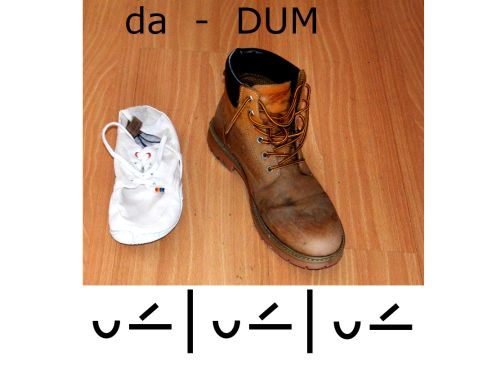
1) An iambus is a metrical foot used in various types of poetry. It consists of a short syllable followed by a long syllable (as in the English word "delay").
2) Iambic poetry was a genre of ancient Greek poetry that included but was not restricted to the
iambic meter and was originally related to the cults of Demeter and
Dionysos. Its characteristics were an insulting and obscene language, sometimes referred
to as "blame poetry". Its most famous early exponents were the Archaic Greek poets
Archilochos, Semonides and
Hipponax.
Iamos
Pindar relates that Euadne became by Apollo the mother of a boy, and when she deserted him for shame, he was fed with honey by two serpents. The Delphic oracle predicted that the boy would be a celebrated prophet, and the ancestor of a great family of prophets. When Iamos had grown up, he descended by night into the waters of the river Alpheios, and invoked Poseidon and Apollo, that they might reveal to him his destination. Apollo led him to Olympia, where he gave him the power to foretell the future from the sacrifices burning on the altars of Zeus, as soon as Herakles should have founded the Olympic games.
Iapetos
1) A Titan, son of Gaia and Uranos. Who his wife was is variously given in the accounts, but authors agree that was the father of Atlas, Prometheus, Epimetheus, and Menoitios. According to Homer Iapetos is imprisoned with Kronos in tartaros. Being the father of Prometheus, the ancient Greeks regarded Iapetos as the ancestor of the human race.
2) Pausanias mentions another mythical personage of this name.
Iasos
1) A son of Phoroneus, and brother of Pelasgos and Agenor.
2) A son of Argos and Euadne, a daughter of Strymon, or a son of Peitho.
3) A son of Argos Panoptes and Ismene, the daughter of Asopos, and the father of Io.
4) A son of Triopas, and brother of Agenor. The same person as 3), but with a different ancestry.
5) A son of Io.
6) An Arcadian, a son of Lykurgos and Kleophile or Eurynome, a brother of Ankaios and Amphidamas, and the husband of Klymene, the daughter of Minyas, by whom he became the father of Atalante. At the legendary first Olympic games, Iasos won the prize in the horse-race.
7) The father of Amphion, and king of the Minyans.
8) There are three other mythical personages of this name.
Ibykos
A Greek poet (fl. ca. 540 BC) of Choral Lyric who served at the court of Polykrates on the island of Samos. Probably nothing of his work survives.
icon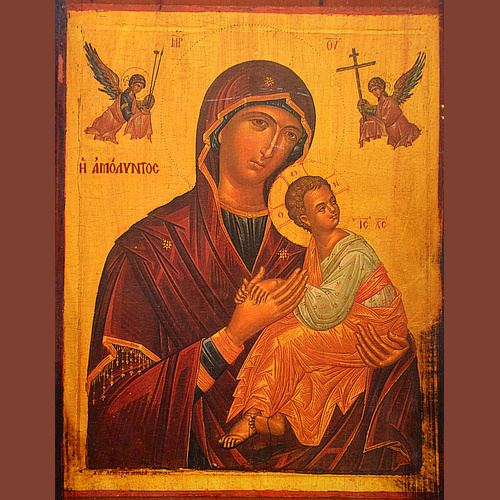
A religious picture painted in oil on a small wooden panel. They are venerated in the Greek Orthodox
religion.
 iconostasis
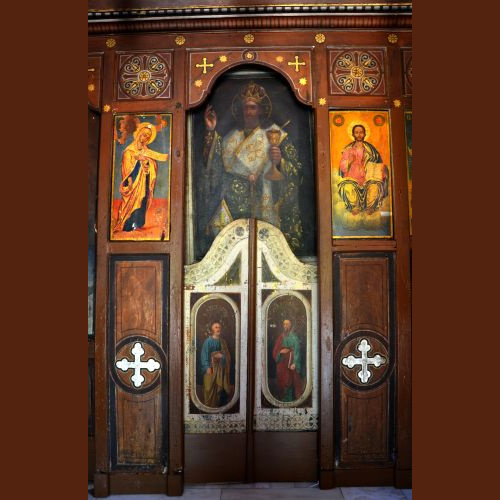
An iconostasis initially was a small wall in a church or basilica
that served as a symbolic marker of the division between the sanctuary and the nave, i.e.
between heaven and earth. Later it was an altar screen embellished with icons running across the
entire end of a church.
 Idaion Andron
A cave on the east slope of the Ida mountain range on Crete, where, according to tradition, Zeus is believed to have been born and brought up. - Another putative site of the birth of Zeus is the Psychro cave.
Idas
1) A son of Aphareus, whence he and his brother Lynkeus are called Apharetides, or Aphareidae. He was married to Marpessa, and became by her the father of Kleopatra. They called their daughter also Alkyone because Marpessa was once carried off by Apollo, and lamented over the separation from her beloved husband like Alkyone had once wept about Keyx. When Idas and Apollo fought over the possession of Marpessa, Zeus intervened and left the choice to Marpessa. She chose Idas, fearing that Apollo would desert her when she grew old. - The two brothers, Idas and Lynkeus, also took part in the Kalydonian Hunt, and in the expedition of the Argonauts. Best known is their fight with the Dioskouroi, with whom they had grown up from their childhood. Together they had carried off some herds from Arcadia, and when the booty was to be distributed, a deadly fight broke out, in the course of which Zeus struck Idas with a flash of lightning.
2) A person who was killed by Phineus at the wedding of Perseus.
3) A son of Aigyptos, who was married to Hippodike.
4) One of the companions of Diomedes, whom the incensed Aphrodite changed into birds.
Idmon
1) A son of Apollo and Asteria (other personages are also named as his mother), and from his father he had the gifts of prophecy and healing, and was therefore widely worshipped in Greece. He joined the expedition of the Argonauts as one of their soothsayers, although he knew beforehand that death awaited him. During the journey, he was killed by a boar, or a serpent. In other traditions, he died of a disease.
2) There are three other mythical personages of this name.
idol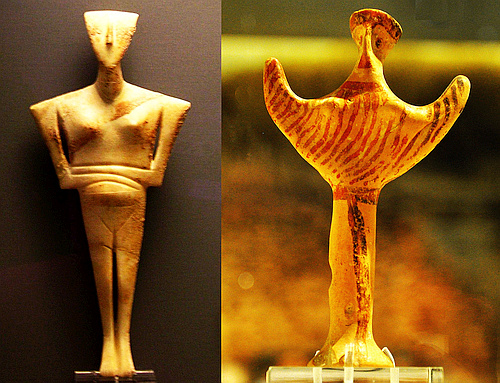
A cult image of the Aegean Bronze Age that is itself worshipped. It
depicts or represents a deity or spirit, and on the other hand is one itself. Best known are the idols of the
Cycladic culture and those of the Mycenaean
civilization. Lacking written traditions, their religious function is still unclear.
Idomeneus
1) A son of Deukalion, and grandson of Minos and Pasiphaë. He is described as a man of extraordinary beauty and was one of the suitors of Helena. Together with Meriones, the son of his half-brother Molos, he led the Cretans in 80 ships against Troy. According to Philostratos, he even offered Agamemnon to come with 100 Cretan ships if he would share the supreme command with him. In the Trojan War, Idomeneus was a distinguished hero, offered to fight with Hektor and slew several Trojans in the battle near the ships. After the sack of Troy, he returned home safely according to one tradition. In later traditions he is said to have come into a terrible storm and to have vowed to Poseidon to sacrifice to him whatever he should meet first on his safe landing. The first person he then met on the shore was his own son. He sacrificed him, whereupon Crete was afflicted with a plague and Idomeneus was expelled.
2) A son of Priam.
Idyia
The "knowing goddess", a daughter of Okeanos and Tethys, and the wife of king Aietes of Kolchis.
Ikarios
1) An Athenian, who lived during the reign of Pandion. When Dionysos arrived in Attica, he was hospitably received by Ikarios and the god showed his gratitude by teaching him the cultivation of the vine, and giving him bags filled with wine. Ikarios then gladly distributed the gifts from the god; but some shepherds found their friends drunk from the wine, thought that they had been poisoned, killed Ikarios and buried his body under a tree. Erigone, Ikarios' daughter by Phanothea, searched him and in the end found his grave with the help of Ikarios' faithful dog Maira. She then hung herself on the tree under which he was buried. - Zeus (or Dionysos) placed the three among the stars: Ikarios as the constellation Boötes (or its brightest star Arkturus), Erigone as the constellation Virgin (Virgo), and Maira as the constellation Canis Major (or its brightest star, the dog-star Sirius).
2) A Lakedaimonian, a son of Perieres and Gorgophone (but other ancestries are also named). When Hippokoon, a natural son of Oibalos, expelled his step-brothers, Tyndareos and Ikarios, from Lakedaimonia, they fled to Thestios. After Herakles had slain Hippokoon and his sons, Tyndareos returned to Sparta, while Ikarios remained in Akarnania. There he became the father of Penelope, Alyzeus, and Leukadios, by Polykaste. When his daughter Penelope had grown up, he promised her hand to the victor in a foot-race, and Odysseus won the prize.
Ikarus
A son of Daidalos. For their flight from Crete, Daidalos attached to his body wings made of feathers and wax, and advised him not to fly too high. Ikarus ignored the warning, flew too near to the sun so that the sun melted the wax and he drowned in the sea. - The fable of the wings of Ikarus was interpreted in antiquity as the invention of sails; in fact some traditions stated that Daidalos and Ikarus fled from Crete in a ship.
ikria
Ikria (Greek: "bench") was the temporary seating for the audience in early Greek theatres. It consisted of wooden planks on top of uright timbers and was later replaced by the permanent stone seating of the cavea.
Iktinos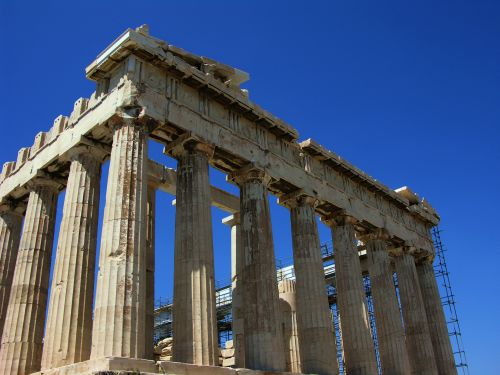
Iktinos (fl. 5th century BC) was an ancient Greek architect. Ancient sources identify him and
Kallikrates as co-architects of the Parthenon.
According to Pausanias he was also the architect of the temple of
Apollo at Bassae. Other sources also mention him as the architect of the gigastic
Telesterion at Eleusis.
Iliad
An ancient Greek epic poem, together with the Odyssey attributed to Homer, and counted among the oldest extant works of Western literature. It is divided into 24 books, written in dactylic hexameter and containing 15,693 lines. Composed in Homeric Greek, a literary amalgam of Ionic Greek and other dialects, it was written down around the late 8th or early 7th century BC. - The Iliad is set during the Trojan War, the ten-year siege of the city of Troy ("Ilion") by the "Achaeans", a coalition of Mycenaean Greek city-states. It tells of the events and battles of a few weeks in the last year of the siege, centered around the anger of Achilles from a fierce quarrel between him and King Agamemnon. It follows the events until the death of the Trojan prince Hektor, moving between wide battleground scenes and more personal interactions. - The Iliad is a central part of the Epic Cycle.
Ilion
The name of the city of Troy most commonly used in the Iliad.
Iliou persis
The Iliou persis ("Sack of Ilium", or "The Sack of Troy") is a lost epic of ancient Greek literature, part of the Epic Cycle that relates the story of the Trojan War. Chronologically, the story of the Iliou persis comes after that of the Little Iliad, and is followed by that of the Nostoi.
Illyria
In classical antiquity the western part of the Balkan Peninsula, roughly corresponding to Yugoslavia of modern times.
Ilos
A son of Tros, and grandson of Erichthonios. In mythological tradition he was believed to be the founder of Troy (Ilion).
Inachos
A river god and most ancient mythical king and priest of Argos. He is described as a son of Okeanos and Tethys, and father of Phoroneus and Aigialeus. - It is said, that in the dispute between Poseidon and Hera about the possession of Argos, Inachos decided in favour of Hera. And in an Argive tradition, Inachos led the Argives after the flood of Deukalion from the mountains into the plains.
ingot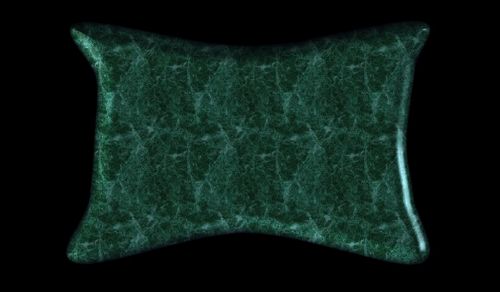
A plate of metal cast in a mold, sometimes in the shape of an 'oxhide'. Such 'oxhide ingots', 20 - 30
kg slabs usually of copper, were widely produced and distributed in the Mediterranean between ca. 1600 BC and ca. 1000
BC. Their actual pupose remains unclear. Often considered as a sort of currency, but this is questioned because their
weight was not standardized. Perhaps they were just meant to be used as raw material.
inhumation
The practice of burying a body in the ground; as opposed to cremation.
Ino
A daughter of Kadmos and Harmonia, and the secret lover of Athamas, who married her after Nephele left him. The common story about her is related under Athamas; however, there are many variations of her story, which was variously treated by ancient Greek dramatists. In one of these traditions, Hera inflicted Athamas and Ino with madness because of bringing up Dionysos. In this state, Athamas killed Learchos, one of his sons with Ino. When he was on the point of killing also the other, Melikertes, Ino fled with him and threw herself with the boy into the sea. According to a Megarian tradition, the body of Ino was washed on the coast of Megara, where it was found and buried. After her apotheosis she was called Leukothea.
in situ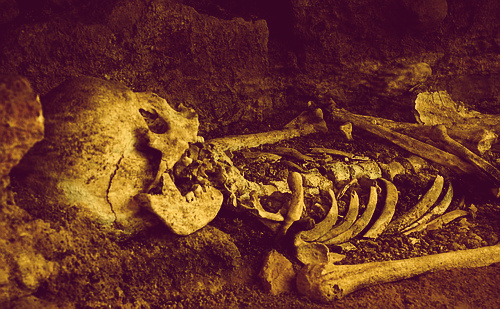
A Latin phrase literally translated as "on site" or "in position". In archaeology, it refers to an
artifact that has not been moved from its original place of deposition. It is of crucial importance for the
interpretation of the artifact's historical placement and of the culture which formed it. Only after the find-site has
been recorded, the artifact should be removed for further studies.
insula
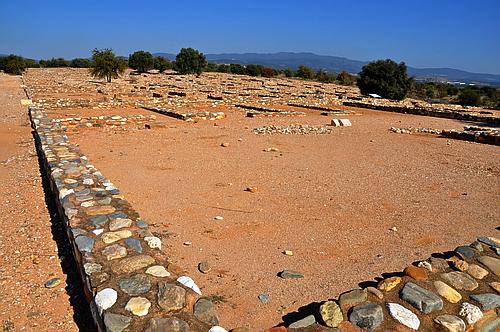
In the Hippodamian system a square or rectangular block of
buildings terminated by streets.
intaglio
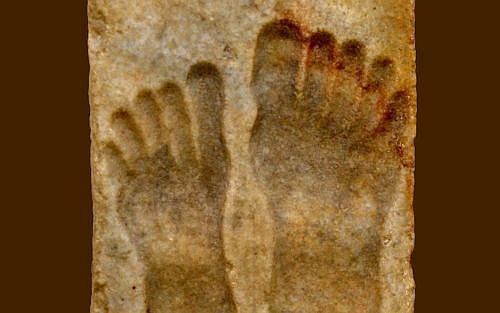
A figure or design incised or engraved in stone or other hard material.
intercolumniation
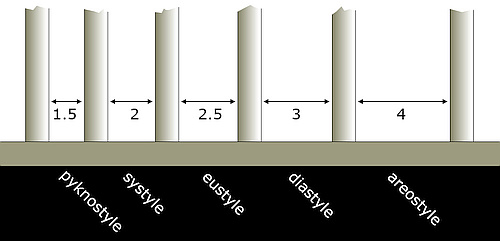
Intercolumniation describes the spacing between columns in a
colonnade. It is the ratio of column spacing to column diameter, measured at the bottom
of the column shafts. There are pyknostyle,
systyle, eustyle,
diastyle, and areostyle colonnades. Vitruvius
warned that when columns are placed three column-diameters or more apart, stone
architraves break.
intramural
Within the walls (of a settlement).
Io
In ancient Greek mythology a mortal heroine with many different traditions. According to the most common one she was a daughter of Inachos, and is recorded as the first priestess of Hera at Argos. Zeus loved her, and because of the jealousy of Hera metamorphosed her into a white cow. However, Hera asked and obtained the cow from Zeus, and gave her to Argos Panoptes to watch over her. He tied her to an olive tree in the grove of Hera - the place, where later the Argive Heraion was erected. But Zeus wanted Io back and ordered Hermes to carry her off. Hermes only succeeded by slaying Argos with a stone, and therefore Homer often uses the epithet of Argeiphontes ("the slayer of Argos") when referring to Hermes. Then, Hera sent a gadfly to sting Io, still in the form of a cow, constantly and leave her no rest. She fled ever further, crossed the Bosporus (meaning "ox passage", so named because of her crossing) until she arrived in Egypt. There, she was restored to human form by Zeus and bore him the son Epaphos.
Iobates
King of Lykia, and the father of Anteia. When Proitos sent Bellerophontes to him with the request to kill him, Iobates refrained from doing so and thought of other ways to let him disappear. Therefore, he sent Bellerophontes on suicide missions, first to kill the fire-breathing Chimaira, then to fight the fierce Solymoi, and finally to defeat the Amazons. When Bellerophontes had survived all these challenges and even an ambush, Iobates was so impressed by the hero that he gave him his daughter Anteia to marry.
Iokaste
A daughter of Menoikeus, and wife of Laios, by whom she became the mother of Oedipus. Later, she unwittingly married her son Oedipus and became by him mother of Eteokles, Polyneikos, Antigone, and Ismene. When the truth of the tragedy appeared, she hanged herself. - Her name is also given as Epikaste.
Iolaos
Son of Iphikles; nephew and companion of Herakles with whom he shared many adventures. Later, he married Megara, Herakles' first wife. Iolaos is also mentioned as one of the Argonauts. He was the only protector of the Heraklids when they were persecuted by Eurystheus. But, meanwhile of an old age, he prayed to the gods for help. Thereupon the goddess Hebe, now wife of the immortalized Herakles, restored his youth for a single day, on which he fought and beheaded Eurystheus.
Iole
Daughter of king Eurytos, who held an archery competition to find a husband for his daughter. Herakles entered the competition and won, but Eurytos did not keep his promise. According to one of the many traditions, Herakles then slew Eurytos and his sons and took Iole as his concubine. Later, when Deianeira had accidentally poisoned Herakles, he asked his eldest son Hyllos to marry Iole so that she would be well taken care of.
 Iolkos
An ancient city in Magnesia, Thessaly, now part of the modern municipality Volos. In ancient Greek mythology, Aison was the rightful king of Iolkos, but his half-brother Pelias usurped the throne. It was this Pelias who sent Aison's son Jason on the quest for the Golden Fleece. This has been interpreted as a symbol of the opening of new trade routes to the Black Sea. When the Argonauts successfully returned, Jason brought with him a wife, the sorceress Medea, later queen of Iolkos and Corinth.
Ion
In ancient Greek mythology the eponymous ancestor of the Ionians. He is the son of Apollo by Kreusa, the daughter of Erechtheus and wife of Xuthos. The best known of the various stories about Ion is told in the tragedy Ion by Euripides. In this version, Kreusa gave birth to Ion in a cave below the Propylaea and abandoned him there. Apollo appointed Hermes to bring the child to Delphi, where he was educated by a priestess. Later, when the boy had grown up, Xuthos and Kreusa consulted the Delphic oracle about the means of obtaining an heir. The answer was that the first human being that Xuthos would meet when leaving the temple should be his son. Consequently, Xuthos met Ion and adopted him as his son. Kreusa, however, thought that he was the son of her husband by a former lover and decided to kill him. So he was presented a cup filled with the poisonous blood of a dragon, but before drinking it, Ion poured out a libation to the gods and a pigeon which drank of it died instantly. Kreusa fled to the altar of the god, but Ion dragged her away and was about to kill her when a priestess intervened and told them the secret, reconciling mother and son. - In other traditions, Ion is represented as mythical king of Athens between the reigns of Erechtheus and Kekrops.
Ionia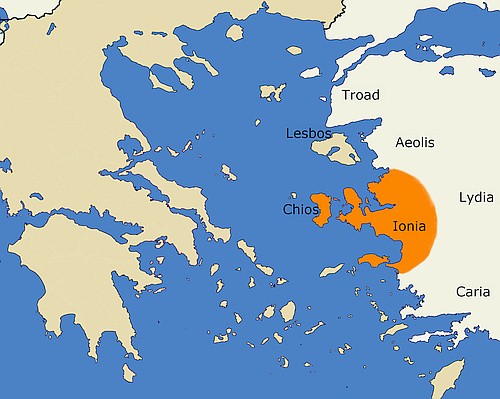
A coastal region in Asia Minor, present-day Turkey around Izmir
(former Smyrna). It never was an official state but a territory named after the Ionians, who
colonized in the Archaic period the shores and
islands of the eastern Aegean when the Greeks began to disperse their growing populations and expand their economic
basis. - It shares only the name with the Ionian islands and the Ionian Sea, both of which
are on the western side of the Greek mainland.
Ionian islands
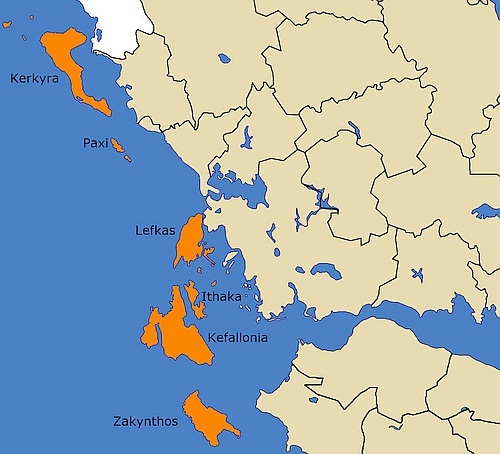
A group of islands (2300 km2, 205,000 inhabitants) off the west coast of Greece,
traditionally called the Heptanese ("Seven Islands"). They include, among many smaller islands, Kerkyra (Corfu), Paxi,
Lefkas, Ithaka, Kefallonia, and Zakynthos. The seventh island, Kythera, lies off the southern tip of the
Peloponnese and is part of the regional unit Attica.
Ionian League
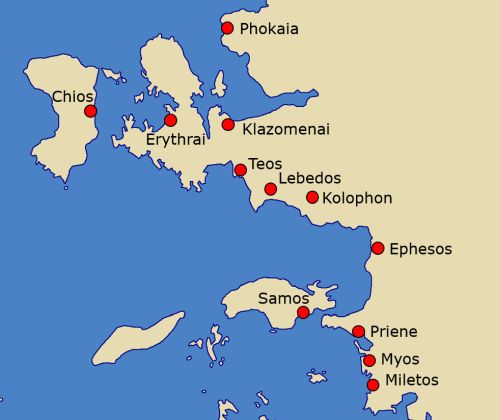
A confederation of twelve Ionian cities, a dodecapolis, formed in the
mid-7th century BC. The member cities according to Herodotus were: Miletos, Myos, Priene, Ephesos, Kolophon, Lebedos,
Teos, Klazomenai, Phokaia, Erythrai, Chios, and Samos.
Ionian Revolt
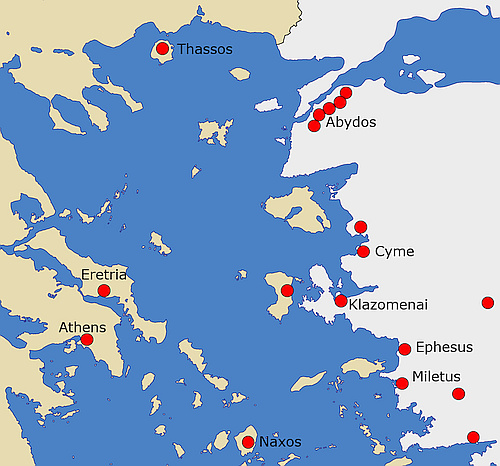
The military rebellions by Greek regions of Asia Minor against
Persian rule, between 499 BC and 493 BC. The cities of Ionia had been
conquered by Persia around 540 BC, and thereafter were ruled by native tyrants. The
rejection of these local tyrants led to the general rebellion in 499 BC against the Persian king
Darius the Great. Supported by Athens and
Eretria, the insurgents fought and burnt Sardis, the capital of
Lydia, in 498 BC but were then defeated in several battles. By 493 BC all of Asia Minor was brought back under
Persian control but this uprising was the ultimate cause for the Persian Wars that
Darius started in 492 BC.
Ionians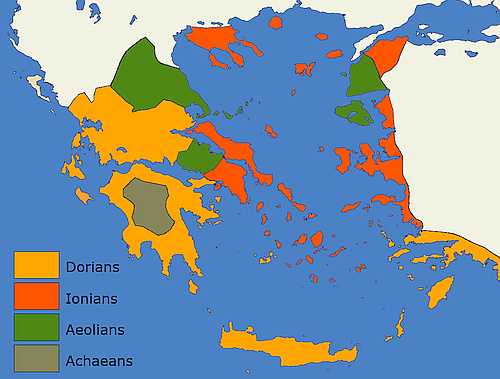
One of the four major ethnic groups in ancient Greece, the others being
Dorians, Aeolians, and Achaeans. "Ionians" in the
narrowest sense only refers to the population of Ionia in Asia
Minor. In a broader sense, it encompasses all speakers of the Ionic dialect, which includes the populations of
Attica, Euboea, the Cyclades
and many colonies founded by Ionian colonists.
Ionian School
A term referring to a type of philosophy centered in Miletos, Ionia, in the 6th and 5th centuries BC. However, it is insofar misleading as it was not a real "school". The Ionian philosophers like Thales, Anaximander, Anaximenes, Herakleitos, Anaxagoras, Archelaos, and Diogenes of Apollonia all followed different viewpoints that can hardly be summarized as a "school". Aristotle called them physiologoi, meaning 'those who discoursed on nature'. Sometimes they are referred to as cosmologists or physicalists who tried to explain the nature of matter.
Ionian Sea
The part of the Mediterranean Sea between southern Italy, eastern Sicily and the northern Greek mainland.
Ionic order
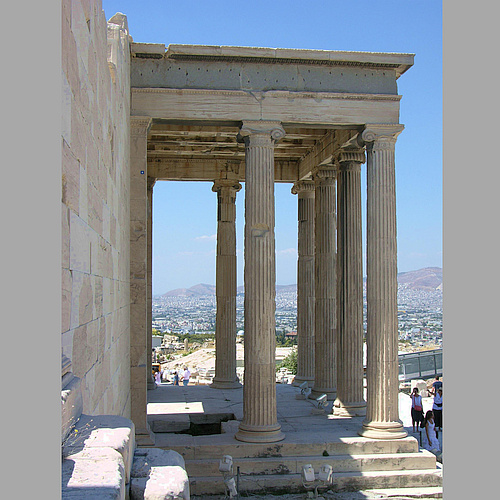
One of the three main architectural orders that developed
in Ionia and on some of the Greek islands by the 6th century BC. With its refined proportions and
graceful elements ancient Greeks considered it to be feminine as opposed to the more masculine
Doric order. - Ionic columns rests on an elaborate
curving base. The shaft of the column is more slender than in
the Doric style (height to base ratio of Ionic columns 8:1, Doric ratio 4:1 to 6:1),
and the fluting on the shaft is more prominent than on a Doric column. Characteristic is
the capital: two spiral volutes resemble partially unrolled
scrolls with oculi ("eyes") at their centre, and the echinus between the volutes usually
with egg-and-dart decoration. Unlike the axisymmetric Doric capitals: front and back
of Ionic capitals are different than the sides. Characteristics of the Ionic
entablature are an architrave consisting of three parallel bands, and a decorative
continuous sculptured frieze with bordering dentils.
Ion of Chios
Ion of Chios (ca. 490/480 - ca. 420 BC) was a Greek writer, dramatist, lyric poet and philosopher. He was a contemporary of Aischylos, Euripides and Sophokles. Of his own work only a few fragments survived.
Iophon
Iophon (fl. 428 BC - 405 BC) was a son of Sophokles and himself a tragic poet. In the competition of tragedies in 428 BC, he won the second prize, Euripides being first, and Ion third. Of his fifty plays only a few fragments remain.
Iphigeneia
Iphigeneia, or Iphigenia, was according to common tradition a daughter of Agamemnon and Klytaimnestra. - When the Greeks gathered in Aulis for their campaign against Troy, Agamemnon killed a stag in the sacred grove of Artemis. As a consequence, a calm detained the Greek fleet in the port of Aulis. The seer Kalchas declared that only the sacrifice of Iphigeneia could soothe the anger of Artemis. Agamemnon refused and could only be moved at last by the entreaties of Menelaos. So Odysseus and Diomedes were sent to fetch Iphigeneia, pretending that she would be married to Achilles. When Iphigeneia had arrived and was about to be sacrificed, Artemis appeared and carried her in a cloud to Tauris, where she served the goddess as her priestess. - Later, Orestes, the brother of Iphigeneia, followed the advice of an oracle to retrieve from Tauris the image of Artemis, which was believed once to have fallen from heaven. When Orestes, accompanied by his friend Pylades, arrived in Tauris, he was to be sacrificed like other Greeks gone astray, according to the custom of Tauris. But Iphigeneia recognised her brother, and fled with him and the image of the goddess. While Orestes returned to Mycenae, Iphigeneia went to Brauron where she died as a priestess of Artemis. - The Lakedaimonians maintained that the carved image of Artemis, which Iphigeneia and Orestes had carried away from Tauris, existed at Sparta, and was worshipped there under the name of Artemis Orthia.
Iphikles
1) A son of Amphitryon and Alkmene of Thebes, was one night younger than his half-brother Herakles. He was first married to Automedusa, the daughter of Alkathoos, by whom he became the father of Iolaos, and afterwards to the youngest daughter of Kreon. He accompanied Herakles on several expeditions, and was one of the Kalydonian hunters.
2) A son of Thestios by Laophonte or Deïdameia. He was one of the Kalydonian hunters and of the Argonauts.
3) He was married to Diomedeia or Astyocheia, and was the father of Podarkes and Protesilaos. Like the other two Iphikles, he joined the expedition of the Argonauts and was celebrated as a swift runner, winning the prize at the funeral games of Pelias.
Iphikrates
Iphikrates (ca. 418 BC - ca. 353 BC) was an Athenian general and son of a shoemaker. He owes his fame as much to his military successes as to the improvements he made in the equipment of the peltasts. With his reforms of these light-armed mercenaries he introduced longer spears and swords, substituted linen cuirasses in place of heavier bronze armor, launching a new footwear, and replacing the heavy aspis with a lighter pelte. These changes enabled his troops to take a more aggressive approach in battle and in 392 - 390 BC he dealt the Spartans a heavy blow by almost annihilating a battalion of about 600 men of their famous hoplites. After conquering city after city for the Athenians he was sent to the Dardanelles, where he was equally successful. In ca. 378 BC he assisted the Persians in an unsuccessful attempt to reconquer Egypt and in 373 BC commanded an expedition for the relief of Kerkyra, which was besieged by the Spartans. After the peace of 371 BC, Iphikrates sided with his father-in-law Kotys against Athens for the possession of the entire Thracian Chersonesos. Since he refused to besiege the Athenian strongholds, the Athenians soon pardoned him and gave him another command.
Iphitos
1) A son of Eurytos. He was one of the Argonauts but was killed by Herakles.
2) A son of Naubolos of Phokis, was also among the Argonauts.
3) A son of Haimon (but other descendancies are also given). At the request of the Delphic oracle, he restored the Olympic games, and instituted the Olympic Truce to ensure their peaceful celebration.
4) Apollodorus mentions yet another Iphitos.
Iris
Virgin goddess in ancient Greek mythology. She is imagined as walking over the rainbow to bring messages down from the Olympos. Iris was especially sent by Hera, whereas her male counterpart Hermes was the messenger and troubleshooter of Zeus.
Iron Age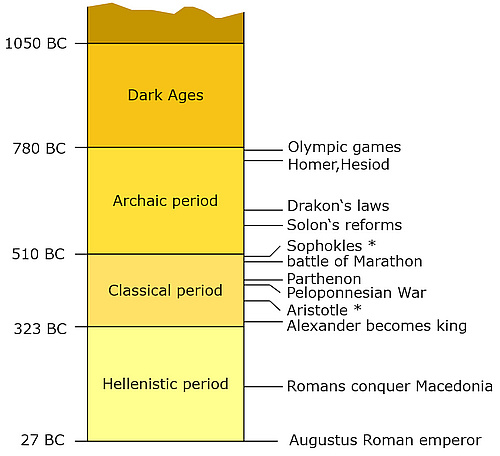
An archaeological period in which iron was introduced as the main material for toolmaking. It
followed the Bronze Age in Europe, spreading from the Caucasus in the late 11th century
BC. Meteoritic iron was already used in the 4th millenium BC, but the ability to smelt iron ore, remove impurities and
regulate the amount of carbon in the alloy was only developed in the Iron Age. Its absolute dating is much depending on
the geographic region, the differences amounting to some 500 years. In Greece, the Iron Age begins after the collapse of
Mycenaean civilization around 1050 BC with the onset of the
Dark Ages. The end of the Iron Age is much less clearly defined since ironworking
remained an important technology until recent times. Regarding Greece, this end is more or less arbitrarily set at 168
BC, when the Romans decisively defeated the Macedonians at Pydna, or 31 BC, when
Augustus became Roman emperor.
 Isis
Isis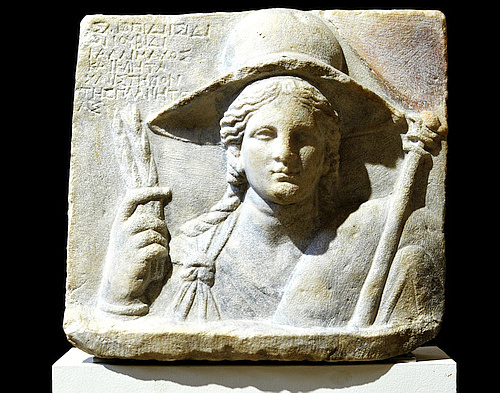
Isis is the Greek form of an ancient Egyptian word for "throne", applied to the Egyptian goddess Aset
or Eset. She was worshipped in Egypt since about 2300 BC and in the course of time became one of the most important
deities of ancient Egypt. She was associated with rites for the dead, as magical healer and as mother. When commercial
ties with Egypt increased in the Hellenistic period, the worship of Isis also appears
in Greece. Her cult subsequently spread throughout the Roman Empire.
Ismaros
1) In Homer's Odyssey, a town of the Kikonians, sacked by Odysseus and his men.
2) There are two mythological personages of this name.
Ismene
1) A daughter of Oedipus by Iokaste. She was a sister of Antigone, Eteokles, and Polyneikos.
2) A daughter of Asopos and Metope. By her husband Argos, she became the mother of Iasos and Io.
isodomic masonry

A type of masonry with rectangular ashlar blocks, where all courses are
of equal height.
Isokrates
Isokrates (436 - 338 BC), an ancient Greek rhetorician, was recognized as one of the ten greatest Attic orators. His teachings and writings were highly influential in his time. After the battle of Chaironeia, which he perceived as the loss of Greek liberty, he starved himself to death.
Isthmian Games
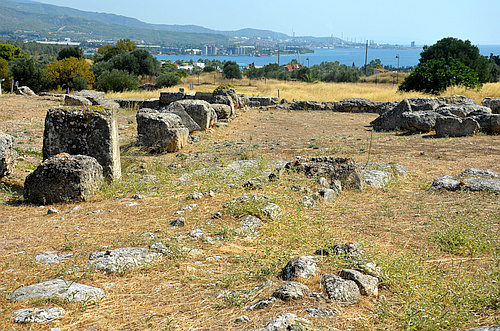
The 'Isthmian Games', also called 'Isthmia', were one of the
Panhellenic Games of ancient Greece, and were named after the
Isthmus of Corinth, where they were held. Like the Nemean Games, the Isthmian
Games were held both the year before and the year after the Olympic Games (the
second and fourth years of an Olympiad). Tradition has it that they originated as funeral games for
Melikertes, instituted by Sisyphos, legendary founder
and king of Corinth, who discovered the dead body and buried it subsequently on the
Isthmus. - Originally a nightly rite of the Corinthians, the games eventually developped into a full-fledged event of
athletic games dedicated to Poseidon and open to all Greeks, comparable to those at
Olympia. Until the 5th century BC, the winners of the Isthmian games received a wreath of celery, later replace by a
wreath of pine leaves. Victors could also be honored with a statue or an ode.
isthmus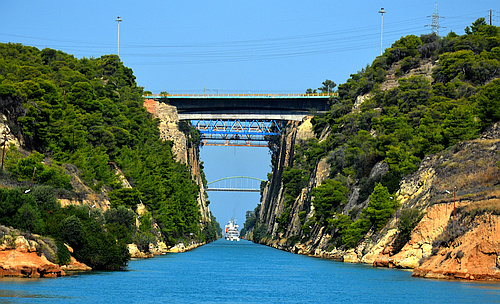
(isthmus = "neck") A narrow piece of land that joins two larger pieces of land like a bridge.
- Best known is the Isthmus of Corinth (--> site page)
joining mainland Greece to the Peloponnese.
Ithaka
One of the Ionian islands, situated between Kefallonia and mainland Greece. It is generally identified with the home of Odysseus as described by Homer. The lack of convincing archaeological evidence and some discrepancies between modern topography and the description in the Odyssey, however, led Dörpfeld to propose the nearby island of Lefkas as Homer's Ithaka.
ithyphallic
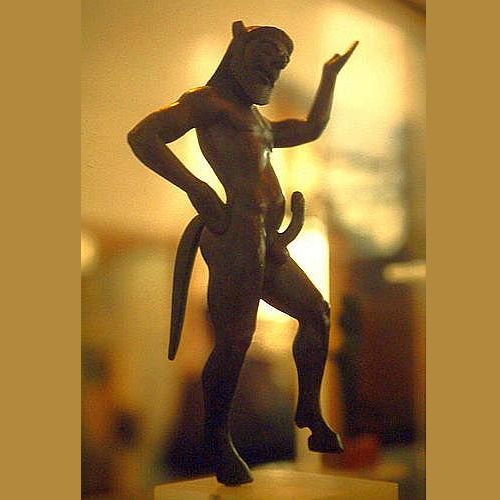
Having an exaggerated erect phallus. Often used in representations of
Priapos or satyrs.
Ixion
King of the Lapiths and husband of Dia. When Deioneus, the father of Dia, demanded of Ixion the bridal gifts he had promised, Ixion treacherously invited him to his house and caused him to be thrown into a pit filled with fire, in which he perished. No one wanted to purify Ixion of this treacherous murder, but at last Zeus took pity upon him and invited him to his table. But instead of being grateful, Ixion tried to seduce Hera, whereupon Zeus made a phantom of Hera. By this, Ixion became the father of a centaur, who again having intercourse with Magnesian mares, became the father of the hippocentaurs. As a special punishment for Ixion, Hermes chained his hands and feet to a fiery wheel, which rolled perpetually in the lower world.

