
GREECE
 GLOSSARY
| A | B | C | D |
| E | F | G | H |
| I | J | K | L |
| M | N | O | P |
| Q | R | S | T |
| U | V | W | X |
| Y | Z |
2026-01-21
color code:  = mythology;
 = history & culture;
  = geography;
  = archaeology &
architecture
= archaeology &
architecture
taenia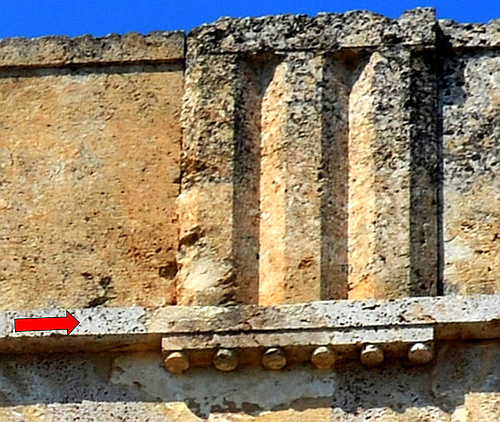
In ancient Greek temple architecture a narrrow projection separating the
Doric architrave from the
frieze.
Talaos
In ancient Greek mythology the son of Bias and Pero, king of Argos and one of the Argonauts.
Tartaros
Ancient Greek mythology is not very clear about this Tartaros. According to one tradition he is a son of Aether and Gaia. According to another tradition, he was by his mother Gaia the father of the Gigantes Echidna and Typhon.
tartaros
In the Iliad a place far below the earth. It is even as far below hades as heaven is above the earth. It is sometimes used as synonymous with hades, but later tradition has it that it is the place in the underworld in which the spirits of wicked men such as Sisyphos and Tantalos are punished for their crimes. Also the Gigantes, who rebelled against the Olympians, were thrown into the tartaros after their defeat.
 Tauris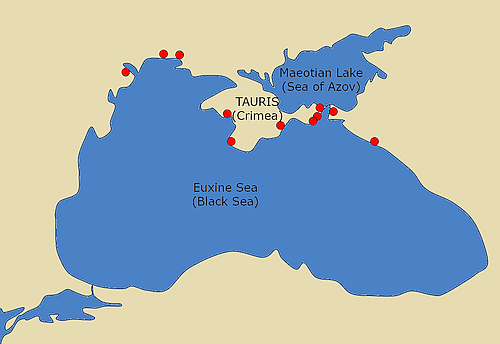
In antiquity the southern coast of the Crimean peninsula. Its inhabitants worshipped the virgin
goddess Artemis and were notorious for sacrificing shipwrecked or unsuspecting travelers.
- The Taurians are especially known from the drama Iphigenia in Tauris by
Euripides.
Tegeates
A son of Lykaon, and said to be the founder of ancient Tegea in Arcadia. He was married to Maira.
Teiresias
One of the most renowned soothsayers in all antiquity. He was blind from his seventh year, and there are different traditions as to which mythical events led to his blindness. It is also related that he spent seven years of his life as a woman, and that he was able to understand the voices of birds. His prophecies are especially related to Thebes, such as those dealing with the war of the Seven against Thebes and that of the Epigoni. Actually, there is scarcely any event in the mythical history of Greece with which he is not connected in some way or other. This is based on the belief that he lived a very long life of seven generations. Even after his death, Teiresias in the underworld, while the souls of other mortals were mere shades, retained the powers of perception.
Telamon
1) A son of Aiakos and Endeïs, and a brother of Peleus. He was one of the Kalydonian hunters and of the Argonauts. After he, together with Peleus, had killed his step-brother Phokos, Aiakos expelled them from Aegina and Telamon went to Salamis. Later he married Periboia, a daughter of Alkathoos, by whom he became the father of Aias. Telamon was a great friend of Herakles and joined him on his expedition against Laomedon of Troy. There, Herakles gave to him a daughter of Laomedon, by whom he became the father of Teukros and Trambelos. Telamon also joined Herakles in his fight against the Meropes, against the giant Alkyoneus, and in his campaign against the Amazons where he slew Melanippe.
2) A surname of Atlas, describing him as the sufferer or the bearer of heaven.
Telegoneia
The Telegoneia is a lost ancient Greek epic poem about Telegonos, son of Odysseus by Kirke. As part of the Epic Cycle of poems, it comes chronologically after the Odyssey and thus forms the final episode of the cycle.
Telegonos
1) A son of Proteus. After he and his brother challenged Herakles to a wrestling contest, both were killed by Herakles.
2) A king of Egypt who married Io, after she had found her son Epaphos and had come to rest.
3) A son of Odysseus by Kirke, whose name ("born far away") signals that he was born on the island of Aiaia. After Odysseus had returned to Ithaka, Kirke sent Telegonos to search his father. On the voyage, his ship was cast by a storm on the shore of Ithaka, and driven by hunger, he began to plunder the fields. Odysseus and Telemachos were informed about the ravages and went to fight the stranger. In the course of this fight, Telegonos ran Odysseus through with his spear. At the command of Athena, Telegonos then accompanied Penelope and Telemachos to Aiaia, where Odysseus was buried.
Teleklos
Teleklos (fl. 8th century BC), son of King Archelaos, was the 8th Agiad dynasty king of Sparta. In his reign several towns of the perioikoi, the "dwellers round about", were conquered. Teleklos was killed during a skirmish with the Messenians and succeeded by his son Alkmenes.
Telemachos
Telemachos was the son of Odysseus and Penelope. When the Greeks gathered for their campaign against Troy and Odysseus feigned idiocy, Palamedes placed the infant Telemachos before the plough with which Odysseus was ploughing and thereby disclosed the deception. During the following nearly 20 years of his father's absence, Telemachos grew up to manhood. Then, Athena, assuming the appearance of Mentes, went to Ithaka and advised Telemachos to gather information concerning his father at Nestor's palace. He was kindly received but as he could not find more information, he proceeded to Sparta. There, Menelaos told him about the prophecy of Proteus concerning Odysseus, whereupon Telemachos returned to Ithaka. There he met his father, disguised as a beggar, and after he disclosed his identity, they set out together to punish the suitors of Penelope.
Telephassa
The wife of Agenor, and mother of Europa, Kadmos, Phoinix, and Kilix. After Europa had been carried off by Zeus, she and her sons went to search her but Telephassa died on the expedition.
Telephos
A son of Herakles and Auge. He was reared by a hind (elaphos), and educated by king Korythus in Arcadia. When Telephos had grown up, he consulted the Delphic oracle to find out who his mother was. He was told to to go to king Teuthras in Mysia. There he was kindly received, found his mother, and married the daughter of Teuthras whom he succeeded on the throne. During his reign, the Greeks proceeded to the Trojan War and when they invaded Mysia, Telephos repelled them, but was wounded by Achilles. This wound could not be cured and an oracle informed him that this could only be done by the one who caused it. Also the Greeks received an oracle and this told them that they would reach Troy only with the help of Telephos. In this way, a reconciliation was easily brought about.
Teleutias
A brother of the Spartan king Agesilaos II, and a Spartan naval commander in the Corinthian War. He was active to regain control of the Gulf of Corinth and fought in the campaign against Argos in 391 BC, before he was detached to Rhodos and Aegina. In 382 BC Teleutias commanded an expeditionary force of 10,000 men on a campaign against the Chalkidian League and was killed in a battle at Olynthos where his army suffered severe casualties.
Telkhines
A prehellenic tribe, the original inhabitants of the island of Rhodos, but also known in Crete and Cyprus.
Temenos
1) A son of Pelasgos.
2) A son of Phegeus.
3) A son of Aristomachos. He was one of the leaders of the Heraklids and after the conquest of the Peloponnese he received Argos as his share.
temenos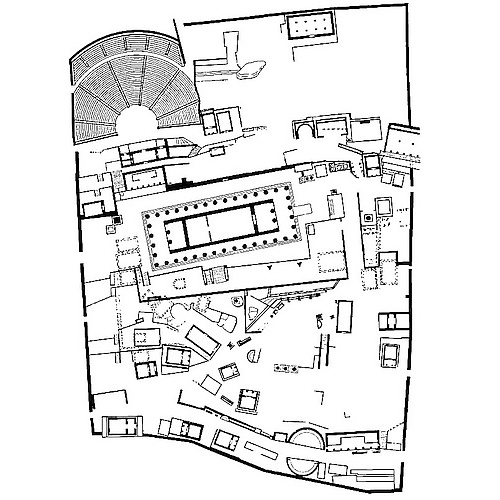
In ancient Greece a sacred enclosure where gods were worshipped, with sanctuaries,
temples and sometimes also secular buildings. - Here: the temenos of Delphi.
temple
An ancient Greek building as religious center to worship a specific god or goddess whose cult statue was placed inside. Unlike Christian churches the Greek temple has an outward orientation: its interior is not meant to receive a large number of worshippers, all significant elements like the colonnade or the elaborate façade are designed to be seen from outside.
The temple façade has three main parts, each of which consists of three elements: the three steps (krepidoma, the uppermost is the stylobate), the columns (with base, shaft and capital), and the entablature (consisting of architrave, frieze, and geison).
All of these architectural elements vary according to their specific architectural order, which may be Doric, Ionic or Corinthian.
Finally there are different ground plans of Greek temples, the main types being
antae, distyle, prostyle,
amphiprostyle, dipteros, and
peripteros.
 Tenedos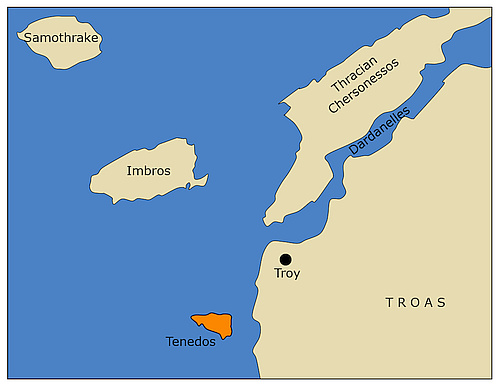
Turkish island in the northeastern Aegean Sea. It is mentioned in the
Iliad and the Aeneid. According to tradition, the Greeks hid their fleet
here towards the end of the Trojan War to make the Trojans believe that they left and to lure
them into taking the Wooden Horse into their city. - Because of its strategic
location near the entrance to the Dardanelles, it played an important role also in
classical antiquity.
Tennes
Son of Kyknos, the king of Kolonae in Troas, (or of Apollo) and Prokleia. After the death of Prokleia, Kyknos married Philonome, who fell in love with her step-son. When he did not respond her love, she accused Tennes before his father of improper conduct towards her. Consequently, Kyknos threw his son into a chest and exposed it to the sea. The chest was driven on the coast of an island, which then was called Tenedos, after its inhabitants had chosen him for their king. Finally, Kyknos heard of the innocence of his son, killed Philonome, and went to Tenedos. There are different traditions but according to one of them both he and Tennes were slain by Achilles on his voyage to Troy.
Tereus
A son of Ares and king of the Thracians. He was asked to help against some enemy by the Attic king Pandion, who had two daughters, Philomela and Prokne, and twin sons, Erechtheus and Boutes. As reward for his assistance, Tereus received Prokne as his wife. By her, he became the father of Itys, but then he concealed Prokne and pretended that she had died so that he could marry Philomela. After some time, however, the sisters learned the truth, Prokne killed her own son Itys and placed his flesh in a dish before Tereus. The sisters then fled, pursued by Tereus, and when they were trapped, prayed to the gods. Consequently, Prokne became a nightingale, Philomela a swallow, and Tereus a hoopoe.
Terpsichore
One of the nine muses, associated with choral song and dancing. It is said that she and the river-god Acheloos were the parents of the Seirens.
terracotta
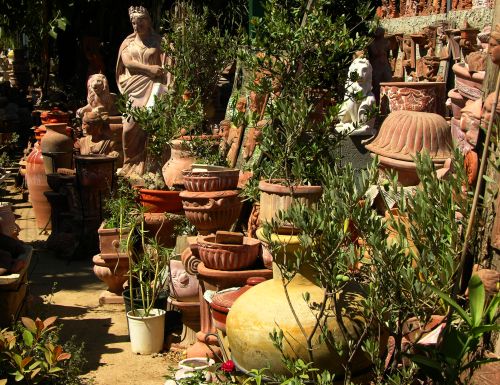
Terracotta (Italian: "baked earth") denotes a type of earthenware, a clay-based unglazed or glazed
ceramic, where the fired body is porous. Terracotta is the term normally used for sculpture made in earthenware, and
also for various utilitarian uses such as vessels, water and waste water pipes, or roof tiles.
Tethys
One of the Titanides, daughter of Gaia and Uranos. By her brother, Okeanos, she was the mother of Thetis, Eurynome, Perse, and the Okeanids. - Not to be confused with Thetis.
tetrastyle
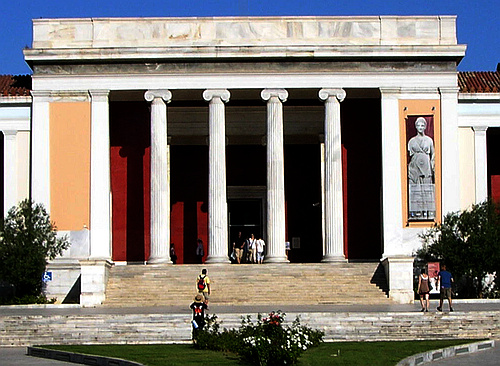
In ancient Greek architecture, a tetrastyle portico has four
columns. This arrangement was commonly used for small structures such as public
buildings.
Teukros
1) In ancient Greek mythology a son of the river god Skamandros by the nymph Idaia. According to one tradition he was the first king of Troy, while in another tradition Dardanos was a native prince of Troy, and Skamandros and Teukros then immigrated into Troas from Crete.
2) A son of Telamon and Hesione, of Crete. He was a step-brother of Aias, and the best Greek archer in the Trojan War. When he returned from Troy, Telamon would not receive him in Salamis for which traditions give different reasons. Teukros sailed away and found a new home in Cyprus.
Thaïs
A famous Greek hetaira, said to have been very witty and entertaining. She accompanied Alexander the Great on his campaigns where she was the lover of Ptolemaios I Soter. It is unclear if she also was the lover of Alexander, but at least he liked to "keep Thaïs with him". She is especially noted for instigating the burning of Persepolis shortly after 330 BC.
thalamos
The burial chamber in Mycenaean mortuary architecture. In
tholos tombs it is a stone-built structure with circular ground-plan and a corbelled vault.
Chamber tombs have subterranean burial chambers cut into the rock, usually with a
rectangular ground-plan. They may also have stone benches along the walls, side niches and sometimes ceilings like gable
roofs. In any case, the thalamos has burial pits for one or more burials dug into the floor and covered by stone slabs.
Thaleia
1) One of the nine muses, associated with comedy. By Apollo she became the mother of the Korybantes.
2) A daughter of Hephaistos, and by Zeus, the mother of the Sicilian daemons Palikoi.
3) A daughter of Nereus and Doris.
4) See: Thalia.
Thales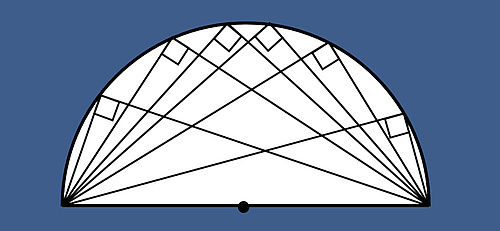
Thales of Miletos (ca. 624 - ca. 546 BC) was a pre-Socratic
Greek philosopher, mathematician and astronomer from Asia
Minor, and one of the Seven Sages of Greece.
Aristotle regarded him as the first Greek philosopher. He broke away with mythological explanations of the world and
sought explanations by theories and hypothesis, i.e. empiricism. Aristotle reported Thales's hypothesis of water being
the single ultimate substance. In mathematics, Thales introduced deductive reasoning to geometry and applied this to
calculate the heights of pyramids and the distance of ships from the shore. Today he is best known for the "Thales'
theorem".
Thalia
1) (Greek: Blooming one or abundance) One of the Charites.
2) Compare: Thaleia.
Thamyris
An ancient Thracian bard, a son of Philammon and the nymph Argiope. In his hubris, he thought to surpass the muses in song. As a consequence, he was deprived of his sight and of the power of singing.
Thanatos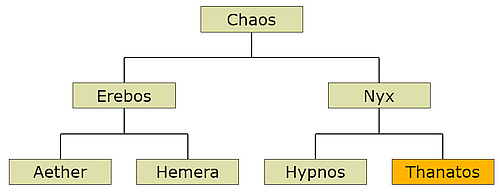
In Greek mythology the personified god of death, son of Nyx (Night) and
brother of Hypnos (Sleep). In ancient Greek art the two brothers were mostly presented as
youths either sleeping or holding inverted torches in their hands. Hesiod describes him as
horrible, cruel, painful and malignant. His heart is made of pitiless iron, and when he takes hold of you, the world of
light ceases to be. However, his role in myths is overshadowed by that of Hades.
Theagenes
Theagenes was an athlete from Thassos, famed for his extraordinary strength and swiftness, distinguished in all kinds of athletic contests. He was a victor at Olympia in the 75th Olympiad, 480 BC, and had numerous victories at the Olympian, Pythian, Nemean, and Isthmian games. In total, he was said to have 1300 victories at panhellenic games. - A curious story is told by Pausanias: a man on Thassos who had a grudge against Theagenes, scourged the statue erected for the athlete in his hometown. The statue fell upon the man and killed him. The statue was then put on trial for murder and exiled by being thrown into the sea. When the country was caught by a drought, the Delphic oracle declared that this would remain until the statue of Theagenes was restored.
Theano
1) In ancient Greek mythology the wife of Antenor, and priestess of Athena at Troy.
2) One of the Danaides.
3) There is another mythical personage of this name.
 theatre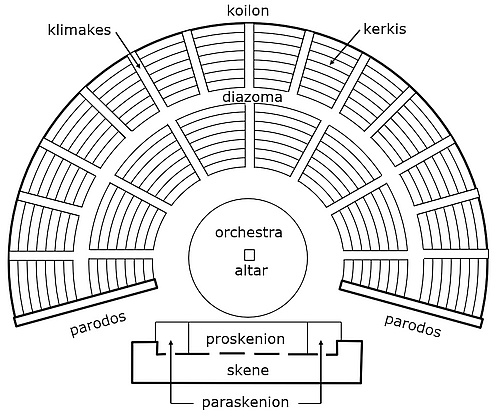
1) Theatrical performances were one of the major inventions of the ancient Greeks. The tragedies, dramas, comedies, and satyr plays were very popular with the Greek audience, especially the contests into which the great playwrights entered. They were a celebration of community and had an educational function, presenting moral virtue, vice, and the irreversibility of fate.
2) Theatres were already built in the Minoan culture, where they were
used for public assemblies and cultic services. For this, each palace had an open square, on two sides enclosed by steps
in an L-form for the audience. - In Classical Greece another form of open buildings for theatrical performances evolved.
Set into a hillside, overlooking the sea or a wide landscape, the theatre consisted of concentric rows of seats
(koilon, cavea, or theatron), subdivided by horizontal walkways,
diazomata, into upper and lower tiers. Perpedicular to the ring of seats are the
klimakes, steps to ascend in the koilon, forming a wedge-shaped seating section, kerkis.
From there the audience looked down to the central orchestra where the
chorus appeared on the scene. Behind this was the skene, the
background for the actors. Additions of later times were a front stage, proskenion
(logeion), a stage on the sides, paraskenion, and a side entrance,
parodos, to the orchestra. - The oldest theatre of this kind is the Theatre of Dionysos
(--> site page) on the south slope of the
acropolis in Athens, other prominent examples are at
Epidaurus (--> site page), Palaia Epidaurus (-->
site page), and Dodona (-->
site page).
Thebe
1) A daughter of Prometheus. The city of Thebes is believed to be named after her.
2) A daughter of Asopos and Metope. She became by Zeus the mother of Zethos. Also she is said to have given the name to Thebes.
Thebes
Thebes (modern Greek: Thíva) is a city in Boeotia. In ancient Greek myths it played an important role as the site of the stories related to Kadmos, Oedipus, Dionysos and others. - Archaeological excavations in the area of Thebes have unearthed a Mycenaean settlement and Linear-B tablets showing the importance of the site in the Bronze Age. - Later, Thebes emerged as a major force in Greek history. It was a major rival of ancient Athens, sided with the Persians during the 480 BC invasion, and ended Sparta's hegemony at the Battle of Leuktra in 371 BC under the command of Epaminondas. At the time of the Macedonian conquest of Greece, Thebes was the most dominant city-state, but its Sacred Band famously fell at the Battle of Chaironeia in 338 BC against Philip II and Alexander the Great before the city was finally destryed by Alexander in 335 BC.
Theia
1) One of the Titanides, daughter of Gaia and Uranos. By her brother Hyperion she became mother of Eos, Helios, and Selene. Therefore, she was regarded as the deity from which all light spread out.
2) A daughter of Okeanos and mother of the Kerkopes.
Themis
A daughter of Gaia and Uranos. By Zeus she became the mother of the Horai, Eunomia, Dike, Astraia, Eirene, and the Moirai. She was regarded as the personification of the order of things as established by law or custom, and cherished as divinity with prophetic power. As such, she was in possession of the oracle in Delphi, that she took over from Gaia and was followed by Apollo.
Themistokles
Themistokles ("Glory of the Law"; ca. 524 - 459 BC) was an Athenian non-aristocratic politician and general in the early years of democracy in Athens. Supported by the lower class Athenians, he was elected archon in 493 BC and immediately advocated for increasing the naval power of Athens. He fought at the Battle of Marathon in 490 BC, perhaps as one of the ten strategoi. In the following years he became the most prominent politician in Athens and in 483 BC he persuaded the polis to build 200 triremes which then formed the backbone of the Athenian fleet in the upcoming second invasion of the Persians. Themistokles was in effective command of the Greek allied navy at the battles of Artemision and Salamis in 480 BC. He was the central figure and mastermind behind the tactics and the subterfuge which led to the decisive Greek victory at Salamis. After the invasion ended with the Battle of Plataiai in the following year, he aroused the hostility of Sparta by ordering Athens to be re-fortified. And in Athens, he was perceived as arrogant, which led to his ostracism in 472 BC. He went into exile in Argos but the Spartans maneuvered him into a treacherous plot so that he had to flee from Greece. He went to Asia Minor, entered the service of the Persian king who made him governor of Magnesia, where he then lived for the rest of his life. - Themistokles was posthumously rehabilitated and recognized as a hero of the Athenian and actually Greek cause.
Theogenes
--> Theagenes
Theognis
Theognis of Megara was a Greek lyric poet (ca. 7th century BC), whose works features ethical maxims and practical advice about life. Along with Homer and Hesiod he is among the earliest poets whose work has been preserved as a continuous manuscript.
Theogony
The "genealogy or birth of the gods" is a 1,022 line poem attributed to Hesiod. Written around 700 BC, it is the oldest and most complete account of the mythological genealogy of deities in ancient Greece.
Theophrastos
Theophrastos (ca. 371 - ca. 287 BC) was a Greek philosopher, born on Lesbos. At a young age he came to Athens and studied in Plato's school. After Plato's death he joined Aristotle, and when he fled Athens Theophrastus became head (scholarch) at the Lykeion. He presided over the Peripatetic school for thirty-six years, the period of its heyday. - Theophrastos had a wide field of interests. Two of his works on plants have survived for which he is often considered as the "father of botany". In philosophy, he continued Aristotle's work on logic, but also devoted himself to grammar and language, ethics and metaphysics. In his teachings, space is regarded as the mere arrangement and position of bodies, time as an accident of motion, and motion as a necessary consequence of all activity.
Thermopylae
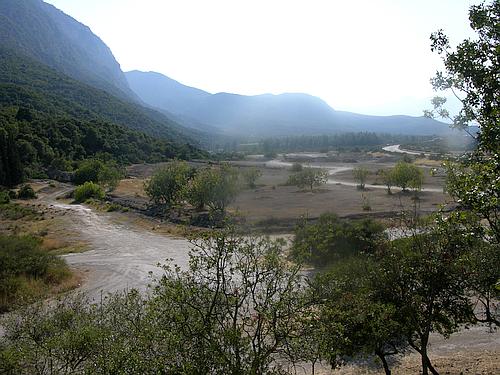
(Greek: "hot gates") A place in Fthiotis where a narrow coastal
passage existed in antiquity, the sea reaching up to the steep cliffs of the Kallidromos mountains and leaving only a 7
km long bottle-neck, very narrow in places. It derives its name from its hot sulphur springs. - It is most famous for
the Battle of Thermopylae in 480 BC. When the Persian king Xerxes and his troops -
according to the historian Herodotus 1,700,000 soldiers - invaded Greece in the
Persian Wars, they were to be stopped at the pass of the Thermopylae, defended by
only 300 Spartans and 700 Thespians under the command of the Spartan king
Leonidas. It was the most unequal battle ever fought with heavy losses on the Persian
side, but on the third day a local resident betrayed the Greeks and led the special forces of Hydarnes on a mountain
path of Anopeia to the rear of the Greek troops. In this hopeless situation Leonidas ordered his main force to withdraw
and retreated with his Spartans to their last stand on Kolonos hill, where all but two Spartans were killed. - See also:
site page.
Thersandros
1) A son of Sisyphos.
2) A son of Polyneikos and Argeia. He was one of the Epigoni, who conquered Thebes where he was then made king. He joined the Greeks in their expedition against Troy, but when they landed in Mysia he was slain by Telephos.
3) There is another personage of this name.
Thersites
A son of Agrios, according to tradition the most ugly and most imperdinent talker among the Greeks at Troy. In the assembly he spoke in an unbecoming manner against Agamemnon, for which he was chastised by Odysseus. When he calumniated Achilles, the latter slew him.
Theseus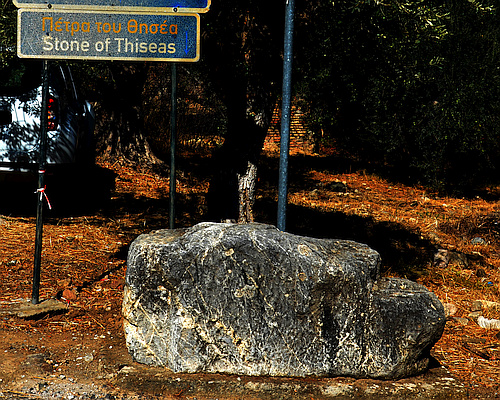
The great legendary hero of Attica is a mythological personage with
complex legends, mainly because later tradition tried to present him as a much more historical figure than he really
was. - Aigeus, king of Athens, traveled to Troizen and,
despite a warning from the oracle, impregnated Princess
Aithra there during a drunken night. According to one version of the myth, Aithra was led to the sea by
Athena that same night, where she also had intercourse with
Poseidon. This is the basis for the belief that Theseus had two fathers: one mortal and one divine. This is supposed
to explain his exceptional qualities, but like other demigods, most notably Herakles, he had to earn his immortality
through the posthumous fame of great deeds. - Theseus grew up in Troizen without a father, for Aigeus soon returned to
Athens. He left his son his sandals and a sword, which he buried beneath a massive stone, and instructed Aithra to lead
Theseus to this spot when he was grown up and strong enough. This happened one day, and with the sandals and sword,
Theseus set out for Athens to claim his birthright. Instead of the easier option of traveling to Athens by boat, Theseus
chose the overland route around the Saronic Gulf, demonstrating his prowess by
destroying the robbers and monsters that infested the country: Periphetes,
Sinis, Phaia the Kromyonian sow, Skiron, Kerkyon, and
Prokrustes. - In Athens, Theseus entered incognito the palace of the king, who was now
married to Medea, Jason's former wife. She, possessing magical
powers, recognized Theseus, and feared that he, as the firstborn, would be king and not her son. Medea therefore wanted
to poison Theseus, but Aigeus recognized his son by his sandals and sword, and as the two celebrated their happy
reunion, Medea fled to Asia. - As a result of the death of Androgeos and the ensuing
war, Athens regularily had to send to Minos their tribute of seven youths and seven
maidens. When this occasion returned, Theseus offered himself as one of the youths, planning to slay the
Minotauros, or perishing in the attempt. When they arrived at
Crete, Ariadne, the daughter of Minos, became enamoured of
Theseus, and provided him with a sword with which he slew the Minotauros, and a clue of thread by which he found his way
out of the labyrinth. Having successfully completed his task, Theseus set sail, carrying off Ariadne, but either lost or
abandoned her on the island of Naxos. As the vessel in which they sailed approached Attica, they neglected to hoist the
white sail, which was to have been the signal that the expedition had had a prosperous issue, and this neglect led to
the death of Aigeus. Soon after he landed, Theseus is said to have instituted the
Isthmian Games. - One of the adventures of Theseus was his expedition against the
Amazons, when he carried off their queen Antiope. The Amazons in their turn invaded
Attica, and penetrated into Athens itself, where in the final battle Theseus overcame them. - Theseus figures in almost
all the ancient heroic undertakings. He was one of the Argonauts (but Medea tries to
poison him later), he joined in the Kalydonian Hunt, aided
Peirithoos and the Lapiths against the
centaurs, and assisted Peirithoos in his attempt to carry off
Persephone from the lower world. In the end, Theseus
met with a treacherous death at the hands of Lykomedes. - Theseus was believed to have
appeared to aid the Athenians at the battle of Marathon. When in 469 BC a skeleton of
large size was found in Sevros and brought to Athens, believed to be that of Theseus, a temple was erected in his
honour (but what is known as the "Theseion" is actually a temple of Hephaistos).
Thespios
A son of Erechtheus.
Thespis
Thespis (fl. 6th century BC) is credited in ancient Greek sources with the introduction of a new form of plays, called tragedies. While earlier plays presented only a chorus, he added an actor on the stage who performed the words of individual characters in the stories, distinguishing between the characters with the aid of different masks. When in 534 BC competitions to find the best tragedy were instituted at the City Dionysia in Athens, Thespis won the first documented competition. He was also known for touring various cities, carrying his costumes, masks and other theatre props in a horse-drawn wagon.
Thesprotia
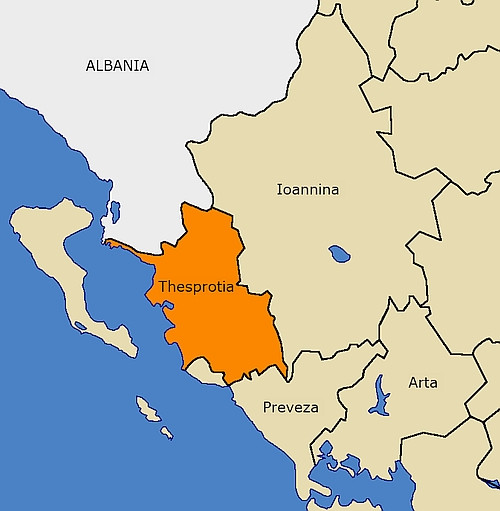
One of the regional units (1,500 km2, population 41,000) of
Epirus. Its capital and largest town is Igoumenitsa. Thesprotia is named after the Thesprotians, an ancient Greek
tribe that inhabited the region in antiquity. - See also: site
page.
Thessalos
1) A son of Haimon, from whom Thessaly was believed to have received its name.
2) A son of Jason and Medea. He succeeded Akastos on the throne of Iolkos.
3) A son of Herakles and Chalkiope, was the father of Pheidippos and Antiphos.
Thessaly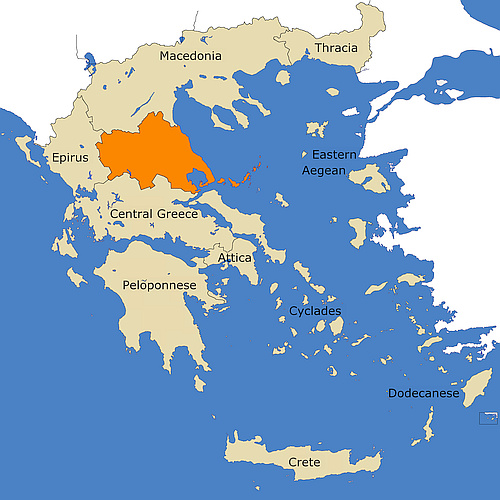
A geographic and modern administrative region of Greece (14,000 km2, 688,000 inhabitants),
east of Epirus and south of Macedonia. It includes
Karditsa, Larissa, Magnesia, Trikala, and the Sporades. - During the Mycenaean period,
Thessaly was known as Aeolia, a name that continued to be used for one of the major tribes of Greece, the
Aeolians.
Thestios
A son of Ares (or of Agenor). He was the father of Iphikles, Euippos, Plexippos, Eurypylos, Leda, Althaia, and Hypermnestra.
thetes
In the political reforms of Solon (circa 594 BC) the lowest social class of ancient Athens. They were workers for wages, who could not afford their own hoplite armor like the zeugitai. - The four classes were: pentakosiomedimnoi, hippeis, zeugitai, and thetes.
Thetis
The most important sea goddess, one of the Nereids, a daughter of Nereus and Doris. She was the mother of Achilles and played a prominent role in major Greek myths. - When Hera, Poseidon and Athena had rebelled against Zeus and had him bound, it was Thetis, who brought in one of the Hundred-Handed to rescue Zeus. - When Hera had given birth to Hephaistos, she found him so ugly that she threw him out of Olympos and when he crashed to earth, the infant became crippled in both legs. It was Thetis who rescued Hephaistos and nursed him back to health and as a reward, Hephaistos made a new set of armour for Thetis' mortal son Achilles during the Trojan War. - During her wedding with king Peleus, Eris, the only goddess not invited, threw a golden apple in their midst, it was inscribed: "To the Fairest". Three powerful goddesses - Hera, Athena and Aphrodite - each claimed to be the fairest and each wanted the prize. This lead to the Judgement of Paris, and finally to the Trojan War. - Thetis secretly tried to make all of the seven sons she had with Peleus immortal by anointing each infant in ambrosia. Just before she could complete this with her youngest son, Achilles, she was disturbed by Peleus and therefore Achilles' body became invulnerable to all weapons, except for his heels. Endowed with the gift of prophecy, she knew that if her son went to war in Troy, he would have a life of fame and glory in battle, his name immortalised, but he would die young. Thetis tried to prevent him from fulfilling this destiny, but failed.
She is sometimes confused with Tethys.
Thirty Tyrants
The Thirty Tyrants (Ancient Greek: oi triákonta týrannoi) were a pro-Spartan oligarchy installed in Athens after its defeat in the Peloponnesian War in 404 BC. Although the Thirty Tyrants were in power for only 18 months, they were responsible for the killing of 5% of the Athenian population, the confiscation of citizens' property, and the exile of democratic supporters.
Thoas
1) King of Kalydon and Pleuron, in Aetolia. He went with forty ships against Troy.
2) A son of Dionysos and Ariadne. He was king of Lemnos and married to Myrina, by whom he became the father of Hypsipyle and Sikinos. When the Lemnian women killed all the men in the island, Hypsipyle saved her father Thoas, and concealed him. Later, he was discovered and either escaped or was killed.
3) A son of Ikarios and Periboia, and a brother of Penelope.
4) There are three other mythical personages of this name.
tholos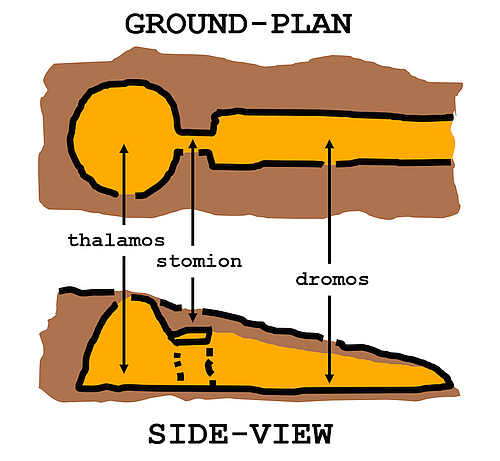
A building, especially a temple, with circular ground-plan in ancient Greece. - Most notable are,
however, the tholos tombs or 'beehive tombs' of the Mycenaean era. They appear around
1600 BC, and by 1500 BC they are quite widespread all over the Mycenaean heartland. They follow the same tripartite
layout as the much more frequent chamber tombs: a
dromos (entrance passage) leading to a monumental stomion (doorway) behind which lies
the thalamos (burial chamber). The main difference between chamber tombs and tholos tombs is
that the latter have burial chambers and doorways built of stone and not only carved into the rock. In later versions of
tholos tombs also the dromos is made of nice ashlar masonry. Tholos tombs, except the very
early ones, are usually built into the slope of a hillside and covered with earth so that only the upper part remains
above ground. The chambers, built as corbelled vaults, usually contained several burial pits in the ground, covered by
stone slabs. - The immense effort required to build such huge tholos tombs and the extraordinarily rich grave goods
indicate that this form of mortuary architecture was meant for the elite of Mycenaean society if not only for the ruling
class.
Thoosa
1) A daughter of the sea-god Phorkys. By Poseidon she became the mother of the Cyclops Polyphemos.
2) The wife of king Laomedon of Troy.
Thracia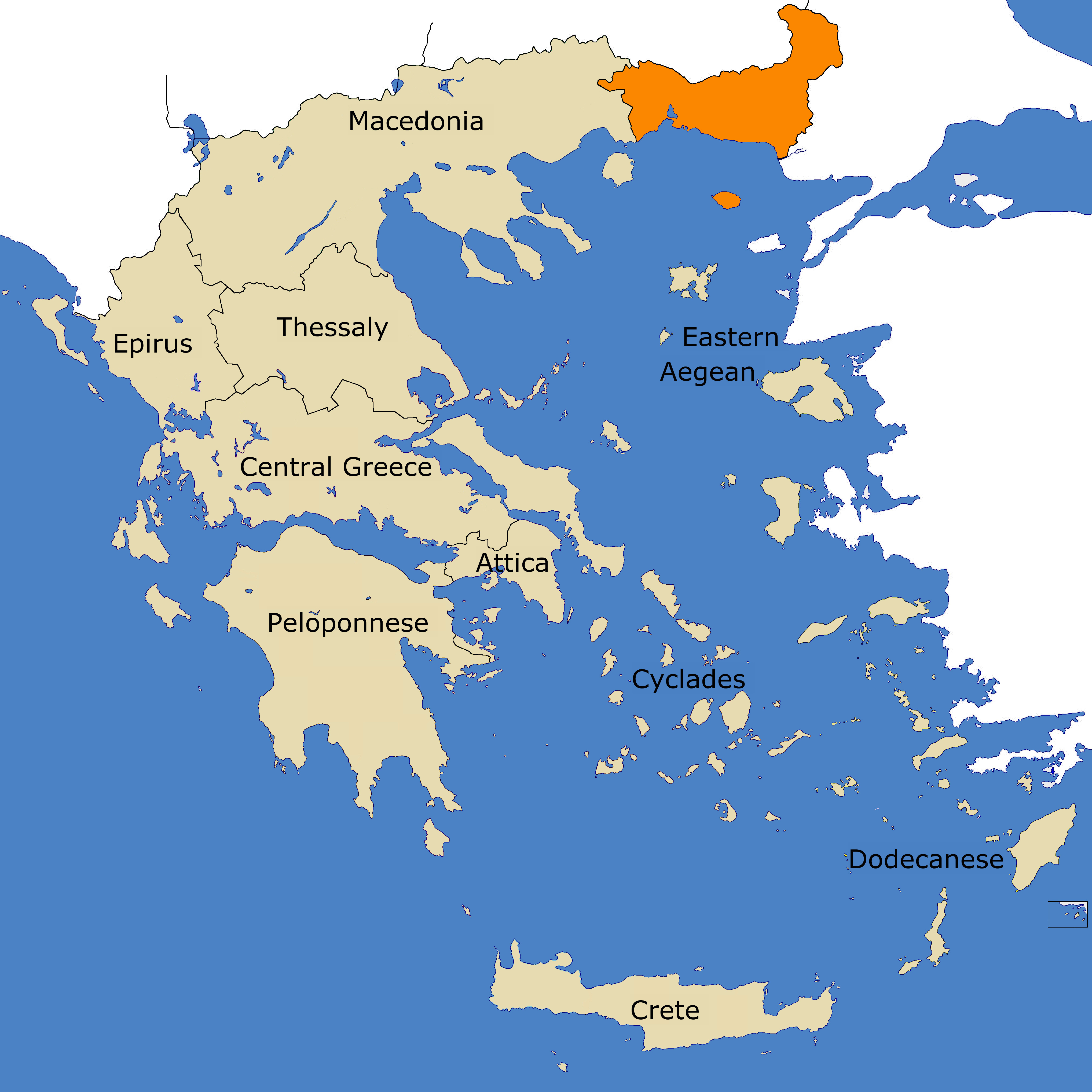
Thracia (Thrace) is the region in the most northeastern part of the country (8600 km2,
371,000 inhabitants). It includes Evros, Rodopi, and Xanthi. Ancient Thracia was considerably larger, including parts of
modern Bulgaria and the European part of Turkey.
Thracian Chersonesos
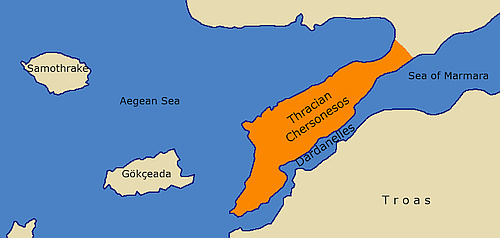
In antiquity the present Gallipoli peninsula in Turkey, north of the
Dardanelles.
Thrasymedes
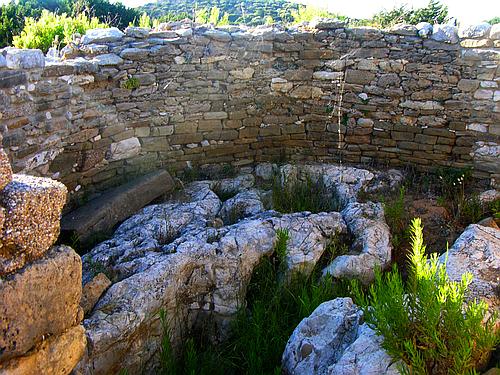
A son of Nestor and Anaxibia. He accompanied his father on the
expedition against Troy, and returned with him to Pylos. His
conjectured tomb is still shown at Voidokoilia (see: site
page).
threshold
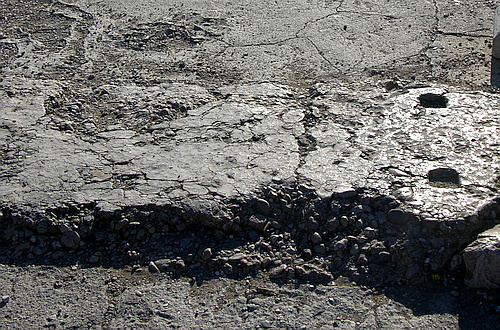
The piece of timber or stone which lies below the bottom of an entrance door. It has to be crossed
when entering the bulding.
Thukydides
Historian and general (ca. 460 - ca. 400 BC). He was born near Athens as the son of an aristocrat. When he was old enough he joined the army and advanced to become the commander of the Athenian fleet. He was, however, defeated by the Spartans under general Brasidas in the battle of Amphipolis in 422 BC and was then exiled from Athens for 20 years. In this time, he wrote his famous History of the Peloponnesian War. For this work he was dubbed the "father of scientific history" because of his strict standards of evidence-gathering and analysis of cause and effect without referring to some intervention by the gods. Outstanding in his book is the Melian dialogue reflecting international relations while Perikles' Funeral Oration is a milestone in political theory.
Thule
The ancient Greek and Latin name for an island presumed to be the most northerly region of the world. It has been variously identified as one of the Shetland Islands, Iceland or Norway.
Thyades
Thyades or Thyiades is the name of the female followers of Dionysos, synonymous with Mainades.
Thyestes
Son of Pelops and Hippodameia. Together with his brother, Atreus, killed an illegitimate son of Pelops to please their mother. Then they went into exile in Mycenae, where their brother-in-law held the throne. When he died, Atreus gained control of the kingdom, but Thyestes seduced Atreus' wife, Aerope, and again went into exile. Eventually he returned - having been made to believe that he was forgiven - and ate the meal his brother Atreus served him. When the final course was brought in, the identity of Thyestes' meal was revealed: the platter contained the heads of all his children except the infant, Aigisthos. Thyestes cursed his brother and fled.
Timarchos
An important Athenian sculptor and bronze founder of the late 4th century BC. His father was Praxiteles, his grandfather Kephisodotos the Elder. He worked together with his brother, Kephisodotos the Younger, making it nearly impossible to attribute a work to either of the two.
timocracy
A timocracy (Greek: timo = "price, worth" and -kratia = "rule") is a form of government where only property owners may participate in governing the state. Solon introduced the idea of timokratia as a graded form of oligarchy in his constitution for Athens in the early 6th century BC, allocating political rights and economic responsibility depending on membership of one of four tiers of the population. - When power derives entirely from wealth with no regard for social or civic responsibility, timocracy becomes plutocracy.
Timon
1) Timon of Phlius (ca. 320 BC - ca. 230 BC) was a Greek skeptic philosopher and writer. In philosophy, he was mainly influenced by Pyrrho. Of his numerous writings, namely poetry, tragedies, satiric dramas, and comedies, very little remains. His most famous composition was his Silloi, a satirical account of famous philosophers which is known from ancient quotations.
2) Timon of Athens (5th century BC) was a legendary misanthropist. According to Aristophanes, Timon was an angry despiser of mankind who held Alkibiades in high regard because he correctly believed Alkibiades would someday harm Athens.
Timotheos
Timotheos (died ca. 340 BC) was a Greek sculptor, one of the rivals and contemporaries of Skopas of Paros. Around 380 BC, he was probably the leading sculptor at the temple of Asklepios at Epidaurus, and between 353 and 350 BC he worked on the Mausoleum in Halikarnassos.
 Tiryns
A Mycenaean archaeological site in
Argolis, some kilometres north of Nafplion. - Tiryns was a hill fort with occupation
ranging back seven thousand years, from before the beginning of the Bronze Age. It
reached its height between 1400 and 1200 BC, when it was one of the most important centers of the Mycenaean world. Most
notable are its palace, its cyclopean tunnels and especially its walls, which gave the
city its Homeric epithet of "mighty walled Tiryns". In ancient times, the city was linked to the myths surrounding
Herakles, with some sources citing it as his birthplace. - In 1300 BC the citadel and
lower town had a population of 10,000 people covering 20-25 hectares. The site went into decline at the end of the
Mycenaean period, the palace being destroyed in 1200 BC. Nevertheless, the city population continued to increase and by
1150 BC the population were 15,000 people. By the time Pausanias visited Tiryns in the
2nd century AD it was completely deserted. - The site was excavated by Heinrich
Schliemann in 1884-1885, and is the subject of ongoing excavations by the German Archaeological Institute at Athens
and the University of Heidelberg. In 1999, Tiryns was recognized as one of the World Heritage Sites.
 Tisamenos
1) A son of Orestes and Hermione, was king of Argos. Tisamenos was slain when the Heraklids invaded the Peloponnese.
2) A son of Thersandros and Demonassa, was king of Thebes.
3) A seer from Elis who won great respect especially from the Spartans. He accompanied the Greek allies when they faced the Persian army near Plataiai. Reading the omens of sacrifices, he advised the Greeks to stay in defense and not to cross the river Asopos. After ten days of ill omens from their sacrifices, the Persians crossed the river to attack the Greeks and were thoroughly defeated.
Tisiphone
1) One of the Erinyes.
2) A daughter of Alkmaion, leader of the Epigoni, and Manto, daughter of the seer Teiresias. Her father gave her to king Kreon of Corinth to be brought up, but Kreon's wife sold her as a slave because she feared her beauty. According to Apollodorus, she was coincidentally bought by her father, who kept her as a maid, not knowing that she was his daughter.
3) There is another mystic personage of this name.
Titan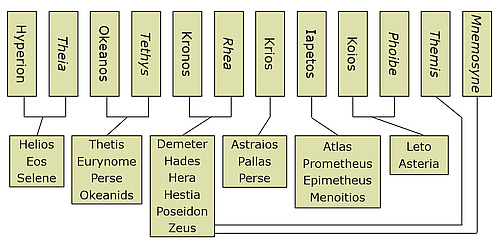
A member of the second generation of deities in Greek mythology. They are the twelve children of the primordial deities Gaia and Uranos, namely: Hyperion, Iapetos, Koios, Krios, Kronos, Mnemosyne, Okeanos, Phoibe, Rhea, Tethys, Theia, and Themis. - Their children represent the second generation of Titans. Finally, in the titanomachy, the Titans were overthrown by the children of Kronos, under the leadership of Zeus.
Titanides
The female Titans.
titanomachy
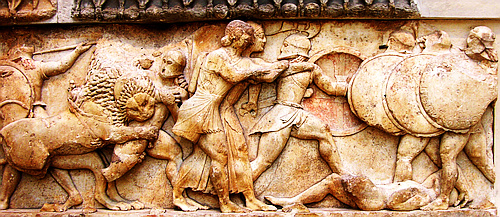
In Greek mythology the ten-years lasting battles between some (not all) of the
Titans and the Olympians and their allies to decide the supremacy in the world.
It ended with the victory of the Olympian Gods, the younger generation. - The titanomachy was recounted by
Hesiod in his Theogony and was a popular subject in the
arts.
Tithonos
King of Troy; son of Laomedon, brother of Priam. Eos fell in love with him and asked Zeus to make Tithonos immortal, but forgot to ask Zeus to also bestow eternal youth. When Tithonos had become an old, shrivelled man, Eos turned him into a cicada.
Tlepolemos
1) A son of Herakles by Astyocheia or by Astydameia. Tlepolemos was king of Argos, but after slaying his uncle Likymnios, he had to flee and settled in Rhodos. From there he joined the Greeks in the Trojan War with nine ships and was killed by Sarpedon.
2) A Trojan, a son of Damastor, who was slain by Patroklos.
toumba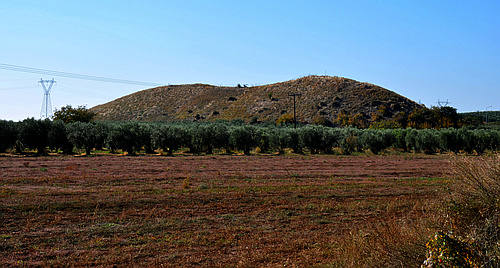
An artificial mound resulting from successive layers of deposits of a destroyed ancient settlement.
The term is especially applied to mounds from Bronze Age and
Early Iron Age settlements. In Thessaly toumbas are
usually called magoulas.
trabeated system
--> post and lintel
tragedy
A form of drama addressing human suffering that invokes an accompanying katharsis or pleasure in the audience. Many cultures have developed forms that provoke this paradoxical response, but the tragedy in Western civilisation has a 2500 years old tradition that goes back to ancient Greece. However, only a fraction of the works of Aischylos, Sophokles and Euripides has survived. - Many philosophers, including Plato and Aristotle, have analysed, speculated upon, and criticised the genre.
transept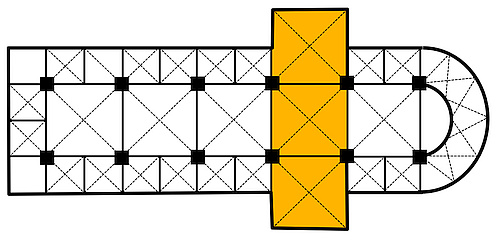
A section of a building that lies across the main body of the building. In a cruciform
("cross-shaped") basilica it is an area set crosswise to the
nave.
triglyph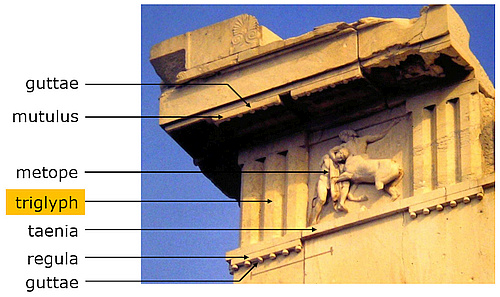
Weight supporting blocks with vertical grooves producing three raised strips. In the architecture of
Doric temples the frieze consists
of alternating triglyphs and metopes. Triglyphs are the representation in stone of the
ends of earlier timber beams that supported the roof. In classical architecture triglyphs are always accompanied by a
set of six guttae below them.
Triopas
1) A son of Poseidon and Kanake, and the father of Iphimedeia and Erysichthon. He expelled the Pelasgians, but had to emigrate himself and went to Karia. Because her sacred grove had been violated, Demeter punished him (or his son) with insatiable hunger.
2) An Argive, father of Iasos, Agenor and Messene.
tripod
A tripod (Greek: "three-footed") generally is a three-legged piece of furniture. It is the most stable furniture construction for uneven ground and therefore frequently used. In ancient Greece, sacrificial tripods used for offerings or other ritual procedures were particularly associated with Apollo and the Delphic oracle.
Triptolemos
The favourite of Demeter, and the inventor of the plough and agriculture. There are very different traditions about him, but in the most common one he received from Demeter seeds of wheat and a chariot with winged dragons. With this he rode all over the earth, making man acquainted with the blessings of agriculture. He had temples and statues both at Eleusis and Athens.
trireme
A trireme (Ancient Greek: trieres = "three-rower") was an ancient vessel propelled mainly by rowing that was used by the ancient maritime civilizations of the Mediterranean, especially the Phoenicians, ancient Greeks and Romans. It had three rows of oars, manned with one man per oar. Triremes were fast and agile, the dominant warship in the Mediterranean during the 7th to 4th centuries BC. They played a vital role in the Persian Wars, the creation of the Athenian maritime empire, and its downfall in the Peloponnesian war.
Triton
A minor sea-god, son of Poseidon and Amphitrite. He is said to have helped the Argonauts pulling back their ship, the Argo, back to the sea when they were stranded in the middle of the Libyan desert. - In ancient Greek art, Triton was represented with a great shell which he blew as his horn.
trittyes
--> deme
Troas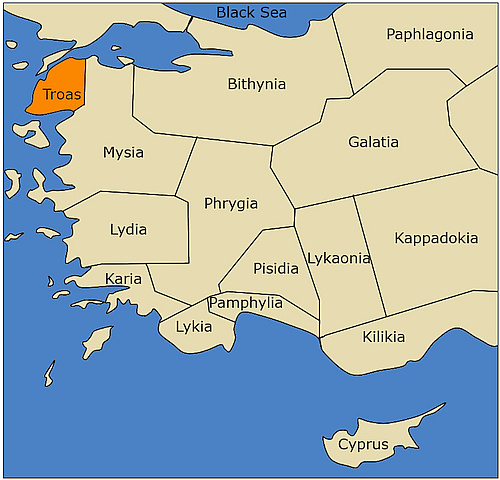
Troas, also called Troad, is the historical name of the peninsula in the northwestern part of
present-day Anatolia, Turkey. It is bounded by the Dardanelles to the northwest, by
the Aegean Sea to the west and the massif of Mount Ida to the east. The Troas is the region around ancient
Troy from which its name is derived.
Trojan Horse
--> Wooden Horse
Trojan War
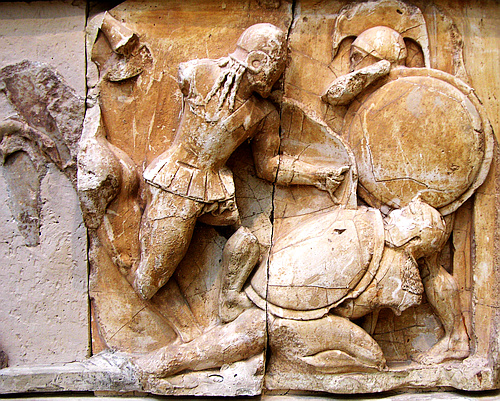
The ten years siege and sack of Troy by Mycenaean Greeks, the
"Achaeans", from the central and southern Greek mainland. It is handed down in
Homer's epic poem Iliad (although it only relates a
period of four days and two nights in the tenth year of the siege), in the Epic
Cycle, book 2 of the Aeneid, various Greek
tragedies, and Greek tradition in general. - The antecedents go far back to the
Judgement of Paris and Aphrodite promising
Paris the fairest mortal to be his wife. To Paris this was
Helena, the wife of king Menelaos of Sparta. When
Paris kidnapped her (or perhaps she came willingly), this was the actual cause of the Trojan War. When Menelaos demanded
her return, the Trojans refused. Under the command of king Agamemnon of
Mycenae, the Greeks then gathered an enormous army at Aulis.
Due to the dead calm caused by Artemis, the fleet could only leave after Agamemnon had
sacrificed his daughter Iphigeneia. The Greek invasion force then set sail to
Troy, led by the greatest Greek heroes: Achilles,
Patroklos, Diomedes,
Odysseus, Nestor, and the two warriors named Aias. For ten
years, the Achaeans besieged Troy and ravaged the countryside, but the city, heavily fortified and
guarded by Hektor and other heroes of the royal household, did not fall. Also, none of the
numerous battles outside the city walls was decisive. Even the gods were involved:
Poseidon, Hera, Hephaistos,
Thetis, Athena, and Hermes aided the Greeks, while
Ares, Aphrodite, Artemis,
and Leto were on the side of the Trojans. Zeus and
Apollo, often involved in the fights, seemed to have favoured the Trojans but mostly
remained impartial. Finally, Odysseus had the idea to build a hollow Wooden Horse in
which 40 warriors were concealed. Meanwhile, the Greeks burned their camp and sailed away, hiding behind the island of
Tenedos. Although warned by Kassandra and
Laokoon the Trojans pulled the Wooden Horse into the city walls and turned to a night of
mad revelry and celebration. At midnight the hidden Greeks killed the guards, signaled the waiting fleet and opened the
city gates. Troy was burned and razed to the ground, most of its people killed. - Concerning the historicity of the
Trojan War, largely rejected in the 18th century, new facts have appeared. Meanwhile, the location of ancient Troy has
been securely confirmed, and most scholars believe that there is at least a historical core to the tale. If seen as a
specific historical conflict it is usually dated to the 12th or 11th century BC, many preferring the dates given by
Eratosthenes, 1194-1184 BC. This would correspond to the archaeologically confirmed
devastating burning of Troy VIIa.
Troy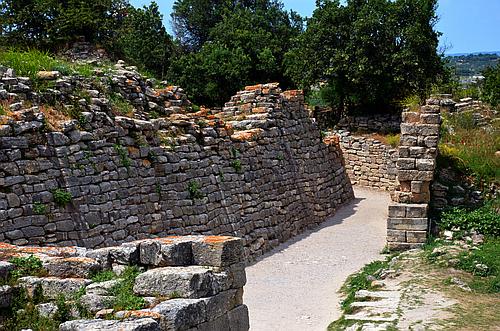
Legendary region or city and citadel in
Asia Minor. Homer usually refers to this city, of which
Priam was the last king, under the name "Ilion". The excavations by Heinrich
Schliemann since 1870 placed this site at Hisarlik in modern Turkey, a view meanwhile securely confirmed.
Excavations at Hisarlik by the University of Tübingen are still ongoing. - In spite of several destructions,
Troy-Hisarlik was repeatedly rebuilt. Of the ten distinct strata, the oldest (Troy I) is dated to the third millenium
B.C.; Troy II (ca. 2500-2200 BC) must have been a wealthy residence. Schliemann considered it to be Homeric Ilion, but
this is now thought to be Troy VIIa (the citadel was probably destroyed in the period between 1325 and 1200 BC by
Mycenaean Greeks). Troy IX is Hellenistic and Roman.
- See also: site page.
Tros
A son of Erichthonios and Astyocheia, and a grandson of Dardanos. By Kalirrhoë he was the father of Ilos, Assarakos and Ganymede. The country and city of Troy derived their name from him.
Tsountas
Christos Tsountas (1857 - 1934) was a Greek archaeologist. In 1886, he discovered and identified the Mycenaean citadel of Tiryns. In a survey he identified a number of other Bronze Age sites and carried out important excavations at Mycenae. His investigation of several burial sites on islands of the Cyclades led him to coin the term "Cycladic civilization" and is therefore known as "father of Cycladic research".
tumulus
A funerary monument in the form of a conical man-made mound of stones and earth covering one or more
tombs.
Twelve Labours of
Herakles
--> athloi
Tyche
In ancient Greek mythology the goddess of fortune, perhaps one of the Okeanids. Worshipped since the 4th century BC, she is somehow related to Nemesis: Tyche could give good luck to a person, but if this was undeserved, Nemesis could take it away.
Tydeus
A son of Oineus and Periboia. He was king of Kalydon, but because of some murder he had committed, he had to flee and went to Adrastos at Argos, who purified him from the murder, and gave him his daughter Deïpyle in marriage by whom he then became the father of Diomedes. Together with Adrastos he joined the expedition against Thebes, where he was wounded by Melanippos, who, however, was slain by him. When Tydeus lay on the ground wounded, Athena wanted to rescue him, but Amphiaraos, in his hate against Tydeus, intervened: he cut off the head of Melanippos and brought it to Tydeus. When Tydeus cut it in two and ate the brain, Athena disappeared shuddering and Tydeus died.
tympanon
--> pediment
Tyndareos
The son of Perieres and Gorgophone. He was king of Sparta and married to Leda. One night Leda was embraced both by Zeus and Tyndareos, and the result of this was the birth of Polydeukes and Helena, the children of Zeus, and of Kastor and Klytaimnestra, the children of Tyndareos. When Tyndareos saw that his beautiful daughter Helena was beleaguered by suitors, he began to be afraid, that if one should be successful, the others would create trouble. On the advice of Odysseus, he had them all swear to protect the suitor that should be preferred by Helena, against any wrong that might be done to him. To reward Odysseus for this good advice, Tyndareos himself begged his brother Ikarios to give to Odysseus his daughter Penelope.
Typhon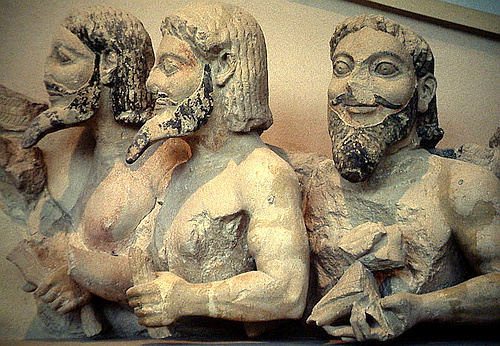
A monster of the primitive world, is described either as a destructive hurricane or as a
fire-breathing giant. Hesiod distinguishes two separate beings: Typhaon and Typhoeus,
often confused with later writers. There, Typhaon is a fearful hurricane, who by Echidna
became the father of Orthos, Kerberos, the
Lernaean Hydra, Chimaira, and the
Sphinx. Typhoeus, on the other hand, is described as a monster with a hundred heads,
fearful eyes, and terrible voices, the youngest son of Tartaros and
Gaia. He wanted to acquire the sovereignty of all immortals and men, but after a fierce fight was killed by
Zeus with a flash of lightning.
tyranny
In its modern sense a political system with an absolute ruler unrestrained by law or constitution. In ancient Greece, the term originally merely meant an authoritarian sovereign. In the seventh and sixth centuries BC, tyranny was often seen as an intermediate stage between oligarchy and more democratic forms of polity. Later, it had a more negative connotation. Plato and Aristotle define a tyrant as "one who rules without law, and uses extreme and cruel tactics - against his own people as well as others".
Tyro
A daughter of Salmoneus and Alkidice. She was the wife of Kretheus, by whom she became the mother of Aison, Pheres, and Amythaon. But Tyro was also the beloved of the river-god Enipeus in Thessaly, in whose form Zeus visited her and made her the mother of Pelias and Neleus.
Tyrrhenians
A name used by ancient Greek authors to refer to a prehellenic tribe, usually identified with the Etruscans, an ancient people in Italian Etruria, whose culture flourished mainly in the 6th century BC.
Tyrtaios
A Greek lyric poet (fl. 7th century BC) from Sparta, known especially for political and military elegies.

