
GREECE
 GLOSSARY
| A | B | C | D |
| E | F | G | H |
| I | J | K | L |
| M | N | O | P |
| Q | R | S | T |
| U | V | W | X |
| Y | Z |
2026-01-22
color code:  = mythology;
 = history & culture;
  = geography;
  = archaeology &
architecture
= archaeology &
architecture
caduceus
--> kerykaion
 Cape Artemision
--> Artemision
capital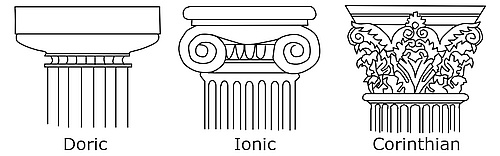
The topmost element of a column. It projects on each side to support the
abakus and it is the junction between the circular shaft and
the square abakus. The bulk of the capital may be convex as in the
Doric order, scrolling out as in the Ionic order or
concave as in the Corinthian order.
carinated
Refers to vessels with a sharp edge like a keel (Latin carina), produced when a concave profile sits next to a convex profile.
 caryatid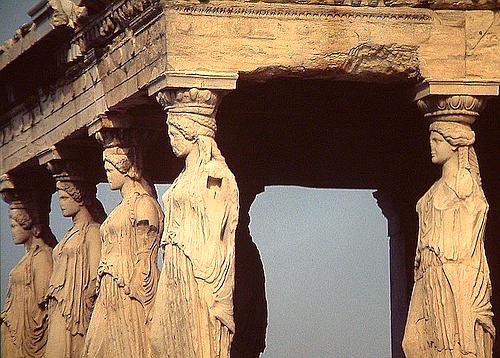
A sculptured female figure used as a column. This occurs sometimes in the
Classical period. It is thought that the name could derive from the place Karyai in the
Peloponnese, where the sculptors' models came from.
Caskey
John "Jack" Langdon Caskey (1908-1981) was an American archaeologist and classical scholar. He excavated in Troy, Lerna, and Agia Eirene (island of Kea). From 1949 to 1959 he was director of the American School of Classical Studies in Athens, and from 1959 to 1979 he was head of the Classics department at the University of Cincinnati.
Cassander
--> Kassandros
Cassiopeia
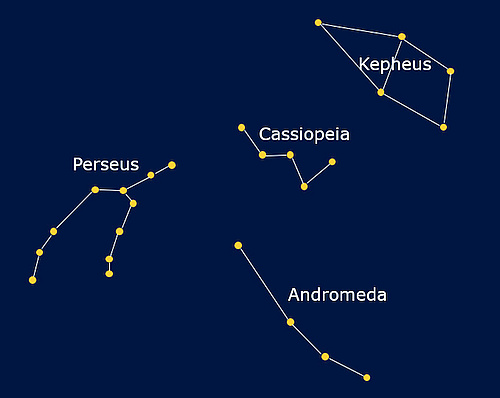
The wife of Kepheus and mother of
Andromeda. She boasted that her daughter was fairer than the Nereids and therefore
Poseidon brought disaster to the country which could only be stopped by sacrificing
Andromeda. Perseus saved the maiden and married her. - In the night sky the constellation
of Cassiopeia can be seen along with her daughter, her husband, and Perseus.
Catalogue of Ships
An epic catalogue in Book 2 of Homer's Iliad, which lists the contingents of the Achaean army that sailed to Troy.
cauliculus
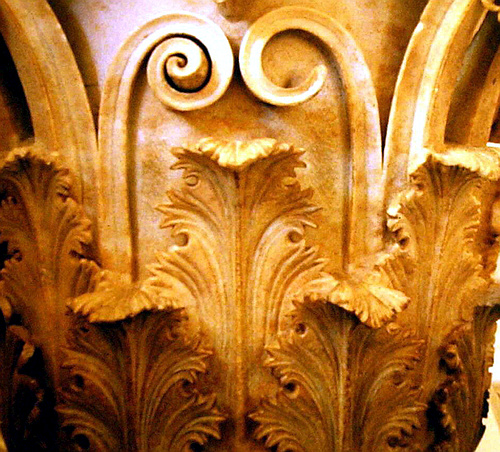
Stalks with two leaves from which rise the spiral scrolls of the
Corinthian capital.
causeway
A raised road built on a mound, e.g. leading to an island.
cavea
The seating area in an ancient Greek theatre. See: koilon.
cella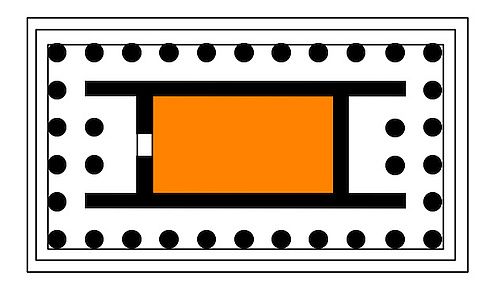
The central inner room, also called naos, of a Greek temple. It has no
windows and has a single axially located entrance at one of the short sides. The cella housed the cult statue of the god
or goddess to whom the temple was dedicated. In larger temples this would be in a separate adyton.
celt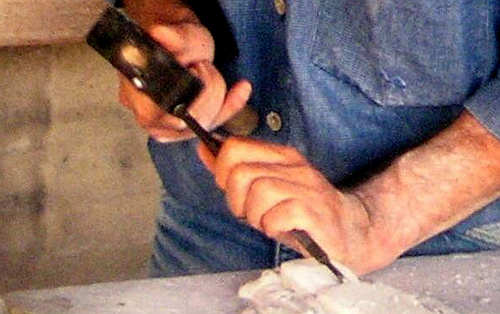
A stone sculptor's chisel.
censer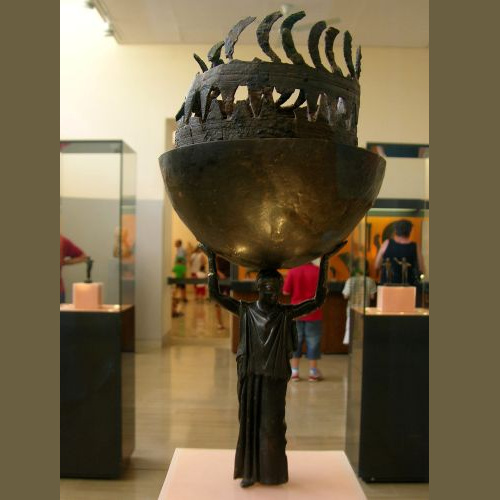
A censer or incense burner is a vessel made for burning incense (an aromatic biotic material which
releases fragrant smoke when burned) or perfume in some solid form. Since ancient times, they have been used in many
cultures, usually with spiritual and religious connotations.
centaur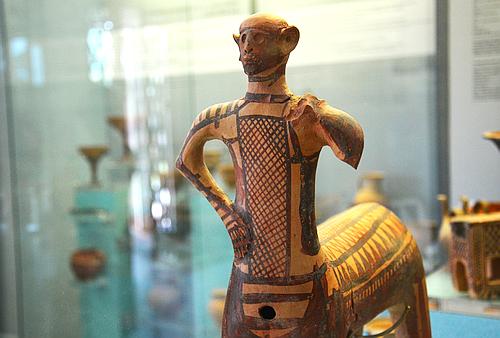
Centaurs ("bullkillers") are mythological creatures that were half man half horse. They are said to
have lived a wild and savage life on the mountains of Pelion where they occasionally abducted the women of neighboring
tribes. A very popular theme in arts is their fight with the Lapiths at the
marriage-feast of Peirithoos. There may have been two distinct generations that are
both designated as centaurs: the earlier group are merely wild and strange creatures which may be acquainted with the arts as
in the case of Cheiron, whereas a later group is more described as gigantic monsters
(hippocentaurs).
Centaurus
In ancient Greek mythology a son of Apollo and Stilbe. He is the twin brother of Lapithes and father of the mythological beasts known as centaurs. - A bright constellation in the southern sky also bears his name.
Central Greece
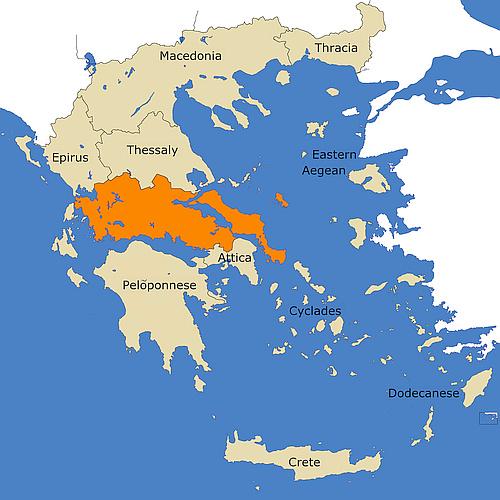
Administrative region of Greece (15,550 km2, 510,000 inhabitants) including
Aetoloacarnania, Evrytania, Euboea,
Phokis, Fthiotis, and
Boeotia.
Cerberus
--> Kerberos
Ceyx
--> Keyx
Chabrias
Chabrias (before 420 - 357 BC) was an Athenian general active in the first half of the 4th century BC. During his career he won a number of battles, both on land and sea, so that Demosthenes celebrated him as one of the most successful commanders Athens ever had.
Chadwick
John Chadwick (1920 - 1998) was an English linguist and classical scholar. Together with Michael Ventris he deciphered Linear B in 1952.
Chaironeia
A village in Boeotia, located about 80 kilometers east of Delphi. It is best known as the site of the Battle of Chaironeia in 338 BC, fought between the Macedonians led by Philip II of Macedon and an alliance of some of the Greek city-states including Athens and Thebes. It ended with a decisive victory of the Macedonians, marking their final domination over Greece.
Chalkidike
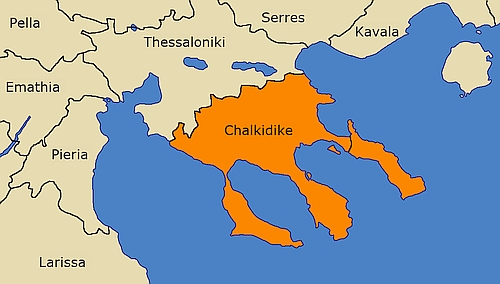
Mountaineous region in northern Greece, part of Macedonia. Most
prominent are the three elongated peninsulae - from West to East: Kassandra (ancient
Pallene), Sithonia (ancient Longos), and the autonomous
polity Athos (ancient Akté).
Chalkiope
A daughter of king Aietes of Kolchis and his wife Idyia. She was a sister of Medea and half-sister of Absyrtos. When Phrixos reached Kolchis on the flying ram with the Golden Fleece, Aietes gave him sanctuary and Chalkiope to marry. Together they had four sons: Argos, Kytissoros, Phrontis, and Melas. At the magical ram's request, its body was sacrificed and its Golden Fleece was placed in the Garden of Ares at Kolchis. - After Phrixos had died of old age, his sons set out on a quest to avenge the unjust expulsion of their father from Orchomenos. They soon became shipwrecked on an island, from where they were rescued by the Argonauts, who were on the way to recover the Golden Fleece. After that, when Medea fled Kolchis together with the Argonauts and Absyrtos was killed in their pursuit, Chalkiope was Aietes' only child who stayed with him in Kolchis.
chamber tomb
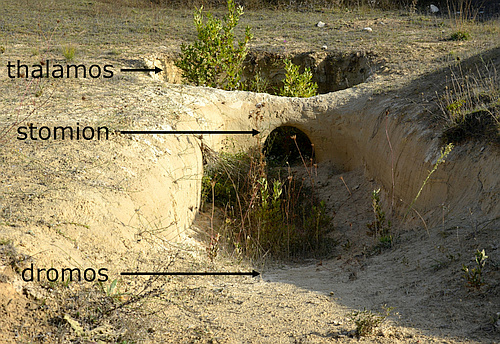
A form of mortuary architecture that was in use in the Late Bronze
Age during the Mycenaean period between 1600 BC and 1100 BC. The tombs are cut into
the rock and have a tripartite structure, consisting of dromos (entrance passage),
stomion (doorway) and thalamos (burial chamber; in the
picture with collapsed ceiling). The chamber tombs often have additional niches and side chambers used for primary or
secondary burials. They were much more frequent than the contemporary tholos tombs.
chancel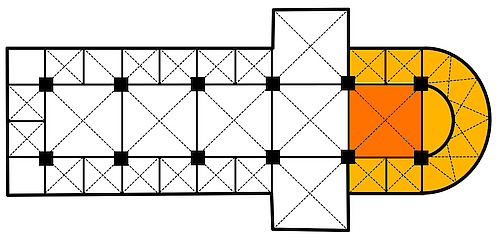
The part of a church where the altar stands with the choir, usually in the
eastern part of the church. If there are more architectural elements at this end, like an
ambulatory, they are mostly included.
Chaones
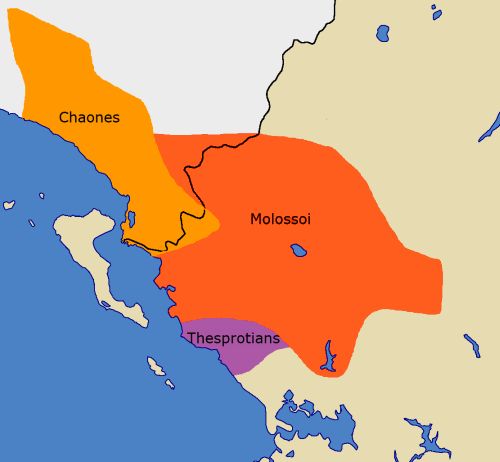
An ancient Greek tribe that inhabited the region of Epirus located in
the north-west of modern Greece and southern Albania.
Chaos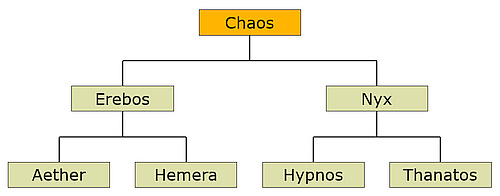
In ancient cosmogonies the infinite space that existed before the creation of the world. Out of this
the gods, men, and all things arose. Ovid describes it as a confused mass which contained
all elements of the things to be created. In Hesiod's theogony this is personalized,
making Chaos the mother of Erebos (darkness) and Nyx (night).
Chares of Athens
Chares of Athens was an Athenian general in the 4th century BC and who for a number of years was a key commander of Athenian forces. He was also a well connected politician enabling him to procure the commands with which he enriched himself and his adherents.
Chares of Lindos
Chares of Lindos (fl. 280 BC) was a Greek sculptor born on the island of Rhodos. He was a pupil of Lysippos. Chares' greatest accomplishment was the construction of the Colossus of Rhodos in 282 BC, an enormous bronze statue of the sun god Helios and also the patron god of Rhodos. It was one of the Seven Wonders of the Ancient World. Probably Chares did not live to see his project finished, because according to several legends he committed suicide.
Charicles
An ancient Athenian politician. He was mentioned by Aristotle and by Xenophon as one of the Thirty Tyrants.
Charilaos
A king of Sparta (fl. early - mid 8th century BC). It was probably during his reign that the Spartans invaded the Argolis. However, he is better known as the nephew and pupil of the Spartan reformer Lykurgos.
Charis
--> Aglaia
Charites
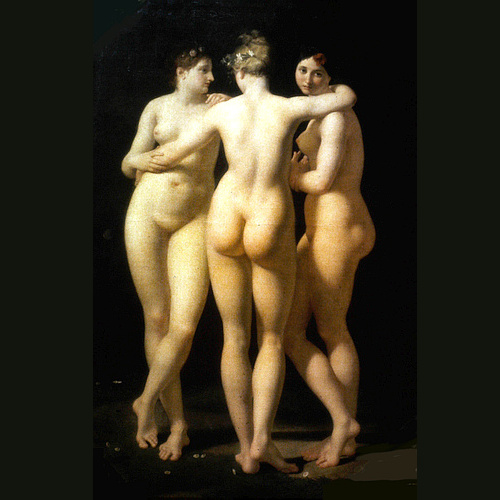
The three sisters Aglaia, Euphrosyne,
and Thalia, daughters of Zeus and
Eurynome. They were worshipped as givers of beauty and charm and, like the Horai
attendants of Aphrodite.
Charon
Ferryman of the dead in the underworld. Charon would ferry the buried bodies across the rivers Acheron, Kokytos, and Styx to the gate of Hades. His fee was one obol, a silver coin, placed under the tongue of the dead. Since Charon refused to ferry unburied bodies, the funeral was a rite of high importance in classical Greece.
charonian stairway
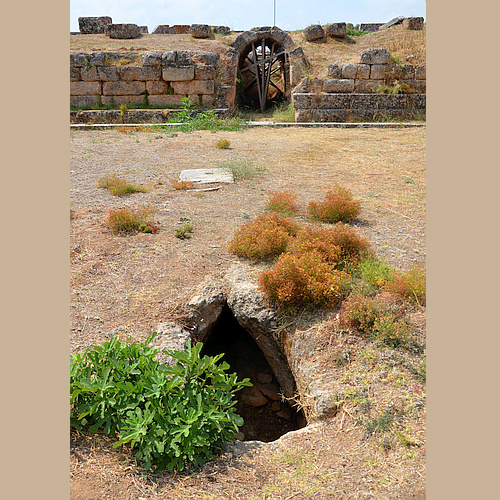
The charonian stairway (stairway of Charon) is a vaulted underground passage in
a few Greek theatres that allows actors impersonating a chthonic
deity or the soul of a deceased to appear from below the earth in the orchestra and
perf orm there.
 Charybdis
A monster, daughter of Gaia and Poseidon. She used to suck down the waters thrice every day into her maw and then spew them out causing gigantic waves. To avoid this, passing ships had to sail close to the opposite side of the straits where the six headed monster, Skylla awaited them. The location has a long time been associated with the Strait of Messina (northeast of Sicily), but this has been questioned convincingly by new proposals, favouring the strait between Lefkada and mainland Greece.
Cheiron
Wise and immortal centaur, son of Kronos and Philyra. To avoid being detected by his wife Rhea, Kronos disguised as a horse and therefore their child was born as a centaur. Cheiron was a teacher of Asklepios, Achilles, and Jason. When Cheiron was accidentally wounded by Herakles during his fourth labour (athloi), he gave up his immortality and died.
Chilon
Chilon was an ephor and poet of Sparta in the 6th century BC. He was regarded as one of the Seven Sages of Greece.
Chilonis
Chilonis was a Spartan princess and queen: daughter, wife, sister and grandmother of four different Spartan kings: Leonidas II, Kleombrotos II, Kleomenes III and Agesipolis III respectively.
Chimaira
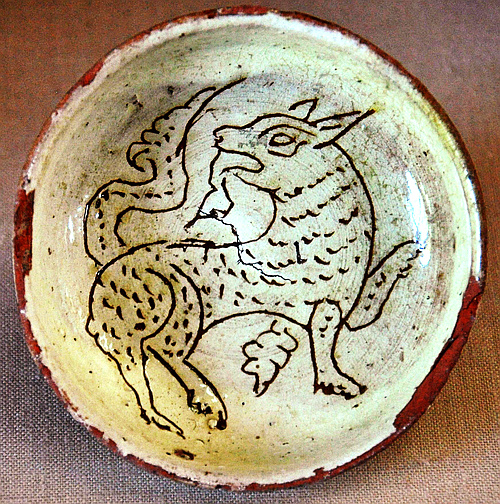
(Greek: "chimaira" = goat) In ancient Greek mythology a fire-breathing, three-headed monster, child
of Hydra, or of Typhon and
Echidna. It was imagined with the head of a lion, the body of a goat and the tail of a dragon. The Chimaira
terrorized Lykia until it was killed by Bellerophontes.
Chione
1) A daughter of Boreas and Oreithyia, and sister of Kalais, Kleopatra, and Zetes. By Poseidon she was the mother of Eumolpos.
2) A daughter of Daidalion. She became the mother of twins: Autolykos by Hermes, and Philammon by Apollo. She was killed by Artemis for having contested her beauty.
3) The mother of three Hyperborean giants by Boreas.
4) The mother of Priapos by Dionysos.
chiton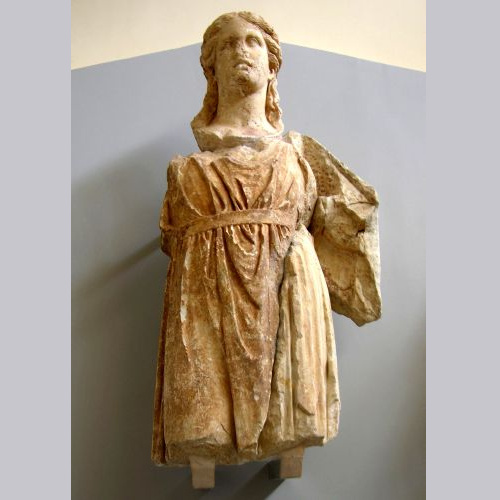
Basic garment in ancient Greece. It was considered feminine and sexy, worn by both women and men -
especially poets and artists. The chiton was fastened at the shoulders and tied with a belt, either under the breast
("high-girded") or around the waist ("low-girded") and often combined with a himation.
chlamys
The chlamys was an ancient Greek type of rather short cloak of woolen material. Originally it was wrapped around the waist like a loincloth, but later laid over the shoulders, often pinned with a fibula over the right shoulder. It could be worn over another item of clothing but for young soldiers and messengers it was often the sole garment.
choir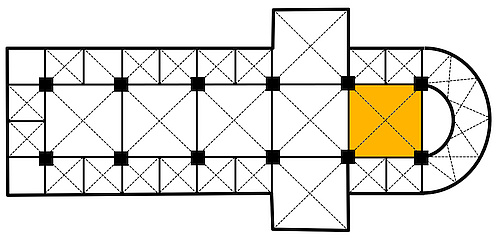
The space in a church reserved for the clergy. It lies between the apse
and the transept.
Choirilos
Choirilos (546 - ca. 460 BC) was an Athenian tragic poe, who presented plays as early as 524 BC, when he was 22 years old.
Chora
The generic name for the main town on a Greek island, regardless of the town's actual name. Therefore, nearly every island in Greece has a town called Chora.
choregos
Wealthy citizen(s) who funded performances in the Greek theatre.
chorodidaskalos
The director of a chorus. He taught songs and ritual dances; originally he performed as well.
chorus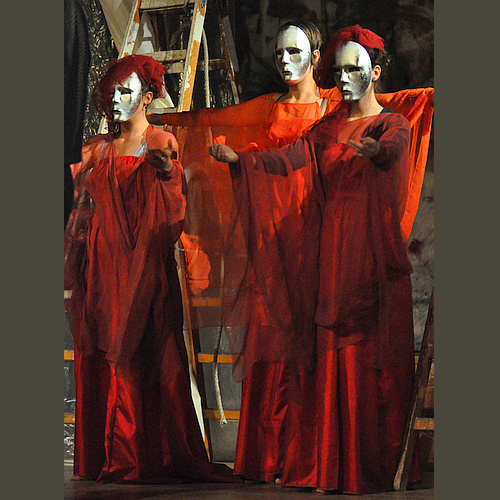
The oldest element of theatrical performances in ancient Greece. It is
a homogeneous group of 12 to 50 performers, speaking or singing their texts in unison. Their non-individualised
character is sometimes stressed by them wearing masks. Members of the chorus were ordinary citizens under the direction
of a leader, the chorodidaskalos.
chresmographion
Chamber between the pronaos and the cella in Greek temples where oracles were delivered.
Chronos
The personification of Time in pre-Socratic philosophy and later literature. In Greek mythology he was a consort of Atropos. - He was already in antiquity often confused with the Titan Kronos.
Chrysaor
(Khyseos = golden; aor = sword) One of the monsters born from the blood of Medusa when Perseus cut off her head. Married with Kallirhoe with whom he fathered the three-headed Geryon and the snake-like Echidna.
Chryseis
Astynome, usually called Chryseis because of her father Chryses, a priest of Apollo. In the Trojan War she was taken prisoner by Achilles and in the distribution of the booty she was given to Agamemnon. When Chryseis' father appealed to Agamemnon and offered a ransom for the return of his daughter, he was treated shamelessly, and sent away. Chryses prayed to Apollo for revenge and his prayers were answered: Apollo rained arrows on the Greek army until Agamemnon returned Chryseis to her father. - Now that Agamemnon was deprived of his prize he took Briseis away from Achilles, who was offended by this seizure and withdrew from the fighting. As a consequence, the Greeks suffered heavy losses until Achilles returned to the fight after the death of Patroklos.
chryselephantine
sculpture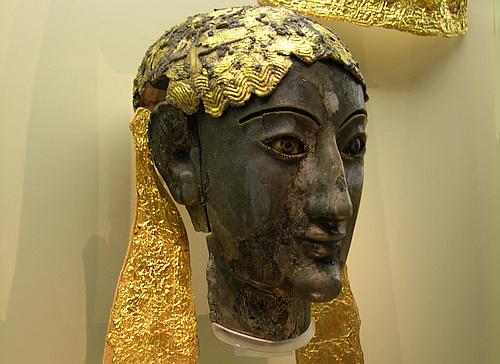
(from Greek chrysós = gold, and elephántinos = ivory) A cult statue made of gold and
ivory, highly valued in ancient Greece. Ivory slabs, representing the flesh, were built around a wooden frame and sheets
of gold represented garments, armour, hair, and other details. Glass paste, glass and semi-precious stones could be used
for the eyes and on other parts of the statue.
Chrysippos
Chrysippos (ca. 279 - ca. 206 BC) was a Greek Stoic philosopher. Born in Asia Minor, he moved to Athens as a young man, where he became a pupil of Kleanthes in the Stoic school founded by Zenon of Kitieus. After the death of Kleanthes around around 230 BC, Chrysippos became the third head (scholarch) of the school. He was a prolific author and stood out due to his contributions to logic, the theory of knowledge, ethics and physics. He widely expanded the doctrines of stoicism which made it one of the most influential philosophical movements for centuries in the Greek and Roman world.
chthonic
(Greek khthonios = "in, under, or beneath the earth") Chthonic literally means "subterranean". In Greek religion it refers to deities or spirits of the underworld like Hades, Persephone and the Erinyes. But for some aspects, also gods like Hermes or Demeter could be considered chthonic. - Ancient Greek has several words for "earth", one of them being khthon, which refers to the interior of the soil, rather than the territory or the surface of the land.
Cicones
--> Kikonians
cist grave
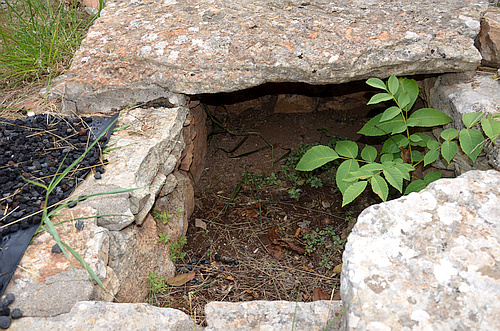
A shallow burial structure in the form of a small, box-like chamber, usually constructed of large
stone slabs set on end. Similar slabs are used for the roof, in some cases also for the floor.
citadel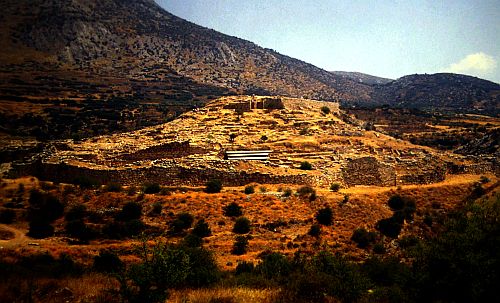
Citadel ("little city") denotes the smaller or inner fortified city, often on a hilltop.
citizen
Citizenship was determined by own rules in the different poleis, one extreme being Sparta. In Classical Athens, on the other hand, a citizen was a person with the right to take part in the assembly, serve on juries and take a turn as a member of the ruling council. Only male Athenians were allowed citizen rights, women and slaves were excluded.
city-state
--> polis
Classical period
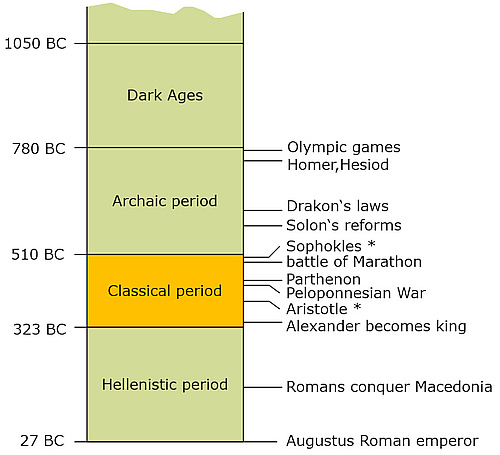
The peak of ancient Greek culture between 510 BC (fall of the Athenian
tyranny) until 323 BC (death of Alexander the Great).
Most important features of this period are the evolution of democracy mainly in
Athens, the Persian Wars ending with an Athenian
hegemony, the Peloponnesian war resulting in
Sparta's domination, but also the "golden age of Perikles" with an enormous boost in
culture, science, and art. The greatest temples, the Parthenon and the
temple of Zeus in Olympia were
erected in this period. Also in sculptures revolutionary developments are seen. Finally, this period saw the rise of
Macedonia to a world power under Alexander the Great,
who subjugated most of the then known world under his reign.
Cloisonné style
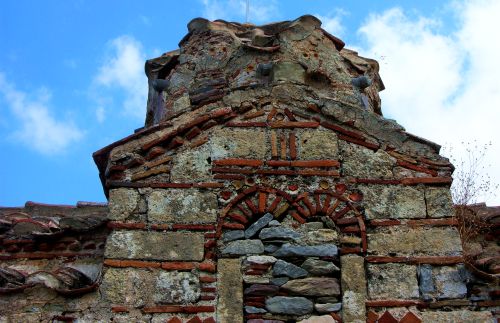
Architectural style in which the walls incorporate sculpted stones and
bricks. This decorative element is often found in Byzantine churches in Greece.
collared jar
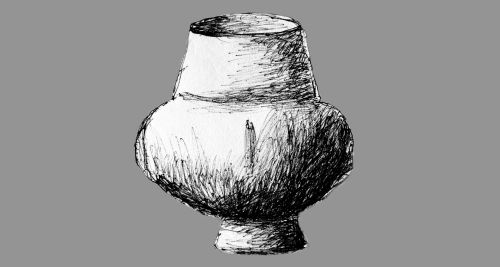
A closed jar with a convex curved body and a constricted, cylindrical neck with no separate mouth.
Such vessels were produced in the Prehistoric Period.
colonisation
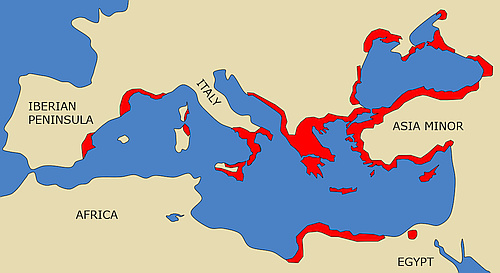
Due to population increase and upheavals in the Eastern Mediterranean during the
Dark Ages between the 12th and 9th centuries BC, Hellenic tribes
(Achaeans, Ionians,
Aeolians, Dorians etc.) migrated from the Greek mainland to the islands of the
Eastern Aegean and the coastal zone of Asia Minor, where they founded new settlements
(First Colonisation). Then, in the Archaic period, the increasingly powerful city-states
founded Greek colonies as far away as Africa, Sicily, Italy, southern France, and southern Spain. In this 'Second
colonisation' of the Mediterranean the Greeks 'sat like the frogs around the pond' (Plato).
colonnade
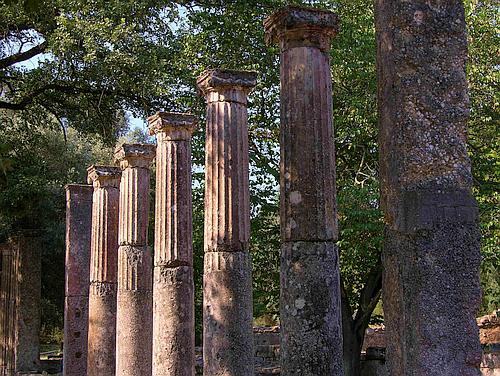
In classical architecture, a long sequence of columns joined by their
entablature, either free-standing or part of a building. When in front of a building,
it is called a portico, when enclosing an open court, a
peristyle. - Colonnades have been built since antiquity and interpretations of this classical model have continued
through to modern times.
Colossus of Rhodos
The Colossus of Rhodos was a bronze statue of the Greek god Helios, erected in the city of Rhodos, on the Greek island of the same name, by Chares of Lindos in 280 BC. It was 70 cubits, or 33 metres high, making it the tallest statue of the ancient world and one of the Seven Wonders of the Ancient World. The popular conception of the statue standing with its legs spanning the entrance to the harbor is imaginative, but not correct; actually it was a free-standing erect figure at the entrance to the harbor of the city of Rhodos. The hollow figure had an iron frame supporting the bronze casing of the body and was filled with stones to add weight and give stability. In 226 BC, it was destroyed by an earthquake and never rebuilt.
column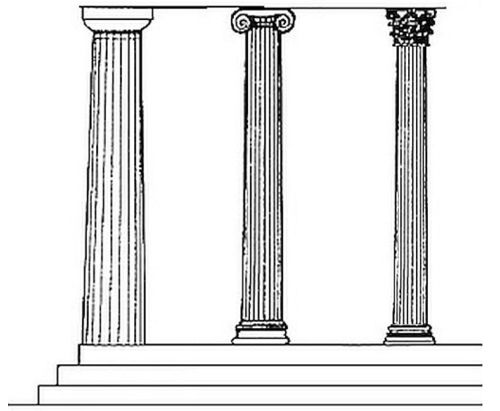
Architectural element with circular cross-section supporting a structure above. It consists of a
base, shaft and capital. In Greek
temples there are, depending on the architectural
order, mainly Doric, Ionic or
Corinthian columns. - Compare: pillar.
comedy
In ancient Greece a genre of of theatrical plays intended to evoke cheerfulness and laughter. It originated from phallic processions at country festivals and evolved, together with the tragedy, into a major part of Greek theatre. Most prominent among its playwrights are Aristophanes and Menandros.
compluvium
In Roman houses, the open space left in the roof of the atrium to let light and fresh air in.
conch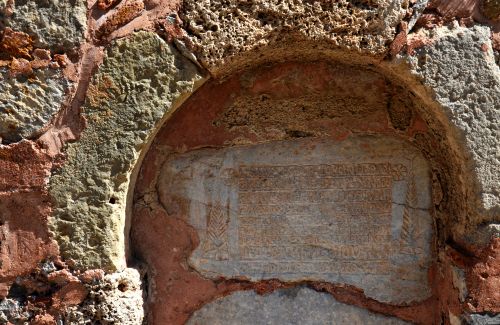
A rectangular or semi-circular recess on a wall. It can serve decorative or functional purpose. -
Sometimes conch is used a synonym of apse.
corbelling
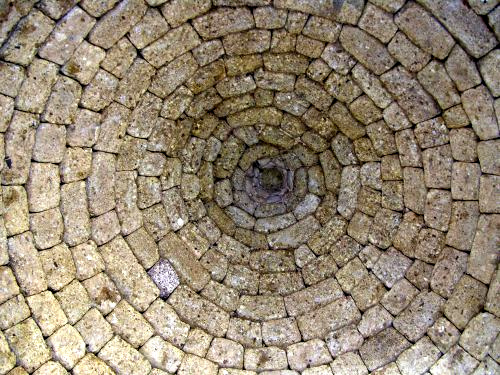
A building method in which circular courses of stones narrow progressively from the bottom to the
top. Finally, a small aperture is left which is closed by the keystone. - See also:
tholos.
Corfu
--> Kerkyra
 Corinth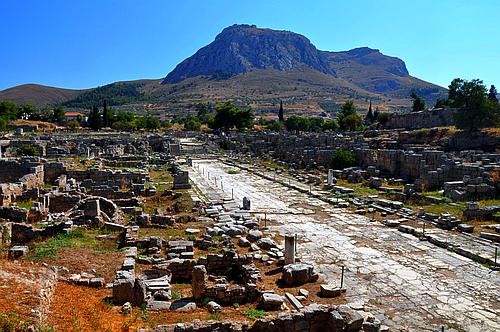
City with 31,000 inhabitants in the north-east of the Peloponnese,
at the Gulf of Corinth and the isthmus. Ancient
Corinth was one of the wealthiest and most powerful of the ancient Greek city-states with a
population of 90,000 in 400 BC. Due to its location, the city was a major trading hub and a thriving artistic center.
The Romans demolished Corinth in 146 BC, and in its place built a new city in 44 BC. Corinth is also known as the city
where Paul the Apostle spent 18 months around 50-52 AD. - See also: site
page.
Corinthian gulf
--> Gulf of Corinth
Corinthian order
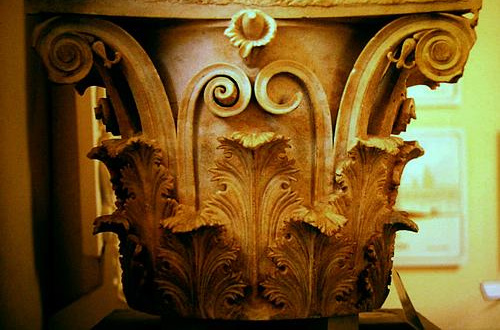
One of the three main architectural orders in classical
Greece. It emerged late in the 5th century BC as a variation of the Ionic order with
differences especially in the column capitals: these consist of an
"cauliculus", an upside-down bell lavishly decorated with stylised acanthus leaves and small vine-like spirals below a
flat abakus. - Considered as too "showy" by ancient Greeks, it was rarely used until the
Hellenistic and Roman periods.
Corinthian War
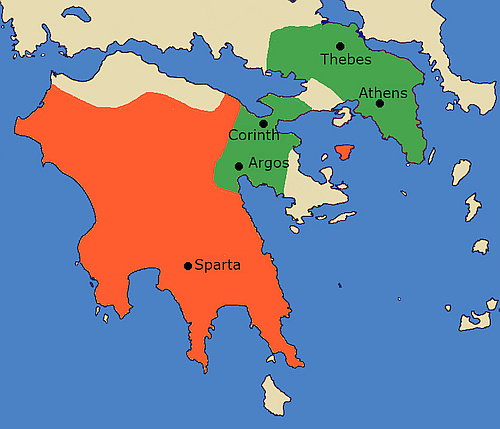
A conflict in ancient Greece lasting from 395 BC until 387 BC, where
Sparta fought against a coalition of Athens, Thebes,
Corinth, and Argos, initially supported by
Persia. The deeper cause of the war was Sparta's expansionism and hostilities broke
out when both Sparta and Corinth intervened in a local conflict in northwestern Greece. Sparta had several early
successes in land battles, but the fighting soon became stalemated. At sea, the Persian fleet decisively defeated the
Spartan fleet early in the war. Athens too advantage of this to launch naval campaigns and recaptured several islands
that belonged to the Athenian Empire in the 5th century BC. This again alarmed the Persians, who now changed sides and
backed Sparta. This defection weakened the allies who now sought peace. In 387 BC the Peace of Antalkidas was signed,
giving Persia the control of all Ionia and independence to all other Greek cities. It confirmed Sparta's hegemonic
position and enabled Persia to interfere in Greek politics.
cornice
--> geison
coroplastic art
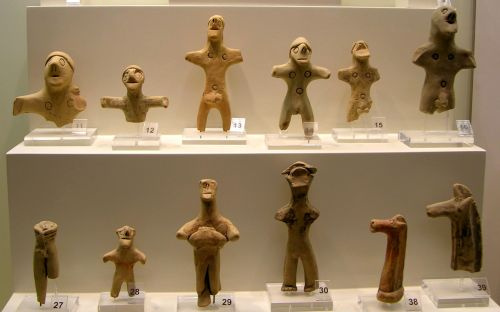
The art of producing terracotta statues and statuettes.
cosmology

(Greek: kosmos = "world" and -logia = "study of") The study of the origin, evolution,
and eventual fate of the universe. In ancient Greece it was one of the subjects of
philosophy, in modern times a branch of astrophysics.
course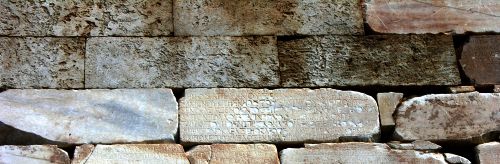
A continuous row of building materials, such as stone or brick.
cremation
The reduction of a corpse to ashes as a way of disposing of it. - Both burial and cremation are evident in the archaeological record in the Neolithic era. From the Cycladic civilization around 3000 BC until the Sub-Mycenaean period in 1100 BC, Greeks practiced burial. Homer's account of Patroklos' burial as cremation with subsequent burial in a tumulus could be seen as the earliest description of cremation rites. However, burial was preferred in the Mycenaean culture so that Homer may refer to the more common use of cremation at the time the Iliad was written.
Cretan Bull
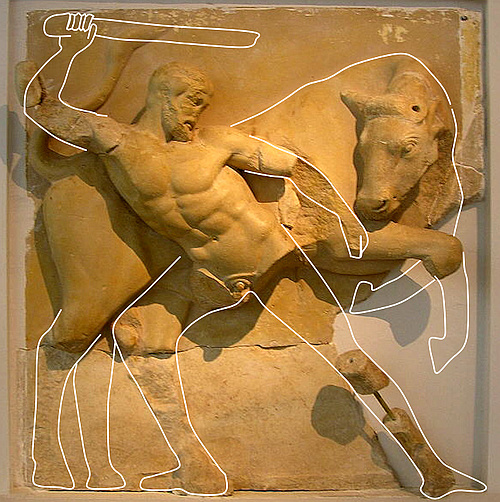
A savage bull ravaging Crete, captured by
Herakles and delivered to Eurystheus as his Seventh
Labor. - Later stories have it that Eurystheus released the bull on the plain of
Marathon ("Marathonian Bull"), where it was once more captured by Theseus.
Crete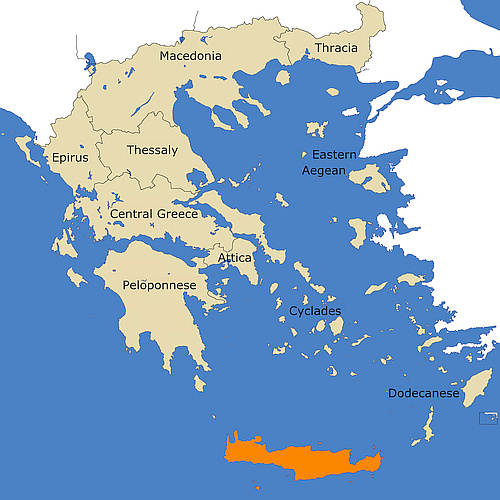
1) Largest Greek island, 21,700 km2, 500,000 inhabitants. In the 3rd and 2nd millenium BC, it
was the centre of the Minoan culture. The location of the island made it ideal for trading
with the Greek mainland, Aegean islannds, Asia Minor, the Middle East and Africa.
2) A daughter of Asterion, and wife of Minos. In other mythological traditions she was the mother of Pasiphaë by Helios.
cubit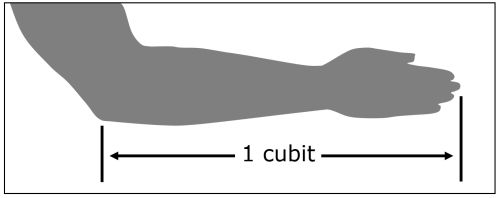
An ancient unit of length based on the forearm length from the middle finger tip to the elbow. In
antiquity, cubits of various lengths were employed in many parts of the world. In ancient Greece, it was about 46 cm.
cuirass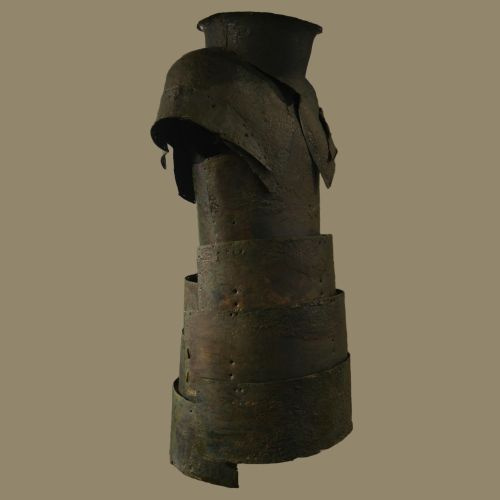
Body armour, usually made of bronze, worn by Greek soldiers to protect their back and chest (all
upper organs). Cuirasses are known since the Mycenaean period like the famous one
pictured here, which comes from a grave in Dendra in the 15th century BC. Later cuirasses were more refined, custom-made
to fit the individual soldier.
cunei
--> kerkis
Cyclades
A group of islands southeast of mainland Greece in the Aegean. It includes more than 200 islands, the major ones being
Amorgos, Anafi, Andros, Antiparos, Delos, Ios, Kea, Kimolos, Kythnos Milos Mykonos Naxos Paros, Folegandros, Serifos, Sifnos, Sikinos, Syros, Tinos, Santorini.
The name ("encircling islands") refers to the island group forming a circle around the sacred island
of Delos.
Cycladic period
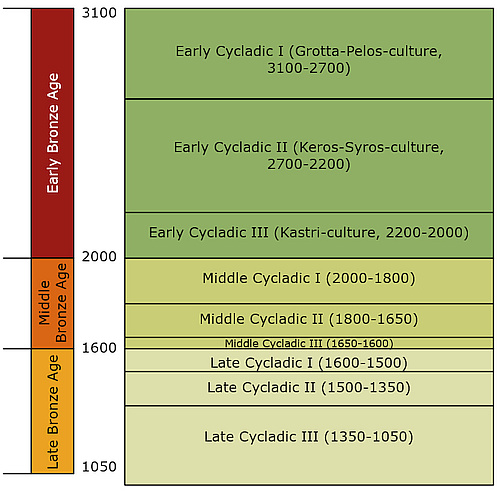
An archaeological term to identify various cultural periods on the Cycladic
islands during the Bronze Age, i.e. between ca. 3100 BC and 1050 BC, when it
converged with the Minoan culture on Crete. It complements two
parallel terms: Helladic on the Greek mainland and Minoan
for Crete.
Cycladic pottery
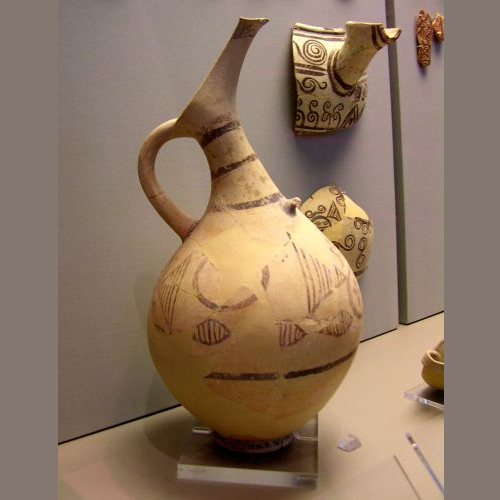
The local clay of the Cyclades proved difficult for artists to work with, so
that the pottery, plates, and vases of the Cycladic period usually is not very delicate. All
pottery of the early Cycladic civilization was made by hand and has thick walls. Among utilitarian pottery, large
pithoi are quite frequent, but there are also other shapes like the
pyxides and the mysterious frying pans. Concerning the
decoration of vessels, the Marine style plays an important role, reflecting the sea-based
culture of the Aegean islands.
cyclic poets
A shorthand term for the early Greek epic poets, authors of the Epic Cycle. Practically nothing is known about them, but assuming that Homer lived in the 8th century BC, then the cyclic poets should be dated in the 7th - 5th centuries BC. None of their works has survived and is only known from fragments and later summaries.
Cyclopean wall
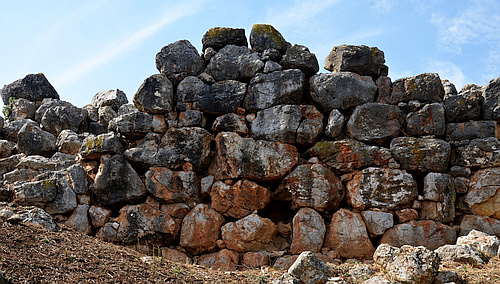
A wall, notably a defensive wall, built of enormous irregular boulders in the
Mycenaean period. Their thickness reaches some 10m. The name was chosen because it was
imagined that only Cyclopes could have moved such boulders weighing up to 14 tons. Best examples
are at Tiryns, but also at Mycenae.
Cyclops
A primordial giant with a single round eye in the middle of the forehead. In Hesiod's Theogony three Cyclopes appear: Arges, Brontes, and Steropes, described as strong, stubborn, and "abrupt of emotion". They are the sons of Gaia and Uranos, but since their father hated all his offsprings they were confined and after Kronos' defeat of Uranos even thrown into the tartaros. When Zeus needed their help in the titanomachy he released them, and afterwards they were the blacksmiths of the Olympian Gods, manufacturing the thunderbolts of Zeus. When one of these thunderbolts killed Asklepios, Apollo killed the Cyclopes. - Homer apparently describes another generation of Cyclopes, a gang of lawless shepherds. One of them is Polyphemos, elaborately mentioned in the Odyssey.
Cygnus
--> Kyknos
cynicism
A philosophical school of ancient Greece in which the purpose of life was to live in virtue, in agreement with nature. According to the Cynics, this was to be achieved by rigorous training and by living in a natural way, rejecting all conventional desires for wealth, power, sex and fame. The first philosopher to propagate these ideas of a simple life free from all possessions was Antisthenes, followed by his pupil Diogenes of Sinope, who took cynicism to its extremes and lived in a jar on the streets of Athens. Cynicism spread with the rise of Rome in the 1st century, and cynics could be found begging and preaching throughout the cities of the empire until the late 5th century.
Cypria
A poem of ancient Greek literature forming the first part of the Epic Cycle that relates the story of the Trojan War and is chronologically followed by the Iliad. It was quite well known in classical Greece as a "prequel" to the Iliad, but received its written form perhaps only in the late seventh century BC after earlier oral traditions.
Cyrenaics
--> Kyrenaics
Cyrene
--> Kyrene
Cyrus
1) Cyrus II of Persia (ca. 600 - 530 BC), commonly known as Cyrus the Great, was the founder of the Achaemenid Empire. At the height of his reign the empire expanded from the Mediterranean Sea and the Dardanelles in the west to the Indus River in the east, the largest empire the world had yet seen.
2) Cyrus the Younger (died 401 BC), son of Darius II, was a Persian prince and general.

