
GREECE
 GLOSSARY
| A | B | C | D |
| E | F | G | H |
| I | J | K | L |
| M | N | O | P |
| Q | R | S | T |
| U | V | W | X |
| Y | Z |
2026-01-20
color code:  = mythology;
 = history & culture;
  = geography;
  = archaeology &
architecture
= archaeology &
architecture
Kabeiroi
Mystic divinities who occur in very early traditions of the ancient world. Aischylos mentions them in one of his plays, saying that they offered the Argonauts wine from Lemnos. Greek logographers described them as minor deities, grandchildren of Proteus and sons of Hephaistos. Sanctuaries of the Kabeiroi were on several islands and near Thebes.
Kadmos
A son of Agenor and Telephassa, and brother of Europa, Phoinix, and Kilix. When Europa was carried off by Zeus to Crete, Agenor sent out his sons in search of their sister, and Telephassa accompanied them. During the tedious search Telephassa died and Kadmos, after burying her in Thracia, went to Delphi to get advice from the oracle. He was told to stop searching, but to follow a certain cow up to the spot where she would sink down with fatigue. Kadmos did so, followed the cow into Boeotia, and where she sank down he built the city of Thebes. He called its acropolis Kadmeia. There was also a dragon, son of Ares, who killed the companions of Kadmos. He then slew the dragon, and on advice of Athena sowed the teeth of the dragon. Out of these sprang up armed men who immediately started to fight, killing each other except of five: Echion, Oudaios, Chthonios, Hyperenor, and Pelor. According to legend, these five Spartoi became the ancestors of the five oldest families at Thebes. Athena assigned him the government of the city, and Zeus gave him Harmonia as his wife. The marriage took place in the Kadmeia and according to legend all the gods were there. Kadmos gave to Harmonia the famous peplos and necklace which he had received from Hephaistos (or from Europa), and became by her the father of Autonoë, Ino, Semele, Agaue, and Polydoros.
Kalais
In ancient Greek mythology the winged son of Boreas (North Wind) and Oreithyia. He was one of the Argonauts and together with his brother Zetes chased away the Harpies so that the blind seer Phineus could once again eat his meal unimpeded. However, Zeus prevented the brothers from harming the Harpies.
Kalamis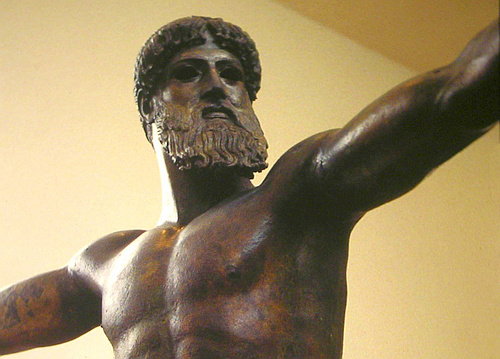
A Greek sculptor, active in the Early Classical period, probably
from Athens. He worked primarily in bronze, and is perhaps the sculptor of the bronze
"Poseidon of Artemision", now in the National Archaeological Museum in Athens. However,
also marble and chryselephantine statues by him are also recorded.
 kalathos
A basket in the form of a top hat, made from reeds or twigs. It was used in ancient Greece to hold wool or fruit and signifies abundance and fertility in ancient Greek art. In archaeology, the term is also applied to ceramic vases in the shape of the kalathos basket.
Kalchas
In ancient Greek mythology a celebrated Argive soothsayer, who had the gift for interpreting the flight of birds received by Apollo: "as an augur, Kalchas had no rival in the camp". It was Kalchas who prophesied that only the sacrifice of Iphigeneia could soothe the anger of Artemis towards Agamemnon so that she would provide favourable winds for the Greek expedition against Troy. During the Trojan War, he predicted that the city would fall in the tenth year of the siege and only if Philoktetes would join the Greeks. He also ensured that the captive Chryseis was sent back to her father so that Apollo would stop the plague that he had sent as a punishment. As a consequence, this started the quarrel between Achilles and Agamemnon, which almost lead to the defeat of the Greeks. After the sack of Troy he did not join the Argives onto their ships because he foresaw their doom. Kalchas died shortly after the war, and there are two versions: according to one tradition he died of shame because Mopsos beat him in a contest of soothsaying. In another tradition he died of laughter when the day that was to be his death day arrived and the prediction didn't seem to come true.
Kallias
Kallias (fl. 5th century BC) was an Athenian statesman, soldier and diplomat. Born into a prosperous Athenian family which owned slaves in the silver mine of Lavrio, he was one of the richest men in Athens. He fought at the battle of Marathon in 490 BC, and in the time of Perikles took on the role of diplomat and ambassador for Athens and the Delian League. Probably around 449 BC, he went to Susa to conclude with the Persian king Artaxerxes I a treaty of peace, known as the Peace of Kallias, which ended the Greco-Persian War and guaranteed the safety of the Greek city-states in Asia Minor.
Kallias of Chalkis
Kallias of Chalcis (fl. 4th century BC), together with his brother Taurosthenes, succeeded his father as tyrants of Chalkis on Euboea. With the support of Philip II of Macedon he threatened the tyrant of Eretria, aiming to control all of Euboea. In response, Athens sent troops to Euboea and in 350 BC Kallias was defeated. He then went to the Macedonian court, but fell into disgrace and proceeded to Thebes. Kallias did not get support there and even feared to be attacked by both, Thebes and Macedonia. He now sought the support of Athens and, through the influence of Demosthenes, obtained an alliance. The defeat of the Macedonian party in Eretria and Oreus by Phokion in 341 BC, gave Kallias control over of all Euboea.
Kallikrates
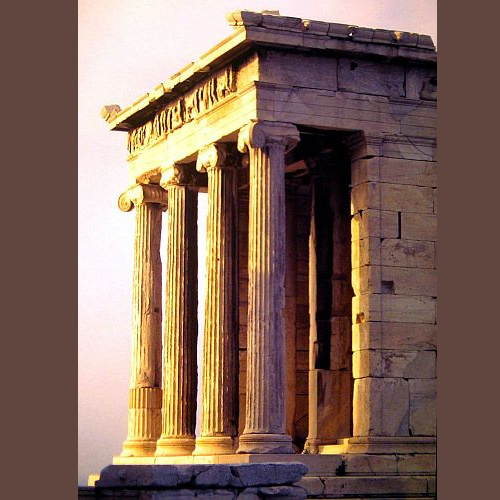
Kallikrates (fl. middle of the 5th century BC) was an ancient Greek architect. He and
Iktinos were co-architects of the Parthenon. According
to an inscription, Kallikrates was also the architect of the "Temple of Athena Nike" (or a smaller predecessor on the
same site) on the Acropolis. He was one of the architects of the
Classical circuit wall of the Acropolis, and of the middle of three amazing walls
linking Athens with Piraeus.
Kallimachos
Kallimachos (310/305 - 240 BC) was a noted poet, critic and scholar at the Library of Alexandria.
Kallinos
Kallinos (fl. mid-7th century BC) was an ancient Greek elegiac poet from Ephesos in Asia Minor. His works represent the genre of martial exhortation elegy, also composed by his contemporaries Tyrtaios, Archilochos and Mimnermos.
Kalliope
The oldest, most famous and leader of the muses. She was associated with epic poetry and, by Apollo, or by Oiagros, mother of Orpheus.
Kallippos
Kallippos (ca. 370 BC - ca. 300 BC) was an ancient Greek astronomer and mathematician. He studied under Eudoxus of Knidos at the Academy of Plato, and also worked with Aristotle at the Lykeion. Observing the movements of the planets, he found that Eudoxus' scheme of 27 connected spheres was not sufficient to account for their movements. Therefore he added seven more and detected a variation in the lengths of the seasons, caused by a variation in the speed of the Sun, the solar anomaly.
Kallirhoë
1) Daughter of Acheloos, married Alkmaion and gave birth to Akarnan and Amphoteros.
2) An Okeanid, i.e. one of the three thousand daughters of Okeanos and Tethys; she was the wife of Chrysaor and the mother of the three-headed Geryon and the snake bodied Echidna.
Kallisthenes
Kallisthenes of Olynthos (ca. 360 - 328 BC) was a Macedonian historian. Aristotle was Kallisthenes' great uncle, and through his influence, he was appointed to attend Alexander the Great on his expedition against Persia as the official historian. During the first years of the campaign, Kallisthenes enthusiatically praised the conqueror, but in later years he began to sharply criticize Alexander's adoption of Persian customs, especially the servile ceremony of proskynesis. In the end, Alexander did not continue the practice, but Kallisthenes was accused of a conspiracy to assassinate the king, imprisoned and died seven months later from torture or disease. Others report that he was crucified. This ended the relationship between Alexander and Aristotle.
Kallisto
A huntress, for whom different lineages are mentioned. She accompanied
Artemis and enjoyed Zeus with her charms. In order to conceal his affair, Zeus changed
her into a she-bear. Nevertheless, Hera arranged that Artemis killed her during a chase.
Zeus, hereupon, placed her as the constellation Great Bear (Ursa Major) in the night sky. Being pregnant at the
time of her death, Zeus made Hermes save Arkas from the womb
and took the baby to be raised by Maia. Later, Kallisto was joined by her son who became the
nearby constellation Little Bear (Ursa Minor). - It is a nice detail that Hera, still outraged, persuaded
Tethys and Okeanos not to allow Kallisto to enter their
realm, the Ocean. This is why Kallisto keeps circling the polar star without ever setting under the horizon (at least in
Greece and geographical latitudes north of it).
Kallistratos
Kallistratos (died ca. 350 BC) was an Athenian orator and general. He supported Spartan interests at Athens, recognizing that Thebes posed a greater threat to Athens. In 361 BC he was denounced in Athens for unclear reasons, fled to Macedonia and was condemned to death in absentia. Finally returning to Athens in the 350's he was executed.
kalos inscription
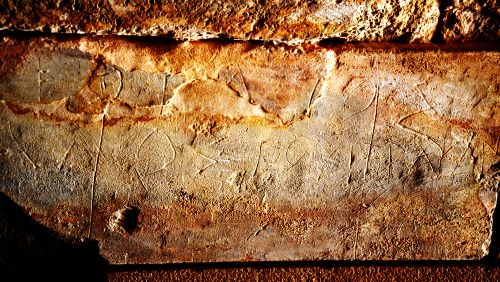
A kalos inscription (Greek: kalos = "beautiful") is a form of epigraph with an erotic
connotation, found as graffiti and on vases, mainly during the Classical period from
550 to 450 BC. In most cases the inscription gives the beloved's name in the form X kalos, i.e. "X is beautiful".
Usually, it is the name of a male youth, but there are some with names of girls or women.
 Kalpe
Kalpe
The ancient Greek name for the Rock of Gibraltar, one of the Pillars of Herakles.
kalpis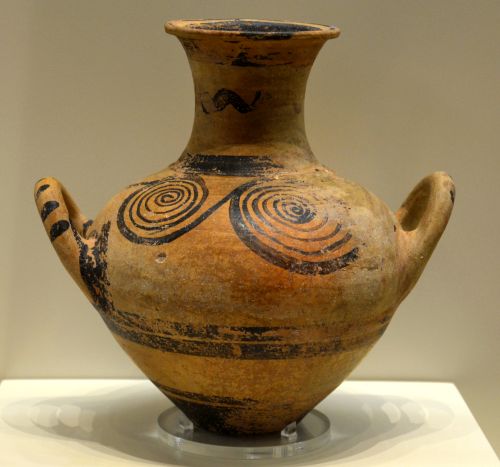
A type of ancient Greek pottery used for carrying water. It is a
variant of the hydria having just two handles, whereas the hydria has three handles.
 Kalydon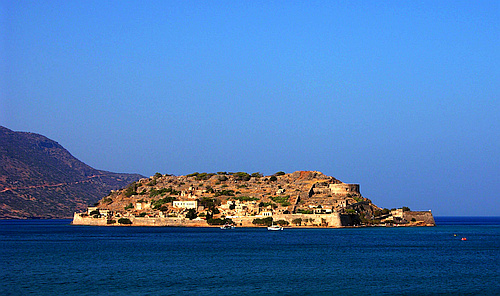
1) An island, now uninhabited, near Elounda, northeastern Crete. Also
known as "the last refuge", it was a leper colony from 1903 until 1957. - See also:
site page.
2) An ancient Greek city in Aetolia, on the west bank of the river Evenus. Its name is most famous today for the Kalydonian hunt.
3) A son of Aitolos and Pronoe. By Aiolia, he became the father of Protogeneia. He is said to be the founder of the Aetolian town of Kalydon.
Kalydonian Hunt
The Kalydonian Hunt is one of the great heroic legends of ancient Greece, following the adventures of the Argonauts and preceding the Trojan War. - When Oineus, king of Kalydon, one year forgot to make the usual sacrifice to Artemis, the goddess of the hunt was infuriated. As a punishment, she sent the Kalydonian Boar, one of the terrifying chthonic monsters of Greek mythology, to devastate the land of Kalydon. To save themselves from the beast, Oineus sent messengers all around Greece asking for help to kill the boar, promising its pelt and tusk in return. Among the heroes that answered the call were his son Meleagros and the fearless huntress Atalante. Lists of the other participants are not consistent, but most probably include Ankaios, Dryas, Echion, Eurypylos, Hippasos, Hippothoos, Hyleus, Idas, Iolaos, Jason, Kastor, Mopsos, Peleus, Phoinix, Polydeukes, and Telamon. Being the only woman in the hunt, the participation of Atalante caused considerable division. When Atalante landed the first blow to the beast, shooting an arrow through his skin, she triggered its death and finally Meleagros finished it off. Meleagros, who had become enamoured to Atalante, gave her the belt of the boar, but the men considered it disgraceful that a woman should get the trophy where men were involved. A bloody fight evolved in which Meleagros slew his uncles. When Althaia, Meleagros' mother, learned what had happened, she burned a magical piece of wood she had once stolen from the Moirai and thereby fulfilled the prophecy that this would kill Meleagros. In this way, Artemis also got her revenge on king Oineus.
Kalyke
1) A daughter of Aiolos and Enarete, and mother of Endymion.
2) A daughter of Hekaton and mother of Kyknos by Poseidon.
3) A daughter of Danaos, mentioned by Apollodorus.
Kalypso
Hesiod mentions a daughter of Okeanos and Tethys with this name, and Apollodorus a daughter of Nereus, whereas the Kalypso in the Odyssey is a nymph, daughter of Atlas. This Homeric Kalypso lived on the island of Ogygia, on the coast of which Odysseus was thrown after his shipwreck. Kalypso received him friendly, fell in love with him and promised him eternal youth and immortality if he would remain with her. But Odysseus could not forget Ithaka, and finally after seven years, the gods made Kalypso allow him to leave.
kalyx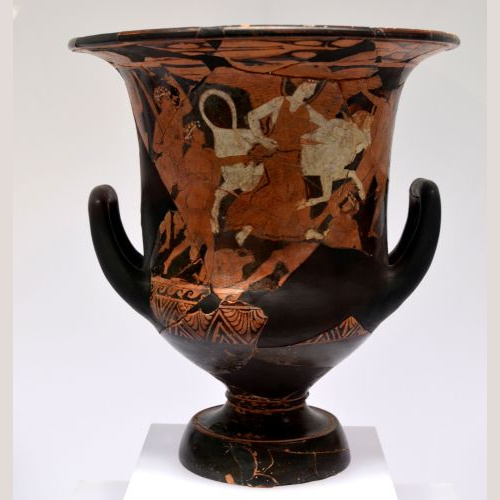
1) A clay drinking vessel, with high rim, popular in Chios.
2) A metal vase used in Macedonia in the 4th century BC, with a
globular body, no foot and no handles.
Kamares ware
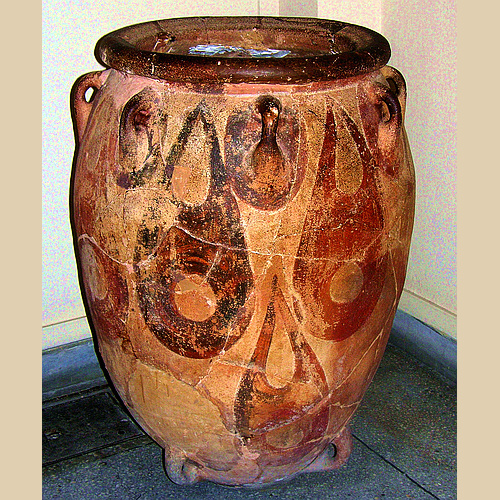
A style of Minoan pottery, named after first finds in the cave
sanctuary at Kamares. It is the first style of polychrome wares of Minoan civilization,
characterized by repetitive, highly stylized forms. The vessels were covered with a dark-firing slip and lavishly
decorated with slips in white, reds and browns.
Kanake
A daughter of Aiolos and Enarete, who had several children by Poseidon.
kantharos
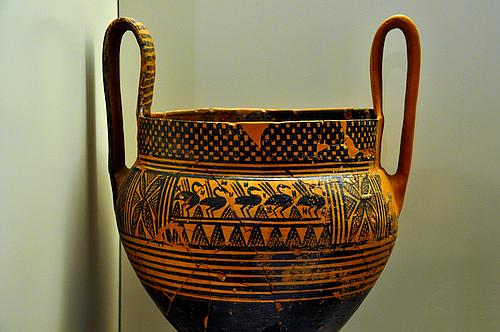
In ancient Greece a vase for drinking and libations, characterized by two vertical high-flung
handles.
Kapaneus
A son of Hipponoos and Astynome (or Laodike). He was married to Euadne by whom he became the father of Sthenelos. Kapaneus was one of the Seven against Thebes, and during the siege of Thebes attacked the Ogygian or Electrian gate. He was so presumptuous to claim that even the fire of Zeus would not prevent him climbing the walls of the city; but when he was ascending the ladder, Zeus struck him with a flash of lightning. It is said that, while his body was consumed by the flames, his wife leaped into the fire and killed herself. He is one of those heroes whom Asklepios was believed to have restored to life.
Kapodistrias
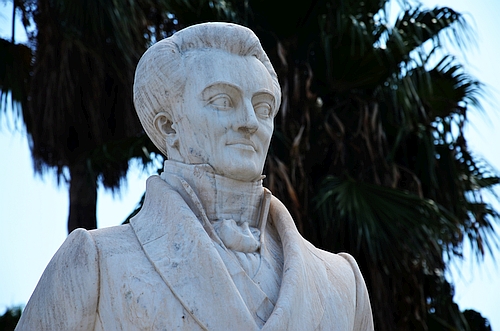
Count Ioannis Antonios Kapodistrias (1776 - 1831) was one of the most distinguished politicians and
diplomats in Europe of his time. After a long career in European politics and diplomacy and being Foreign Minister of
the Russian Empire, he was elected as the first head of state of independent Greece (1827-31). After touring Europe to
promote the Greek cause, he landed in Nafplion, the first capital of Greece, on 7
January 1828. He met a disastrous situation: although still fighting Ottoman occupants internal conflicts had led to two
civil wars, Greece was bankrupt and unable to form a united national government. Kapodistria launched a comprehensive
modernisation programme with such major reforms that he was considered as the actual founder of the modern Greek state.
He founded schools, established foundations for young women to work and inaugurated the first university to educate the
first teachers of a liberated Greece. - When he ordered the imprisonment of Petrobey Mavromichalis, the Bey of the
rebellious Mani peninsula, he sparked off the deadly revenge of the Mavromichalis family. On the early morning of
October 9, 1831, he decided to go to church despite the warnings of his servants and bodyguards. Arriving at the church
of Saint Spyridon in Nafplion, he was met by his assassins, Konstantis and Georgios. Konstantis drew a pistol, fired and
missed. The traces of the bullet can be seen in the church wall until today. Konstantis then drew his dagger and stabbed
Kapodistrias in the stomach while Georgios shot Kapodistrias in the head.
Karia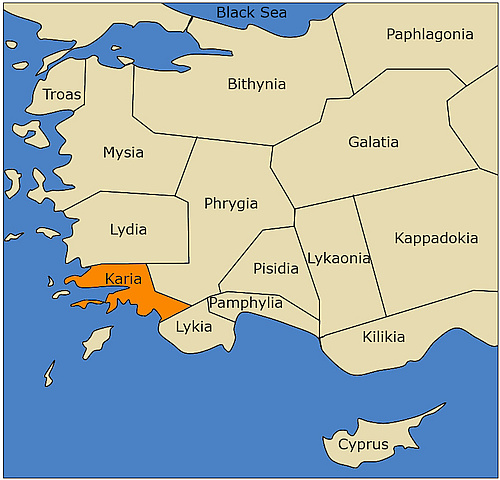
(from Luwian: Karuwa = "steep country") A region of western Anatolia extending along the coast
between Lydia and Lykia, bordering
Phrygia in the East. The Karians, the original inhabitants of Karia, were of Minoan
descent according to Herodotus, while the Karians themselves maintained that they were
Anatolian mainlanders. Later, Greeks colonized western Karia, forming Greek-dominated
city-states there.
Karneades
(Greek: "of Carnea") An Academic skeptic (214/3 - 129/8 BC) born in Kyrene. Since 159 BC, he refuted all previous dogmatic doctrines, especially stoicism, and even epikureanism. Instead, he doubted the ability, not just of the senses but also of reason, in acquiring truth. Nevertheless, he believed that we can ascertain probabilities of truth, to enable us to live and act accordingly. - As head of the Academy, he was one of three philosophers sent to Rome in 155 BC where his lectures on the uncertainty of justice caused consternation among the leading politicians. He left no writings, so his teachings are only known via his successor Kleitomachos.
Kassandra
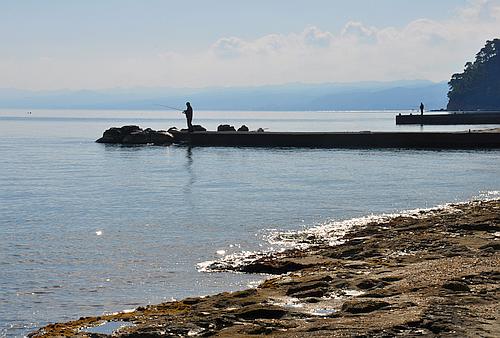
1) The most westerly peninsula of the Chalkidike, ancient Pallene.
2) The daughter of Priam and Hekabe. In
the Iliad, she is portrayed as the devoted daughter of the king and the queen, as a
member of the royal household of Troy who witnesses the fall of
her father's city and the tragic enslavement and/or murder of the population. In later tragedies, such as
Agamemnon by Aischylos, she is given a much darker, more tragic appearance. She
was said to have been loved by Apollo but rejected him; as a punishment, Apollo gave her
the gift of prophecy but not of conviction. This shows when she tries to warn her father that the Greeks shall capture
and burn Troy, but is ignored. Later, when Troy was burnt down to the walls and her parents were dead,
Agamemnon took her with him as his slave and concubine. She tries to warn him of the
murderous plot but again is ignored. And so, after their arrival at Mycenae, both are
killed by Klytaimnestra.
Kassandros
Kassandros (ca. 350 - 297 BC), or Cassander, was a son of Antipater. From 305 BC until 297 BC he was king of the ancient Greek kingdom of Macedonia. In his youth, Kassandros was taught by the philosopher Aristotle at the Lyceum in Macedonia together with Alexander the Great.
Kastor
Brother of Polydeukes, one of the Dioskouroi.
katharsis
("purification" or "cleansing") The purification and purgation of emotions - especially pity and fear - through art or any extreme experience. The metaphor was originally used by Aristotle in the Poetics to describe the purifying effects of tragedy on the mind of a spectator.
katholikon
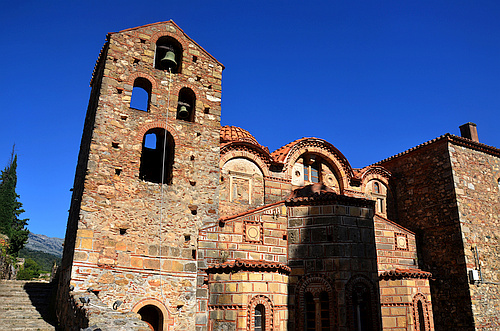
The central church of a monastery in the Eastern Orthodox Church.
keel-vaulted
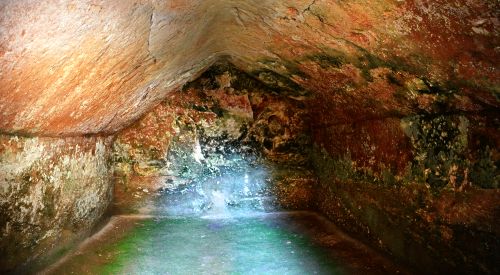
Late Bronze Age tomb built of stone with rectangular ground-plan and
a roof which is pitched or gabled like the inverted keel of a boat.
Kekrops
According to Apollodorus the first king of Attica. He is described as an autochthon, the upper part of whose body was human, while the lower was that of a dragon. He was married to Agraulos, by whom he had a son, Erysichthon, and three daughters, Agraulos, Herse, and Pandrosos. In Attic legends, Kekrops is credited with the introduction of first elements of civilization such as marriage, the political division of Attica into twelve districts, and the abolishment of bloody sacrifices. - During the reign of Kekrops, Poseidon hurled his trident into the ground and produced a spring on the acropolis of Athens. After this achievement he wanted to take possession of the country. Athena, however, wanted the same and in the presence of Kekrops planted an olive-tree on the acropolis. Kekrops decided in her favour when the possession of Attica was disputed between her and Poseidon, who had no witness to attest that he had created the well. - The name of Kekrops occurs also in other parts of Greece: tradition in Boeotia called him a son of Pandion, whereas in Euboea he was known as a son of Erechtheus and Praxithea, and a grandson of Pandion. These general accordances with local differentiations point to Kekrops as an initially Pelasgian hero.
Kelaino
1) One of the Pleiades, a daughter of Atlas and Pleione. Some call her the mother of Lykos and Eurypylos by Poseidon, and according to others she was the mother of Lykos and Chimaireus by Prometheus.
2) There are several other mythological personages of this name, including a Harpy, a Danaid, and an Amazon.
Kenchreus
--> Kychreus
kenotaph
(Greek: kenos = "empty", taphos = "tomb") A tomb or a funerary monument in honour of a person or a group of persons whose remains are buried elsewhere. Sometimes it is the initial tomb for a person that has later been interred elsewhere.
Kephalos
1) A son of Hermes and Herse (or Kreusa according to Hyginus). He was carried off by Eos, who became by him the mother of Tithonos (or Phaëton according to Hesiod).
2) A son of Deion, the ruler of Fokis, and Diomede. He was married to Prokris, by whom he become the father of Arkeisios, the father of Laertes. Also this handsome Kephalos was loved by Eos, but he and Prokris had promised to remain faithful to each other. One day, when Kephalos was hunting, Eos made amorous advances to Kephalos, but he rejected. Eos then told him that it is noble not to break his vow until Prokris had broken hers, and advised him to try her fidelity. So the goddess changed his appearance and provided him with precious gifts with which to tempt Prokris. Indeed, Prokris was overwhelmed by the presents and broke her vow. When she recognized her husband in the stranger, she fled to Crete where she received help from Artemis who presented her a dog and a spear that would never miss its object. With this, Prokris returned home in the disguise of a youth, and went on a chase with Kephalos. He was impressed by the excellence of her dog and spear and wanted to buy both but she would not part with them for any prize except for love. When he agreed, she made herself known to him, and he became reconciled to her. But she was stilled worried that Eos might allure him and watched him closely when he went hunting. On one of these occasions he accidentally killed her with the never-erring spear. - For assistance in other matters, Kephalos was rewarded by Amphitryon of Thebes with an island which he called after his own name Kefallonia.
Kepheus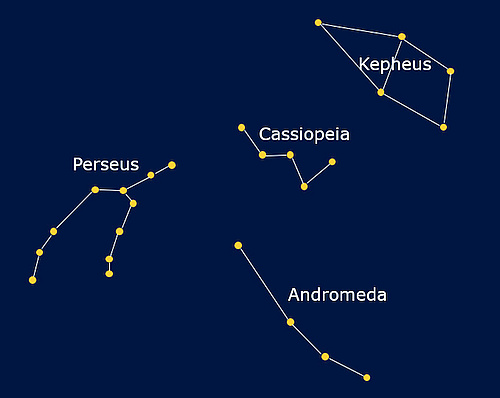
1) King of Ethiopia, husband of Cassiopeia and father of Andromeda. He appears in the night sky as a constellation next to those of his wife and of his daughter.
2) King of Tegea (--> site page) in
Arcadia. He took part in the Kalydonian Hunt and is
also mentioned as one of the Argonauts.
Kephisodotos
1) Kephisodotos the Elder (flourished about 400 - ca. 360 BC) was a Greek sculptor, perhaps the father or an uncle of Praxiteles. Documented is one of his works, Eirene bearing the infant Pluton, ca. 380 - 370 BC, of which a Roman copy is exhibited in the Glyptothek in Munich.
2) Kephisodotos the Younger, son of Praxiteles and grandson of Kephisodotos the Elder (see above). None of his work remains as original, but only as later Roman copy. He worked as a team with his brother Timarchos, renowned especially for portraits.
Kerameikos
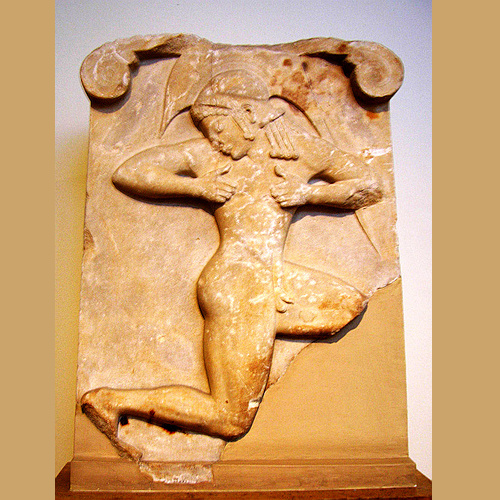
A district of Athens northwest of the
Acropolis. It extends both within and outside the ancient city walls. Originally the potters' quarter of the city,
it was also the site of an important cemetery with numerous funerary monuments erected along the road out of the city
towards Eleusis.
Kerberos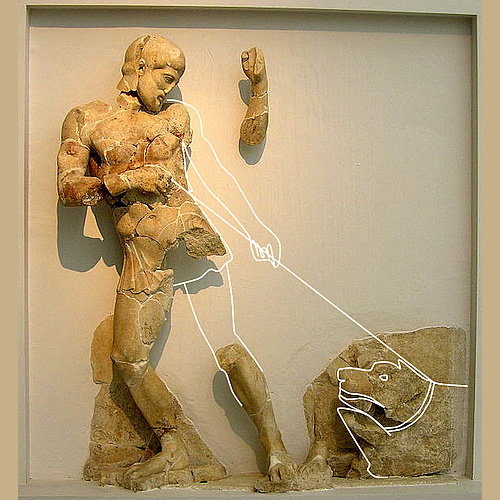
Ferocious watchdog of the underworld, offspring of
Echidna and Typhon. He obeys only
Hades and Persephone, friendly to the souls that enter the underworld, but
fiercely preventing anyone to leave. In art, he is sometimes presented with three heads and a dragon's tail. - As his
Twelfth Labour, Herakles temporarily brought him to the
daylight and presented him to Eurystheus.
kerkis
The wedge-shaped seating section separated by narrow stairs in the koilon of an
ancient Greek theatre.
Kerkopes
Droll and thievish gnomes, sons of Theia, the daughter of Okeanos. They annoyed and robbed Herakles in his sleep, but they were taken prisoners by him. What happened to them afterwards is not clear.
Kerkyra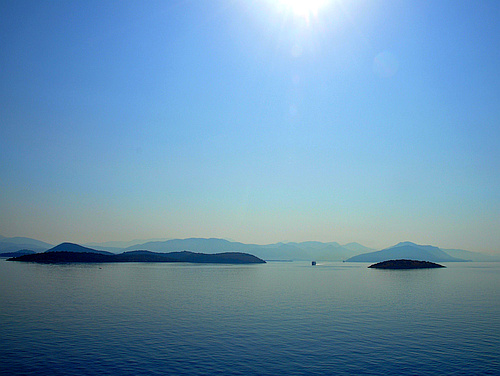
1) Kerkyra (modern Corfu) is a Greek island in the Ionian Sea. Together with small satellite islands, it forms the northwesternmost part of Greece. Since mythological times it shares the history of Greece with numerous battles and conquests. Castles on strategic locations across the island are a legacy of these struggles. Since 1864 it is part of modern Greece.
2) A daughter of the river god Asopos and the
river nymph Metope. She was abducted by Poseidon to
the island of Corcyra (Kerkyra) where she bore him a son Phaiax.
kernos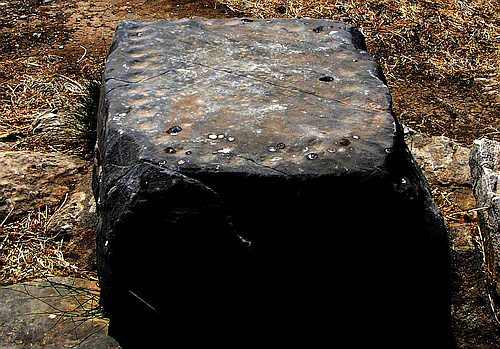
A ritual vessel with several receptacles for offering different kinds of fruits or crops to the
goddess Demeter. The term is also applied to much older ritual artefacts for similar
purposes of the Minoan culture.
kerykaion
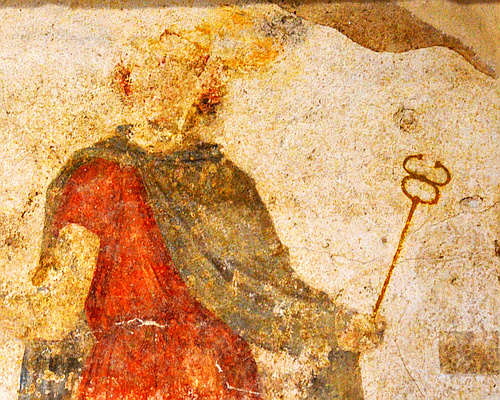
(Latin: caduceus) In Greek mythology the staff carried by
Hermes. The short staff is entwined by two serpents, sometimes also surmounted by wings. It goes back to
Mesopotamian tradition of 4000 to 3000 BC. Besides Hermes, also Iris as herald of
Hera, carried a kerykaion. Not to be confused with the rod of
Asklepios, which is entwined by one serpent only.
Keryneian Hind
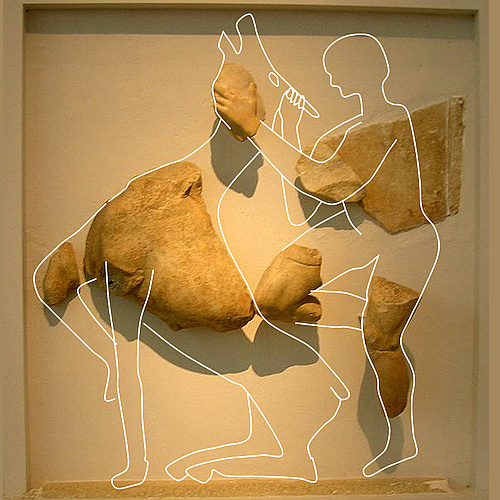
A hind is actually a female deer. On the other hand, it is said to have had golden horns, which would
indicate a male deer. To capture it was the Third Labour of
Herakles, but it took him one year to find the magical animal.
Keto
1) A sea-goddess, the daughter of Pontos and Gaia, sister and wife of Phorkys.
2) An Okeanid, mother of the Indian nymph Astris by Helios.
keystone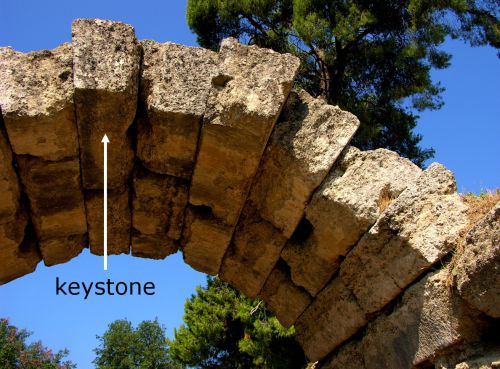
The central, topmost stone of an arch.
Keyx
1) King of Trachis, was connected by friendship with Herakles. He was the father of Hippasos, who fell in battle fighting as the ally of Herakles. - In other traditions, Keyx was a nephew of Herakles.
2) The husband of Alkyone. He drowned in a shipwreck. - It is not clear if this is the same personage as (1) above.
Kikonians
A Thracian tribe mentioned by Homer. In the Iliad they are said to have joined the Trojans in the war, led by Euphemos. In the Odyssey, Odysseus and his men take Ismaros, the stronghold of the Kikonians on the south coast of Thracia, by surprise. After slaying most of the Kikonian men and taking their women as slaves, they feasted so long that Kikonian reinforcements came and attacked the Achaeans, so that Odysseus and his men had to flee in their ships. - Orpheus, the Thracian lyre-player who sought his lover Eurydike in the underworld, was said to have been torn to pieces by Kikonian women after he rejected their advances. - In Classical times, the tribe of the Kikonians had already disappeared.
Kilikia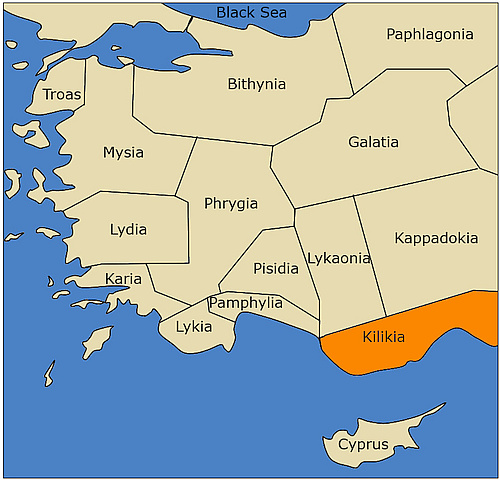
In antiquity the south coastal region of Asia Minor, extending
inland from the southeastern coast of modern Turkey, north of the island of Cyprus. It was a political entity from
Hittite times (16th - 14th century BC) into the 6th century BC.
Kilix
A son of Agenor and Telephassa. He and his brothers Kadmos and Phoinix were sent out by their father in search of their sister Europa, who had been carried off by Zeus. The search was not successful and Kilix settled in the country that was named Kilikia after him.
Kimon
An Athenian statesman and strategos) (510 - 450 BC), son of Miltiades. Kimon was a prominent figure in creating the powerful Athenian maritime empire after the first Persian invasion of Greece. After his celebrated bravery in the Battle of Salamis in 480 BC he was appointed as admiral and played an important role in the formation of the Delian League, becoming its first principal commander. In 466 BC, Kimon led a force to Asia Minor, where he destroyed a Persian fleet and army at the Battle of the Eurymedon river. In Athenian politics, he played an increasingly prominent role as supporter of the aristocrats against Perikles. An unsuccessful attempt to support the Spartans during the helot uprisings led to his ostracism in 461 BC. In the following year, the first Peloponnesian War between Athens and Sparta broke out, and after the end of his exile, Kimon negotiated a truce with Sparta, which however did not lead to a permanent peace.
Kinaithon
Kinaithon of Sparta (fl. 764/3 BC) is a legendary Greek poet to whom the lost epics Oidipodeia, Little Iliad and Telegoneia were ascribed. Plutarch remarked: "he added unnecessary pomp and drama to the oracles".
Kinyras
A famous mythological hero of Cyprus. According to the common tradition, he was a son of Apollo or Paphos, king of Cyprus, and priest of Aphrodite, whose worship he had brought with him from Kilicia. He was married to Metharme, the daughter of the Cyprian king, Pygmalion, by whom he had several children. His son Adonis, however, is said to have been the result of an incestuous intercourse with his daughter, Smyrna. When he discovered this crime, into which he had been led unwittingly by Aphrodite, he killed himself. - Another tradition relates that Kinyras did not keep his promise to assist the Greeks in the Trojan War and that he was therefore cursed by Agamemnon and killed by Apollo.
Kirke
(Greek = "hawk") Powerful sorceress and beautiful semi-goddess, a daughter of Helios and Perse; sister of Aietes and Pasiphaë. She lived on the island of Aiaia, served by maidens she had lured to her home and guarded by men whom she had turned into wild animals. One of her Homeric epithets is polypharmakos, "knowing many drugs or charms". - She welcomed Jason with the Argonauts and her niece Medea when they had fled from Kolchis to her island. But when she learned that Medea had murdered her own brother and that it was Kirke's brother who pursued her niece, she banned them from her island. - When Odysseus landed on Aiaia, she turned most of his crew into swines. Only with the help of Hermes could Odysseus save his men and himself, but Kirke kept him as lover for one year on her island before she approved his leave.
kithara
An ancient Greek musical instrument. It was the professional version of the simpler lyre, a folk-instrument with two strings. The kithara with seven or more strings was played by professional musicians, the kitharodes, to accompany dances, epic recitations, rhapsodies, odes, and lyric songs.
Kleandros
A tyrant who ruled the city of Gela on Sicily, which had previously been an oligarchy. He reigned for seven years before he was assassinated in 498 BC by a citizen of Gela who wanted to promote the establishment of a democratic system in his city. However, power was transfered to his brother, Hippokrates of Gela.
Kleanthes
Kleanthes of Assos (ca. 330 BC - ca. 230 BC), was a Greek Stoic philosopher. Originally a boxer, he came to Athens to attend the lectures of Zenon of Kitieus, the founder of the Stoic school. To earn his living, he worked as water-carrier at night. After the death of Zenon around 262 BC, he succeeded him as the second head (scholarch) of the Stoic school. He further developed Zenon's ideas in accordance with the principles of materialism and pantheism. His pupil was Chrysippos who became one of the most important thinkers in stoicism.
Klearchos
Klearchos (fl. second half of the 5th century BC) was a Spartan mercenary and general. In 411 BC he was sent with a fleet to the Dardanelles and became governor of Byzantium. He was quite unpopular and in his absence the gates were opened in 409 BC to the Athenians under the command of Alkibiades besieging the city. Klearchos returned to Sparta and was given a military force to protect Byzantium and the neighbouring Greek colonies from Thracian attacks. However, when the ephors of Sparta learned that the citizens of Byzantium considered him a tyrant, they recalled him through a messenger. Ignoring the messenger, Klearchos proceeded to Byzantium, successfully fought the Thracian tribes, but was declared an outlaw by the ephors. In the following, he sided with Cyrus the Younger in his attempt to dethrone his brother Artaxerxes II and after the death of Cyrus was treacherously seized, handed over to Artaxerxes and executed.
Kleio
One of the nine muses, associated with epic poetry and history; her name means "to celebrate".
Kleisthenes
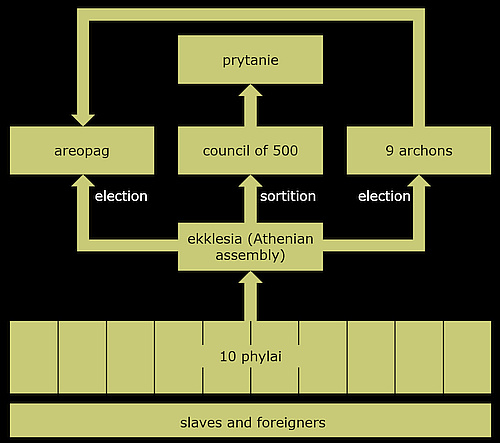
Nobleman from Athens (ca. 570 - 507 BC). After years of tyranny in
Athens, followed by Spartan occupation, Kleisthenes introduced radical reforms
to the Athenian constitution. Instead of Solon's division of the citizens into four classes
according to their wealth, Kleisthenes installed 10 phylai solely based on where they lived. By this, the nearly
unlimited power of the nobility was broken up and full civic rights were installed also for the lower classes of
Athenian citizens. Also, most of the offices were appointed by sortition and ostracism
was included in the constitution. Because of these reforms Kleisthenes became the "father of Athenian
democracy". But, as usual in antiquity, these rights did not extend to foreigners,
slaves, and women.
Kleitias
Kleitias (fl. ca. 570 - 560 BC) was an ancient Athenian vase painter of the black-figure style. Kleitias' most celebrated work today is the "François Vase" (ca. 570 BC), which bears over two hundred figures in its six friezes. Painted inscriptions on five vases name Kleitias as their painter and Ergotimos as their potter, showing the craftsmen's close collaboration.
Kleito
In Greek mythology a mortal woman who lived on the central mountain of Atlantis. She was married with Poseidon, with whom she had five pairs of twin boys who ruled Atlantis and the surrounding seas for many generations.
Kleitomachos
1) Born in Carthago under his original name Hasdrubal, he came to Athens in 163/2 BC and studied philosophy under Karneades. He succeeded his master as head of the Academy around 127/6 BC and like him was an advocate of skepticism.
2) A celebrated athlete from Thebes. Pausanias notes that he won the boxing and pankration at the 141st Olympiad in 216 BC, the pankration at three Pythian Games, as well as the wrestling, boxing, and pankration at an Isthmian Game. The latter achievement was only equaled by Theagenes of Thassos. Aelian praised Kleitomachos for his temperance and especially noted his abstinence from sex.
Kleoboulos
A Greek poet (6th century BC) from Lindos on the island of Rhodos. He was regarded as one of the Seven Sages of Greece.
Kleombrotos II
Kleombrotos II was a Spartan king (reigned 242 - 241 BC) of the Agiad dynasty. He married Chilonis, the daughter of Leonidas II, whom he followed on the throne after Leonidas fled to avoid trial. But one year later Leonidas returned to Sparta, once more took the throne and exiled Kleombrotos and Chilonis.
Kleomenes I
Agiad king of Sparta, who reigned about 520 - 490 BC. He followed a sometimes aggressive foreign policy aimed at crushing Argos and extending Sparta's influence both inside and outside the Peloponnese. During his reign the Peloponnesian League was formally constituted and Kleomenes intervened twice successfully in Athenian affairs. He was a prominent figure organising the Greek resistance against the Persian Empire, but kept Sparta out of the Ionian Revolt. In ca. 490 BC he died in prison under mysterious circumstances. The claims of Spartan authorities that he killed himself due to insanity have been questioned.
Kleomenes II
Kleomenes II was Agiad King of Sparta from 369 to 309 BC.
Kleomenes III
Kleomenes III was Agiad King of Sparta from 235 to 222 BC. He tried to reform the Spartan state and from 229 BC to 222 BC waged war against the Achaean League. When he was defeated in the battle of Sellasia in 222 BC, he fled to Egypt and after a failed revolt in 219 BC, he committed suicide.
Kleon
An Athenian general (died 422 BC) during the Peloponnesian War. As a politician, he was the first prominent representative of the poor and commercial class in Athens, although he himself was an aristocrat. He rose to prominence after the death of Perikles in 429 BC and was subsequently one of the most influential figures in Athenian politics, advocating for an aggressive military strategy against Sparta. His contemporaries Thukydides and Aristophanes represented him as a warmongering demagogue. He was killed in the failed Athenian campaign to take Amphipolis.
 Kleopatra
1) A daughter of Idas and Marpessa. She was the wife of Meleagros and after her husband's death hanged herself or died of grief. She was also called Alkyone.
2) A Danaid, betrothed to Agenor.
3) Two other mythical personages of this name are mentioned by Apollodorus.
4) Kleopatra of Macedon (c. 355/354 BC - 308 BC), was the daughter of Philip II of Macedon and Olympias of Epirus, and was the only full sibling of Alexander the Great. In 336 BC, she married her uncle, Alexander I of Epirus, and at this wedding her father, Philip II, was assassinated. - Kleopatra ruled Epirus while her husband was fighting in southern Italy, and when he fell in battle in 331 BC, Olympias returned to Epirus and took over the government. In 325 BC, Kleopatra went back to Macedonia and very probably kept close contact to her brother Alexander while he led his campaign in the east. After his death in 323 BC, several of Alexander's generals wanted to marry her, not least to gain more influence among the diadochi. She declined all these offers and went to Sardis. There, Antigonos kept her as a privileged captive. After years, she tried to flee to Ptolemaios, but was assassinated in 308 BC, presumably ordered by Antigonos, who then gave a beautiful funeral in her honour.
Kleophon Painter
The Kleophon Painter (fl. mid-to-late 5th century BC) was an anonymous Athenian vase painter of the "red figure style". He is named after an inscription on one of his works praising a youth "Kleophon". He may have come from the workshop of Polygnotos, and himself teaching the Dinos Painter. Three vases indicate a collaboration with the Achilles Painter.
Kleophrades
Painter
The Kleophrades Painter (fl. ca. 510 BC - ca. 470 BC) was an anonymous Athenian vase painter. His work is considered amongst the finest of the red figure style.
klepsydra
An ancient Greek water clock used for timing speakers at public debates.
kleruchs
Citizens of Athens who were assigned a land lot (kleros) in the allied cities and settled there to ensure Athenian domination.
Klotho
One of the Moirai; she is the Fate who spins the thread of life.
Klymene
1) Daughter of Okeanos and Tethys. She was married to Iapetos, by whom she became the mother of Atlas, Prometheus, and others. By Helios, she was the mother of Phaëton, Aigiale, Aigle and Aetheria.
2) A daughter of Iphis or Minyas, and the wife of Phylakos or Kephalos, by whom she became the mother of Iphikles and Alkimede.
3) According to Apollodorus, she was the mother of Atalante by Iasos.
4) A relative of Menelaos and a companion of Helena, together with whom she was carried off by Paris. After the fall of Troy, when the booty was distributed, she was given to Akamas.
5) There are several other mythical personages of this name.
Klymenos
1) A Cretan, a descendant of Herakles. He is said to have come to Eleia 50 years after the flood of Deukalion, and to have restored the Olympic games.
2) Mythological king of Arcadia or of Argos. By his wife Epikaste he was the father of several children, among them his daughter Harpalyke, for whom he entertained an unnatural love and committed incest with her. To avenge her father's crime, Harpalyke killed her younger brother (or her own son), and placed his flesh prepared in a dish before her father. Klymenos thereupon hanged himself and Harpalyke was changed into a bird.
3) A son of Presbon and king of Orchomenos.
4) There are several other mythical personages of this name.
Klytaimnestra
Daughter of Leda and wife of Agamemnon, by whom she became the mother of Orestes, Iphigeneia, Elektra, and Chrysothemis. When her husband was away as leader of the Achaeans in the ten years of the Trojan War, Klytaimnestra took Aigisthos, the sole survivor of Atreus' rage, as her lover. Together they murdered Agamemnon and his mistress Kassandra after their return from Troy. Later, Klytaimnestra was killed by her son Orestes. - Klytaimnestra is one of the central characters in the Oresteia of Aischylos, retold and adapted in many works up to modern times.
 Knossos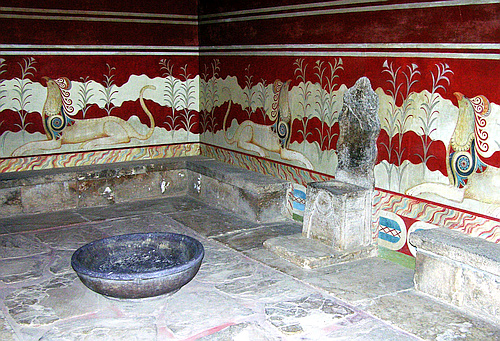
Knossos is the largest Bronze Age archaeological site on
Crete and is considered Europe's oldest city. - The site was discovered in 1878 by Minos
Kalokairinos after coins were found scattered over the hill with Knosion or Knos inscribed on the obverse
and an image of a Minotauros or labyrinth on the
reverse. Both symbols point to the mythical king Minos, said to have reigned over Knossos.
- In 1900 the English archaeologist Sir Arthur Evans and his team began with the
excavations that continued for 35 years. The size of the site far exceeded the original expectations and revealed the
Minoan palace of Knossos as ceremonial and political centre with a confusing maze of
workrooms, living spaces, and storerooms around a central square. In the course of the excavations, Evans had to
reconstruct and stabilize architectural remains, but these inaccurate and irreversible intrusions have also been
criticized. Nevertheless, numerous now-famous artefacts have been found, and based on the stratigraphy of the remains,
Evans developed an archaeological concept of the civilization that used it, which he called
Minoan. Equally important was the discovery of tablets inscribed with two ancient scripts, which Evans termed
Linear A and Linear B. With the decipherment of Linear B
by Michael Ventris, it became clear that ko-no-so in Mycenaean Greek is the Minoan
Knossos. - The site was abandoned for unknown reasons around 1350 BC, at that time occupied by
Mycenaeans, and never resettled. - See also: site page.
Kober
Alice Elizabeth Kober (1906 - 1950) was an American classicist, and became an assistant professor of classics at Brooklyn College in 1930, where she remained for the rest of her career. Also since 1930 she became interested in the then undeciphered script Linear B. When she got access to the Linear B inscriptions collected by Sir Arthur Evans at Knossos she hand copied most of them and in the end had 180,000 cards in which she punched holes for sorting the data according to specific parameters. Her efforts to decipher the language were severely delayed by her teaching duties and other thankless tasks. Being a chain smoker, she died at the age of 43, probably of cancer. After her death Michael Ventris built on her work and finally deciphered Linear B in 1952.
koilon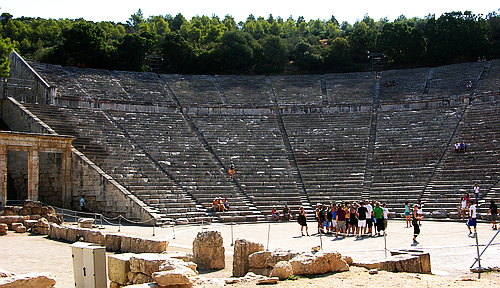
The koilon, also called cavea or theatron, is the seating area of an ancient Greek
theatre. The hollow structure was built into a hillside, overlooking the sea or a wide
landscape. It consists of concentric rows of stone seats, divided by narrow stairs into kerkis.
Upper and lower tiers were separated by horizontal walkways, the diazomata.
koine
The dialect of the ancient Greek language which replaced the previous regional versions of the language. It was the common supra-regional form of Greek spoken and written during Hellenistic times and in Late Antiquity.
koinon
(Greek: "common") A term roughly equivalent to Latin res publica, "the public thing." In ancient writings it appears in the context of "league" or "federation", an association of distinct city-states. As government of a league, koinon comprised such functions as defense, diplomacy, economics, and religious practices among its member states.
Koios
A Titan, son of Gaia and Uranos. By his sister Phoibe he became the father of Leto and Asteria.
Kokytos
("lamentation") In ancient Greek mythology one of the five rivers of the underworld.
Kolchis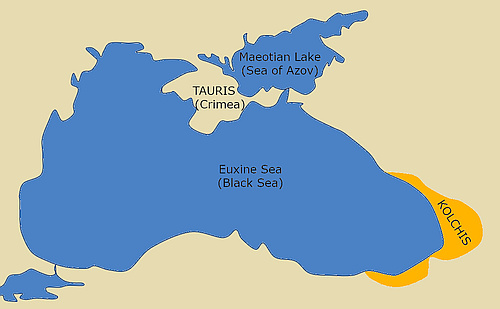
A region on the eastern coast of the Black Sea around present-day western Georgia. It was a kingdom
from about the 13th century BC until the first century BC. It is the mythical home of king
Aietes and of Medea, and is the place from where the
Argonauts took the Golden Fleece to Iolkos.
Kolchis is also said to be the home of the Amazons.
Kolokotronis
Theodoros Kolokotronis (3 April 1770 - 4 February 1843) was a Greek general and the pre-eminent leader of the Greek War of Independence (1821 - 1829) against the Ottoman Empire. His greatest success was the defeat of the Ottoman army under Mahmud Dramali Pasha at the Battle of Dervenakia in 1822. From 1823 to 1825, he took part in the Greek civil wars, was briefly imprisoned and in 1825, he was appointed commander-in-chief of the Greek forces in the Peloponnese. In this function he defended Greece against an Ottoman-Egyptian intervention in the Mani. - After the war he was a strong supporter of Ioannis Kapodistrias and after his assassination in 1831 backed Prince Otto of Bavaria to become king of Greece. Later, however, he opposed Otto's regency, was charged with treason and sentenced to death, but in 1835 he was pardoned.
komos
A ritualistic procession in a drunken revelry, the precise nature of which is actually unknown. That some komoi were expressly described as semnoí ("modest", "decent"), means that standard komoi were anything else.
Koon
A son of Antenor. In the Trojan War he wounded Agamemnon in one fight but was afterwards slain by him.
Kopreus
A son of Pelops and father of Periphetes. After having murdered Iphitos, he fled to Mycenae, where he was purified by Eurystheus, who used him to instruct Herakles of the labours he had to perform.
kore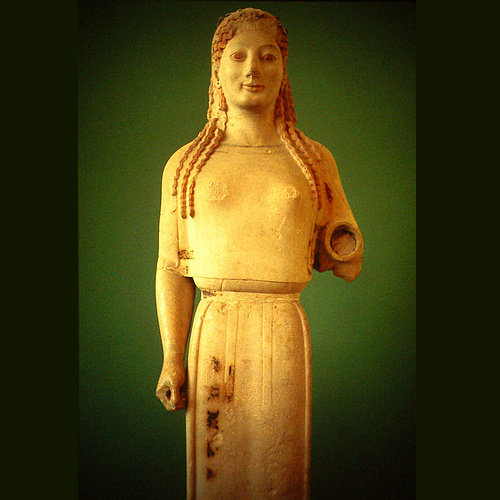
1) (Greek: "maiden") In the Archaic period, a statue of a standing, dressed female figure. The male representation is called kouros.
2) Sometimes this name stands for Persephone.
Korinna
An ancient Greek lyris poetess from Tanagra in Boeotia. She either lived in the times of Pindar or in the Hellenistic period. Her works are not very esteemed by modern critics.
Korinthia
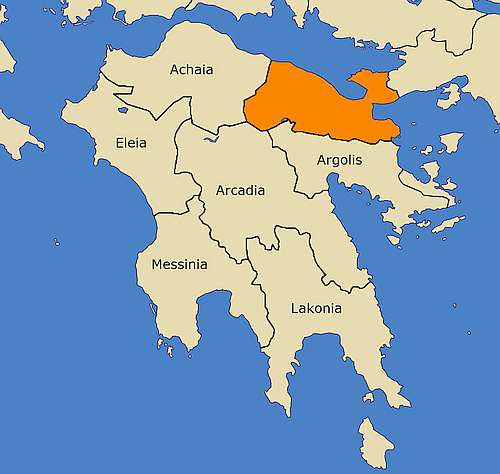
Korinthia is one of the regional units of Greece (2300 km2, 138,000 inhabitants). It is
situated in the north-eastern part of the Peloponnese peninsula. - See also:
site page.
Korykian cave

The Korykian cave lies on the slopes of Mount Parnassos near
Delphi. It was sacred to the korykian nymphs and the
muses, and a place of worship for Pan. In 1969, an excavation by
French archaeologists produced thousands of objects, ranging in time from the Neolithic
and Mycenaean up to the Classical period. - The cave
has always been a place of refuge for the people of the area during foreign invasions e.g. from the
Persians in the 5th century BC, the Turks during the
Greek War of Independence, and from the Germans in 1943. - See also:
site page.
kotinos
The olive wreath with which the winner in the Olympic Games was crowned in Classical times. It was regarded as a symbol of the Olympic ideals and peace. Some link it also with Athens, whose sacred tree was the olive tree (but for me this is bit far-fetched since olives played an important role in all of Greece).
Kotys
1) Kotys I became king in Thracia in 384 BC and allied with Athens. He married his daughter to the Athenian general Iphikrates and with his help extended his territory. By 360 BC, Kotys controlled the whole Chersonesos peninsula. In September of the same year he was murdered by two of Plato’s students, perhaps under the pretext that he had wronged their father. They were proclaimed honourary citizens upon their return to Athens.
2) A Thracian divinity with riotous celebrations resembling those of the Phrygian Kybele. Her worship was later also introduced at Corinth and Athens and was connected with licentious frivolity.
kouloures
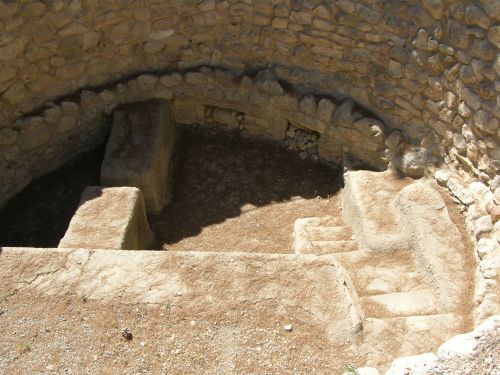
A term coined by Arthur Evans during his expedition to
Knossos in 1903 to describe a circular subsurface pit with stone walls found in certain
Minoan settlements. Constructed around Middle Minoan II (1850-1750 BC), the kouloures were
most probably a type of granary to store excess harvest.
Kouretes
Rustic spirits (daimones), for whom different numbers (3, 5, or 9) are given. Rhea appointed them to guard infant Zeus hidden in a cave on Mount Ida. They drowned the boy's cries with a frenzied dance of clashing spears and shields, and so kept him concealed from his cannibalistic father Kronos. - According to Strabo, they were a legendary people of Aetolia, where they fought against the Kalydonians of Meleagros after hunting a monstrous boar.
kouros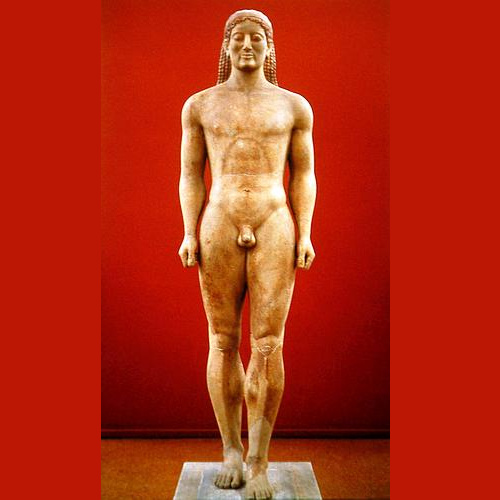
In the Archaic period, a statue of a symmetrical stiff standing, nude
male figure, with the left leg set forward. The female representation is called kore.
Krantor
A Greek philosopher (4th century BC) of the Old Academy. - He studied philosophy as a pupil of Xenokrates and became one of the most distinguished supporters of the philosophy of the older Academy. Of his numerous works only fragments have been preserved. According to their principal subjects, Krantor was classed as a moral philosopher.
krater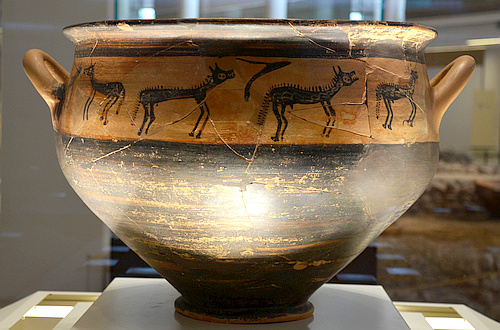
("mixing vessel") In ancient Greece a large, open, ceramic bowl with handles on the side. It was used
for mixing wine and water.
Krateros
A Macedonian general (c. 370 - 321 BC) under Alexander the Great and one of the diadochi. During the campaign in Persia he commanded Alexander's infantry and was also sent on independent missions. After Alexander's unexpected death in Babylon he aided Antipater in the Lamian War against Athens in 322 BC. In the following year he was killed in battle against Eumenes in Asia Minor.
Krates
1) Krates of Thebes (ca. 365 - ca. 285 BC) was a cynic philosopher. He gave away all his money to live a life of poverty on the streets of Athens, where he was highly respected. Krates was the teacher of Zenon of Kitieus, the founder of stoicism. Among the surviving fragments of his teachings is his description of the ideal cynic state.
2) Krates of Athens (died 268-264 BC) was the pupil and eromenos of Polemon, whom he succeeded as head (scholarch) of the Platonic Academy in 270/69 BC. The most renowned of his pupils was Arkesilaos, his successor.
3) An Athenian poet of the Old Comedy. He won three times at the City Dionysia in the middle of the 5th century BC and was mentioned by Aristophanes as an important representative of the previous generation of comic poets.
Kratinos
Kratinos (519 - 422 BC) was an Athenian poet of the Old Comedy. Not much is known about his personal life except his 27 victories in the City Dionysia and other competitions.
Kreon
1) Mythical king of Corinth, father of Glauke. When Glauke married Jason, the sorceress Medea found herself forsaken and took revenge by sending Glauke a dress that killed her by fire when she put it on.
2) A son of Menoikeus, king of Thebes after Oedipus went into exile and Eteokles and Polyneikos had killed each other. He ordered a heroe's funeral for Eteokles and that the body of Polyneikos was to be left unburied. When Antigone defied Kreon and covered the body of her brother Polyneikos with a thin layer of dirt, Kreon condemned her to be buried alive. His conduct is especially known from from the works "Oedipus" and "Antigone" of Sophokles. Kreon had a son, Haimon, and two daughters, Henioche and Pyrrha.
krepidoma
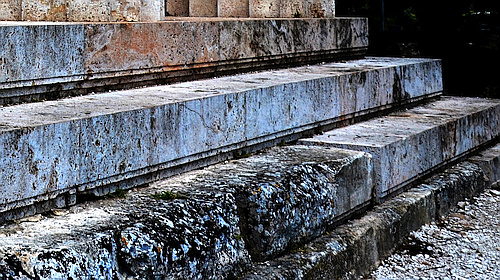
The stone base of a building. In ancient Greek temples this consisted
of three steps, the uppermost being the stylobate on which the
columns stand.
Kresphontes
One of the Heraklids, son of Aristomachos. After the conquest of the Peloponnese, he reigned in Messenia, but during an urprising he and two of his sons were killed. A third son, Aipytos, was encouraged by his mother Merope to avenge his father.
Kretheus
The mythical founder of the town of Iolkos. He is described as a son of Aiolos and Enarete, who was married to Tyro, the daughter of Salmoneus, by whom he became the father of Aison, Pheres, Amythaon, and Hippolyte.
Kreusa
1) A Naiad, daughter of Okeanos and Gaia. By Peneios she became the mother of Hypseus, king of the Lapiths, and of Stilbe.
2) A daughter of Erechtheus and Praxithea. She was married to Xuthos, by whom she became the mother of Achaios and Ion. - According to another tradition, she was beloved by Apollo, and by him became the mother of Ion, as told in the "Ion" of Euripides.
3) A daughter of Priam and Hekabe. She was the wife of Aeneas, and became by him the mother of Askanios and Iulus. When Aeneas fled after the fall of Troy, she followed him but could not find his traces and vanished. When Aeneas returned to search for her, she appeared to him as a shade, foretold him his future fate and revealed to him, that she was kept back by the great mother of the gods.
Krios
A Titan, son of Gaia and Uranos. He was the father of Astraios, Pallas, and Perses.
Kritias
Kritias (ca. 460 - 403 BC) was an Athenian poet and political figure. He was noted in his days for his tragedies, elegies and prose works, but he is especially known for his role in Athenian politics. Being suspected of an act of vandalism he was exiled but called back at the end of the Peloponnesian war in 404 BC on demand of the Spartians. He was then elected to the dictatorial, Sparta-friendly regime of the Thirty Tyrants. In the time that followed, anyone suspected to resist or had great personal wealth was executed. In Eleusis, a mass execution of 300 men was ordered. Kritias became known as one of the ultimate villains, but was killed in a fight near Piraeus between pro-democratic Athenian exiles and supporters of the Thirty Tyrants.
Kroisos
Kroisos (595 BC - ca. 546 BC), also spelled Croesus, was a king of Lydia. He issued the first true gold coins and was known as an immeasurably rich man. His wealth became proverbial and remained so until today. - When he thought of expanding his territory towards the east, he first consulted the oracle at Delphi. With typical ambiguity, he received one of the most famous oracular statements, telling him that if he attacked the Persians, he would destroy a great empire. Now feeling confident, Kroisos launched his campaign, but in the end was defeated by the Persian king Cyrus the Great and taken prisoner. Now he realized that the powerful empire destroyed by the war was his own. Cyrus wanted to have him burnt at the stake, but - as legend goes - Kroisos prayed to Apollo, whereupon rain clouds appeared, dousing the flames with a sudden downpour and Kroisos was saved.
Kronos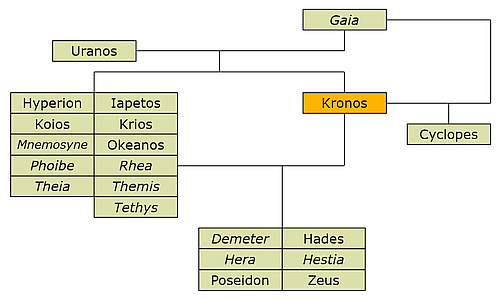
1) A son of Uranos and Gaia, and the youngest of the Titans. Together with his mother he begot the Cyclopes, and when Uranos threw the Cyclopes into the tartaros, Kronos castrated his father at the instigation of Gaia. Out of the blood thus shed sprang up the Erinyes. The Cyclopes were delivered from tartaros and Kronos took over the government of the world and later lost it to his son, Zeus.
2) --> Chronos.
krotalon
A krotalon was a sort of clapper or castanet used in religious group dances in ancient Greece.
Ktesias
Ktesias (fl. 5th century BC) was a Greek physician and historian from Karia. He wrote several historical treatises and was a physician at the court of Artaxerxes Mnemon, whom he also accompanied in 401 BC on his expedition against his brother Cyrus the Younger.
Ktesibios
Ktesibios (fl. 285 - 222 BC) was a Greek inventor and mathematician from Hellenistic Alexandria. He studied the elasticity of air and wrote the first treatises on the science of compressed air, whence he is called the "father of pneumatics."
Ktesippos
1) The name of two sons of Herakles, the one by Deianeira, the other by Astydameia.
2) One of the suitors of Penelope, was killed by Philoitios, the cowherd.
kyathos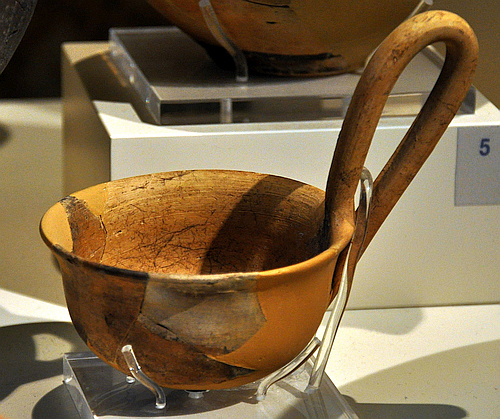
("dipper") A modern term to describe an ancient Greek vase resembling a ladle. It consists of a tall,
round bowl, slightly tapering, and a single perpedicular handle.
Kybele
The Phrygian mother of the gods. Her cult was spread to mainland Greece by Greek colonists in Asia Minor around the 6th century BC.
Kychreus
A mythical personage with different traditions, all of which are somehow connected to a dragon. - In one version he was a son of Poseidon and Salamis. He became king of the island of Salamis where he was honoured as a hero because he delivered the island from a dragon. - In another tradition, Kychreus himself was called a dragon because of his savage behavior. Being expelled from the island, Demeter received him at Eleusis and appointed him as priest in her sanctuary. - In still another tradition, Kychreus had brought up a dragon, which was expelled. - It is said that during the battle of Salamis Kychreus appeared on one of the Greek ships in the guise of a dragon.
Kyknos
(Ancient Greek: kyknos = "swan")
1) A son of Apollo by Thyria or Hyria. He was a handsome hunter, living in the district between Pleuron and Kalydon, and was arrogant and disrespectful towards numerous other youths who became enamoured of him and sought his attention. When all of them deserted Kyknos, only Phyllios remained. To get rid of him, Kyknos at last imposed upon him three impossible labours: to kill a lion without weapons, to catch alive two monstrous vultures which devoured men, and with his own hand to lead a bull to the altar of Zeus. Phyllios somehow managed the first two tasks, but needed the help of Herakles for the third one. Herakles then warned Phyllios to no longer obey orders of Kyknos. At this point, Kyknos felt disgraced and committed suicide by throwing himself into a lake. His mother did the same and Apollo transformed both into swans.
2) A son of Poseidon by Kalyke, Harpale, or Skamandrodike. After his birth, his mother exposed him on the sea-shore, where he was found by fishermen. They called him Kyknos because a swan flew over him. Later, he married Prokleia, the daughter of Laomedon, by whom he became the father of Tennes and Hemithea. After the death of Prokleia, he married Philonome, who fell in love with her stepson Tennes. Unable to win his love, she calumniated him, so that Kyknos in his anger threw his son together with Hemithea in a chest into the sea. Afterwards, when Kyknos learned the truth about his wife's conduct, he buried her alive and went to the island of Tenedos, where his son had meanwhile become king. However, Tennes did not allow his father to land and cut off the anchor. - In the war against Troy, Kyknos fought with the Trojans, but at last was slain by Achilles. Since Kyknos could not be wounded by iron, Achilles strangled him with the thong of his helmet.
3) A son of Ares and Pelopeia, challenged Herakles to single combat, and was killed by him.
4) A son of Ares and Pyrene, also killed by Herakles in single combat. At his death he was changed by his father into a swan. - This is perhaps the same personage as (3).
5) A son of Sthenelos, and a friend of Phaëton. While lamenting the fate of Phaëton on the banks of the Eridanos, he was metamorphosed by Apollo into a swan, and placed among the stars.
6) Another Kyknos is mentioned by Hyginus.
kylix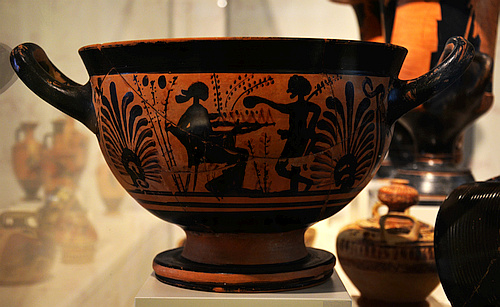
(Greek kylix = "cup"; pl.: kylikes) In ancient Greece a type of pottery with a broad,
shallow body with two handles on opposite sides, raised on a pronounced foot. It was the most common cup for drinking
wine. - The main alternative as cup for wine-drinking was the kantharos.
Kyniska
Kyniska (born ca. 440 BC) was the daughter of the Eurypontid king of Sparta, Archidamos II, and the sister of the later king of Sparta, Agesilaos II. - While most women in the ancient Greek world were kept in seclusion and forbidden to learn any kind of skills in sports, the contrary was true in Sparta. Being very wealthy, Kyniska became an expert equestrian. She started to breed horses and was a very successful trainer. - The ancient Olympic Games were almost entirely male-only and women were forbidden even to set foot in the main stadium at Olympia. However, women were allowed in the equestrian competitions, not by running or as spectators, but by owning and training the horses. Therefore, Kyniska employed men and won in the olympic four-horse chariot racing in 396 BC and again in 392 BC, although she could not see her victories herself.
Kypselos
1) A son of Aipytos, father of Merope and father-in-law of Kresphontes.
2) The first tyrant of Corinth. In the 7th century BC, Corinth had been involved in wars with Argos and Kerkyra, causing discontent of its citizens. Around 657 BC, Kypselos was polemarchos, the archon in charge of the military, and he used his power to expel the ruling dynasty and other aristocrats, but allowed them to found Corinthian colonies. During his rule he also increased trade with the colonies in Italy and Sicily and after thirty years was succeeded as tyrant of Corinth by his son Periandros in 627 BC.
Kyrenaics
A hedonist school of philosophy founded in the 4th century BC by Aristippos of Kyrene, named after the birthplace of its founder. The Kyrenaics taught that the only essential good is pleasure and recognized this not just as the absence of pain, but as positively enjoyable sensations. Such momentary pleasures were especially seen as physical ones more than anticipation or memory, but altruistic behaviour was also recognized as a source of pleasure while accepting the value of social obligation. - The school of the Kyrenaics vanished within a century, being followed by epikureanism.
Kyrene
1) A nymph, daughter of Hypseus. While hunting on mount Pelion, she was found by Apollon wrestling with a lion. He abducted her, made her the queen of Libya and the mother of Aristaios and Idmon. - By Ares, she became the mother of Diomedes, the later king in Thracia.
2) Ancient, quite prosperous city in Libya, sacked by Alexander the Great in 331 BC.
Kytissoros
A son of Phrixos and Chalkiope. After the death of his father, he and his brothers set out to avenge her father's ill treatment by Athamas. They stranded on an island in the Euxine (Black Sea), from where they were rescued by the Argonauts and returned with them to Kolchis.

