
GREECE
 GLOSSARY
| A | B | C | D |
| E | F | G | H |
| I | J | K | L |
| M | N | O | P |
| Q | R | S | T |
| U | V | W | X |
| Y | Z |
2026-01-22
color code:  = mythology;
 = history & culture;
  = geography;
  = archaeology &
architecture
= archaeology &
architecture
dado
The lower section of a wall revetted with orthostats.
Daedalic period
dagger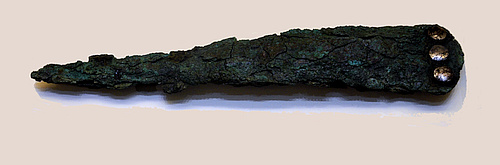
A short weapon used for thrusting and stabbing.
Daidalos
("cunning" or "curiously wrought"; latinized: Daedalus) Legendary inventor and craftsman, whose cunning accomplishments were compared in the Iliad to those of Hephaistos, and some even say that he was descendant from him. It is said that one of his miraculous inventions were statues moving of their own will (robots?). - After killing his nephew by throwing him from the Acropolis he had to leave Athens and found refuge with king Minos on Crete. For him, he designed the labyrinth of the Minotauros in Knossos. Later, after Theseus had subdued the Minotauros, Daidalos and his son Ikarus were themselves imprisoned in the labyrinth for having helped Theseus. Here, Daidalos fashioned wings made of feathers and wax for him and his son and they flew away. Ikarus flew too close to the sun so that the wax of his wings melted and he fell into the sea and drowned. Daidalos was more successful and reached Sicily. Minos pursued him even there, but perished in a death trap designed by Daidalos. - In spite of all the fabulous traditions Pausanias maintained that Daidalos was a historical figure.
daimon
Daimons are protecting spirits, analogous to the guardian angels of Christian tradition. The Greeks believed in daimones since earliest times, though Homer does not mention them but Hesiod elaborates on them in detail.
dais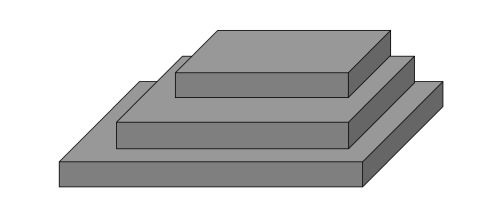
A raised platform or table, e.g. for speakers or honoured guests.
daktylos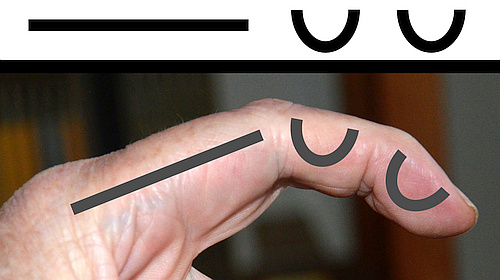
(Greek: dáktylos = "finger") A foot in poetic meter. It consists of a stressed long syllable
followed by two short syllables and is often used in ancient Greek poetry as part of a
hexameter. The Greek word dáktylos is itselfs a dactyl. - The opposite is the
anapaest: two short followed by a long syllable.
Damastes
--> Prokrustes
Damokles
A flatterer who was exaggerating his admiration of the happiness of his host, Dionysios II, the tyrant of the city of Syracuse. It is said that Dionysios, offended by this flattery, placed Damokles under a sword that was suspended by a single hair to make him aware of the precarious nature of happiness. From this episode comes the phrase "the sword of Damokles".
Damophon
An ancient Greek sculptor (fl. around 190 BC) of the Hellenistic period, who executed many acrolithic statues for Messene and other cities of the Peloponnese.
Danaë
The daughter of Akrisios, king of Argos. Zeus came to her in the form of a shower of gold and seduced her; their son was Perseus.
Danaides
The fifty daughters of Danaos and Pieria. After their escape from Egypt to Argos (see: Danaos), they were pursued by Aigyptos and his 50 sons. To prevent war, Danaos gave way but instructed his daughters to kill their husbands on their wedding night. All except Hypermnestra did so, and for this they were punished in tartaros: they had to fill a bath to wash off their sins, but they had only sieves to carry the water, so the water kept leaking out.
Danaos
("sleeper") In Greek mythology a twin brother of Aigyptos. Danaos and his wife Pieria had fifty daughters, the Danaides, and Aigyptos had fifty sons. When Aigyptos ordered his sons and the Danaides to marry, Danaos fled with his wife and his daughters from Egypt to Argos. Later Danaos was killed by Lynkeus, taking vengeance for the death of his brothers (see: Danaides).
Daphne
("laurel") A ravishingly beautiful maiden who is always in some way associated with Apollo. Pausanias describes her as a mountain nymph whom Gaia appointed as priestess in Delphi. In other accounts she is a daughter Of Gaia and a river-god. In any case Apollo fell in love and pursued her, although there are different versions of how this came to be. Just before Apollo could reach her, she was transformed into a laurel-tree (daphnê), which then became sacred to Apollo, and in art Apollo is often depicted with a laurel wreath.
 Dardanelles
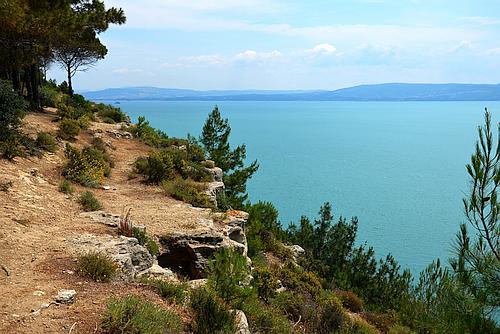
A narrow strait in northwestern Turkey, in antiquity known as Hellespont. It is 61 kilometres long
and 1.2 to 6 kilometres wide and lies on the boundary between Europe and Asia, connecting the Mediterranean with the Sea
of Marmara that leads to the Black Sea. It has in all times been a commercially important maritime route that was
controlled by Troy in the Bronze Age. - The Dardanelles
were crossed by the Persian army of Xerxes I in 480 BC to invade Greece, and in 334 BC by
the Macedonians of Alexander the Great in the opposite
direction to conquer Persia. The strait also played an important role in the brutal
Peloponnesian War (431-404 BC) as venue of many sea battles.
Dardanoi
An ancient people who settled in the Troas. They were closely related to the Trojans.
Dardanos
Son of Zeus and mythical ancestor of the Trojans. The royal Trojan lineage is: Zeus > Dardanos > Erichthonios > Tros > Ilos > Laomedon > Priamos.
Darius I
Darius I, also called Darius the Great (ca. 550 - 486 BC), was the third king of the Persian Achaemenid Empire. Under his rule, the empire had its largest extent, reaching from parts of Eastern Europe in the west to the Indus Valley in the east. But Darius also met with rebellions throughout his kingdom since the day when he ascended the throne, and he crushed all of them. One of the uprisings was the Ionian Revolt, which constituted the first major conflict between Greece and the Persian Empire. In its course Darius undertook a campaign to punish Athens and Eretria for their aid in the Ionian Revolt, and subjugate Greece. After the Persian troops were defeated in the Battle of Marathon 290 BC he planned another campaign, but died during the preparations and left this task to his son, Xerxes.
Darius II
Darius II (ruled 423 - 404 BC) was the son of Artaxerxes I and a court concubine. He married Parysatis and became by her the father of Artaxerxes II and Cyrus the Younger.
Darius III
Darius III (ca. 380 - 330 BC) was the last king of the Achaemenid Empire of Persia from 336 BC to 330 BC. His empire was already unstable due to unreliabel satraps when Alexander the Great began his invasion in 334 BC. After the Persians were defeated in several battles, Darius disgraced himself by deserting his army and running away from the fight. He was then killed by his cousin Bessus.
 Dark Ages

The period between ca. 1050 BC and 780 BC, i.e. the time between what is called the
'Dorian Invasion', followed by the collapse of the Mycenaean
civilization, and the beginning of the Archaic period, characterized by the rise of
aristocratic city-states. The name derives from the
fact that there are very few records from this period although modern archaeology reveals some new insights. - In terms
of pottery finds it practically coincides with the Geometric period.
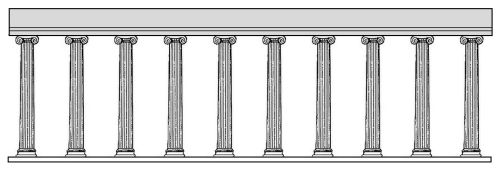
decastyle
Deianeira
1) The last earthly wife of Herakles. When she, Herakles and their son Hyllos arrived at a river during their wanderings, the centaur Nessos offered to carry Deianeira across. When Herakles, with Hyllos on his shoulders, waded through the river, Nessos tried to abuse Deianeira, but was hit by a deadly arrow-shot from Herakles. As a revenge, the dying centaur told Deianeira that his blood was a powerful love potion. So she secretly put some of the blood on Herakles' cloak, but it turned out to be a deadly poison, burning away the flesh like an acid. Seeing this, Deianeira killed herself in despair and Herakles built his own funeral pyre.
2) A daughter of Nereus and Doris.
Deïdameia
1) A daughter of Bellerophontes. By Euandros she became the mother of Sarpedon. Homer calls her Laodameia.
2) A daughter of Lykomedes in the island of Skyros. When Achilles, prior to the Trojan War, was concealed there in a maiden's disguise, Deïdameia became by him the mother of Neoptolemos.
3) The wife of Peirithoos. Her wedding led to the famous fight between the Lapiths and the centaurs. She is usually called Hippodameia.
Deimos
In Greek mythology the personification of fear, son of Ares and Aphrodite. He and his brother Phobos used to accompany their father in his chariot when he appeared during battles. - One of the moons of the planet Mars is called Deimos.
Deïon
1) A son of Aiolos and Enarete. He was king in Phokis and husband of Diomede, by whom he became the father of Asteropaia, Ainetos, Aktor, Phylakos, and Kephalos.
2) A son of Herakles and Megara.
Deioneus
1) Father of Dia, the wife of Ixion. When Deioneus refused his son-in-law the bridal gift, Ixion had him thrown into a pit of burning coals and thereby killed him. He is also called Eioneus.
2) A son of Eurytos of Oekhalia.
Deïphobos
1) A son of Priam and Hekabe, was next to Hektor the bravest among the Trojans. He and his brothers, Helenos and Asios, led the attack against the Greek camp, where he killed Hypsenor. When he was challenged by Idomeneus he called Aeneas to his assistance. Later he slew Askalaphos, was wounded by Meriones, and Athena assumed his appearance to deceive Hektor in his fight with Achilles. Later traditions relate that he prevented Helena to be handed over to the Greeks after the death of Paris. For this, he was most hated by the Greeks and when Troy fell he was cruelly killed either by Menelaos or by Palamedes, or even by Helena.
2) A son of Hippolytos, who purified Herakles after the murder of Iphitos.
Delian League
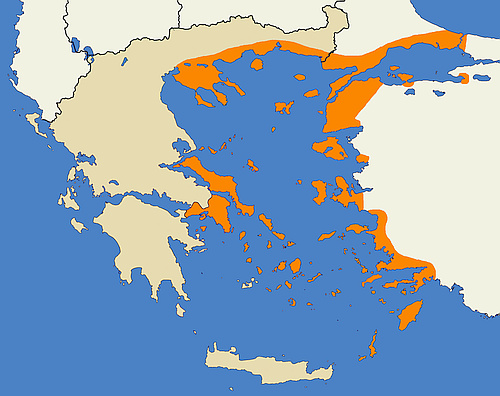
The Delian League (also: Athenian League) was a military alliance of 150-300 Greek
city-states under the hegemony of Athens. It was founded in
478 BC after the battle of Plataiai to defend the Greeks of the Aegean and in
Asia Minor against the persistent threat of the Persian empire. The confederacy gradually
developed into an Athenian naval power where the allies became increasingly less autonomous. Athens began to use the
League's funds for its own purposes and in 454 BC Perikles, in a symbolic gesture, moved
the League's treasury from Delos - whence the name of the League - to Athens. By 431 BC the dominant role of Athens
posed a growing threat to Sparta, and this prompted the outbreak of the
Peloponnesian war, and after the war in 404 BC with Spartan supremacy the League
was dissolved. - When Sparta's hegemony grew in the first half of the 4th century BC, Athens partly revived the League,
known as the "Second Athenian League" (386 - 371 BC) and gained again a position of prime naval power in the Eastern
Aegean.
Delos
Two barren islands in the centre of the ring of the Cyclades: Mikra Delos (3.6 km2) and Megale Delos (ancient Rheneia, 17 km2). Inhabited since the third millennium BC and mythical birthplace of the twin gods Apollo and Artemis, the islands became a major cultic centre in the 7th century BC. In 1990 inscribed on the UNESCO World Heritage List because "the archaeological site is exceptionally extensive and rich and conveys the image of a great cosmopolitan Mediterranean port."
 Delphi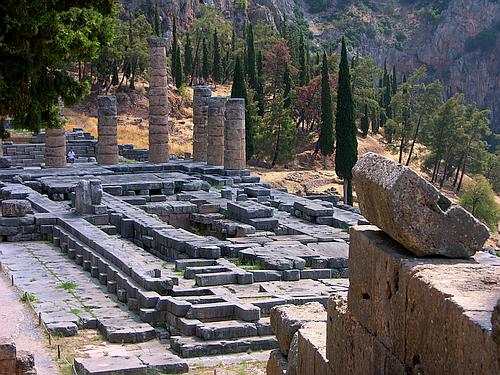
In classical times one of the major cultic centres of Greece, seat of the Delphic
oracle, sanctuary of Apollo and site of the
Pythian Games. - See also:
site page.
Delphic
amphictyony
The Amphictyonic League of Delphi was organized to protect and support first the sanctuary of Apollo at Delphi. The council of the League had religious authority and could pronounce punishments like fines or expulsion or even declaration of Sacred Wars. The foundations of the Delphic Amphictyony are obscure but it originally consisted of 12 tribes of the region. In the begin a religious organization, it bacame politically important in the 6th century BC with the rise of powerful city-states striving for dominance. When the oracle became independent from the city of Krissa, to which the sanctuary originally belonged, Krissa imposed a tax on the pilgrims who had to pass their territory on their way to Delphi. This lead to the first Sacred War 596-585 BC, resulting in the destruction of Krissa. In 449-448 BC the Phokians marched against Delphi, but were stopped by a Spartan army in the second Sacred War. After the Spartan retreat Athens gave the rule of Delphi and the organization of the Pythian Games back to Phokis, but after the Peace of Nikias in 421 BC Delphi was autonomous again. When the Phokians sacked Delphi in 356 BC, another Sacred War was declared against them, and after ten years of fighting Phokis was expelled from the League, their two votes falling to Macedonia. This encouraged Philip II of Macedon in his expansionist policy and led to the fourth Sacred War. The Battle of Chaironeia in 338 BC then confirmed the final domination of Macedonia over Greece. In the following period the League lost more and more of its importance although it still existed in the second century AD.
Demaratos
Demaratos was the 15th Eurypontid king of Sparta (515 - 491 BC). Opposing his co-ruling Spartan king, Kleomenes I, he emmigrated and fought on the Persian side in the Second Persian invasion of Greece.
deme
In ancient Greece, a deme was a subdivision of Attica. Such demi probably existed already in the 6th century BC or earlier, but only the reforms of Kleisthenes in 508 BC made them partucularly important. Until then, citizenship was based on membership in a phratria, one of the aristocratic family groups. This was now replaced by the required enrollment in the citizen-lists of a deme. - Demi were later combined to trittyes, larger population groups, which in turn were combined to form the ten tribes, or phylai of Attica.
Demeter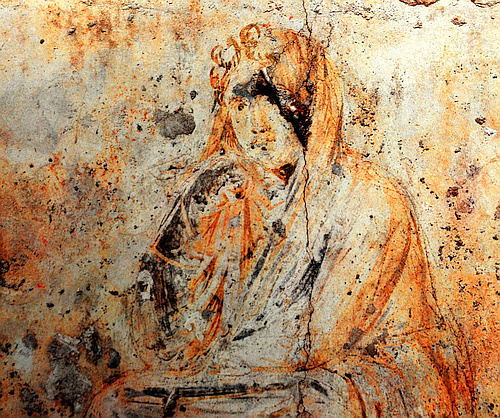
Greek goddess of agriculture. She is represented in art as a mature woman, usually with a veil, an
ear of wheat and the Horn of Plenty being her attributes. Her daughter was Persephone,
the maiden. When Persephone was kidnapped by Hades and brought to the
underworld Demeter could not find her and stopped all plants from growing on earth.
Zeus had to intervene and arranged the compromise that Persephone stays with her mother for
half of the year and with Hades for the other half. - Main cult centre of Demeter was
Eleusis with the Eleusinian Mysteries.
Demetrios Poliorketes
Demetrios I (337 - 283 BC), called Poliorketes ("The Besieger"), was a son of Antigonos I Monophthalmos and Stratonike. He was a Macedonian nobleman, military leader, and finally king of Macedon (294 - 288 BC).
demiourgos
Demiourgos is a term used to describe a socioeconomic class and political class in ancient Greek.
democracy
(Greek demos = "people" + kratos = "rule") A form of government in which the state authority lies in the hands of those who are governed. Plato sets it against monarchy (rule by an individual), oligarchy (rule by a small élite) and timocracy (rule by one race or nationality over another). A democratic system was first developped in Athens in 508 BC.
Demokritos
Pre-Socratic philosopher (ca. 460 - 370 BC), student of Leukippos of Milet. He is the originator, or at least one of the first advocate, of the idea of atomism, arguing that all matter is made up of smallest, indivisible elements which he called atoma. - Later, he became known as the "Laughing Philosopher" because he taught that happiness is the greatest good and that it can be achieved though moderation, calm and freedom from fear.
Demonike
A daughter of Agenor and Epikaste, who became by Ares the mother of Euenos, Molos, Pylos, and Thestios. Hesiod calls her Demodoke.
demos
In ancient Greece a term referring to the citizens, their assemblies, or the lower classes. - See also: deme.
Demosthenes
(384 - 322 BC) Prominent Athenian statesman and recognized as one of the ten greatest Attic orators. His orations provide an important insight into the politics and culture of ancient Greece during the 4th century BC. Cicero acclaimed him as "the perfect orator" who lacked nothing. He delivered his first judicial speeches at the age of 20 and then made his living as a professional speech-writer (logographer) and a lawyer. In his political speeches since 354 BC he opposed Macedon's expansion under Philip II to preserve his Athens' freedom. After Philip's death he played a leading part in his city's uprising against the successor, Alexander the Great. These efforts failed and were met with harsh Macedonian reactions. To prevent similar revolts after the death of Alexander the Great, Antipater sent his men to track Demosthenes down, but he took his own life, in order to avoid being arrested.
dentil
(lat. dens = tooth) A small block of stone used as repeating element in classical
architecture, derived from earlier timber constructions. It occurs especially in
Ionic temples of Asia Minor, but also elsewhere and
in later architectural styles.
depa amphikypella
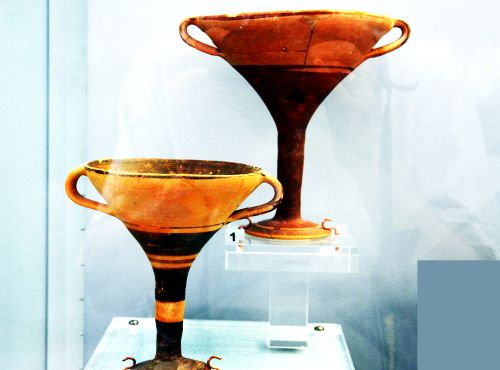
A term used by Homer to designate a two-handled drinking cup. It appears
in Linear-B texts for a large jar.
Deukalion
1) The story of Deukalion immediately brings to mind the figure of Noah in the Genesis. Myths about a "Great Flood" can not only be found in Greek and Christian tradition but actually appear in many cultures, with the oldest written tradition perhaps in the Epic of Gilgamesh (around 2000 BC). - In ancient Greek mythology, Deukalion was a son of Prometheus and Klymene. He was king in Phthia, and married to Pyrrha. When Zeus decided to purge the earth from the degenerate race of men, Prometheus advised his son to build a ship. Deukalion did so and stored a vast amount of provisions in it. When Zeus sent a great flood all the humans were destroyed, only Deukalion and Pyrrha were saved. After the ship drifted for days on the water it landed on Mount Parnassos (other traditions name various other mountains). When the waters had subsided, Deukalion made sacrifices to "Zeus Phyxius", the helper of fugitives. He and Pyrrha then went to the sanctuary of Themis and prayed, that mankind be restored. Themis advised them to cover their heads and throw the bones of their mother behind them when walking from the temple. Bewildered at first, they realized that the earth is their mother and that her bones are the stones. So when they walked away they threw stones behind them, and out of each stone that Deukalion threw sprang up a man, and out of each stone that Pyrrha threw sprang up a woman. In this way they became ancestors of a new human race. - Deukalion was by Pyrrha the father of Hellen, Amphiktyon, Protogeneia, and others.
2) A brother of Amphion.
3) A son of Minos and Pasiphaë. He was one of the Argonauts and took part in the Kalydonian Hunt. He was the father of Idomeneus and Molos.
4) A son of Herakles.
5) A Trojan, slain by Achilles.
Dia
1) Daughter of Deioneus or Eioneus and the wife of Ixion. By him, or according to other myths by Zeus, she became the mother of Peirithoos.
2) A surname of Hebe and Ganymede.
3) There are two other mythical personages of this name.
4) An ancient name of the island of Naxos.
diadochi
(Latin: "successors") The rival generals, family members and friends of Alexander the Great who fought in the "Wars of the Diadochi" for control of Alexander's empire after his death in 323 BC. Among these were Antigonos, Antipater, Kassandros, Krateros, Lysimachos, Perdikkas, Ptolemaios, and Seleukos.
Diagoras
Diagoras "the Atheist" of Melos (fl. 5th century BC) was a Greek poet and sophist. He spoke out against the Greek religion, and criticized the Eleusinian Mysteries. Accused of impiety, he had to flee from Athens and died in Corinth.
diakonikon
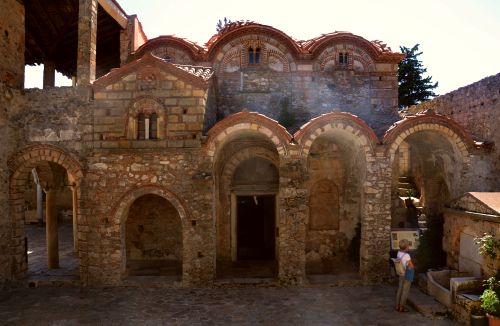
An apartment to the S of the entrance to a Christian basilica, part
of the narthex. Here the deacons (diakonoi) received the offerings of the faithful
on tables.
diastyle
Columns set at an intercolumniation of three column diameters. Vitruvius warned that with columns set this far apart, stone architraves break.
diazoma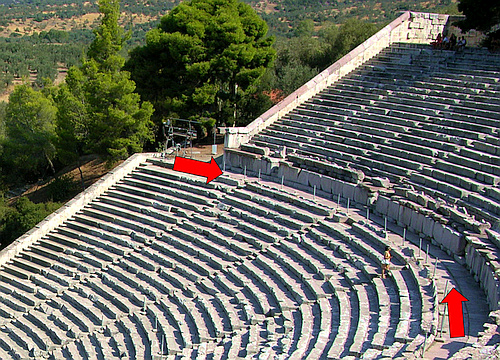
In an ancient Greek theatre the horizontal walkways that separate
upper from lower tiers.
Dike
("Justice") In ancient Greek mythology the personification of justice, one of the Horai. According to Hesiod she was a daughter of Zeus and Themis, and the sister of Eunomia and Eirene. She was considered to watch over the deeds of man and the maintenance of justice, approaching the throne of Zeus whenever a judge violated justice. She would severely punish all wrong, in this respect related to the Erinyes, but she would also reward virtue. The dramas of Sophokles and Euripides are the best representations of this personification of justice.
Diktaion Andron
--> Psychro cave
dinos
In ancient Greek pottery, the dinos (plural dinoi) is a mixing bowl or cauldron.
Dinos Painter
An Attic red-figure vase painter (fl. second half of the 5th century BC). His use of an increased amount of white to stress details initiates the "Rich Style" of vase painting of the following generation. His works have been found not only in Athens, Sicily and Italy, but also in Spain and Syria.
Diodorus
Diodorus Siculus (of Sicily) was a Greek historian, author of the monumental Bibliotheca historica covering the history from the Bronze Age until about 60 BC.
Diogenes of
Apollonia
Diogenes of Apollonia (fl. 5th century BC) was an ancient Greek philosopher. He believed air to be the ultimate source of all being, all other substances being derived from it, and - as a primal force - to be intelligent.
Diogenes of Sinope
Diogenes of Sinope (ca. 412 - 323 BC) was a Greek cynic philosopher. He was a disciple of Antisthenes in Athens and led a simplistic, austere life. None of his works survived, but anecdotes and commentaries of classical authors indicate his impact on his times. Once he was kidnapped by pirates who sold him to Xeniades in Corinth, Diogenes reputedly said: "Sell me to that man, he needs a master." Xeniades set him free and Diogenes educated Xeniades's sons. It is said that Diogenes walked around Corinth with a lit lamp in daytime, looking for "a human being". Especially noted is the period when he was living in a barrel (actually, a huge clay jar) on the streets of Athens. Alexander the Great met him there and asked what he could do for him, Diogenes replied that he could step out of his sunlight. After Diogenes died in his barrel, he was given a magnificent funeral.
diolkos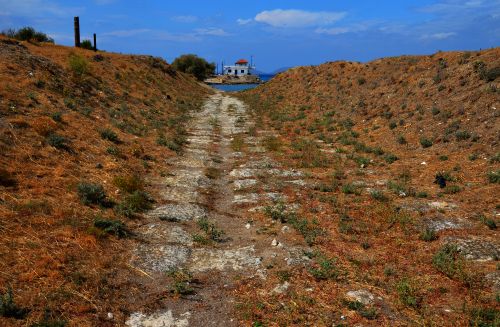
The ancient paved path across the isthmus of
Corinth. Since no canal existed in antiquity, ships were dragged along the diolkos from
Kenchreai, harbour of ancient Corinth on the Saronic gulf, to Lechaion, the city's
second harbour on the Corinthian gulf. - See also:
site page.
Diomedes
1) Son of Ares and Kyrene. He fed his horses with human flesh and was killed by Herakles in his Eighth Labor.
2) King of Argos, son of Tydeus and husband of Aigiale. He is one of the major Greek heroes in the Trojan War, where he even wounded Aphrodite when she tried to protect her son, Aeneas. Diomedes was also one of the Epigoni who captured Thebes one generation after his father died in this attempt.
Dione
1) ("the Goddess") A Titan (or an Okeanid) and consort of Zeus (etymologically, Dione is a female form of Zeus). In Dodona, Dione instead of Hera was worshipped as wife of Zeus.
2) One of the Hyades is also named Dione.
Dion of Syracuse
Dion (408 - 354 BC) was tyrant of Syracuse in Sicily, and a disciple of Plato. He became the most trusted adviser of his brother-in-law Dionysios I of Syracuse but fell in disgrace with his successor Dionysios II. After an intrigue he was banished and lived a prosperous life in Athens until Dionysios dispossessed him of his estates and income. In 357 BC, he landed in Sicily and in 355 BC became master of Syracuse. However, his imperious behaviour alienated the population and in the following year he was assassinated.
Dionysia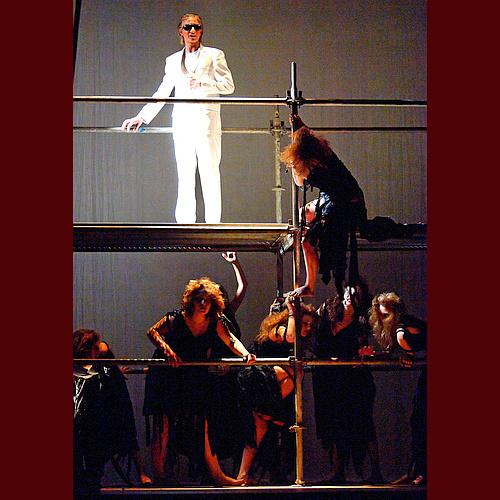
The orgiastic and dramatic festivals held periodically in honor of Dionysos,
especially the celebrations held in Athens, which gave rise to Greek
comedy and tragedy.
Dionysios I
Dionysios I or Dionysios the Elder (ca. 432 - 367 BC) was a Greek tyrant of Syracuse in Sicily. He conquered several cities in Sicily and southern Italy, and made Syracuse the most powerful of the Greek colonies in Magna Graecia. However, he was regarded as the worst kind of despot - cruel, suspicious and vindictive.
Dionysios II
Dionysius II or Dionysios the Younger (ca. 397 BC - 343 BC) was a Greek politician who ruled Syracuse from 367 BC to 357 BC and again from 346 BC to 344 BC. When his father, Dionysios I died in 367 BC, Dionysios began ruling under the supervision of his uncle, the philosopher Dion. Because of Dionysios' lavishly dissolute lifestyle, Dion invited his teacher Plato to Syracuse and together they tried to restructure the government, establishing Dionysios as the archetypal philosopher-king. This failed, Dionysios banished his uncle and took complete power in 366 BC, where he turned out to be completely incompetent. In 357 BC, Dion returned with a small army, acclaimed by the Syracusans, and Dionysios went into exile. Returning in 346 BC, eight years after Dion's assassination, he was forced out of Syracuse again and died in Corinth.
Dionysos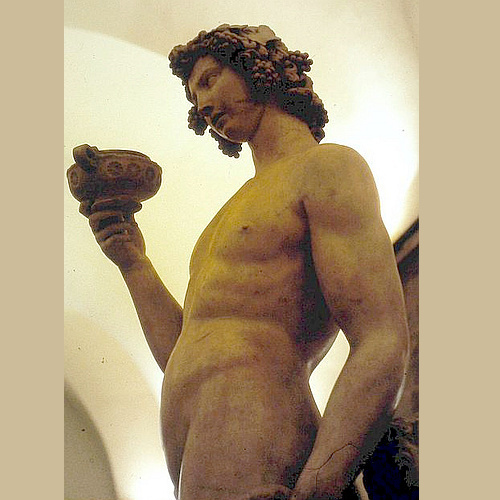
Son of Zeus and the mortal Semele. He is
the god of wine, agriculture, and fertility, but also god of the Greek theatre. His
mother, Semele, died before giving birth, but the myth says that Zeus took the unborn Dionysos from her womb and sewed
him inside his thigh until it was time for the child's birth.
Dioskouroi
The famous heroes Kastor and Polydeukes (Pollux). They were the sons of Leda and Tyndareos, and thus brothers of Helena. In other traditions all three, or only Polydeukes and Helena, were children of Zeus. Among all the adventures of the Dioskouroi there are three main episodes:
- When Theseus had carried off their sister Helena from Sparta, he kept her in confinement in Attica, but when he was away the brothers invaded Attica, ravaged the country and liberated Helena. Menestheus, eager to usurp the reign of Athens, opened the city gates and the Athenians paid divine honours to them.
- They took part in the Kalydonian Hunt and were also among the Argonauts. During this voyage they came into a terrible storm, but when Orpheus prayed to the gods the storm subsided and stars appeared above the heads of the Dioskouroi. In the further course of the voyage Polydeukes conquered Amykos, the gigantic son of Poseidon.
- The Dioskouroi, together with Idas and Lynkeus, the sons of Aphareus, had once carried away a herd of oxen from Arcadia. They came into a quarrel about the distribution of the booty and this evolved into a real fight. In this battle, Kastor, the mortal, fell by the hands of Idas, but Polydeukes slew Lynkeus, and Zeus killed Idas by a flash of lightning. The immortal Polydeukes then prayed to his father Zeus to be permitted to die with Kastor. Zeus was moved by the attachment of the two brothers and placed them among the stars as the constellation Gemini.
The two heroes were believed to have ruled Sparta as kings and were awarded divine honours there. Their worship as theoi sôtêres, i.e. mighty helpers of man, spread all over the Greek world, but they were especially worshipped as the protectors of travellers by sea, for Poseidon had rewarded their brotherly affection by giving them power over wind and waves so that they could assist the shipwrecked.
dipinto
A term applied in archaeology and epigraphy to sketched or painted inscriptions (as opposed to engraved).
dipteros
A classical Greek temple with two rows of
columns on all four sides.
dipylon
("double gates") The main entrance through the northwestern city walls to Athens.
Dirke
Wife of king Lykos of Thebes. Because she tormented Antiope, she was tied by her hair to a bull, letting him drag her through the mountains until she was dead. In another tradition, Dionysos turned her into a spring.
diskobolos
A discus thrower.
distyle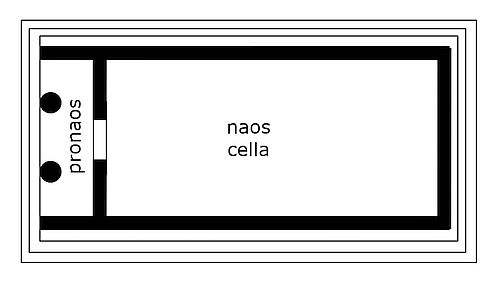
A distyle, or more precisely a distyle in antis, is a classical Greek
temple where the side walls extend to the end of the porch, forming the
pronaos between two antae. Between these are two
columns, seldom caryatids, supporting the
pediment. Behind this is the central room of the temple, the
cella (naos). - The distyle is the earliest form of Greek temples, and sometimes there
is another porch with a similar construction at the rear.
dithyrambos
An ancient Greek hymn sung and danced in honor of Dionysos. Plato remarks in the Republic that dithyrambs are the clearest example of poetry in which the poet is the only speaker, while according to Aristotle the dithyramb was the origin of Athenian tragedy.
Dodecanese
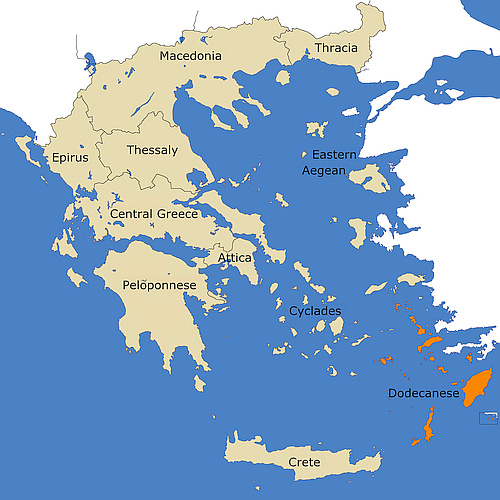
The Dodecanese ("twelve islands") denotes a group of 15 larger plus 150 smaller Greek islands in the
southeastern Aegean Sea, off the coast of Asia Minor, of which 26 are inhabited. It
includes Astypalaia, Halki, Kalymnos, Karpathis, Kos, Leros, Lipsi, Nisyros, Patmos, Rhodos, Symi, and Tilos.
dodecastyle
A portico with twelve columns.
Dodona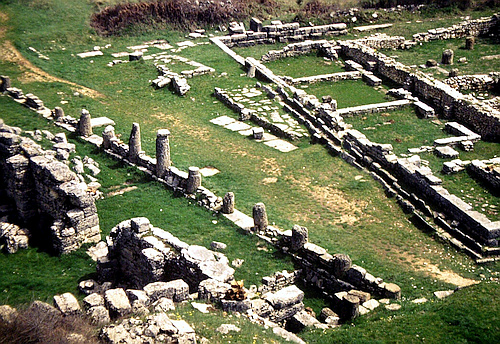
Ancient cult place of Zeus and Dione in
Epirus. It is one of the oldest and most important sanctuaries of early Greek history
which goes back to prehistoric times when deities were not worshipped in temples but in sacred groves. The
oracle of Dodona was already known to Homer and it is said
that the goddess Athena installed a piece of Dodona's sacred oak tree into the ship of the
Argonauts to advise them during their dangerous expedition. - See also:
site page.
Dörpfeld
Wilhelm Dörpfeld (1853 - 1940) was a German archaeologist and architect. He joined Schliemann in some of his excavations and introduced modern methods in archaeology, especially stratigraphic excavation. He directed excavation projects in Olympia, Tiryns, Troy, Pergamon, and Athens.
dog-leg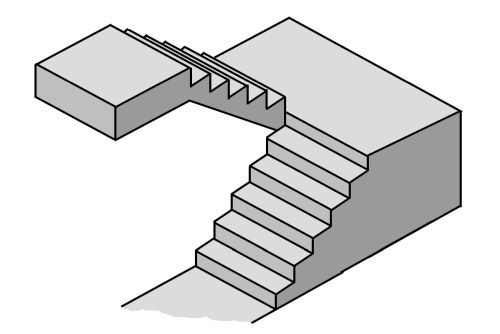
A sharp bend or turn e.g. of a road or of an architectural structure like a staircase.
Dolopes
An ancient Greek tribe in the area of Thessaly, sometimes also considered as Aetolians.
Dorian Invasion
The Dorian Invasion is a much debated concept of historians in ancient Greece thought to explain why older dialects and traditions in southern Greece and on some islands of the Aegean were replaced by the one of the Classical era. In Greek mythology the Dorians took possession of the Peloponnese in a campaign called the "Return of the Heraklids". Ancient historians saw this as a possibly real event, but until now there is no positive proof of such a mass invasion of the Dorians. Their origin remains unclear in spite of attempts to link them to the equally mysterious Sea Peoples. The Dorian Invasion thus refers to the cultural break after the Mycenaean period without giving a conclusive explanation.
Dorians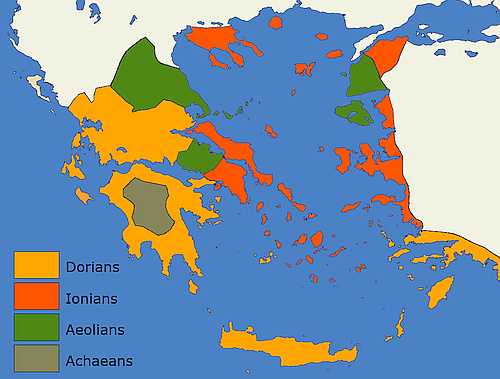
A Hellenic tribe that appears in Greece around 1100 BC, bringing with them
Iron Age technology and subjugating the local population. In classical Greece, the
Dorians were one of the four major ethnic groups, the others being the Ionians, the
Aeolians, and the Achaeans.
Doric order
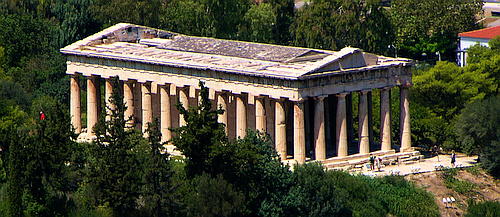
The oldest and most severe of the architectural orders in
ancient Greece. Its sturdy columns stand without a base on the
flat stylobate of a temple, are slightly tapered, and
their shafts are fluted with wide, parallel concave grooves. A
ring (the necking) separates the top of the shaft from the capital. The Doric capital
consists of two parts, a round echinus and a square abakus.
Above the capital is the architrave, an unadorned beam supporting a
frieze of alternating triglyphs and
metopes. A simple cornice molding above the frieze extends
to protect the parts below from rain. This is crowned by the triangular pediment on the
narrow sides of the temple. - Doric architecture symbolises the male strength and is used for temples dedicated to male
gods, but also to Athena. It is slightly earlier than the
Ionic order but both were established by the end of the 7th century BC on the Greek mainland and in southern Italy
and Sicily.
doron
The breadth of the hand as an ancient unit of measure.
Doris
1) An Okeanid, i.e. one of the three thousand daughters of Okeanos and Tethys. Doris and Nereus are the parents of the 50 Sea-Daughters, i.e. the Nereids.
2) One of the Nereids, i.e. a daughter of Nereus and Doris.
Doros
The mythical ancestor of the Dorians, who is said to have assembled these people in the neighbourhood of Parnassos. According to one mythological tradition he was a son of Hellen, by the nymph Orseis, and a brother of Xuthos and Aiolos. In another tradition, he was a son of Apollo by Phthia, and thus a brother of Laodokos and Polypoetes.
Doryssos
A king of ancient Sparta and according to Pausanias the father of Agesilaos I. He was killed in a battle between the Spartans and the Argives.
drachma
An ancient Greek currency unit issued by many Greek city-states during a period of ten centuries, from the Archaic period up to the Roman period. The name drachma is derived from the verb drássomai ("grasp"). Before it became disc-shaped around 700 BC, a drachma was a fistful (a "grasp") of six oboloí, originally spits of copper or bronze.
Drakon
(Drako, Draco) First Athenian legislator. He was requested by the citizens of Athens in 621 BC as lawgiver of the city-state. Consequently, he replaced the system of oral law and blood feud by a written code, to be enforced only by a court. His laws were perceived as very harsh, demanding the death penalty for most offences. It is said that Solon repealed all of Drakon's laws except those on homicide.
drama
(Greek drama = "action") Fiction presented in a performance. Although the origins in ancient Greece remain obscure, it goes back to celebrations of the god Dionysos. Originally, a chorus appeared under the direction of a leader, the chorodidaskalos. It lasted centuries before the leader not only spoke or sang about the hero but began to impersonate him. The next steps were the addition of a second actor and of dialogues, so that on-stage action and conflicts could be shown. In this way, three types of drama evolved, mainly in Athens: tragedy, comedy, and satyr plays. Drama was great entertainment and the performances attracted a wide audience, but it also had a religious and pedagogical or political component: it offered explanations of the relation between humans and gods, humans and the material world, the origin of violence, and the existence of the irrational.
dromos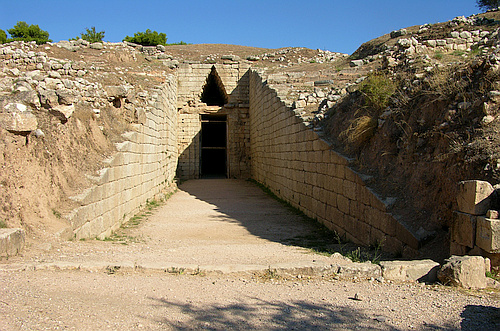
The entrance passage leading to a Mycenaean
tholos tomb or chamber tomb. The dromos is open to the
air. In the case of chamber tombs, the dromos is cut from the rock, sloping downwards to the doorway of the subterranean
tomb with walls usually inclined, being narrower at the top. The dromos of tholos tombs is ground-level with
perpendicular walls built of stones.
dryad
(Greek: drys = "tree") In Greek mythology, a nymph of a tree or of the woods.
Dryas
1) A son of Ares, was one of the Kalydonian hunters. He was killed by his brother Tereus, who had received an oracle that a relative would kill his son Itys.
2) There are five other mythical personages of this name.
Dryopes
A pre-Dorian Hellenic tribe, in Mycenaean times already settled in a part of Fthiotis.

