
GREECE
 GLOSSARY
| A | B | C | D |
| E | F | G | H |
| I | J | K | L |
| M | N | O | P |
| Q | R | S | T |
| U | V | W | X |
| Y | Z |
2026-01-23
color code:  = mythology;
 = history & culture;
  = geography;
  = archaeology &
architecture
= archaeology &
architecture
Labdakos
The mythical third king of the city of Thebes. He was a grandchild of Kadmos, the son of Polydoros, father of Laios and grandfather of Oedipus.
 labrys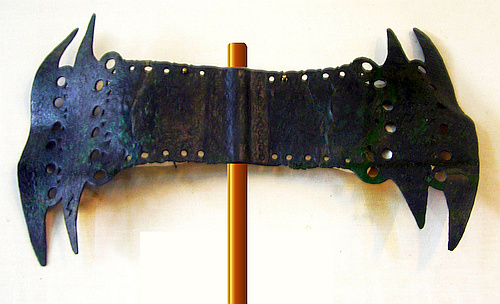
A symmetrical double-axe originally from Crete. The stylized labrys is
most closely associated with the Minoan civilisation which reached its peak in the 2nd
millennium BC, making the labrys one of the oldest symbols of Greek civilisation. In Minoan Crete the symbol always
accompanies the worship of female divinities.
labyrinth
A "cage with convoluted flextions that disorders debouchment". It was the mythical place at Knossos where the Minotauros was kept. According to tradition it was constructed by Daidalos with passage-ways so winding that those unfamiliar with them had difficulty in finding their way out.
Lachesis
One of the Moirai, the "Dispenser of Lots". She is the Fate who weaves a pattern into the thread of life, and thereby assigns destiny to each individual.
 Ladon
Ladon
1) In ancient Greek mythology, a dragon with one hundred heads. Together with the Hesperides, he guarded a tree with golden apples, a wedding gift of Gaia to Hera upon her wedding to Zeus. Ladon was killed by Herakles when completing his Eleventh Labor.
2) A river god, one of the many sons of Tethys and Okeanos.
3) A river in Arcadia, flowing into the Alpheios.
4) A river in Thessaly, flowing into the Peneios.
Laërtes
A son of Arkeisios and Chalkomedusa (according to other traditions, a son of Sisyphos), and husband of Antikleia, by whom he became the father of Odysseus and Ktimene. In his youth, Laërtes is said to have taken part in the Kalydonian Hunt, and in the expedition of the Argonauts. At the time when Odysseus participated in the Trojan War, Antikleia died of grief and Laërtes kept to himself on his farm. When Odysseus had finally returned to Ithaka and killed all the suitors competing for Penelope, Odysseus visited Laërtes, and led him back to his palace, where they have to fend off the families of the dead suitors. Athena lends Laërtes youthful vigour so that he can participate in the fight and kill the attacking father of Antinous. Three years after Odysseus' return, Laërtes died.
Laios
The son of Labdakos; a king of Thebes and the father of Oedipus. As a young man he kidnapped the son of Pelops and as punishment for this crime Apollo foretold him that he would be killed by his own son. So, when his wife Iokaste bore him a son, they had a servant take the infant to Mount Kithairon and expose him there. Oedipus was saved and was raised in the house of Polybos who treated him as his own son. Later, when Oedipus was on his way from Delphi, he met a chariot and when the charioteer tried to push him out of the way, a brawl developped, in the course of which Oedipus killed his real father Laios.
Laistrygones
In ancient Greek mythology a tribe of giant cannibals. According to Thukydides they inhabited southeast Sicily, but a modern study found convincing arguments to identify their harbour with Mezapos in Lakonia, Peloponnese. - In the Odyssey, Homer relates that Odysseus visited them on his voyage back home, that all ships were moored inside the small harbour surrounded by steep cliffs, and that only Odysseus' ship was fastened outside the bay. Three of his men were sent to investigate the terrain, and when they reached the house of the local ruler, Antiphates, the giant immediately killed one of the men and drank his blood. The other two fled, but after an outcry by Antiphates were pursued by thousands of Laistrygones, who then threw large rocks onto the ships and speared the men like fish. Only Odysseus escaped because his ship was not trapped in the harbour.
Lakedaimon
According to ancient Greek mythology a son of Zeus by Taygete, one of the Pleiades. Lakedaimon was married to Sparta, the daughter of Eurotas, by whom he became the father of Amyklas, Eurydike, and Asine. He was king of the country which was called after his own name, Lakedaimonia, while he gave to his capital the name of his wife, Sparta.
Lakedaimonia
Ancient name of Lakonia or of Sparta, respectively.
Lakonia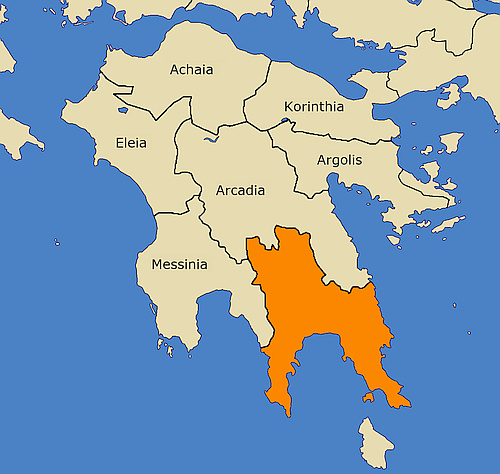
Lakonia, also known as Lakedaimonia, is a region in the southeastern part of the
Peloponnese peninsula (3600 km2, 84,000 inhabitants). In antiquity this
was the principal Spartan state. - See also:
site page.
Lakydes
Lakydes (died ca. 205 BC) was a Greek philosopher. He succeeded Arkesilaos as head of the Academy at Athens in 241 BC, but had to resign ca. 215 BC due to his bad health. Nothing of his works survived.
Lamachos
Lamachos (fl. 5th century BC) was an Athenian general in the Peloponnesian War. Even as general he was so poor that he charged the Athenians money for his clothes and boots. On the other hand he was known for his fiery disposition, fond of taking risks in battle. Although his courage and military skill was acknowledged, Lamachos was sometimes thought less qualified than other generals because he lacked the necessary social position. - In 415 BC, Lamachos was elected general of the Sicilian Expedition together with Nikias and Alkibiades. Lamachos proposed an aggressive strategy against Syracuse while the inhabitants were still unprepared. This might have brought Athens a quick victory instead of the disaster that ensued. He was killed in the fights that followed.
 Lamia
Lamia
1) A city in central Greece. It was founded in antiquity, and is today the capital of the regional unit of Fthiotis and of the Central Greece region.
2) A daughter of Poseidon. By Zeus she became the mother of the sibyl Herophile.
3) A female phantom, by which children were frightened. According to ancient Greek tradition she was originally a Libyan queen of great beauty, beloved by Zeus. Out of jealousy, Hera robbed her of her children, and Lamia as a revenge robbed other people of their children and killed them. The savage atrocities that now made up her life rendered her ugly, her face becoming distorted and frightening. In later times Lamiae were conceived as handsome women who attracted young men to enjoy their pure flesh and blood, and in this way resembling vampires of modern legends.
4) A hetaira of the 5th century BC, mistress of Themistokles. There was a gossip that Lamia with four other hetairai were going with Themistokles with a quadriga to the market - but that the reports were not clear whether the hetairai were dragging the carriage or if they sat with Themistokles in the horse-drawn carriage.
5) Lamia of Athens (around 300 BC) was a celebrated courtesan, and mistress of Demetrios Poliorketes, the later king of Macedon.
Lamian War
The Lamian War (323 - 322 BC) was fought when a coalition of Greek city-states including Athens tried to break loose from Macedonian control after the death of Alexander the Great in 323 BC. The Greek forces under the command of the Athenian Leosthenes had some initial successes defeating the Macedonian ally Boeotia at Plataiai and the Macedonian army of Antipater at Thermopylae. The rest of the Macedonian troops fled to Lamia, where they were besieged by the Greeks. When the Greek fleet was then defeated by the Macedonian navy at the Hellespont, Macedonia could bring reinforcements from Asia, crushing the Greek revolt.
Lampetie
A daughter of Helios by the nymph Neaira. After her birth she and her sister Phaëtusa were carried to Sicily to guard the flocks of their father.
Laodamas
1) Son of Eteokles, inherited Thebes from his father. When the Epigoni attacked the city, he killed Aigialeus, but was afterwards himself killed by Alkmaion.
2) In the Odyssey a son of Alkinoos and Arete.
3) A son of Antenor and Theano; in the Trojan War he was killed by Aias.
4) Some traditions mention him as a son of Hektor.
Laodameia
1) A daughter of Bellerophontes, became by Zeus the mother of Sarpedon, and was killed by Artemis.
2) A daughter of Akastos, and wife of Protesilaos. Since her husband joined the expedition against Troy very soon after the marriage and was the first to be killed in the war, Laodameia prayed to the gods to allow her to meet him again for just three hours. The gods granted her this favour and Hermes led Protesilaos back to the upper world. According to one tradition, Laodameia died together with her husband when he died a second time. In another tradition, Laodameia made a wooden image of her husband after his second death and honoured it with precious offerings. Her father Akastos deplored this cult and made her burn the image. She did so and leaped herself into the flames.
3) A daughter of Amyklas and Diomede.
4) The nurse of Orestes.
5) A daughter of Alkmaion, and wife of Peleus.
Laodike
1) Daughter of king Priam of Troy and Hekabe, wife of Helikaon. Hyginus calls her the wife of Telephos. In yet another tradition, she was the beloved of Akamas, who came as ambassador to Troy and made her the mother of Mounitos. When her son died, she killed herself by leaping from a precipice.
2) A Hyperborean maiden, who was sent with six companions to bring sacrifices to the island of Delos.
3) A nymph. By Phoroneus she became the mother of Apis and Niobe.
4) A daughter of Kinyras, and mother of Stymphalos and Pereus.
5) A daughter of Agapenor, who founded a sanctuary of Aphrodite at Tegea.
6) A daughter of Agamemnon and Klytaimnestra. She is called Elektra by the tragic poets.
Laodokos
1) A son of Antenor. According to the Iliad, Athena assumed his shape to make Pandaros violate the truce between the Greeks and the Trojans.
2) The Iliad mentions another Laodokos as friend and charioteer of Antilochos.
3) A son of Apollo and Phthia, brother of Doros and Polypoetes; all three were killed by Aitolos.
4) A son of Bias and Pero. Tgether with his brother Talaos he took part in the expedition of the Argonauts, and he was one of the Seven Against Thebes.
5) An illegitimate son of Priam.
Laokoön
1) A Trojan hero, who plays a prominent part especially in the post-Homeric legends about Troy. He was a son of Antenor or of Akoites, and a priest of the Thymbraean Apollo, or of Poseidon. - When the Greeks, after ten years of siege, were unable to take Troy by force, they pretended to sail home and left behind the Wooden Horse. While the Trojans assembled around the horse, deliberating whether they should draw it into their city or destroy it, Laokoön hastened to them from the city, loudly cautioned them against the danger which it might bring upon them, and thrusted his lance into the side of the horse. The Trojans, however, resolved to draw it into the city, and rejoiced at the peace which they thought they had gained at length, with sacrifices and feasting. In the meantime, Laokoön was preparing to sacrifice a bull to Poseidon, when suddenly two fearful serpents were seen swimming towards the Trojan coast, where only Laokoön and his two sons remained. The serpents entwined the two boys and their father, and all three were killed. - Lakokoön and his two sons entwined by two serpents is presented in a sculptural group now seen at the Vatican in Rome, and was a popular subject for epic and lyric as well as tragic poets.
2) Another personage of this name is mentioned among the Argonauts.
Laomedon
1) Mythical king of Troy and father of many children, among them his son Priam. According to legend, Poseidon and Apollo helped him to build the walls of Troy, but on this and later occasions he breached his promises. When he again broke his word during an encounter with Herakles he was killed by him.
2) Laomedon of Mytilene was a close friend of Alexander the Great even before the death of Philip II. He accompanied Alexander as one of his generals on his campaign in Asia and obtained the government of Syria.
Lapithes
In ancient Greek mythology a son of Apollo and Stilbe. He is the twin brother of Centaurus and ancestor of the Lapiths.
Lapiths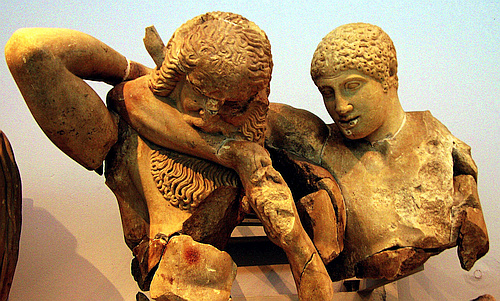
In ancient Greek mythology the Lapiths were living in the mountains of
Thessaly and were governed by Peirithoos. Since he was a half-brother of the
centaurs they demanded their share in their father's kingdom but were rejected. When
Peirithoos married Hippodameia and invited the centaurs to the feast, a bloody fight
broke out between the Lapiths and centaurs. The Lapiths prevailed, but were later humbled by
Herakles.
Larissa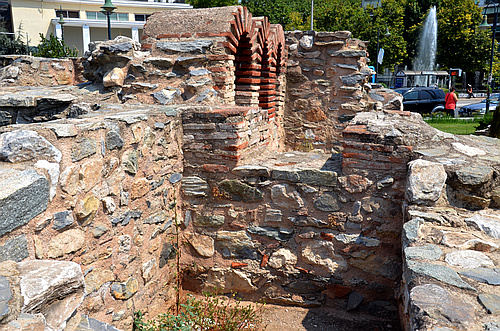
1) One of the regional units of Greece, and part of the region of Thessaly, of which it covers about one-third. Its capital is the city of Larissa (see below). - See also: site page.
2) Capital and largest city of Thessaly and capital of the Larissa regional unit (see above). According to tradition, Achilles was born here, and Hippokrates, the Father of Medicine, died here. - See also: site page.
3) The name implies a citadel and was used generally as a common name for many cities and
districts.
larnax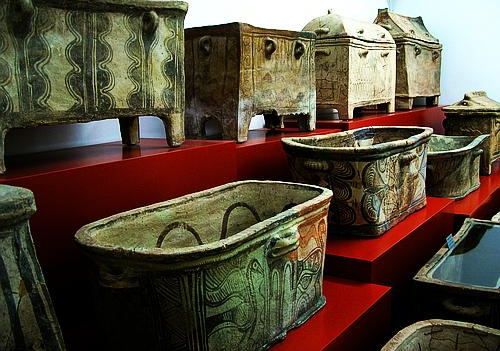
Larnakes are ceramic closed coffins as container for human remains. They appear first in the
Minoan culture in great numbers with elaborate paintings on its surfaces. They occur
again in ancient Macedonia and then later in the
Hellenistic period, when larnakes in the form of small terracotta sarcophagi became popular.
Learchos
2) One of the Daedalian artists at the transition from the mythological to the historical period. Little is known about him and some of the circumstances are contradictory. Pausanias saw a statue of Zeus by him, made of separate pieces of hammered bronze, and remarks that this was the most ancient of all existing statues in bronze. If this implies that the statue belonged to a period when the art of casting in bronze was not yet known, then Learchos must have lived earlier than the 8th century BC.
Leda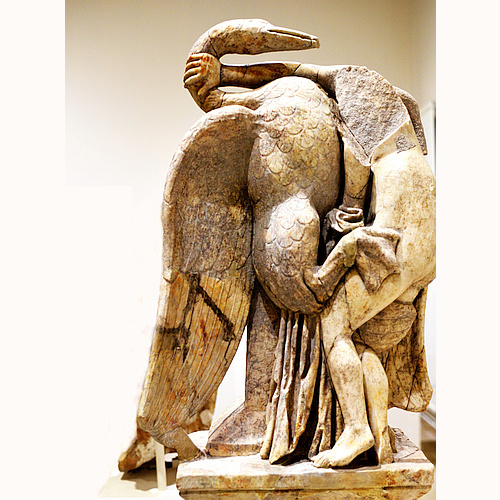
A mythical personage for which very different genearolgies are given. She was the wife of
Tyndareos, and according to the most common tradition, she became by him mother of
Kastor and Klytaimnestra. By
Zeus, who visited her in the disguise of a swan, she begot Polydeukes and
Helena. It is also said that after her death Leda was raised to the rank of a divinity,
under the name of Nemesis. - The visit of Zeus to Leda in the form of a swan was
frequently represented not only by ancient artists.
Leiandros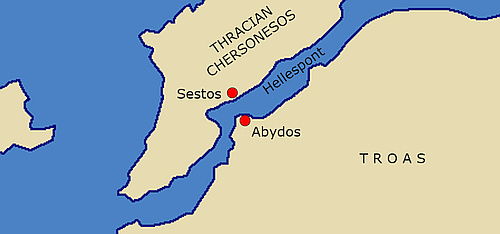
A youth of Abydos, lover of Hero, priestess
of Aphrodite in the city of Sestos. Lovesick Leandros
swam each night across the Hellespont to his lover in Sestos, guided by the light of
the lighthouse on the western shore. In one very stormy night the light was extinguished and therefore Leiandros lost
his way and drowned. On the next morning his corpse was washed onto the coast of Sestos, and in seeing it Hero killed
herself by leaping into the sea. - An epic poem was dedicated to this story and was also treated by
Ovid and Virgil.
lekythos
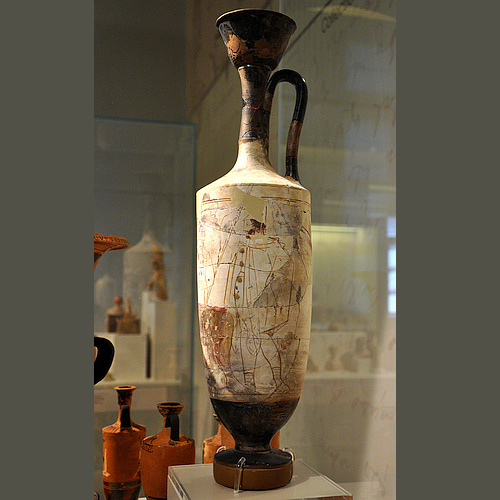
A type of ancient Greek vessel, usually pottery, for storing oil,
olive oil. Typical is the narrow body with almost vertical sides and one handle attached to the neck of the
vessel. It is a sort of jug without pouring lip, although the oinochoe is a better
equivalent of a modern jug. Lekythoi appear since ca. 700 BC and became very popular in the 5th centory BC. They were
especially used for funerary rites and therefore decorated in the white-ground
technique, which was too fragile for everyday use.
Leleges
The Leleges, or Lelegians, were a prehellenic tribe settled in various parts of the Greek mainland and islands, as well as in western Asia Minor. They were one of the aboriginal peoples of the Aegean region, distinct from the Pelasgians, the Bronze Age Greeks, the Cretan Minoans, the Cycladic Telkhines, and the Tyrrhenians. The classical Hellenes emerged as an amalgam of these six peoples. Probably the Leleges survived in Asia Minor into early historical times, when they were assimilated by the Karians.
Lenaia
One of the lesser festivals with a dramatic competition of Athens in ancient Greece. The annual festival in honour of Dionysos Lenaios took place in the month of Gamelion, roughly corresponding to January. Since travel by sea at that time of year was considered unsafe, the audiences for the Lenaia were usually limited to the local population, but metics were allowed to participate.The festival moved to the Theatre of Dionysos in central Athens by the mid-fifth century and originally held competitions only for comedy, but in 432 BC a tragic contest was added. Many of Aristophanes' plays were first performed there. It is unknown when the Lenaia was abandoned, but contests of some sort continued into the 2nd century BC.
Leochares
Leochares (fl. 4th century BC) was a Greek sculptor from Athens. He was one of the sculptors who worked on the Mausoleum in Halikarnassos.
Leonidas I
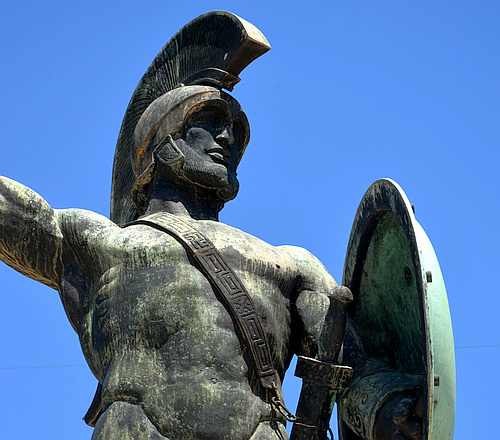
Leonidas I ("Lion's son"), was a warrior king of Sparta. He was the
17th king of the Agiad line, a dynasty which claimed descent from
Herakles. His wife was Gorgo, the daughter of king
Kleomenes I. During the Second Persian War he led
300 Spartans and 700 Thespians to the strategic pass of the Thermopylae to hold back
the invading Persian army, according to Herodotus 1,700,000 soldiers. Leonidas and his
men were killed in this battle in 480 BC.
Leonidas II
Leonidas II ("Lion's son", "Lion-like"), was the 28th Agiad King of Sparta from 254 to 235 BC. Having been raised at the Persian court and being married to a half-Persian half-Macedonian wife, he was watched with suspicion in Sparta. When he opposed the attempted reforms of his Eurypontid co-king, Agis IV, he had to flee and during his exile was deposed from the throne and replaced by his son-in-law, Kleombrotos II. Later, when Agis fought in Aetolia, Leonidas returned to Sparta, exiled Kleombrotos, and thereafter killed Agis, alongside his mother and grandmother.
 Lepanto
--> Navpaktos
 Lerna
Lerna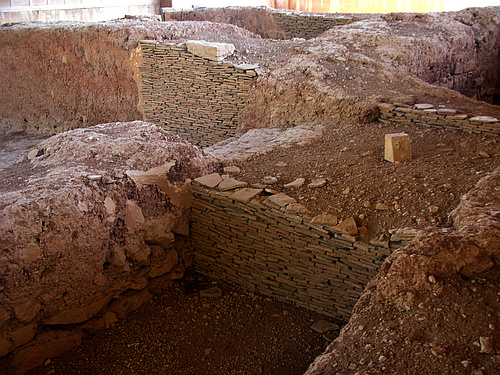
In classical Greece, Lerna was a region of springs and a former lake
and swamps near the village Miloi at the Argolic Gulf. The site is most famous as the
hideout of the Lernaean Hydra, the many-headed water snake killed by
Herakles as the second of his labors. The archaeological
site of Lerna is notable for one of the largest prehistoric tumuli of Greece, accumulated during a long Neolithic
occupation. It also features the well-studied structure known as House of the Tiles, dated to the
Early Helladic period II (2500 - 2300 BC). - See also:
site page.
Lethe
One of the five rivers of the underworld. Also known as ameles potamos (river of unmindfulness), it ensured that all those who drank from its water experienced complete forgetfulness. - In Classical Greek, the word lethe literally means "oblivion", "forgetfulness", or "concealment".
Leto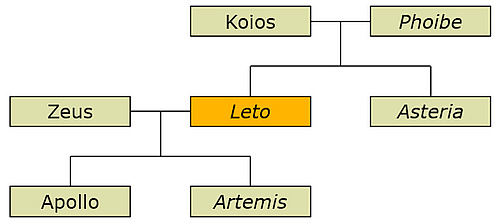
In ancient Greek mythology a daughter of the Titans
Koios and Phoibe, and a sister of
Asteria. According to common tradition she was the mother of Apollo and
Artemis by Zeus, to whom she was married before
Hera (or in other accounts she was his concubine). During her pregnancy she was persecuted
by Hera and therefore was nowhere received. Finally she arrived at the floating island of
Delos, which became fastened at her command, and there gave birth to the twins. Henceforth, Delos was respected as a
sacred island.
Leukippos
1) A son of Oinomaos.
2) A son of Perieres and Gorgophone, and brother of Aphareus. He was prince of Messenia and father of Arsinoe, Hilaeira, and Phoibe. He was one of the Kalydonian hunters.
3) There are three other mythical personages of this name.
Leukippos of Milet
Greek philosopher of the 5th century BC, probably born in Miletos in Asia Minor. He is sometimes credited with the development of the theory of atomism, but usually this credit is given to his pupil Demokritos.
Leukothea
A sea goddess; the name of metamorphosed Ino and Halia.
Leuktra
A village in Boeotia, site of a battle between the Boeotians led by Thebes and the Spartans in 371 BC during the turmoil following the Corinthian War. The Theban victory under Epaminondas crushed the supremacy that Sparta had gained after the Peloponnesian War.
Libya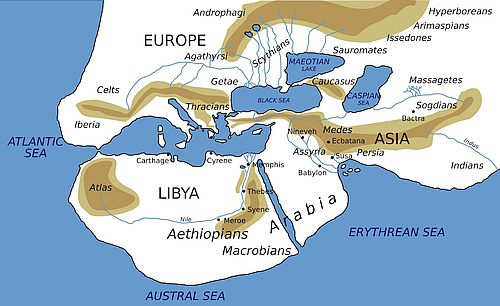
1) To the ancient Greeks, all of Africa west of Egypt was Libya.
Linear A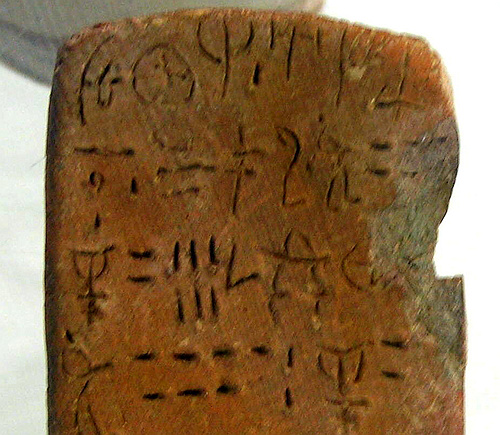
A syllabic script with linear symbols, each one representing a syllable, preserved on terracotta
tablets. It appears on Crete in the 17th century BC and shows some similarities to Egyptian
hieroglyphics, but its decipherment has only begun.
Linear B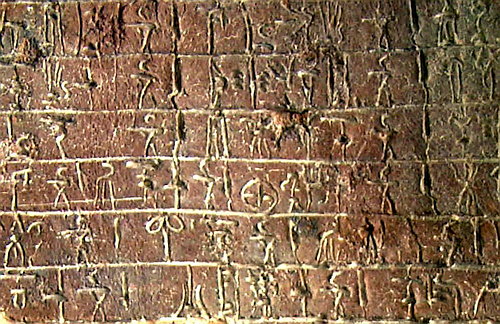
A syllabic script with linear symbols, each one representing a syllable. It first appeared on
terracotta tablets in Mycenaean, but also Minoan palaces
since the 15th century BC. It was deciphered in 1952 by Michael Ventris and
John Chadwick who established that it was Mycenaean Greek.
Linos
Great musician, son of the muse Kalliope, or of Apollo and Psamathe or Aethusa. Linos tried to teach the young Herakles, but because of his poor performance he slapped the young hero, whereupon Herakles struck back with his lyre and killed Linos.
Lion Gate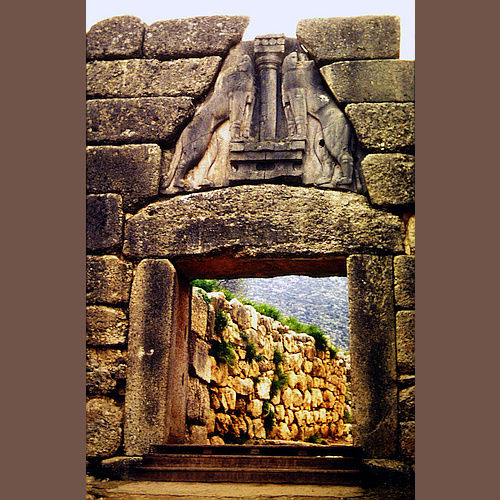
The Lion Gate was the main entrance of the Bronze Age citadel of
Mycenae. It was erected around 1250 BC and is named after the relief sculpture of two
lionesses in a heraldic pose standing on either side of a column in
Minoan style above the gate. It is not only the sole surviving monumental piece of
Mycenaean sculpture, but also the largest sculpture in the prehistoric Aegean. Its
iconographic motif was described in the literature of Classical Greece and in a survey of 1700, Francesco Grimani used
Pausanias's description of the Lion Gate to identify the ruins of Mycenae. In 1841, the
Lion Gate was restored by the Greek archaeologist Kyriakos Pittakis.
Little Iliad
The Little Iliad (Greek: Ilias mikra) is a lost epic of ancient Greek literature, part of the Epic Cycle that relates the story of the Trojan War. It was tentatively attributed to various ancient writers including Homer himself. Chronologically, the story of the Little Iliad comes after that of the Aithiopis, and is followed by that of the Iliou persis.
logeion
--> proskenion
logos
An important term in western philosophy and other fields. It is a Greek word with various meanings, first used by Herakleitos to describe a principle of order and knowledge. The sophists used the term for "discourse", and with Aristotle it refers to "reasoned discourse" or "the argument" in rhetoric. For the Stoics, it stands for the divine animating principle that pervades the universe.
Lotophagi
The Lotophagi or Lotus-eaters were a race of people described in the Odyssey to eat the intoxicating fruit of the lotos (its botanical identity is uncertain), "sweet as honey". The ships of Odysseus were thrown by a storm on the coast of their island, and when his companions ate of the fruit, they forgot about reaching home and wanted to stay. The land of the Lotophagi was usually assumed to be the island of Djerba (Tunisia), but a recent study places it in modern Libya.
Lydia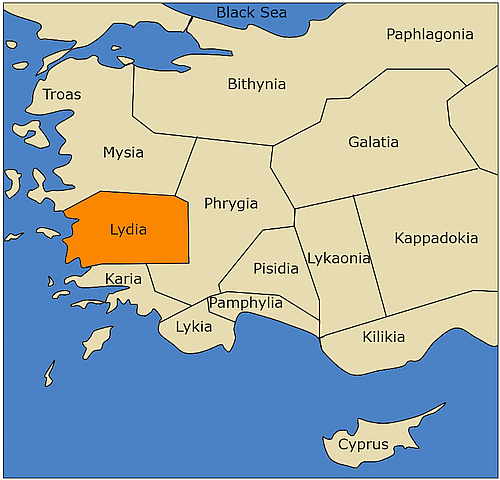
Lydia was an Iron Age kingdom of western
Asia Minor. At its greatest extent, the Kingdom of Lydia covered all of western Anatolia.
Lykaon
1) A son of Pelasgos by Meliboia or by the nymph Kyllene. Mythological traditions about him are quite inconsistent. Some call him the first civiliser of Arcadia, who introduced the worship of Zeus Lykaios. Others describe him as a barbarian who defied the gods. It is said that Zeus changed him into a wolf and that Zeus killed his numerous impious sons by a flash of lightning.
2) A son of Priam and Laothoe, was slain by Achilles.
3) A Lykian, the father of Pandaros.
Lykeion
Gymnasion in an eastern suburb of Athens, named after the grove sacred to Apollon Lykeios. Here Aristotle founded his philosophical school in 335 BC and lectured his students during the day and the general public in the evenings.
Lykia
Ancient country on the southwestern coast of Asia Minor. The first
Greeks settled here according to mythological tradition under the leadership of Sarpedon
after he had been exiled from Crete by his brother Minos. -
When Lykos had to flee Athens around 1200 BC, he took control of the
province which was then named after him. After the Persians conquered Lykia around 540 BC,
it joined the Delian League to liberate the Greek
poleis in Asia Minor.
Lykomedes
1) In ancient Greek mythology a king of the Dolopians on the island of Skyros near Euboea. He was the father of Deidameia, and grandfather of Pyrrhus or Neoptolemos. Once he was visited by Theseus, but fearing his influence on the people of Skyros, killed him by thrusting him from a cliff. The actual cause of this violence is given differently.
2) A son of Kreon, joined the Greek forces in the campaign against Troy.
3) A son of Apollo and Parthenope.
Lykos
1) A son of Aigyptos.
2) A son of Poseidon and Kelaino, whom his father transferred to the islands of the blessed.
3) A son of Hyrieus, and husband of Dirke. He was one of the mythical kings of Thebes.
4) A tyrant of Thebes, a son of Poseidon, or of Lykos (No. 2). In the absence of Herakles, he tried to murder Megara and her children, but was slain by Herakles on his return.
5) A member of the Telkhines. According to tradition, he went to Lykia and there built the temple of the Lykian Apollo.
6) A son of Pandion, and brother of Aigeus, Nisus, and Pallas. When Aigeus expelled him from Athens, he went to the country of the Termili, which was afterwards called Lykia after him. At Athens he was honoured as a hero, and sometimes he is also described as an ancient prophet.
7) A Thracian who was slain by Kyknos in single combat.
8) A king of Lykia. When Diomedes was thrown on the Lykian coast on his return from Troy, Lykos wanted to sacrifice him to Ares, but Diomedes was saved by the king's daughter Kallirhoe.
9) King of the Mariandynians, hospitably received Herakles and the Argonauts.
10) A satyr, son of Hermes. He and his brothers Pherespondus and Pronomus were messengers of the god Dionysos.
Lykurgos
1) Lykurgos (ca. 900 - 800 BC) was the legendary lawgiver of Sparta who established the military-oriented reformation of Spartan society, based on the three Spartan virtues: equality (among citizens), military fitness, and austerity. It is not clear if he was an actual historical figure or a mythological personage.
2) An Eurypontid king of Sparta from 219 BC until his death in 211/210 BC.
3) A son of Dryas, and king of the Edones in Thracia. He is known for his persecution of Dionysos and his worship on the sacred mountain of Nyseion in Thracia. There are various traditions about how he was punished for this. In most accounts the god struck him with madness, in which he committed bloody crimes and was then killed himself.
4) A son of Aleos and Neaira, and a brother of Kepheus and Auge. He was king in Arcadia and father of Ankaios, Epochos, Amphidamas, and Iasos.
5) A son of Pronax and brother of Amphithea, the wife of Adrastos. He was one of the Seven against Thebes, and there fought against Amphiaraos.
6) A son of Pheres and Periklymene, a brother of Admetos. He was king of Nemea, and by Eurydike or Amphithea, became the father of Opheltes.
7) One of the suitors of Hippodameia. He was slain by Oinomaos.
Lynkeus
1) A son of Aigyptos and Argyphia, and husband of the Danaid Hypermnestra, by whom he became the father of Abas. When the Danaides, on command of their father Danaos, killed their husbands in one night, Hypermnestra alone spared the life of her husband Lynkeus and helped him to escape. Danaos thereupon kept Hypermnestra imprisoned, but was later moved to give her to Lynkeus, who succeeded him as king of Argos.
2) A son of Aphareus and Arene, and brother of Idas. He was one of the Argonauts and also took part in the Kalydonian Hunt. He was killed by Polydeukes.
lyre
The lyre, latinized lyra, was a musical instrument with strings that were plucked with the fingers. It is an attribute of Apollo.
Lysandros
Lysandros (ca. 454 - 395 BC) was a Spartan admiral who commanded the Spartan fleet in the Hellespont which defeated the Athenians at Aigospotamoi in 405 BC. In the following year, he forced the capitulation of Athens, bringing the Peloponnesian War to an end, and organized the dominion of Sparta over Greece.
Lysimachos
A Macedonian general (c. 360 - 281 BC) and diadochus of Alexander the Great. Since 306 BC, he ruled Thracia, Asia Minor and Macedonia as basileus.
Lysippides Painter
The Lysippides Painter (fl. ca. 530 - 510 BC), whose real name is not known, was an Attic vase painter in the black-figure style. He is considered the most significant student of Exekias, one of the greatest masters of this technique, from whom he adopted not only his artistic style but also some important motifs. - Remarkable is the collaboration of the Lysippides Painter with the Andokides Painter, another student of Exekias and the purported inventor of the red-figure style. Together they produced several "bilingual vases": one side black-figure and the other side red-figure technique. It has also been proposed that both painters are identical and merely represent one artist using both techniques.
Lysippos
Lysippos (fl. 4th century BC) was a renowned sculptor who worked in bronze. Together with Skopas and Praxiteles, he is considered one of the three greatest sculptors of the Classical Greek era on the transition to the Hellenistic period. However, it is difficult to identify his own original work because he had a large number of disciples in his immediate circle and there was a market for replicas of his work, both in his lifetime and later.

