
GREECE
 GLOSSARY
| A | B | C | D |
| E | F | G | H |
| I | J | K | L |
| M | N | O | P |
| Q | R | S | T |
| U | V | W | X |
| Y | Z |
2026-01-22
color code:  = mythology;
 = history & culture;
  = geography;
  = archaeology &
architecture
= archaeology &
architecture
gable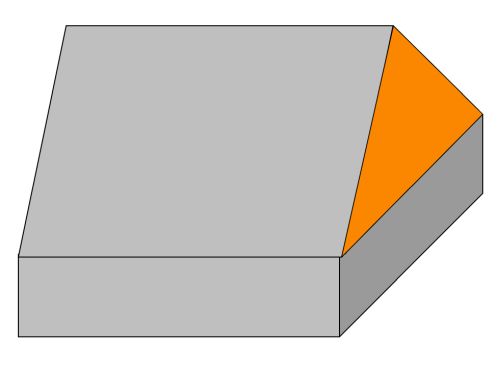
The triangular area of an exterior wall of a building formed by two sloping roofs. With ancient Greek
temples it is called pediment.
Gaia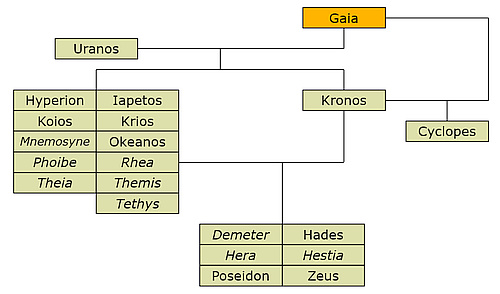
Primeval goddess of the earth, already in neolithic times worshipped as earth-mother. In Greek
mythology Gaia gave birth to Uranos by herself, then mated with him and became mother of
Kronos and the other Titans. Together with her son Kronos she
bore the Cyclopes.
Gallipoli
peninsula
Ganymede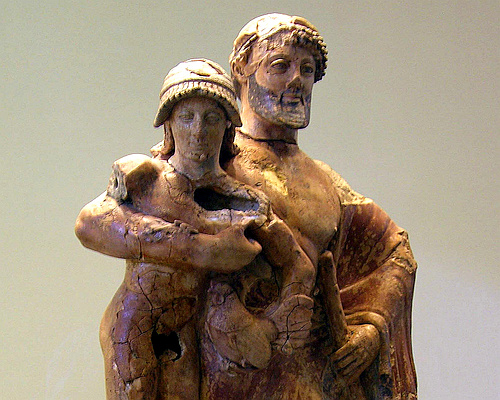
A divine personage from Troy. According to
Homer he was the most beautiful of all mortals and therefore carried off by the gods (or by
Zeus himself) to live in Olympos as cupbearer to Zeus. The original myth had no
erotic content, but in later tradition it is said that Zeus had a desire for him.
geison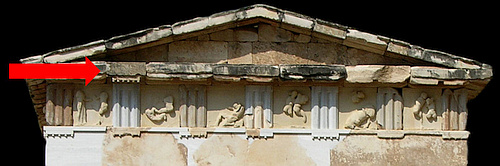
The topmost element of the entablature just below the
pediment. The projecting molding of the geison (cornice) also serves to keep rainwater
away from the walls below.
 Gela
Gela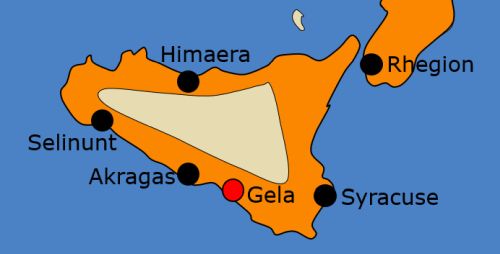
The city of Gela on the southern coast of Sicily was founded by Greek
colonists from Rhodos and Crete in 689 BC. It was not
only the most influential polis in Sicily between the 7th and the 6th century BC but also
the place where Aischylos lived and died. Gela reached its greatest prosperity under
the tyrant Hippokrates of Gela (498 - 491 BC)
and his even more powerful successor, Gelon, who took possession of
Syracuse unopposed and transferred his capital and half of the population there in 482 BC. In 405 BC, Gela was
destroyed by the Carthaginians, but later rebuilt. In 311 BC the Syracusan tyrant Agathokles put to death more than
4,000 of the inhabitants, and in 281 BC the Mamertini (Campanian mercenaries) finally destroyed the city.
Gelon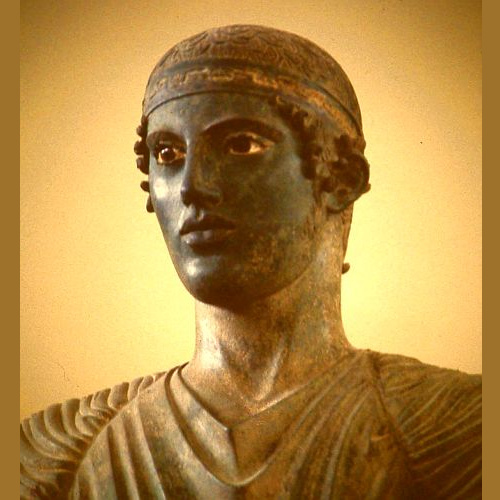
Gelon (fl. 5th century BC) was the tyrant of Gela
and Syracuse in Sicily. He is especially known for winning the chariot race at
Olympia in 488 BC.
 Geometric period
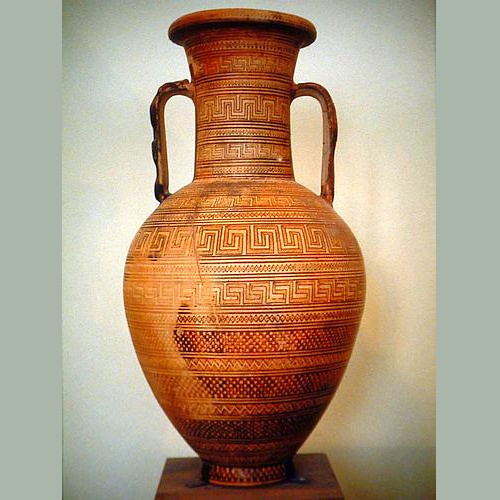
The period from ca. 1200 until 800 BC, i.e. the Dark Ages with the
upcoming of the Dorians and the transition to the Archaic
period. The name is derived from the pottery of this period which is decorated with
pure geometric designs covering the whole surface of the ceramic. This style of vase
painting had its centre in Athens and from there spread across the Greek world. It was
in use ca. 900-700 BC, following the Protogeometric style.
geomoroi
The second of the three classes into which Theseus is said to have divided the inhabitants of Attica. Like the demiourgoi, they were excluded from the great civil and priestly offices which were exclusively reserved for the eupatridai, but the relation in which the geomoroi stood to the two other classes is utterly unclear. Geomoroi have been thought by some writers to be free land-owners, while others have conceived them to have been a class of tenants. Also the political distinctions between the geomoroi and the demiourgoi remain unclear: either there existed none at all, or - more probable - if there were any originally, they gradually vanished.
Gerousia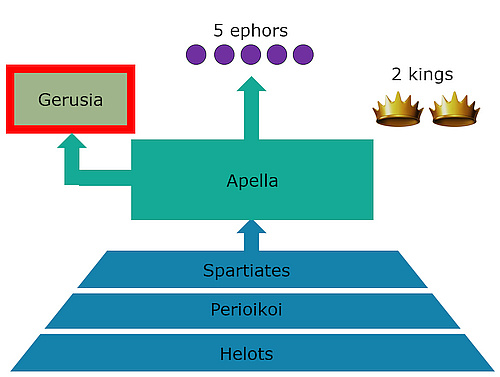
A political institution in ancient Sparta. The Gerousia consisted of 28
elder citizens over the age of 60, elected for lifetime and usually integrated into the royal households. They discussed
matters of high policy and presented alternatives to the Apella. In consultation with the
ephors, the Gerousia also handled aspects of outside contacts because all other states were
considered as past, present, or future potential enemies.
Geryon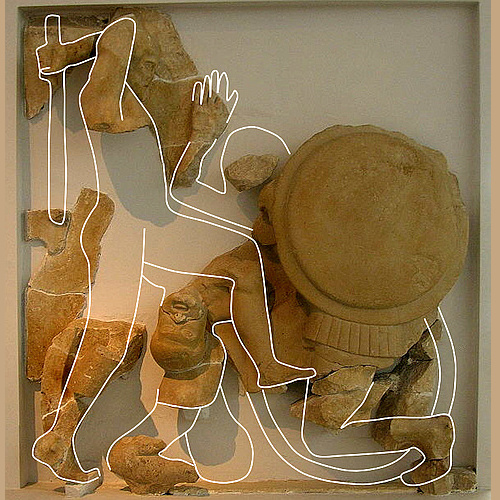
Three-bodied giant, who grazed his cattle in Erytheia, a land somewhere in the far West. In his
Tenth Labor Herakles slew Geryon's two-headed dog,
Orthos, and after a heavy fight also Geryon and his herdsman,
Eurytion.
Giants
--> Gigantes
Gigantes
Originating from the blood of Uranos when he was castrated by Kronos, the Gigantes became so powerful that they tried to overthrow Zeus and the other Olympian gods in an early period of their rule. After the Gigantes were defeated they were confined in tartaros.
gigantomachy
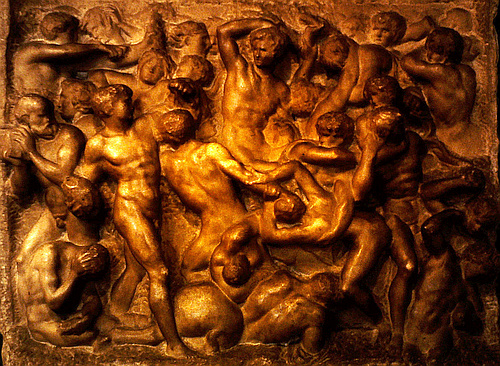
A mythical battle that the Olympian gods fought against the
Gigantes, who claimed power but were defeated.
gladiator
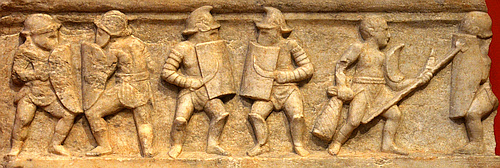
An armed combatant who fought with other gladiators, wild animals or convicts to entertain the
audience in the Roman Empire.
Glauke
1) The daughter of king Kreon of Corinth. After Jason and the Argonauts brought the Golden Fleece to Iolkos, Jason and Medea had to leave the country and finally found refuge in Corinth. Here, Jason fell in love with Glauke and abandoned Medea. Her revenge was merciless: she killed Glauke, Kreon and even the children she had with Jason.
2) One of the Nereids.
Glaukias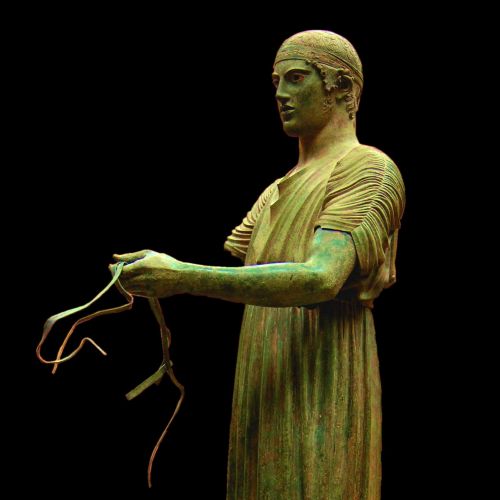
Glaukias (fl. 5th century BC) was a sculptor from Aegina. He made
bronze statues of athletes, especially the bronze chariot and statue of Gelon commemorating his
victory in the chariot race at Olympia in 488 BC.
Glaukos
1) A grandson of Aiolos, son of Sisyphos and Merope, and father of Bellerophontes. He is said to have fed his mares with human flesh to make them spirited and stronger for the horse race. This caused the anger of the gods, especially of Aphrodite, whose power he contested. Therefore, his horses were seized with madness during a chariot race and tore Glaukos to pieces. There are different accounts to explain the cause of this madness.
2) A son of Hippolochos, and grandson of Bellerophontes. He was a prince of Lykia and with his troops assisted king Priam in the Trojan War. He is described as one of the most prominent heroes on the Trojan side but was slain by Aias.
3) One of the sons of Priam.
4) A son of Antenor, fought in the Trojan War. He was slain by the Telamonian Aias.
5) A son of the Messenian king Aipytos. He followed his father on the throne and was esteemed for his piety towards the gods.
6) One of the sons of the Cretan king Minos by Pasiphaë. When he was a boy he fell fell into a cask full of honey, and died in it. It is a long and complicated story, but in the end he was rescued by a certain Polyeidos who restored him to life. - The story was a favourite subject in art and was treated by Aischylos, Sophokles, and Euripides in dramatic compositions.
7) Glaukos of Anthedon in Boeotia was a fisherman with inconsistent accounts of his parentage. By chance he ate some of the herb sown by Kronos and thus became immortal. He is said to have built the ship Argo, and to have accompanied the Argonauts as their steersman. In the sea-fight of Jason against the Tyrrhenians, Glaukos alone remained unhurt and leaped or sank into the sea and became a sea deity. In ancient Greek belief he visited once every year all the coasts and islands, accompanied by marine monsters, and gave his prophecies, which were believed to be very trustworthy.
globular pyxis
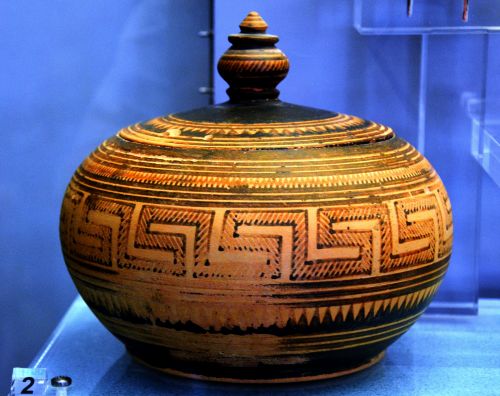
An expanding form of pyxis quite common in the
Protogeometric and Geometric period; opposed to the
"high-handled pyxis".
glyptic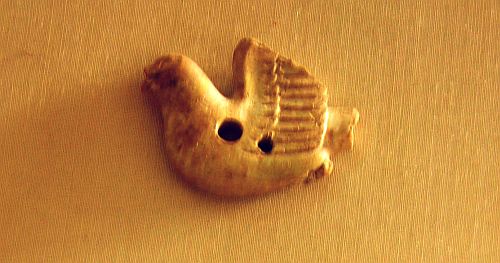
The art or process of carving or engraving especially on precious stone.
 God
God
In ancient Greece any supernatural being that is worshipped. It may control some part of the world or watch over some aspect of life or be the personification of some force. - In Greek mythology, there are three generations of Gods: the most ancient Pre-Titans, the Titans, and the Olympian Gods.
Golden Fleece
When Ino persecuted the twins Phrixos and Helle, they escaped on a golden ram sent by their mother Nephele. Helle fell off the ram and drowned, but Phrixos safely arrived at Kolchis, where he found refuge and married Chalkiope, the daughter of king Aietes. - Later, when Jason and the Argonauts came to Kolchis to demand the fleece, Aietes required that some seemingly impossible tasks were fulfilled first. Jason succeeded with the help of the sorceress Medea and brought the Golden Fleece to Iolkos.
Gordian Knot
Gordios, king of ancient Phrygia, tied a very complicated knot and, according to popular belief, the knot could only be undone by the man who would eventually rule Asia. When Alexander the Great arrived in Gordium in the 4th century BC, and instead of untying the knot he cut it with one blow of his sword (at least, this is the common story), and indeed conquered Phrygia and all of Asia.
Gordios
Legendary king of Phrygia, best known for the Gordian Knot. - According to ancient tradition he was a poor peasant, but one day as he was ploughing an eagle settled on the yoke of his oxen and sat there the whole day. Puzzled by this incident, he went to Telmissos to consult the soothsayers. At the gate of the town he met a girl, who herself possessed prophetic powers. She advised him to offer up sacrifices to Zeus Basileus and helped him with the sacrifices. In return, Gordios married her and became by her the father of Midas. Years later, internal disturbances broke out in Phrygia, and an oracle informed the inhabitants that a cart would bring them a king, who would end the disturbances. At just that time, Gordios, with his wife and son, appeared riding his cart in the assembly, and was instantly made king of Phrygia. He dedicated his cart and the yoke of his oxen to Zeus Basileus in the acropolis of Gordium, and an oracle declared that, whoever untied the knot would rule over all of Asia. - When Alexander the Great arrived in Gordium, he cut the knot with his sword, and applied the oracle to himself.
Gorgidas
The first known leader, or according to Plutarch the constitutor, of the Sacred Band of Thebes around 378 BC. He dispersed their members throughout the front ranks of the Theban infantry in order to increase valour. This was later changed by Pelopidas by forming a fighting unit.
Gorgo
1) Homer describes only one Gorgo, one of the frightful phantoms in hades. Also Euripides speaks of only one Gorgo, although Hesiod had mentioned three Gorgons, daughters of Phorkys and Keto, sisters of the Graiae: Stheno, Euryale, and Medusa. They are described as girded with serpents, and Aischylos adds wings and brazen claws. Medusa, the only mortal one of the sisters, was beheaded by Perseus.
2) Daughter of Kleomenes I, King of Sparta during the 6th and 5th centuries BC, and wife of King Leonidas I, who fought and died in the Battle of Thermopylae. Mentioned by Herodotus, Gorgo was noted for her political judgement and wisdom.
Gorgopas
Gorgopas (fl. 4th century BC) was a Spartan commander during the Corinthian War. He was vice-admiral when Hierax was dispatched to Aegina in 388 BC, and when Hierax soon after left for Rhodos, he took over the command and went on to harass the Athenian territory from his base in Aegina. In a later sea battle, Gorgopas captured four Athenian triremes and forced the rest of the Athenian ships to retreat to Piraeus. Soon after that, Gorgopas was killed in an Athenian ambush.
Gorgophone
A daughter of Perseus and Andromeda. Her name "Gorgon Slayer" refers to her father who killed Medusa. She is a prominent figure in the mythical history of Sparta, having been married to two kings and being considered the first woman to have married twice. By her first husband, Perieres, king of Messenia, Gorgophone was the mother of Leukippos and Aphareus. By her second husband, Oibalos of Lakonia, she was the mother of Tyndareos and Ikarios.
Graces
--> Charites
Graiae
The "sisters gray from birth" were daughters of Phorkys and Keto, sisters of the Gorgons. Originally, only two were named: Pemphredo and Enyo. In later traditions Deino was added. Together they had only one eye and one tooth. Perseus took it away from them and thereby forced them to tell him the way to Medusa. - Like other family members of Phorkys, the Graiae were believed to be sea divinities, envisaged as personifications of the foam on top of the waves of the sea.
Grand Master
The supreme commander of the religious-military order of the Knights of Saint John of Jerusalem on Rhodos.
grave goods
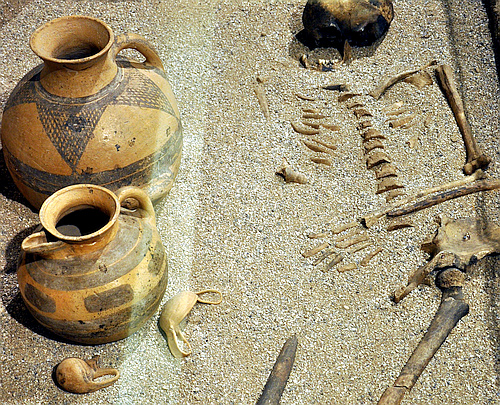
Objects like vases, jewellery, or weapons that accompany the dead in the grave or tomb. This may be
objects from everyday life or specially made for the funeral.
grave stele
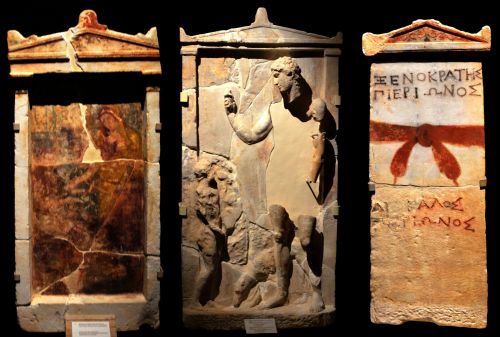
A stone stele decorated with a relief or inscribed, set up on the grave to mark its position and to
identify the dead buried there.
Greco-Persian Wars
--> Persian Wars
griffin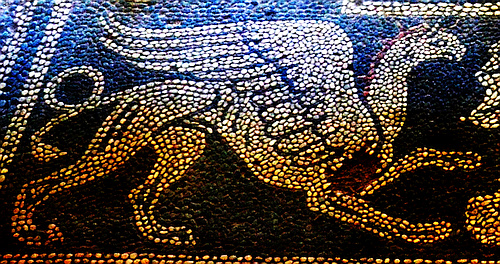
Mythical animal with the body of a lion and the head of an eagle. Originally, griffins were reported
in Anatolia, from where they passed into Minoan tradition, and later appear in ancient
Greek art and mythology.
Gulf of Corinth
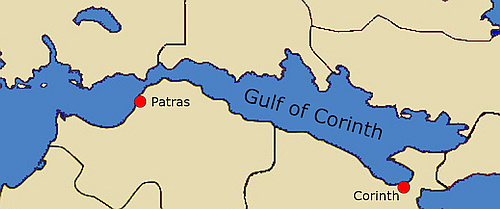
The sea between Greek mainland and the Peloponnese.
guttae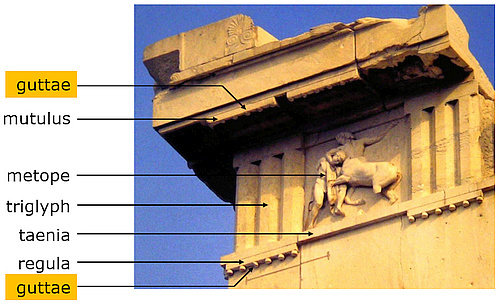
In Doric architecture, a gutta is a small cone-shaped projection in
stone resembling a nailhead in earlier timber constructions. Six guttae are underneath a
regula below a triglyph. Furthermore, at the top of the
entablature, below the geison, lie
mutuli with a set of three rows of six guttae each.
Gylippos
A Spartan general of the 5th century BC. He was the son of a Spartiate, the mother probably a helot. Although of inferior status, he received military training in the Spartan fashion and gained high recognition. When Alkibiades urged the Spartans to send assistance to Syracuse against the Sicilian Expedition of the Athenians, Gylippos was appointed as general of the Spartan forces in 414 BC. His arrival in Sicily marked a turning point in the struggle. Being more daring than his Athenian counterpart Nikias, he conquered key strategic positions and even defeated the Athenian reinforcement, marking the disastrous end of the Athenian campaign in Syracuse. If he ordered the execution of the captivated generals or if it happened against his will remains unclear. - Later, Gylippos embezzled part of a shipment of silver coins to Sparta, and had to flee. He was condemned to death in absentia and disappears from historical records.
gymnasium
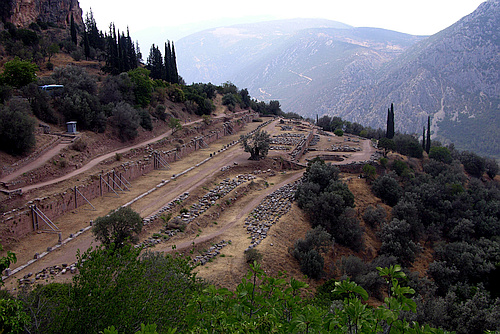
(Greek gymnos = "nude") A building complex in which athletes trained and exercised for light
events. For events on a smaller scale, a palaistra was used. (A gymnasium always had a
palaistra, but a palaistra could exists independently without a gymnasium.)
gymnopaidies
A festival with dances celebrated at Sparta and Thera by youths and men in honour of Apollo and Dionysos.
gypsum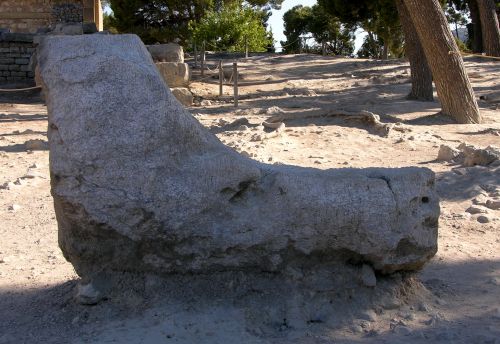
A soft stone used in Minoan architecture.

