
GREECE
 GLOSSARY
| A | B | C | D |
| E | F | G | H |
| I | J | K | L |
| M | N | O | P |
| Q | R | S | T |
| U | V | W | X |
| Y | Z |
2026-01-07
color code:  = mythology;
 = history & culture;
  = geography;
  = archaeology &
architecture
= archaeology &
architecture
Zenon of Elea
Zenon of Elea (ca. 490 - ca. 430 BC) was a pre-Socratic Greek philosopher active in Magna Graecia and a prominent member of the Eleatic School, together with its founder, Parmenides. Aristotle called him the inventor of the dialectic, but he is best known for his paradoxes, which Bertrand Russell has described as "immeasurably subtle and profound". The most famous of these is 'Achilles and the turtoise'.
Zenon of Kitieus
Zenon of Kitieus (ca. 334 - ca. 262 BC) was a Hellenistic philosopher from Cyprus. Based on the moral ideas of the cynics, he founded the Stoic school of philosophy, which he propagated in Athens from about 300 BC. Stoicism laid great emphasis on goodness and peace of mind gained from living a life of virtue in accordance with nature. This philosophy proved very successful, and flourished as the dominant philosophy from the Hellenistic period through to the Roman era.
Zephyros
The personification of the west wind, according to Hesiod a son of Eos and Astraios. Homer frequently mentions Zephyros together with his brother Boreas and both dwelt together in a palace in Thracia.
Zetes
A son of Boreas and Oreithyia, and a brother of Kalais. Zetes and Kalais, called the Boreades, are generally described as winged beings, and mentioned among the Argonauts. During this expedition they delivered Phineus from the Harpies.
Zethos
Son of Zeus and Antiope. He grew up among shepherds, hunting and tending the flocks. After revenging his mother, he reigned Thebes together with his brother Amphion.
zeugitai
In the political reforms of Solon (circa 594 BC) the third division of ancient Athens. At this time zeugitai were granted the right to hold certain minor political offices, but by 457/6 BC they were granted the right to hold the archonship. - The four classes were: pentakosiomedimnoi, hippeis, zeugitai, and thetes.
Zeus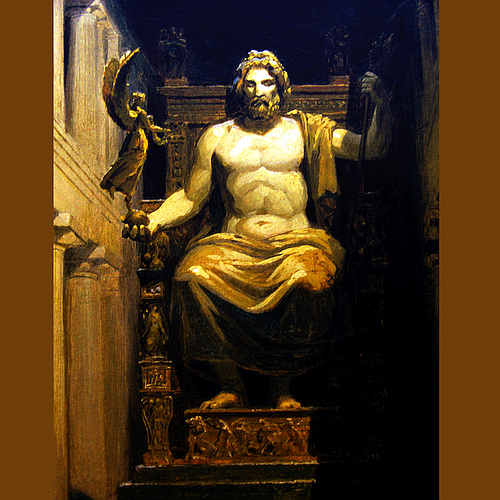
King of the Olympian gods and goddesses, son of
Rhea and Kronos. Because Kronos feared to be usurped by one of
his children, Zeus was born secretly in a cave on Mount Ida (Crete) or in Psychro Cave (Diktaion Andron; -->
site page), or he was raised there. Later he overcame his father and the
Titans and ruled with his siblings on Mount Olympos. In
Greek mythology he is described as highly powerful, strong, charming, persuasive, but also moody. He has regular fights
with his wife Hera and numerous love affairs with other goddesses, producing a remarkable
number of offsprings. Now and then he descends to Earth in some disguise to seduce a maiden and conceive another child.
In art, Zeus is depicted as an older bearded and strong man, the thunderbolt being his attribute.
