
GREECE
 GLOSSARY
| A | B | C | D |
| E | F | G | H |
| I | J | K | L |
| M | N | O | P |
| Q | R | S | T |
| U | V | W | X |
| Y | Z |
2026-01-22
color code:  = mythology;
 = history & culture;
  = geography;
  = archaeology &
architecture
= archaeology &
architecture
Hades
In ancient Greek religion and mythology the god of the dead and the
underworld. After he, together with his brothers Zeus and
Poseidon had defeated the titans, Hades drew the "short straw" when they divided
the world, and received the underworld to rule. He is also known as the god of wealth, due to the precious metals mined
from the earth. He abducted and married Persephone. In ancient Greece he was not
connoted negatively, he is rather described as cold and stern, but a just ruler.
hades
The underworld, ruled by Hades and Persephone. It was located either underground or in the far west beyond the inhabited regions. It was separated from the land of the living by the rivers Styx (hateful), Lethe (forgetfulness), Acheron (woeful), Phlegethon (fiery), and Kokytos (wailing). Charon ferried the arriving dead across the Acheron and was paid for this with a coin placed in the mouth of the dead. They then entered the Hades where the fearful dog Kerberos carefully watched that no unauthorized soul should enter, but especially that none could leave. The three judges of the underworld - Minos, Aiakos, and Rhadamanthys - assigned the appropriate destinations: the Elysian Fields for the righteous and heroes, tartaros for the condemned, but most souls wandered as formless shadows in the fields of Asphodel.
Hadrian
(76 - 138 AD) Roman emperor from 117 to 138. Being a passionate admirer of ancient Greece, he endeavoured to make Athens the cultural capital of the Empire. His philhellenism was also shown in his relationship with his Greek lover Antinoos.
Haimon
1) A son of Pelasgos and father of Thessalos.
2) A son of Lykaon.
3) The son of Kreon, king of Thebes, and Eurydike. He was in love with Antigone, a daughter of the cursed former king, Oedipus. When Eteokles and Polyneikos, the sons of Oedipus, had killed each other over the throne of Thebes, Kreon became king and honoured Eteokles with an elaborate funeral, but forbade a burial of Polyneikos. Antigone secretly covered the corpse of her brother Polyneikos with some earth and therefore Kreon had her immured alive in a cave. When the blind seer Teiresias warned Kreon that his actions would evoke the anger of the gods, Kreon ordered a decent burial of Polyneikos and wanted to free Antigone. However, when Haimon opened the cave, Antigone had already hanged herself, whereupon Haimon stabbed himself with his sword and died clinging to the body of Antigone. - The full story is told in the tragedy Antigone by Sophokles.
Halbherr
Federico Halbherr (1857 - 1930) was an Italian-Austrian archaeologist and epigrapher, known for his excavations in Crete, partly funded by the Archaeological Institute of America. He also was a good friend and advisor of Arthur Evans.
half-timbered
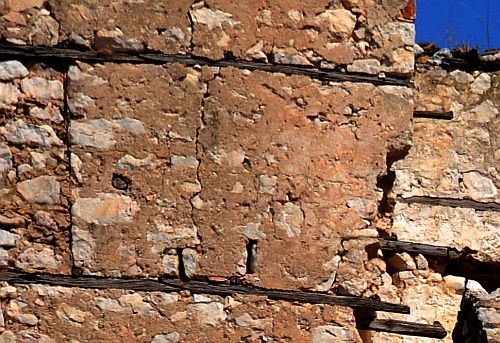
A construction of wooden framework with spaces filled by stone, rubble, or mudbrick. It was
especially used in the Neolithic period.
Halia
1) One of the Nereids.
2) A sister of the Telkhines, by whom Poseidon became the father of six sons and one daughter, Halia. When Halia leaped into the sea, she reveived the name of Leukothea, worshipped as a divine being of Rhodos.
hammer-dressed
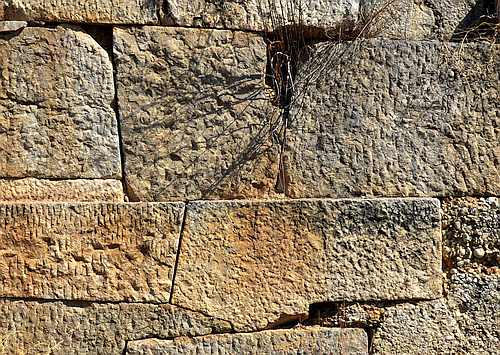
The surface of building stones roughly shaped or faced by the stonecutter with a hammer.
Harmodios
Together with Aristogeiton he killed the Athenian tyrant Hipparchos in 514 BC. After the assasination he was himself killed by a bodyguard. Although the murder of Hipparchos apparently had a personal background, he and Aristogeiton, the Tyrannicides, became a symbol of ancient Athenian democracy.
Harmonia
("harmony", "peace") The daughter of Ares (or of Hades) and Aphrodite, sister of Phobos and Deimos. Harmonia was married with Kadmos, who gave her as wedding present a necklace fashioned by Hephaistos. Her children were: Ino, Agaue, Autonoë, Semele and Polydoros. According to Euripides, she was also mother of the muses. Her necklace proved to be cursed: it passed on to her son Polydoros, then to Labdakos, then to Laios, then to Oedipus, then to Polyneikos and finally to Eriphyle.
Harpalos
Harpalos (fl. 4th century BC) was Macedonian aristocrat and boyhood friend of Alexander the Great. Having a lame leg, he did not accompany Alexander in his campaign against the Persian Empire, but received a post in Asia Minor and supplied Alexander with theatrical plays to read in his spare time. Harpalos also was a scoundrel and absconded three times with large amounts of money. In 324 BC he fled to Athens, was imprisoned there, but could escape to Crete. Shortly afterwards he was killed by his servants (or assassinated by a Macedonian).
Harpies
Winged women, daughters of the Okeanid Elektra, sisters of the rainbow goddess, Iris. They are Aello and Okypete, sometimes also Kelaino was named. Hesiod calls them "Harpies of the lovely hair, winged women soaring aloft like birds." - Meanwhile, they are more seen as monsters because of their role in the adventures of the Argonauts when they met Phineus. He had not only been blinded by Zeus, but in addition Helios made the Harpies steal the food of Phineus. The winged sons of Boreas chased away the Harpies but Zeus prevented that they were harmed.
hearth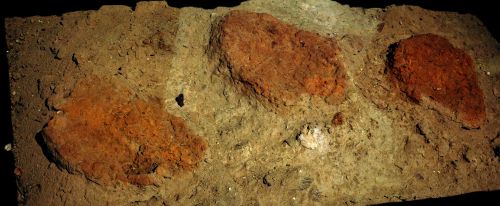
The fireplace floor. Clay hearth structures are known from around 30'000 BC.
Hebe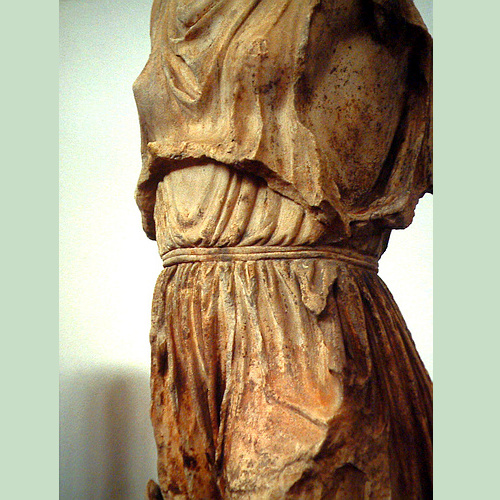
In ancient Greek mythology the goddess of youth and spring, daughter of
Zeus and Hera; cupbearer to the Olympian gods. She
was later married to the immortalized Herakles.
hedonism
In ancient Greek philosophy, a school probably started by Aristippos of Kyrene arguing that pleasure and happiness are the primary and most essential goods and the proper aims of human life. Every person should strive to maximize net pleasure, i.e. the person's pleasure should far surpass the amount of pain.
Hegias
Hegias or Hegesias was a famous Athenian sculptor of the Late Archaic school. However, no surviving work can be ascribed to him with certainty.
Hekabe
The wife of king Priam of Troy, mother of Hektor, Paris, Kassandra and others. After the fall of Troy the Greeks made her a slave. - She is the central figure in a tragedy of Euripides.
Hekate
A chthonic deity with origin in Asia Minor associated with sorcery, hounds and crossroads. In Greece she was the goddess of fertility, of the underworld, and protector of witches. Later she became identified with Persephone.
hekatomb
A hekatomb (Greek: hekaton = "hundred") is a sacrifice of one hundred cattle or any kind of animals, usually designating a festival or celebration devoted to Hera, Athena, or Apollo. In practice, as few as twelve could make up a hekatomb.
Hektor
The principal hero of the Trojans in their war with the Greeks. He was the eldest son of king Priam by Hekabe, the husband of Andromache, and father of Skamandrios. In some traditions he is described as a son of Apollo and father of two sons: Skamandrios and Laodamas. - In the beginning of the Trojan War he is said to have killed Protesilaos, who was the first of the Greeks that jumped upon the Trojan coast. Hektor's first mention in the Iliad is his censure of his brother Paris who had fled from a fight with Menelaos in single combat. He then rushed to the battle, accompanied by Ares, to protect his friend Sarpedon, and slew many Greeks. When Diomedes pressed the Trojans so hard that they had to retreat behind the city walls, Hektor met Andromache and their son Skamandrios at the Skaean gate. After having taken leave of his wife and child, he returned to battle, and challenged the bravest of the Greeks to single combat. Menelaos venture to come forward, but was held back by his friends. The lot then fell upon the Telamonian Aias. When their fight ceased at nightfall, they honoured each other and exchanged presents. After this, Hektor was distinguished in many more fights. In the fierce battle in the camp of the Greeks, he repelled Aias, and the Greek ships were set on fire. Later, he fought with Patroklos, the friend of Achilles, slew him and took off his armour. Polydamas then urged him to withdraw to the city and Apollo forbade Hektor to enter upon a contest with Achilles; but the two most prominent heroes met and at the end of their fierce fight Hektor fell pierced by the spear of Achilles. Achilles tied his body to his chariot, and thus dragged him into the camp of the Greeks where it was thrown into the dust. However, at the command of Zeus, Achilles surrendered the body to the prayers of Priam. When the body arrived in Troy, it was burned, and solemnly buried accompanied by the proper funeral games. - Hektor is one of the noblest conceptions of the Iliad. Besides his virtues of a warrior, he is distinguished also, and perhaps more so than Achilles, by those of a man: his heart is open to the gentle feelings of a son, a husband, and a father.
Helena
A daughter of Zeus and Leda, and the sister of Polydeukes and Kastor; other traditions call her a daughter of Zeus by Nemesis. It is said that Theseus carried her off in her youth to Attica, whereupon the Dioskouroi, her brothers, undertook an expedition to Attica during an absence of Theseus and brought her back to Sparta. Being of surpassing beauty, princely suitors appeared from all parts of Greece. Although Odysseus was one of them, he suggested to Tyndareos, the husband of Leda, to give her to marriage to Menelaos, by whom she then became the mother of Hermione. Later, she was seduced and carried off by Paris to Troy and thus causing the Trojan War.
Helenos
A son of Priam and Hekabe, with the gift of prophecy, but also a great warrior in the Trojan War. Together with Deiphobos he attacked the camp of the Greeks, and in a fight against Menelaos he was wounded by him. There are various tales how he acquired his prophetic powers and there are even more differing traditions of how he later deserted his countrymen and joined the Greeks, foretelling them details of how the fall of Troy would be accomplished.
Heliades
In Greek mythology, the five daughters of Helios: Aigiale, Aigle, Aetheria, Lampetie and Phaëtusa. When they wept over the death of their brother Phaëton, Zeus changed them into poplar trees, their tears into amber.
Helike
1) A daughter of Lykaon. She was beloved by Zeus, but jealous Hera changed her into a she-bear, whereupon Zeus placed her as as the constellation of the Great Northern Bear (Ursa Major) in the sky.
2) A daughter of Selinous, and the wife of Ion. The town of Eliki on the coast of Achaia was perhaps named after her.
3) Hyginus mentions a daughter of Danaos with this name.
Helios
In Greek mythology the god of the sun, the son of Hyperion and Theia, a brother of Selene and Eos. Homer describes Helios as giving light both to gods and men, rising in the east from Okeanos, reaching the highest point at noon time and then descending in the evening in the darkness of the west. The horses and chariot with which Helios makes his daily career are not mentioned in the Iliad and Odyssey, but first occur in the Homeric hymn on Helios and both are described elaborately by later poets. Also, the manner in which Helios during the night passes from the western into the eastern ocean is only described by later poets, who make him sail in a golden boat, manufactured by Hephaistos, round one-half of the earth, and thus arrive in the east at the point from which he has to rise again. - Helios is described as the god who sees and hears everything, and thus able to betray to Hephaistos the faithlessness of Aphrodite, and to reveal to Demeter the carrying off of her daughter Persephone. - The island of Thrinacia ("trident") was sacred to Helios, and there he had flocks of oxen and sheep, each consisting of 350 heads, which never increased or decreased, and were attended to by his daughters Phaëtusa and Lampetie. It has been suggested to identify this island with Meganisi southeast of Lefkada which indeed has the form of a trident, albeit curved.
Helladic period
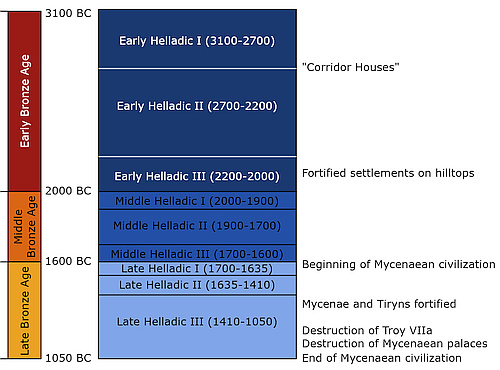
An archaeological term to identify various cultural periods of mainland Greece during the
Bronze Age, i.e. between 3100 BC and 1050 BC, ending with the decline of the
Mycenaean civilization. It complements two parallel terms:
Cycladic for the culture of the Cycladic islands in this period and
Minoan for Crete.
Helle
Daughter of Athamas and Nephele. She and her twin-brother Phrixos were persecuted by their stepmother, Ino, who devised a devious plan to get rid of the twins. In a period of misfortunes and famines the oracle of Delphi was consulted. Ino bribed the messengers so that they brought back the oracle that Phrixos must be sacrificed. Before he was killed, Phrixos and Helle escaped on a golden ram sent by Nephele. Helle fell off the ram in the sea called Hellespont after her and drowned, but Phrixos safely came all the way to Kolchis.
Hellen
1) In one of the traditions a son of Deukalion and Pyrrha, others call him a son of Zeus and Dorippe. By the mountain nymph Orseis, he became the father of Aiolos, Doros, and Xuthos, perhaps also of Amphiktyon. He was king of Phthia in Thessaly, and later left this kingdom to Aiolos. Hellen is the mythical ancestor of all Hellenes, who followed the more ancient Pelasgians.
2) A son of Phthios and Chrysippe.
Hellenika
A collection of books written by the noted historian Xenophon recounting the end of the Peloponnesian War. It is a prime source for the period 411 - 362 BC, not covered by Thukydides, although Xenophon clearly admires the Spartans and does not hide his utter disdain for the Thebans.
 Hellenistic period

The period between 323 BC (death of Alexander the Great) and 27 BC
(Augustus becomes Roman emperor). At this time, Greek cultural influence was at its peak
in Europe, Africa and Asia, experiencing prosperity and evolution in the arts, exploration, literature,
theatre, architecture, music, mathematics, philosophy,
and science. At the same time it was, after the cultural highlights of the Classical
era, a period of decadence, ending with the domination of Roman power.
Hellespont
Ancient name of the Dardanelles.
helot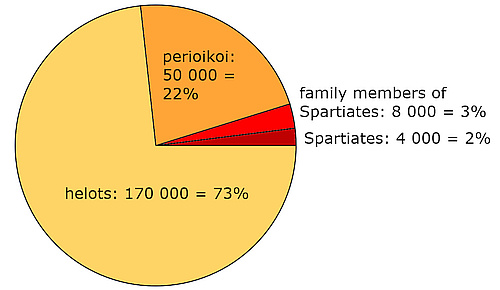
In antiquity the subjugated main population group in the territory controlled by
Sparta. They worked primarily in agriculture and thus supported the Spartan economy, but
were treated as slaves. Some say that they were "slaves to the utmost", others that they had a status "between free men
and slaves". In any case they were ritually mistreated, humiliated and even slaughtered, prompting a number of
uprisings. Given their large number - according to Herodotus, there were seven helots for each
Spartan at the time of the Battle of Plataiai in 479 BC - the need to keep helot
population in check and prevent rebellion was one of the main concerns of the
Spartiates.
Hemera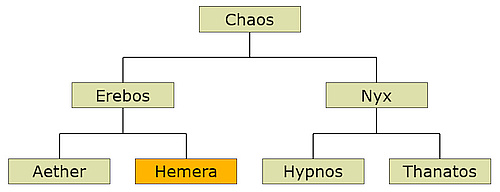
In Greek mythology the goddess of the day, a daughter of Erebos.
hemispherical
bowl
A piece of pottery with hemispherical shape, produced in Greece since the Bronze Age period.
Hephaistos
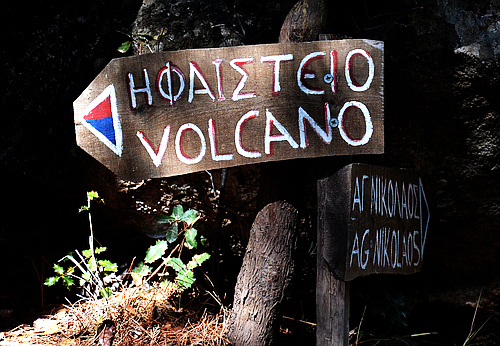
In ancient Greek mythology the lame god of blacksmiths, craftsmen, artisans, especially sculptors,
and of fire. According to some traditions, Hera gave birth to Hephaistos without
Zeus being involved, seeing this as revenge for Zeus giving birth to
Athena without her. When Hephaistos was born, Hera found him so ugly that she threw him
down from Olympos. When he crushed to earth on the island of Lemnos both his legs became
crippled. Thetis nursed him back to health and out of gratitude for her help Hephaistos
later made a new set of armour for her son, Achilles, during the
Trojan War. - Hephaistos, the ugliest of the gods, was married to
Aphrodite, perhaps the fairest of the Olympian
goddesses.
Hera
Greek goddess of marriage, daughter of Kronos and Rhea, raised by the Titans Okeanos and Tethys. There are different versions of how the incredible marriage to her brother Zeus came about: either Hera used magic, or Zeus seduced her in some disguise. Her children with Zeus were Ares, Hebe, and Eileithyia. It is also said that she restored her virginity every year by bathing in the sacred spring of Kanathos (--> site page). Otherwise, she spends much of her time driving off Zeus's innumerable nymphs, mistresses, and other liaisons. Sometimes she also torments offsprings of these affairs, especially Herakles.
Heraion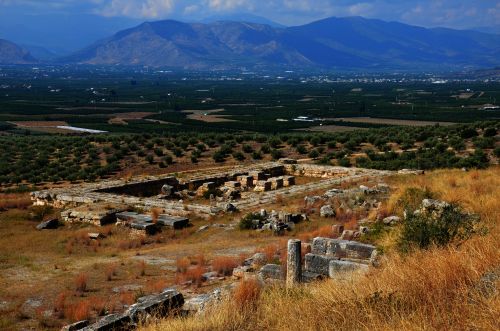
A sanctuary of Hera.
1) The Heraion of Argos is an ancient temple, part of the greatest sanctuary in the Argolid, dedicated to Hera, who herself claims to be the protector of Argos in the Iliad. The site lies about 9 km northeast of Argos. - See also: site page.
2) The Heraion of Samos lies in the southern region of the island. It was built by Greek
colonists in the seventh century BC on the ruins of an older structure. According to
Herodotus the temple was the largest structure in the Greek world.
Herakleitos
Herakleitos of Ephesos (ca. 535 - ca. 475 BC) was a pre-Socratic Greek philosopher. He regarded himself as a self-taught pioneer of wisdom, but very little is known of his life, and the seemingly paradoxical nature of his philosophy made him known as "The Obscure". He maintained that ever-present change is the fundamental essence of the universe, as stated in the famous saying, "No man ever steps in the same river twice" (panta rhei). He also stated that "the path up and down are one and the same", referring to a unity of opposites in the world: all existing entities are characterized by pairs of contrary properties, so that no entity can ever occupy exclusively one single state at one single time.
Herakles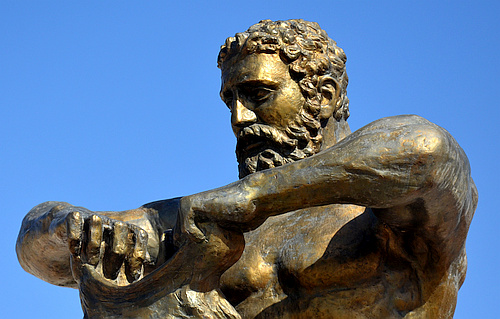
The paramount panhellenic hero, son of Zeus and
Alkmene. His life, full of fearful adventures and countless sorrows, was taken as
historical fact by early writers such as Herodotus and
Xenophon. - His twin-brother, Iphikles, was also born to Alkmene but was the son of
Amphitryon. Zeus had decided that the next son born in the line of
Perseus would rule Argos (and / or
Mycenae) and so Hera (or
Eileithyia) delayed the birth of Herakles so that his cousin, Eurystheus, could
become king and Herakles would be doomed to a troublesome life of wandering and hardship. When Herakles was still a
baby, Hera sent serpents to kill him, but Herakles strangled the beasts in his cradle. Later, Herakles was subject to
Eurystheus, who required from him the Twelve Labors ("athloi", or "erga"), seemingly
impossible and fatal. But even after completing these tasks and the Incidentals
("parerga") with the help of Athena, the challenges were
not ended. These adventures in the latter part of his life are known as the Deeds
("praxeis"). Then, after his wife, Deianeira, had
accidentally poisoned him, Herakles built his own funeral pyre and gave his bow and quiver to
Philoktetes and asked him to light the fire. Then, just before Herakles was consumed
by the flames, Athena (or Nike) raised his body to Olympos to
reside among the immortals and to be married to Hebe, the goddess of youth.
Heraklids
The descendants of Herakles, who had hundreds of children. After the death of Herakles they ruled cities from Asia Minor to Sparta for several centuries. They were persecuted by Eurystheus, but protected by Iolaos.
herm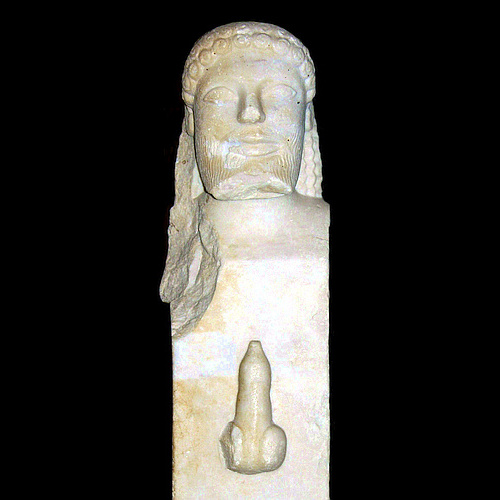
A square pillar, usually of marble, with a bearded head of
Hermes and a phallus. It was set up since the Archaic period as a
guardian of roads, but also as a symbol of virility. Herms were especially set up at crossings, country borders and
other boundaries.
Hermarchos
Hermarchos (ca. 325 - ca. 250 BC) was an epicurean philosopher. He was the disciple and successor of Epikouros as head of the school. His work was directed against Plato, Aristotle, and Empedokles, but none of his writings survived.
Hermes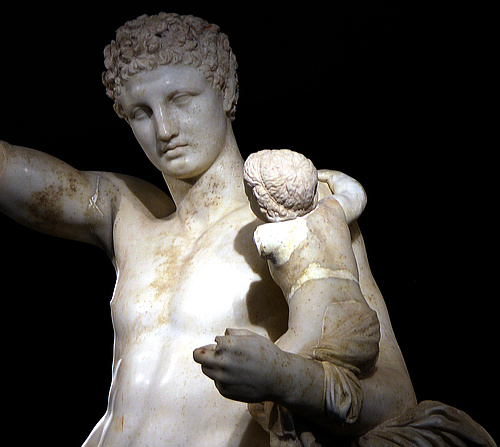
The Greek god of travelers and merchants, god of cunning and invention and theft; son of
Zeus and Maia. He is depicted as a handsome and athletic young
man. His attributes are a winged hat, winged sandals, and a staff entwined with two serpents, the
kerykaion. As Hermes Psychopompos he leads human souls into the
underworld and is the herald of the gods. Especially his father Zeus used him as
troubleshooter to solve various problems. There were no temples erected for Hermes but he is honoured by
herms.
Hermesianax
Hermesianax of Kolophon in Ionia was an ancient Greek elegiac poet of the Hellenistic period. He was very popular in his time but all of his writings are lost except for a fragment of about one hundred lines of his chief work.
Hermione
The only daughter of Menelaos and Helena. According to Homer, Menelaos gave her in marriage to Neoptolemos after the Trojan War. Later writers tell a different story about her. Euripides has it that Menelaos had promised her to Orestes prior to the campaign against Troy and according to others it was her grandfather, Tyndareos, who gave her in marriage to Orestes. It seems that after the war, Neoptolemos took possession of her by force, but was slain thereafter. By Orestes, whose wife she ultimately became, she was the mother of Tisamenos.
Hero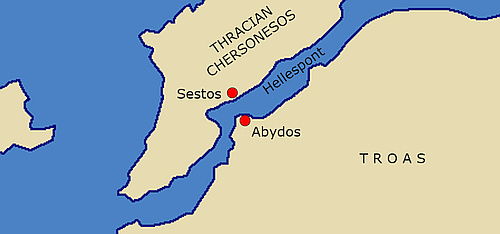
A priestess at the temple of Aphrodite in the city of
Sestos and the lover of Leiandros. Living in
Abydos, Leiandros swam each night across the Hellespont
to his lover in Sestos, guided by the light of the lighthouse on the western shore. In one very stormy night the light
was extinguished and Leiandros lost his way and drowned. On the next morning his corpse was washed onto the coast of
Sestos, whereupon Hero was so deeply grieved that she killed herself by leaping into the sea.
Herodas
Herodas (fl. 3rd century BC) was a Greek poet and author of short humorous dramatic scenes in verse.
Herodes Atticus
Herodes Atticus (AD 101-177) was a rich and distinguished Greek aristocrat and sophist, and also a Roman senator. In 143 AD he was appointed consul at Rome, the first Greek consul ordinarius. He was a renowned author, but most of his literary work is lost. He is better known as philanthropist and benefactor of arts. He was "patron of the arts and letters (and himself a writer and scholar of importance), public benefactor on an imperial scale, not only in Athens but elsewhere in Greece and Asia Minor, holder of many important posts, friend and kinsman of emperors."
Herodotus
First Greek historian (ca. 490-420 BC). He was a friend of Perikles and Sophokles in Athens, and undertook extensive travels to Africa and Asia before he moved to Italy in 444 BC. He is credited with a description of the Persian Wars in their larger historical contexts and handing down a vivid picture of the world and peoples of his time. Modern research has confirmed many of his narratives as historical facts.
heroon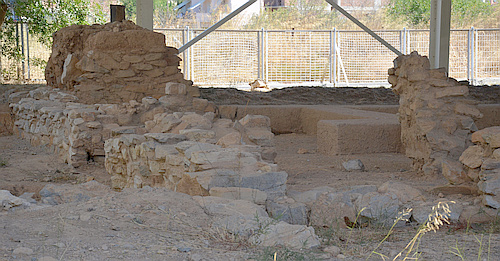
A temple or funerary monument which may be dedicated to the cult of a hero, the offspring of a god
and a human, or a heroized dead person.
Herophilos
A Greek physician (335 - 280 BC) from Chalkedon in Asia Minor. He spent most of his life in Alexandria where he was the first to perform scientific dissections of human bodies. Of his more than nine published books on anatomy, none has survived.
Herostratos
Herostratos was responsible for the destruction of the Temple of Artemis at Ephesos in 356 BC, one of the Seven Wonders of the World, in an attempt to achieve infamy.
Herse
1) The wife of Danaos and mother of Hippodike and Adiante.
2) A daughter of Kekrops and Agraulos, and a sister of Agraulos, Pandrosos, and Erysichthon. She was the beloved of Hermes, and by him the mother of Kephalos.
3) Also called Ersa, the goddess of the dew, a daughter of Zeus and Selene.
Hesiod
A Greek poet probably active between 750 and 650 BC, around the same time as Homer. Several of his works have survived completely, among them his Theogony and Works and Days. He is regarded as 'the first written poet in the Western tradition to regard himself as an individual persona with an active role to play in his subject.' Together with Homer, he is not only credited with establishing Greek religious customs, but he is also a prominent source on Greek mythology, farming techniques, early economy, archaic Greek astronomy and ancient time-keeping.
Hesione
1) A Trojan princess, daughter of Laomedon, and sister of Priam. When Laomedon breached a promise, Poseidon sent a sea-monster to ravage the country. To get rid of this beast, Laomedon followed an oracle and had Hesione chained to a rock to be devoured by the monster. When Herakles returned from his expedition against the Amazons, he offered to save her if Laomedon would give him the horses that he had been given by Zeus in exchange for Ganymede. Laomedon agreed and again breached his promise and was killed by Herakles. According to one tradition, Hesione was then given as a slave to Telamon, by whom she became the mother of Teukros.
2) The wife of Prometheus.
3) A daughter of Danaos, and by Zeus the mother of Orchomenos.
4) The wife of Nauplios, and the mother of Palamedes, Oiax, and Nausimedon.
Hesperides
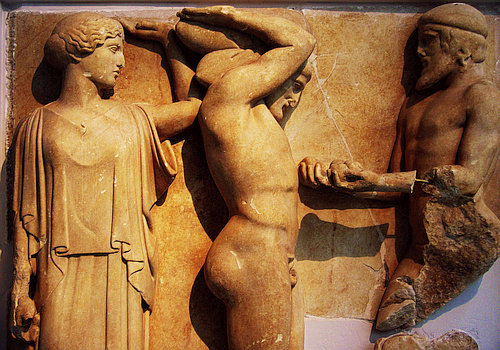
Daughters of Atlas and Nyx. Together with the
dragon Ladon they guarded a tree with golden apples - a wedding gift of
Gaia to Hera upon her wedding to
Zeus. It was the Eleventh Labor of Herakles to retrieve
these apples. With the help of Athena he accomplished this by having
Atlas getting the golden apples while he supported the heavens on his shoulders.
Hestia
Greek goddess of hearth and home. She is the eldest daughter of Rhea and Kronos. After the Titans were overthrown, Hestia kept the hearth lit at Olympos. She is described as calm, gentle, and immune to the advances of Poseidon, Apollo, and Priapos, resolved to remain a virgin. In art, she is usually depicted as a modest young woman, often wearing a veil.
hestiatorion
In ancient Greece a building in which honorary or ritual meals were taken by eminent citizens or foreigners. It was usually located in a sanctuary or a prominent position in the city.
hetaira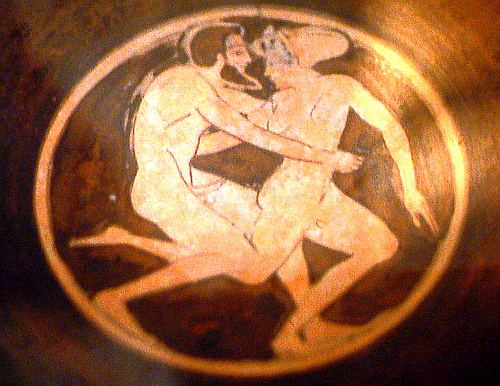
Hetairai ("companions") were one type of prostitutes in ancient Greece. Traditionally, hetairai were
contrasted to pornai, who provided sex for many clients in brothels or on the streets.
Hetairai, on the other hand, were thought to have long-term relationships with only a few men at a time, providing not
only sex, but also companionship and intellectual stimulation. This description of hetairai as high-class prostitutes
has been questioned recently as an euphemism for any kind of prostitution.
hexameter
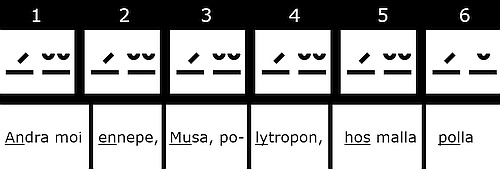
Hexameter is a metrical line of verses consisting of six feet. It was the standard epic metre in
classical Greek and Latin literature. The daktylic hexameter is also used in
Homer's epics Iliad and
Odyssey.
hexastyle
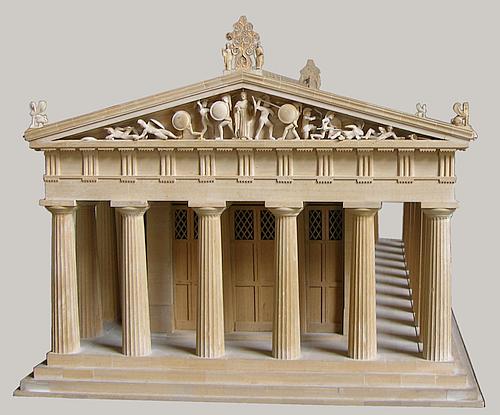
In ancient Greek architecture buildings with six columns on each of the
short sides. This was the standard façade in canonical Greek Doric architecture
between the Archaic period 600-550 BC up to the age of
Perikles 450-430 BC.
Hierax
Hierax (fl. 4th century BC) was a Spartan admiral during the Corinthian War. He was sent to Aegina in 389 BC after Teleutias had earlier driven off the Athenian fleet. Soon after taking command, Hierax departed for Rhodos with most of the fleet, leaving Gorgopas as governor in Aegina. Not long afterward, Antalkidas was sent to replace Hierax as admiral.
Hilaeira
One of the fair daughters of Leukippos, a priestess of Artemis. She was carried off with her sister Phoibe by the Dioskouroi and married to Kastor.
hilt
The handle of a sword or dagger.
himation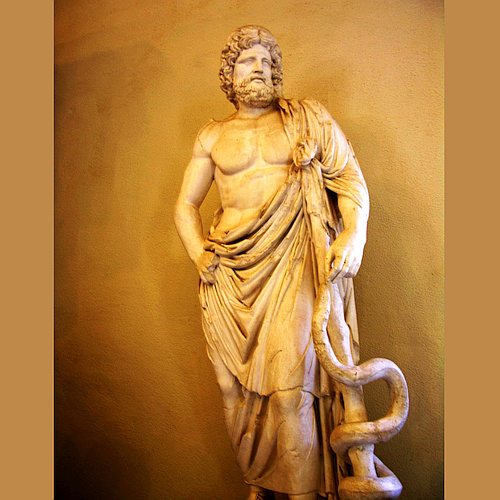
A piece of clothing in ancient Greece, usually worn as a cloak over the lighter
chiton. It was usually draped over the left shoulder and left the right arm free.
Hipparchos
1) One of the sons of Peisistratos. He may have ruled Athens as a tyrant together with his brother Hippias after the death of their father in 528/7 BC. Both Hipparchos and Hippias were quite popular with the Athenians, especially Hipparchos promoting the arts. Then, in 514 BC Hipparchos was assassinated by the tyrannicides, Harmodios and Aristogeiton, apparently because of a personal dispute.
2) Hipparchus of Nicaea (ca. 190 - ca. 120 BC) was a Greek astronomer, geographer, and mathematician, probably the greatest astronomer of antiquity. Based on the observations and mathematical methods accumulated over centuries by the Babylonians and other people from Mesopotamia, he developed trigonometry, solved problems of spherical trigonometry, discovered and measured the Earth's precession, compiled the first comprehensive star catalog of the western world, and with his studies of the apparent solar and lunar motions developped a reliable method to predict solar eclipses.
Hippasos
1) A son of Keyx, the king of Trachis. He accompanied Herakles in the war against Oechalia, was slain by Eurytos.
2) A centaur who was slain by Theseus at the wedding of Peirithoos.
3) A son of Eurytos, was one of the Kalydonian hunters.
4) A son of Priam, the last king of Troy.
5) A son of Hippomedon and Okyrhoe, who was a Phrygian ally of Troy in the Trojan War.
6) There are two more mythological personages of this name.
hippeis
1) A Greek term for cavalry. After the political reforms of Solon (circa 594 BC) in ancient Athens, the hippeis formed the second highest of the four social classes: pentakosiomedimnoi, hippeis, zeugitai, and thetes. A hippeus was required to have an early income that enabled him to purchase and maintain a war horse during his service to the state.
2) The elite detachment of three-hundred horsemen who guarded the two kings of Sparta.
Hippias
1) Hippias of Athens was one of the sons of Peisistratos, whom he succeeded after his death in 528/7 BC as a tyrant. When his brother Hipparchos, who perhaps ruled jointly with him, was assassinated by Harmodios and Aristogeiton (the tyrannicides) in 514 BC, he became a bitter and cruel ruler. Consequently, the unrest among his subjects mounted, and when he began to lose control he sought Persian support. In 510 BC Kleomenes I of Sparta intervened and caused Hippias to flee to Persia.
2) Hippias of Elis (late 5th century BC) was a Greek sophist, and a contemporary of Sokrates. Claiming to be an authority on all subjects, he lectured on poetry, grammar, history, politics, mathematics, and much else. Plato described him as vain and arrogant.
hippocentaurs
--> centaurs
Hippodameia
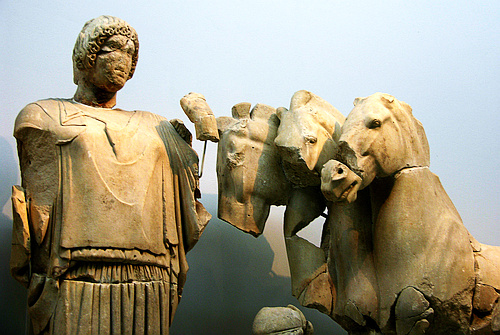
1) Daughter of king Oinomaos, who may have taken an active part in
the plot to kill her father. She then married Pelops and became mother of
Atreus, Thyestes and many more children. According to one
mythological tradition, she instigated Atreus and Thyestes to kill a son that Pelops had by a previous wife, whereupon
Pelops cursed both sons and Hippodameia committed suicide.
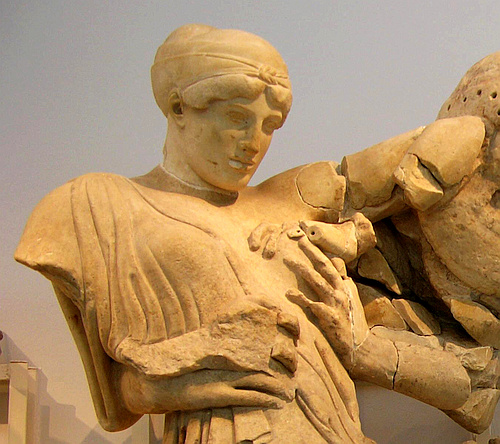 2)
A daughter of Atrax, and wife of Peirithoos. She is sometimes called Deïdameia. During
her wedding, the drunk centaur Eurytion tried to carry
her off, thereby starting the famous fight between the Lapiths and the centaurs.
2)
A daughter of Atrax, and wife of Peirithoos. She is sometimes called Deïdameia. During
her wedding, the drunk centaur Eurytion tried to carry
her off, thereby starting the famous fight between the Lapiths and the centaurs.
3) Daughter of Anchises and sister of Aeneas; married with Alkathoos.
4) The real name of Briseis, the beloved captive of Achilles.
5) The wife of Amyntor, and mother of Phoinix.
Hippodamian system
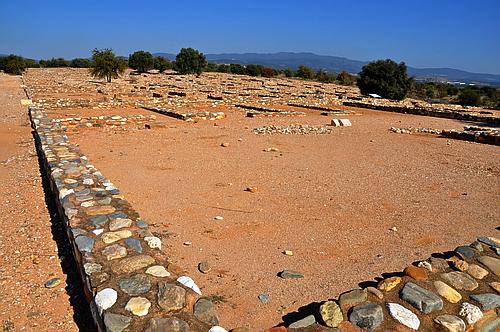
The grid-based system of urban planning, in which the area of the city is divided by "vertical" and
"horizontal" streets into rectangular building insulae, in which the residences and public buildings are located. This
strict regularity contrasts the organic and usually confused layout of cities until the 5th centory BC. The name goes
back to the work of Hippodamos of Miletos, although this system was used already earlier in
Greek colonies in Magna Graecia.
Hippodamos
Hippodamos of Miletos (498 - 408 BC) was an ancient Greek architect, urban planner, physician, mathematician, meteorologist and philosopher. The Hippodamian system was named after him.
hippodrome
An oval track for horse races, surrounded by raised platforms for the spectators.
Hippokoön
1) The eldest, but natural son of Oibalos and Bateia, and a stepbrother of Tyndareos, Ikarios and Arene, After his father's death, Hippokoon expelled his brother Tyndareos, in order to secure the kingdom of Sparta to himself; but Herakles led Tyndareos back, and slew Hippokoon and his sons.
2) There are four other mythical personages of this name.
Hippokrates
The 'Father of Medicine' (ca. 460 - 375 BC), most famous of all Greek physicians. He founded a school of physicians on the island of Kos where he was born, establishing medicine as a profession. Among his lasting achievements are the systematic categorization of diseases, their prognosis and clinical observation. - The Hippocratic Oath is the ethical basis for physicians until today.
Hippokrates of Gela
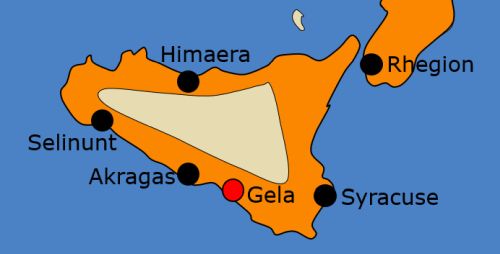
Hippokrates (died 491 BC) was the second tyrant of
Gela who ruled from 498 BC to 491 BC. He succeeded his brother
Kleandros and made Gela the most powerful and flourishing among the Greek
colonies in Sicily in the 6th century BC. He wanted to conquer all of southeastern Sicily in order to create a great
state with Gela as its capital and also besieged Syracuse, but had to withdraw after
Corinth and Kerkyra intervened. He died in battle and was
succeeded by Gelon as the new tyrant of Gela.
Hippolyte
According to ancient Greek mythology a daughter of Ares and Otrera. She was queen of the Amazons, and a sister of Antiope and Melanippe (and of Penthesilea?). As a token of her dignity she wore the "Golden Girdle of Ares", a girdle given to her by her father. When Herakles came to fetch it as one of his athloi, he killed Hippolyte in a fight. - In another tradition she invaded Attica with her Amazons to avenge the abduction of Antiope by Theseus. Being defeated by him she fled to Megara, where she died of grief. - In still other accounts she, and not Antiope, was married to Theseus.
Hippolytos
1) One of the giants killed by Hermes.
2) A son of Theseus and Antiope or Hippolyte. When his first wife died, Theseus married Phaidra, who fell in love with her stepson, but he did not reciprocate her feelings. As a revenge, Phaidra then told Theseus that Hippolytos had made improper advances to her and as a consequence Theseus cursed his son and asked Poseidon to destroy him. When Hippolytos then rode in his chariot near the coast Poseidon sent a bull from the sea to frighten the horses which then dragged Hippolytos to death. Later, Theseus came to know about the innocence of his son, whereupon Phaidra killed herself and Asklepios restored Hippolytos to life.
Hippomedon
1) According to tradition a son of Aristomachos, but Sophokles calls him a son of Talaos. He was one of the Seven against Thebes, and during the siege was slain by Hyperbios or Ismaros.
2) A Phrygian, who became by the nymph Okyrhoe the father of Hippasos.
Hippomenes
A son of Megareus, and a great-grandson of Poseidon. He tricked Atalante into marriage by accepting her challenge to a foot race and, following Aphrodite's advice, dropped three golden apples from the garden of the Hesperides in her path. Atalante stopped to pick them up and thus lost the race.
Hipponax
Hipponax (fl. 6th century BC) was an ancient Greek iambic poet whose verses showed the vulgar side of life in Ionian society. Ancient authors celebrated his malicious wit and mentioned his physical deformation (perhaps only inspired by the nature of his poetry). He was credited with inventing literary parody and influencing comic dramatists such as Aristophanes.
Hipponoos
1) A Corinthian hero, better known as Bellerophontes.
2) King of the Triballi tribe of Thracia. By Thrassa he was the father of Polyphonte.
3) Father of Periboia.
4) There are several other mythical personages of this name.
Hippothoos
1) Father of Aipytos. He succeeded Agapenor as king in Arcadia.
2) He led a troop from Larissa to assist the Trojans. When dragging away the body of Patroklos, he was slain by the Telamonian Aias.
3) Son of Priam, the last king of Troy. He was one of the sons called worthless by Priam after he lost his favorite son, Hektor, defending Troy.
4) One of the Kalydonian Hunters.
5) There is another mythological personage of this name.
 Hisarlik
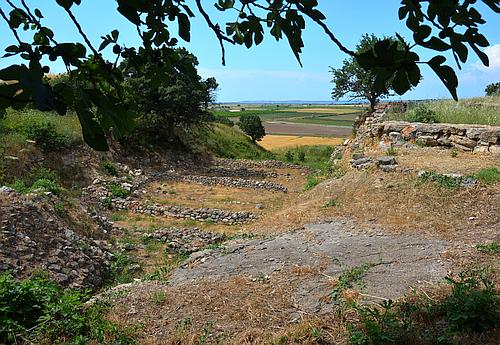
Site in modern Turkey where Schliemann located ancient
Troy.
Hittites
A people that probably came from beyond the Black Sea and settled in the area of modern Turkey during the early second millenium BC. They founded one of the first major civilizations (ca. 1650 - ca. 1200 BC) of the Bronze Age in western Asia. It reached its peak in the 14th century BC, encompassing most of modern Anatolia up to the Assyrian Empire.
hoard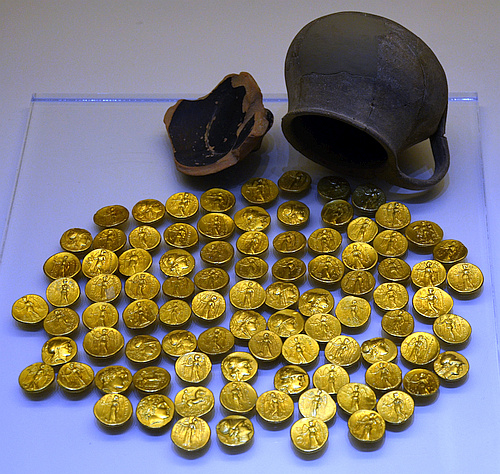
A container with coins hidden in troubled times which the owner could not retrieve and which was
discovered by accident later.
Homer
Homer, or Hómeros, is the praised author of the Iliad and the Odyssey. As author of the first known literature of Europe, he is a central figure in Western culture. Long assumed to be a fictitious character, Homer is now believed to be a historic personage of the 8th century BC, living in ionic Asia Minor. Ancient Greeks celebrated him as the first and greatest of the epic poets. In Plato's Republic, he is referred to as the protos didaskalos, "first teacher", of tragedy, the hegemon paideias, "leader of learning", and the one who ten Hellada pepaideuken, "has taught Greece".
Homeric Hymns
A collection of thirty-three anonymous ancient Greek hymns celebrating individual gods. They are called "Homeric" because they are written in dactylic hexameters like the Iliad and the Odyssey, use similar formulas and dialect. Therefore, the ancient Greeks since Thukydides attributed the hymns to Homer himself. This has first been questioned by the school of Alexandria. Today it is thought that the oldest of the hymns were written in the seventh century BC, somewhat later than Hesiod and more or less contemporary with Homer, placing them among the oldest works of Greek literature; although most of them were composed in the seventh and sixth centuries. Long time neglected, the Homeric Hymns have again attracted much attention, regardless of their authorship, as a profound source of information regarding ancient Greek religious traditions.
hoplon
--> aspis
hoplite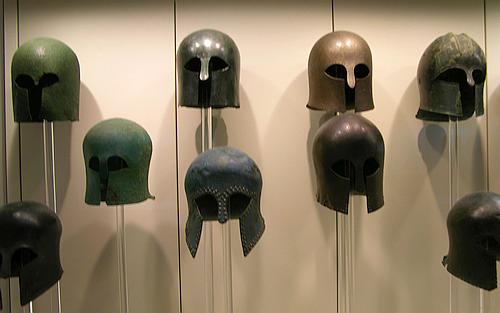
Citizen-soldiers of Ancient Greek city-states. They wore helmets of
various styles, sometimes had a suit of armour, and were armed primarily with spears and
shields. They were free citizens who could afford the bronze armour and the weapons - about a third or half the
adult male population. They received only some basic military training. Since the 8th or 7th century BC, hoplites fought
in a military formation known as phalanx.
Horai
In Greek mythology the divinities originally of the order of nature and of the seasons, i.e. spring, summer and winter, in later times regarded as goddesses of order in general and of justice. Homer does not mention their number or their parents. Later writers give different genealogies and numbers, usually three. They are kind and benevolent and promote the fertility of the earth. They are often mentioned along with the Charites, with whom they are frequently confounded.
horns of
consecration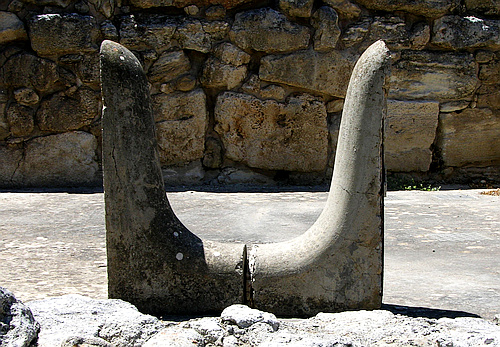
A term introduced by Evans for architectural elements of stone or clay
put on palaces or shrines. In Minoan cult they are a symbol of "divine significance".
Horsehead Amphora
A specific type of amphora, produced in Athens since about 600 BC. They have a very pronounced belly, decorated with black figure horseheads on both sides within reserved rectangular panels and the remaining body of the vase painted black. More than 100 such amphorae are known, but their purpose remains unclear.
House of the Mosaics
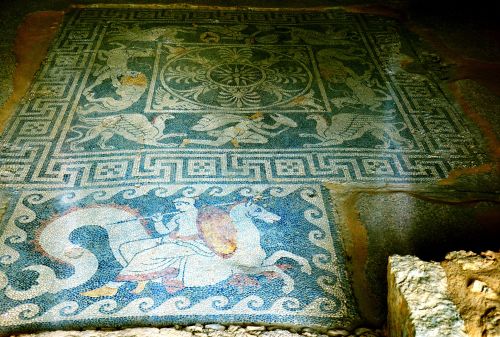
A house built in Eretria on Euboea
around 370 BC. The name was given in modern times because of the floors covered with outstanding pebble mosaics of
mythological themes. The building is a specimen of Classical and
Hellenistic domestic architecture. - See also: site page.
House of the Tiles
--> Lerna
hubris
Hubris, or hybris, is a personal quality of extreme or foolish pride and over-confidence. In ancient Greece it refers to a behaviour violenting the the norms of behavior or challenging the gods. As a consequence, it brings the downfall of the perpetrator. See also: Nemesis.
Hyades
("the rainy") A class of nymphs, of which the myths give different
numbers, names, and descents. Usually, seven are mentioned: Ambrosia, Eudora, Koronis,
Pedile, Phyto, Polyxo, and Thyone. They were the nurses appointed by Zeus to bring up
Dionysos. Zeus showed them his gratitude by placing them in the sky as a star cluster
in the constellation Taurus.
Hyakinthos
1) In ancient Greek mythology the youngest son of the Spartan king Amyklas and Diomede, according to one tradition. He was a youth of extraordinary beauty, beloved by Apollo, who unintentionally killed him during a game of discus. According to some traditions, he was also loved by Boreas or Zephyros, who were jealous of Apollo and drove the discus of the god against the head of the youth, and thus killed him. From his blood there sprang the flower of the same name, hyacinth. (But according to other traditions the hyacinth sprang from the blood of Aias.)
2) A Lakedaimonian who is said to have gone to Athens, following an oracle, to have his daughters be sacrificed. In this way the city should be delivered from famine and the plague. The daughters were later known as the Hyakinthides, but traditions about them vary greatly.
hybris
--> hubris
 Hydra
Hydra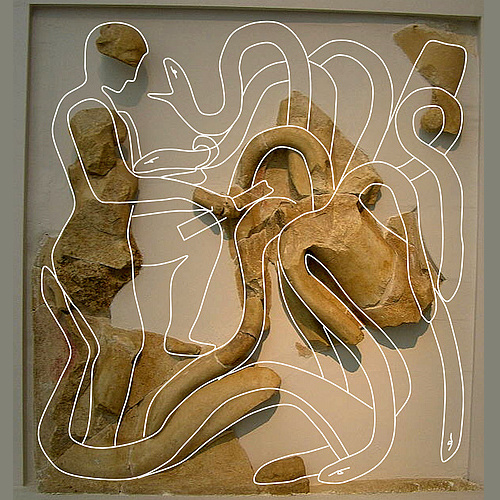
1) Giant multi-headed snake, offspring of Echidna and
Typhon, who lurked for her human prey in the swamps of Lerna.
To kill her was the Second Labour of Herakles, at which he
was assisted by Iolaos and the goddess Athena. The task was
not easy because Hydra's blood was poisonous and whenever one of her nine heads was hacked off there were two new ones
appearing immediately. Herakles prevented this by holding a burning torch at the neck where a head was cut off. When the
Hydra was dead, Herakles dipped his arrows in the poisonous blood.
2) Island (50 km2, 3000 inhabitants) southeast of Argolis.
hydraulis
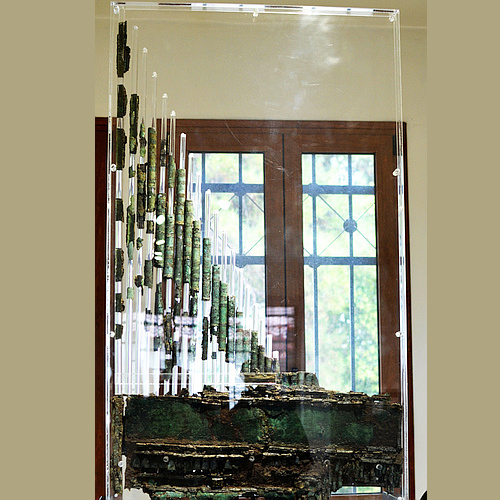
An early type of pipe organ that converts the dynamic energy of water into air pressure to drive the
pipes. It was probably invented by Ctesibius of Alexandria, an engineer of the 3rd
century BC. It was the world's first keyboard instrument, and the predecessor of the modern church organ. In 1992, a
hydraulis of the first century BC was unearthed in Dion, the only find of its kind in Greece and the oldest discovered
specimen of its kind in the world.
hydria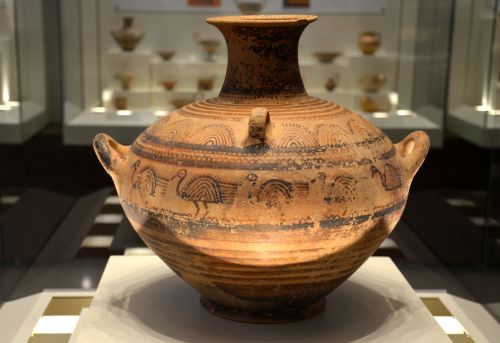
A type of ancient Greek pottery used for transporting water. The
hydria has three handles. Two handles on opposite sides are for carrying and lifting the hydria, while the third
handle - in the middle between the other two - is arranged vertically and used for pouring the water. These vessels have
been produced both in black- and red-figure style.
Hygieia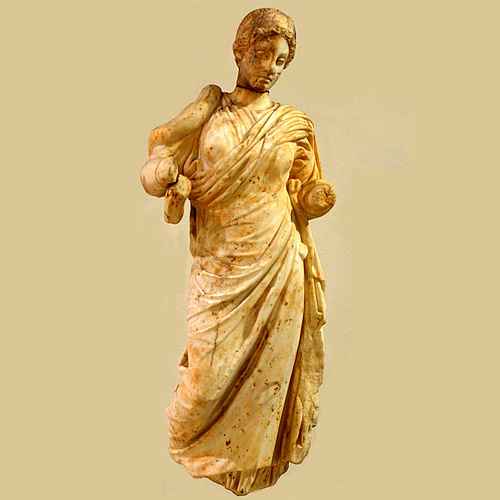
Ancient Greek goddess of health, daughter of Asklepios.
Hyginus
Hyginus Mythographus is said to be the author of two Latin collections of ancient Greek myths and celestial genealogies, published in the 2nd century AD. Although plainly written, like the work of "an ignorant youth, semi-learned", they are a mine of information today, when so many more nuanced versions of the myths have been lost. Hyginus draws from a Greek handbook on mythology as well as from tragedies (Aischylos, Sophokles, Euripides) and epics (Homer, Hesiod).
Hylas
In one version of the myth, a son of Theiodamas, king of the Dryopes, by the nymph Menodike. He was the favourite of Herakles, who, after having killed Theiodamas, took him with him on the expedition of the Argonauts. When they landed on the coast of Mysia, Hylas went to fetch water. Coming to a well, his beauty excited the love of the Naiads, who drew him down into the water, and he was never seen again. Herakles searched for him, but in vain, and in the meantime the Argonauts sailed on, leaving Herakles and his companion Polyphemos behind. Herakles threatened to ravage the country if the Mysians would not help him to find Hylas. Since that time, the locals celebrate an annual festival to the divine youth Hylas, roaming the country and calling out his name.
Hyleus
He took part in the Kalydonian Hunt and was killed by the boar.
Hyllos
1) Eldest son of Herakles and Deianeira, was the husband of Iole. When, after Herakles' death, he and his brothers were persecuted by Eurystheus, they found refuge in Athens. Eurystheus followed them there, but was defeated and slain. Hyllos and his brothers now saw their chance to regain their parental inheritance and invaded the Peloponnese but a plague forced them to withdraw after one year. When Hyllos consulted the Delphic oracle, he was told to wait for "the third fruit," and then enter the Peloponnese by "a narrow passage by sea." So, after three years he marched across the isthmus of Corinth and attacked Atreus, but was slain in single combat by Echemos. - Only the third generation of Heraklids - Aristodemos, Kresphontes, and Temenos - were able to conquer the Peloponnese.
2) A son of Gaia. A river in Lydia was named after him.
Hymenaios
The god of marriage; originally the bridal song, which was then personified. The god Hymen or Hymenaios has a poetical origin, being first mentioned by Euripides or perhaps Sappho. He is perceived as a youth of extraordinary beauty, in art often represented with a bridal torch in his hand. Concerning his descent and doings there were very different local traditions.
Hyperbolos
Hyperbolos (died 411 BC) was an Athenian politician active during the first half of the Peloponnesian war. Aristophanes depicts him in his play "Peace" as a former lampmaker before entering politics. Hyperbolos becomes quite prominent after the death of Kleon in 422 BC and like Kleon he is a demagogue, exercising power solely through speech in the assembly. Especially Thukydides blames him for a decline in Athenian political culture which ultimately led to the loss of the war with Sparta. When he tried to bring about the ostracism of Nikias or Alkibiades, the two joined and induced the people to ostracise Hyperbolos in ca. 416 BC. He then lived on the island of Samos where he was murdered by oligarchic revolutionaries.
Hyperboreans
In ancient Greek mythology a people living "beyond the North Wind". Since Boreas, the god of the North Wind, was believed to reside in Thracia, this would indicate a land far to the north of it. It was also said that in Hyperborea the sun shines for twenty-four hours a day, which we might interpret as lying beyond the arctic circle. However, it is also possible that Hyperborea was a purely fictitious construction.
Hyperion
1) A Titan, son of Gaia and Uranos. He was married to his sister Theia and became the father of Eos, Helios, and Selene.
2) According to Apollodorus a son of Priam.
Hypermnestra
1) One of the Danaides, daughter of Danaos and Pieria. Unlike her 49 sisters, she did not kill her husband, Lynkeus, on the wedding night because he honored her wish to remain a virgin. Therefore, Danaos became angry and wanted her condemned by the Argive court, but Aphrodite saved her. Hypermnestra and Lynkeus then had a happy marriage and founded a dynasty of Argive kings.
2) A daughter of Thestios and Eurythemis. She was the wife of Oikles, by whom she became the mother of Amphiaraos.
hyperoon
The area above the side nave of a temple. In a basilica, the hyperoon was above the side nave and the narthex from where the women watched the service.
Hypnos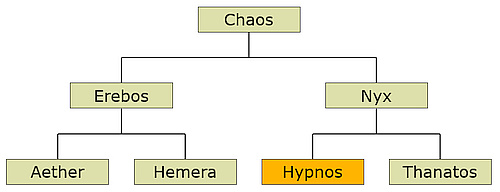
In Greek mythology the personified god of sleep, son of Nyx (Night) and
brother of Thanatos. In ancient Greek art the two brothers were mostly presented as
youths either sleeping or holding inverted torches in their hands.
hypocausts
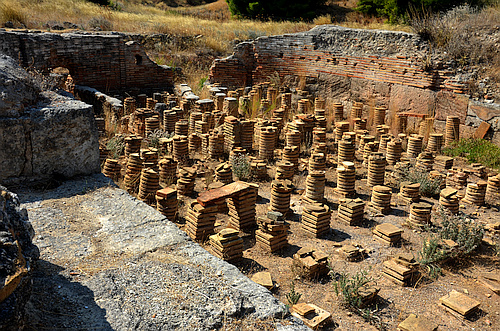
Installations under the floors for heating the rooms in ancient bathhouses especially of the Roman
period.
hypogeum
A hypogeum (from Greek hypo = "under" and gaia = "mother earth") is an underground chamber, temple or tomb.
hyposkenion
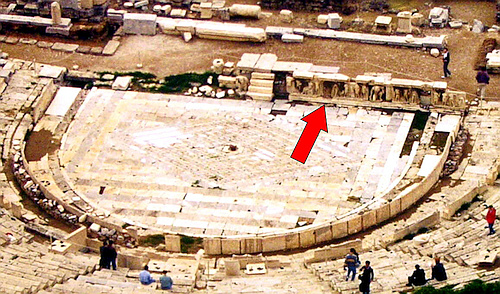
In ancient Greek theatres the wall supporting the raised stage
(skene). This stone construction has decorative elements like reliefs, and can also
have doors giving access into the orchestra.
hypostyle
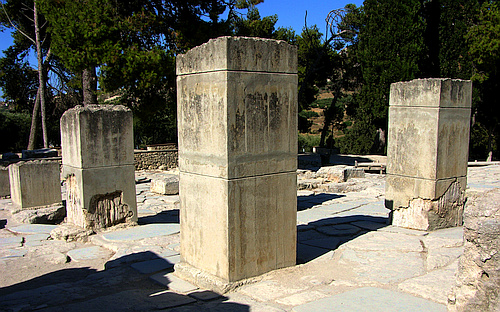
A hypostyle hall has a roof which is supported by columns or piers.
They were especially used in Minoan Crete as ceremonial or banqueting halls, but they
could also be just meeting places.
Hypseus
1) King of the Lapiths in Thessaly; father of the nymph Kyrene.
2) Another personage of this name is mentioned by Ovid.
Hypsipyle
In ancient Greek mythology queen of Lemnos, daughter of Thoas and Myrina. It is said that during her reign the women neglected the worship of Aphrodite, who thereupon afflicted them with an evil smell. When the men then turned to Thracian slaves, the Lemnian women took revenge and, in one night, killed all males on the island. Only Hypsipyle made an exception, spared her father Thoas and concealed him. - Soon afterwards, the Argonauts stopped in Lemnos on their way to Kolchis, and stayed for two years. During that time, the Argonauts had intensive contacts with the Lemnian women and Jason produced two children with Hypsipyle. - When the other women found out that Hypsipyle had saved her father she had to flee for her life. She was then captured by pirates and sold as a slave to the Nemean king Lykurgos. There, she was in charge of baby Archemoros, the son of Lykurgos. When the 'Seven against Thebes' came to Nemea and were looking for water, Hypsipyle left the infant unattended and showed the heroes a fountain. During this time, Archemoros was killed by a poisonous snake. Lykurgos wanted to punish Hypsipyle, but Adrastos, the leader of the Argives intervened.
Hyrieus
A son of Poseidon and Alkyone. He was king of Hyria in Boeotia, and by the nymph Klonia he became the father of Nykteus, Lykos and Orion.

