
GREECE
 GLOSSARY
| A | B | C | D |
| E | F | G | H |
| I | J | K | L |
| M | N | O | P |
| Q | R | S | T |
| U | V | W | X |
| Y | Z |
2025-12-28
color code:  = mythology;
 = history & culture;
  = geography;
  = archaeology &
architecture
= archaeology &
architecture
 Nafplion
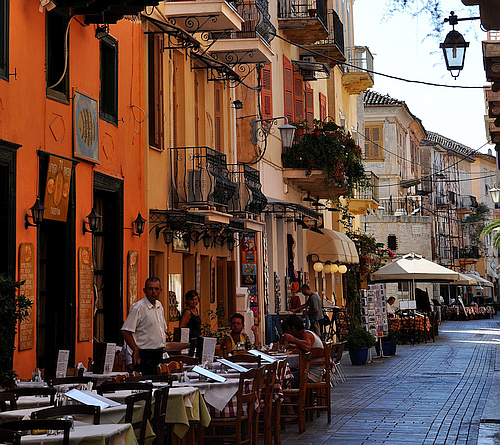
A seaport town (population 15,000; also called Nauplion, Nauplia, or Navplion) in the
Argolis - and my favourite Greek town - that has expanded up the hillsides near the
northern end of the Argolic Gulf. Traces of settlement can be found from the
Bronze Age, but it first became an important sea port in the Middle Ages. It was part
of the lordship of Argos and Nauplia, held initially by the de la Roche family after the
Fourth Crusade before coming under the Republic of Venice and then the Ottoman Empire. During the Greek
War of Independence, Nafplion was a major Ottoman stronghold and was besieged
for more than a year before it surrendered due to starvation. Because of its strong fortifications it then became the
seat of the provisional government of Greece. Ioannis Kapodistrias, first head of
state of newly liberated Greece, set foot on the Greek mainland for the first time in Nafplion on 7 January 1828 and
made it the official capital of Greece in 1829. He was assassinated on 9 October 1831 by members of the Mavromichalis
family, on the steps of the church of Saint Spyridon in Nafplion. An anarchistic period followed until the arrival of
King Otto in 1832 and the establishment of the new Kingdom of Greece. Nafplion remained the
capital of the kingdom until 1834, when King Otto decided to move the capital to Athens. -
Today, Nafplion is the capital of the regional unit of Argolis. Tourism emerged slowly in the 1960s, but (fortunately)
not to the same degree as in some other Greek areas. However, it became the destination of cruise liners in recent
years, causing some problems. Nauplion enjoys a very sunny and mild climate, even by Greek standards. - See also:
site page.
Naiads
Fresh-water nymphs, i.e. the nymphs of the rivers, lakes and springs.
naiskos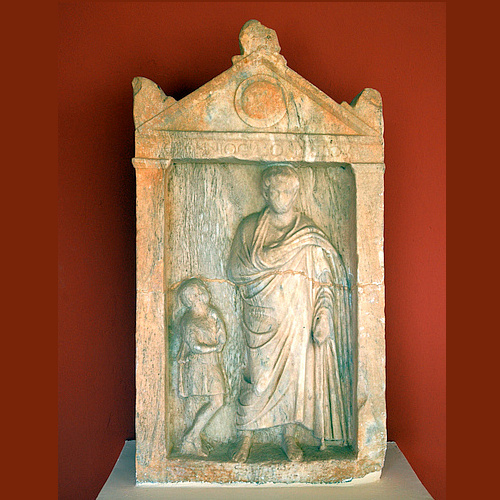
In classical funeral architecture a small temple with
columns or pillars and
pediment. Always with a religious background, it is especially found as grave reliefs or shrines with statues in
Attic cemeteries.
naos
--> cella
narthex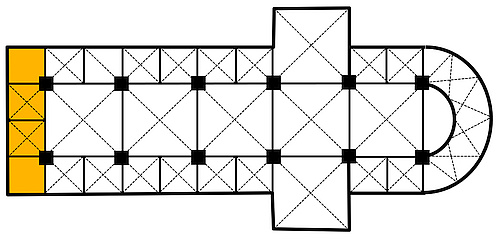
An architectural part of early Christian basilicas, the entrance area
at the (usually western) end of the nave, opposite the church's main altar. Especially in early
Christian churches the space may be divided into an inner narthex, the esonarthex, and an outer narthex,the exonarthex,
which may be either open or enclosed, with a door leading to the outside.
Nauplios
1) A son of Poseidon and Amymone, and father of Proitos and Damastor. He was a famous seafarer and the reputed founder of the town of Nauplion, which derived its name from him.
2) One of the Argonauts and a descendant of (1).
3) A king of Euboea. According to tradition, Klymene and Aerope, daughters of Katreus, had been given to Nauplios to be carried to some foreign country. But Nauplios instead married Klymene, and became by her father of Palamedes, Oeax and Nausimedon; Aerope was given to Pleisthenes, who became by her the father of Agamemnon and Menelaos. - During the siege of Troy, Nauplios' son Palamedes was unjustly sentenced to death by the Greeks. Nauplios, who deeply felt this to be an act of injustice, took bitter revenge: he waited for the return of the Greeks from Troy, placed torches on the coast to misguide the ships, which then suffered shipwreck and many sailors drowned.
Nausikaa
The daughter of Alkinoos, king of the Phaiakians, and Arete. When Odysseus was shipwrecked at the island of Scheria, Nausikaa found him and brought him to the palace of her father, according to the Odyssey.
 Navarino
--> Pylos
Navpaktos
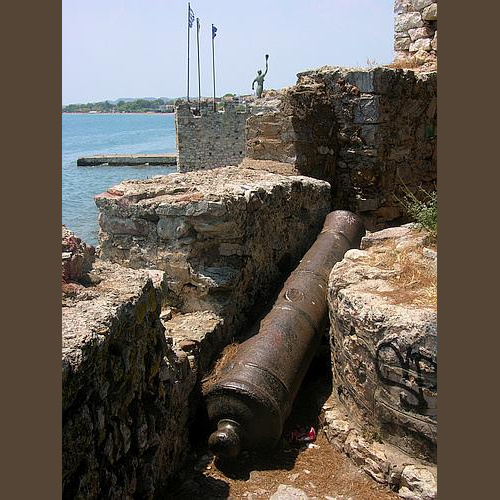
A town in Aetoloacarnania, situated on a bay on the north
coast of the Gulf of Corinth. During the
Peloponnesian war it was an important Athenian naval station. Also in the following
periods its possession was of crucial strategic importance to control access to the Gulf of Corinth. Therefore,
Navpaktos changed hands many times during the crusades and the Ottoman-Venetian wars. In the 15th century it was under
control of the Venetians who called it Lepanto. In 1499 it fell to the Ottoman Empire and was an important base of their
navy in the 16th century. Then in 1517 it was the site of the decisive victory of the major Catholic maritime states in
the Mediterranean over the fleet of the Ottoman Empire in the Battle of Lepanto. There was another short period of
Venetian control in 1687-1699, but for the rest of the time it was occupied by the Ottomans until Greek independence in
1829. - See also: site page.
nave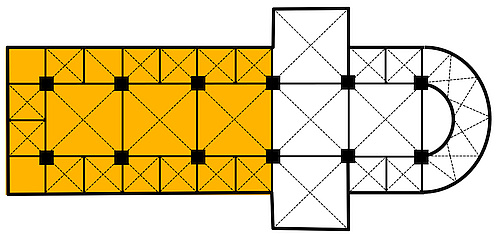
In a basilica the main body of the church between the entrance and
the chancel or the transept if it exists. The nave is the
central aisle of the church and also includes existing side aisles.
Neaira
1) A nymph, who became by Helios the mother of Lampetie and Phaëtusa.
2) A nymph, who became by Zeus the mother of Aigle.
3) A daughter of Pereus, and the wife of Aleos, by whom she became the mother of Auge, Kepheus, and Lykurgos.
4) One of the daughters of Niobe.
5) The wife of Strymon, and mother of Euadne.
necropolis
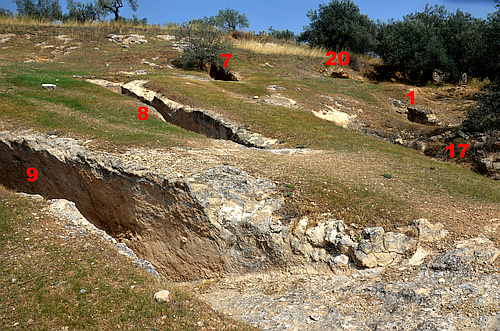
Literally "city of the dead", an ancient cemetery.
Nekromanteion
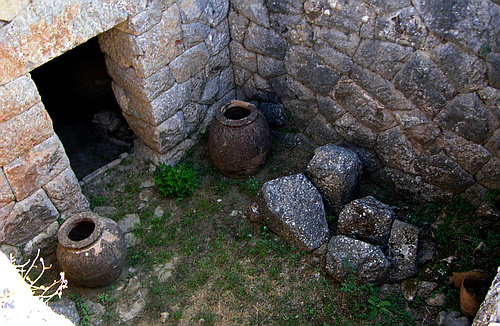
Sanctuary and oracle of the dead at the site where the rivers
Acheron, Phlegethon and
Kokytos meet. A site in Epirus, discovered in 1958 and excavated by S. Dakaris in the
following years fits the location and the descriptions given by Herodotus and
Homer, but its purpose has been questioned. - See also:
site page.
Neleus
A son of Poseidon and Tyro. Tyro was actually married to Kretheus but fell in love with the river-god Enipeus, who refused her advances. One day, Poseidon appeared to her in the appearance of Enipeus, and became by Tyro the father of the twins Pelias and Neleus. Tyro exposed the two boys on a mountain, but they were found and raised by a maid. After the death of Kretheus, the two brothers quarrelled about the succession to the throne of Iolkos. Neleus was expelled and went to Messenia, where his uncle Aphareus gave him part of his land. In many traditions, Neleus is now referred to as king of Pylos. However, it is not clear if this is the Messinian Pylos. It is more likely that Neleus resided at Kakovatos in Triphylia as stated by Strabo (see here and here). By his wife Chloris (or a woman from Thebes) Neleus became the father of Nestor, Chromios, Periklymenos, Pero, and others. - When Herakles had killed Iphitos he went to Neleus to be purified; but Neleus, being a friend of Iphitos' father Eurytos, refused. To take revenge, Herakles marched against Pylos, and slew the sons of Neleus, with the exception of Nestor. When Neleus was thus reduced to a state of defencelessness, Augeas, king of the Epeians, used the opportunity to invade the territory of Pylos, but was defeated by Nestor. Pausanias says that Neleus died at Corinth, and that he, together with Nestor, restored the Olympic Games.
Nemea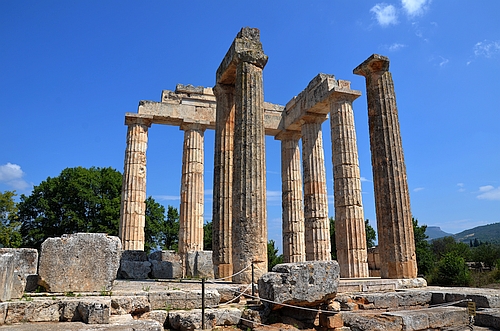
An ancient site in the northeastern part of the Peloponnese, part
of the regional unit of Korinthia. The small village of Archaia Nemea is immediately
southwest of the archaeological site, while the new town of Nemea lies to the west. - In Greek mythology, Nemea was
ruled by king Lykurgos and queen Eurydike. Nemea was
famous as the home of the Nemean Lion, killed by Herakles, and
as the place where the infant Opheltes was killed by a serpent while his nurse fetched
water for the "Seven Against Thebes". The Seven founded the
Nemean Games in his memory. The site is dominated by the mighty
temple of Nemean Zeus, constructed in 330 - 320 BC, with re-erected
Doric columns. Since 1973, the site around the temple is
excavated in annual campaigns that also unearthed the nearby stadium. The material discovered in the excavations is on
display in an on-site museum constructed as a part of the University of California's excavations. - See also:
site page.
Nemean Games
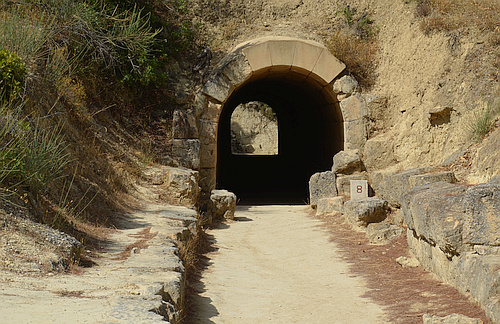
Since 573 BC, the Nemean Games were held every two years as one of the great
panhellenic games. They were instigated by the
"Seven Against Thebes" in memory of young Opheltes, who was killed by a serpent
during their visit. In these games the crown of victory was made of parsley or the wild form of celery and the judges
wore black robes, as a sign of mourning. The stadium, built around 320 BC for the Nemean Games is notable for its
vaulted entrance tunnel with ancient graffiti on the walls.
Nemean Lion
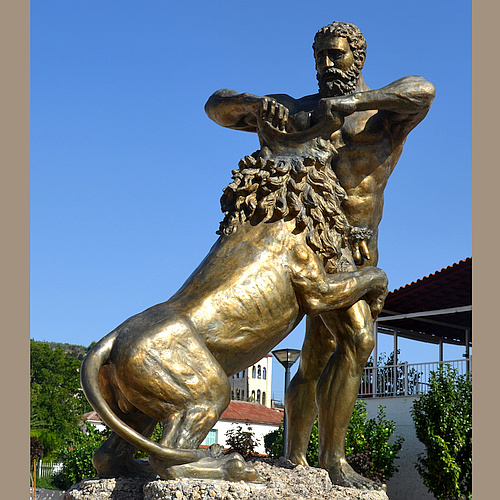
Predatory offspring of Orthos and
Echidna, sister of the deadly Theban Sphinx. In his
First Labour Herakles killed the beast. Its skin and the
club were Herakles's attributes in ancient Greek art.
Nemesis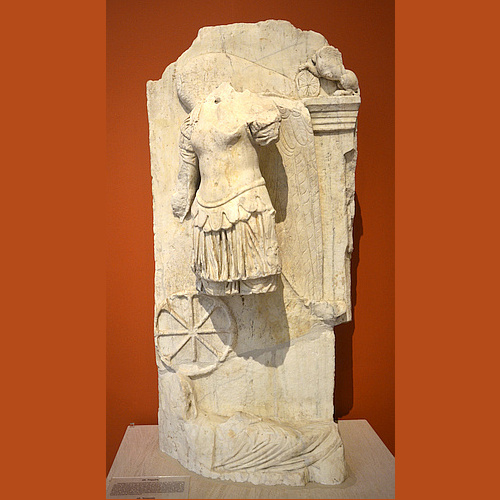
The goddess of vengeance, daughter of Nyx. She stands for law and justice,
punishing evildoers, disdaining hubris, and could also take away good fortune, granted by
Tyche, if undeserved. In art, Nemesis is sometimes depicted as a winged goddess, and
sometimes in a chariot pulled by griffins.
 Neolithic period
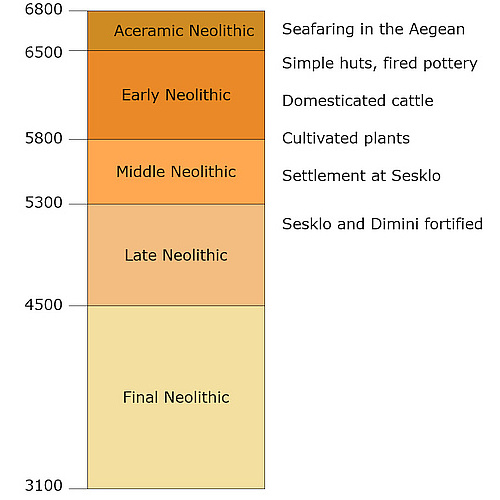
The period ca. 7000 - 3000 BC, traceable especially in mainland Greece in the region of
Thessaly. People had contacts around the Aegean, began to grow crops and raise animals.
By 3000 BC they were living in settlements with streets and houses. - The most complete Neolithic settlements in Greece
are found at Dimini and Sesklo near modern Volos.
Neoptolemos
("young warrior") A son of Achilles and Deidameia. He was also called Pyrrhus, either because he had fair (purros) hair, or because Achilles, while disguised as a girl, had borne the name of Pyrrha. Neoptolemos was brought up in Skyros in the house of Lykomedes, from where Odysseus fetched him to join the Greeks in their campaign against Troy, because it had been prophesied that Neoptolemos and Philoktetes, with the arrows of Herakles, were necessary for the taking of Troy. In the battles, Neoptolemos turned out as a hero worthy of his father, and he was one of the warriors hidden in the Wooden Horse. At the taking of the city he killed Priam at the sacred hearth of Zeus Herkeios, and sacrificed Polyxena to the spirit of his father. When the booty was distributed, Neoptolemos received Andromache, the widow of Hektor, by whom he became the father of Molossos, Pielos, Pergamos, and Amphialos. There are very different traditions about his return from Troy and subsequent events. Homer relates that Neoptolemos returned to Phthia, the kingdom of his father, and there he received Hermione, who had been promised to him at Troy. It is said that Neoptolemos was either slain at Delphi by command of the Pythia, or because of the wrath of Orestes for having been deprived of Hermione.
Nephele
1) The wife of the Thessalian king Athamas, by whom she became the mother of Phrixos and Helle.
2) A woman formed by Zeus from a cloud. She was assaulted by Ixion and became the mother of the centaur.
Nereids
The 50 daughters of Nereus and Doris who live in the sea. Most prominent of these are Amphitrite are Thetis.
Nereus
A son of Pontos and Gaia, and husband of Doris, by whom he became the father of the 50 Nereids. His empire is the Aegean sea. In Greek mythology he is described as a wise and unerring old man, living on the bottom of the sea. Like other sea divinities he was said to have prophetic powers and could appear to humans in different shapes. He plays a prominent part in the story of Herakles. According to Virgil the trident was his attribute.
Nessos
A centaur who met Herakles,
Deianeira, and their son Hyllos, when they arrived at a river. He offered to carry
Deianeira across. When Herakles, with Hyllos on his shoulders, waded through the river, Nessos tried to abuse Deianeira,
but was hit by a deadly arrow-shot from Herakles. As a revenge, the dying centaur told Deianeira that his blood was a
powerful love potion. So she secretly put some of the blood on Herakles' cloak, but it turned out to be a deadly poison,
burning away the flesh like an acid.
Nestor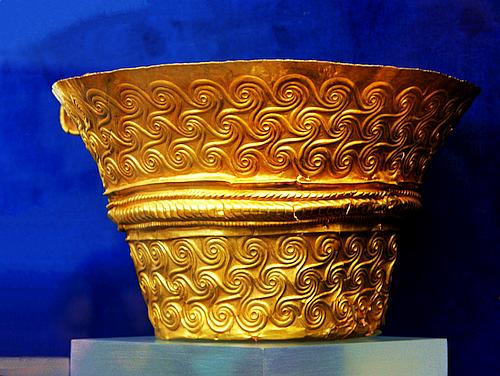
A son of Neleus and Chloris of Pylos in
Triphylia (this probably refers to Kakovatos in Eleia; see also
here), and husband of
Eurydike, by whom he became the father of Peisidike, Polykaste,
Perseus, Stratios, Aretos, Echephron, Peisistratos,
Antilochos, and Thrasymedes. When
Herakles invaded the country of Neleus, and slew his sons, Nestor alone was spared,
because had taken refuge with the Gerenians. Later, since Nestor did not take part in carrying off the oxen of
Geryon from Herakles, the latter developped friendship with Nestor and awarded him by
giving him Messenia. Here, Nestor founded his
palace. - As a young man, he was victorious in several battles, and when the Eleians laid siege to Thryoëssa,
Nestor, without the war-steeds of his father, went out on foot, and gained a glorious victory. Nestor took part in the
fight of the Lapiths against the Centaurs, and is
mentioned among the Kalydonian hunters and the
Argonauts. However, his fame is mainly based on Homer's
Ilias and Odyssey, where his role in the
Trojan War is immortalized. Together with Odysseus he convinced
Achilles and Patroklos to join the Greek campaign and
he himself sailed with his Pylians in sixty ships to Troy. Although already an old man, he fought bravely on the
battlefield, but was chiefly celebrated as a prudent advisor in the council. He managed to reconcile Achilles with
Agamemnon, who sought his advice in all difficult situations. Homer praises his wisdom,
justice, bravery, eloquence, and his knowledge of warfare. Having ruled over three generations of men, his authority was
undisputed. After the fall of Troy, he returned savely home and Zeus granted to him the full
enjoyment of old age, surrounded by intelligent and brave sons. When Telemachos
visited him to inquire about the fate of his father, he was hospitably received.
Nestor palace
--> PalaceOfNestor
Nike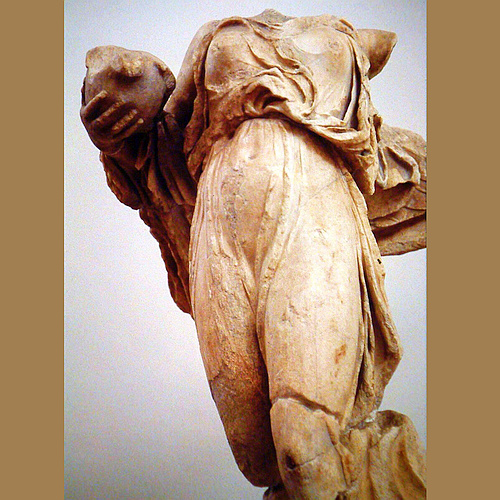
In ancient Greek mytholgy, the winged goddess of victory, who was equally evoked by warriors and
athletes. According to Hesiod, she was the daughter of the
Titan Pallas and the Okeanid
Styx. - Her most famous temple is on the acropolis of
Athens (see here).
Nikias
An Athenian politician and general (ca. 470 BC - 413 BC). He was a member of the Athenian aristocracy and had inherited a large fortune from his father. After the death of Perikles in 429 BC, he became the main rival of Kleon in the struggle for the political leadership of Athens during the Peloponnesian war. Opposing the aggressive imperialism of his opponents, Nikias was regularly elected as strategos and sought an equitable balance with Sparta. He was the driving force in the successful negotiations leading to the 'Peace of Nikias' in 421 BC. Following the peace, he objected the expansionist politics propagated by Alkibiades, the leader of the "war party". Nevertheless, he was appointed as leader of the Sicilian Expedition together with Alkibiades. There, the Athenian siege of Syracuse was nearly successful until the arrival of the Spartan general Gylippos, who turned the situation around so that the Athenians were themselves under siege. After a desperate attempt to escape and two battles, the Athenian army suffered heavy losses and surrendered; Nikias was executed by his captors.
Niobe
Daughter of Tantalos and Dione, married to king Amphion of Thebes. She was the mother of seven boys and seven girls and boasted with this to Leto, who only had two children, Artemis and Apollo. Because of this hubris, all of Niobe's children were killed by Apollo and Artemis with arrow-shots, and Niobe changed to stone.
Nisos
1) King of Megara, son of Pandion (or of Deion or Ares). One tradition relates that Skylla was a daughter of Nisos, and that he died when Minos, on his campaign against Athens, took Megara. However, the tradition at Megara itself does not mention Minos but states that Iphinoe was the daughter of Nisos and that she was married to Megareus.
2) A companion of Aeneas and friend of Euryalos.
3) One of the suitors of Penelope.
North Aegean
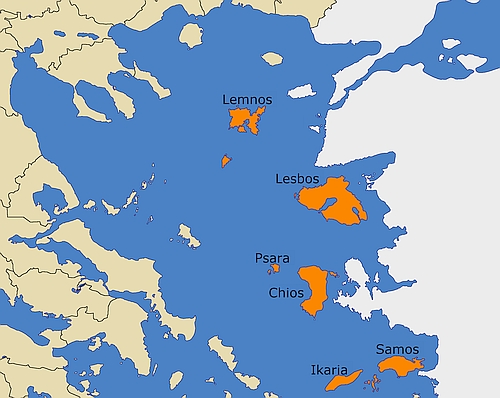
The North Aegean islands are an administrative region of Greece (3900 km2, 195,000
inhabitants) that includes the islands of Lemnos, Lesbos, Chios, Psara, Ikaria, and Samos.
Nostoi
The Nostoi (Greek for "returns") is a lost epic of ancient Greek literature, part of the Epic Cycle that relates the story of the Trojan War. In this work the return of the Greeks after the sack of Troy is described and so the story comes chronologically after the Iliou persis and is followed by that of the Odyssey.
Notos
The personification of the south wind. See also: anemoi.
Nykteus
A son of Hyrieus by the nymph Klonia, brother of Lykos and Orion, and husband of Polyxo, by whom he became the father of Antiope (in other traditions, Antiope was the daughter of Asopos). After Antiope had been impregnated by Zeus and fled to king Epopeus in Sikyon, Nykteus led the Thebans against Epopeus, but was wounded and carried back to Thebes, where he died after asking Lykos to continue the battle and take vengeance.
Nymphaion
Originally, a cave in which the nymphs were worshipped. In later Roman architecture it was a building type with composite facade, frequently multi-storeyed, arranged with niches and little temples in which statues stood. It included fountains, cisterns and water jets.
nymph
A class of numerous inferior divinities, described as daughters of Zeus. They are called to meetings of the gods in Olympos, but they are believed to live in groves, on the summits of mountains, in rivers, streams, glens, and grottoes. According to the places which they inhabit, they are called agronomoi, orestiades, and nêïades.
Nyx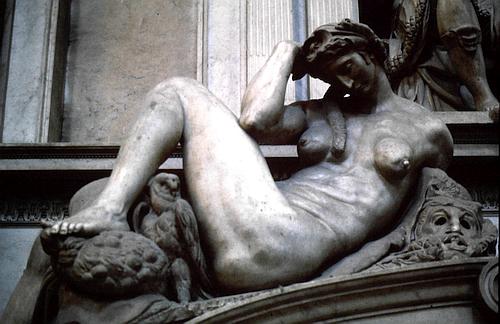
Greek goddess of the night, appearing early in the creation of the world. Personified, she is a
daughter of Chaos and mother of Hypnos (Sleep) and
Thanatos (Death). Such exceptional power was ascribed to Nyx that even
Zeus feared her.

