
GREECE
 GLOSSARY
| A | B | C | D |
| E | F | G | H |
| I | J | K | L |
| M | N | O | P |
| Q | R | S | T |
| U | V | W | X |
| Y | Z |
2026-01-21
color code:  = mythology;
 = history & culture;
  = geography;
  = archaeology &
architecture
= archaeology &
architecture
 abakus

1) (Greek: abax) A flat stone slab underneath the
entablature that forms the top of the capital of a classical
column. It provides a larger supporting surface for the
architrave that it has to carry.
2) Ancient instrument for mathematical calculations. It consists of a frame with beads on wires. The beads, assigned to different values, were shifted to accomplish complicated multiplications and divisions.
Abas
1) Twelfth king of Argos, son of Lynkeus and Hypermnestra, and grandson of Danaos. He married Okaleia, who bore him twin sons, Akrisios and Proitos. When Danaos died, he received his shield, which was sacred to Hera. He became known as a successful conqueror.
2) A son of Metaneira who was changed by Demeter into a lizard.
abaton
--> adyton
Absyrtos
Son of king Aietes of Kolchis. When the Argonauts fled from Kolchis with the Golden Fleece, he was sent after them, but was led into a trap, and killed by his half-sister Medea and Jason. The pursuing Aietes stopped to gather the pieces of his son and thus enabled the Argonauts to escape.
 Abydos
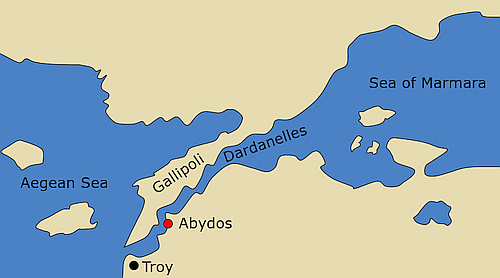
Ancient Greek city (now: Canakkale, Turkey) on the Asian side of the
Hellespont. In Greek mythology it was the home of young Leiandros who was in love
with a priestess of Aphrodite named Hero; Leiandros regularly swam
the channel at night in order to meet with Hero on the other side in Sestos but one night he lost his way and
drowned. Abydos was especially famed for the pontoon bridge that Xerxes I ordered to be
built in 480 BC when his army invaded Greece. In 334 BC the
Macedonians of Alexander the Great crossed the
Hellespont here in the opposite direction to conquer Persia.
 Academy
A suburb of Athens, named after the hero Akademos, where Plato founded his philosophical school in 387 BC that was in use until 526 AD.
acanthus
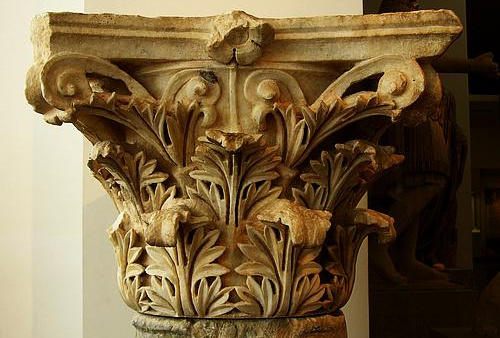
The Greek term akanthos refers to the plant Acanthus mollis, native to Mediterranean Europe.
It was stylised as decorative element of capitals in the
Corinthian order.
Achaean League
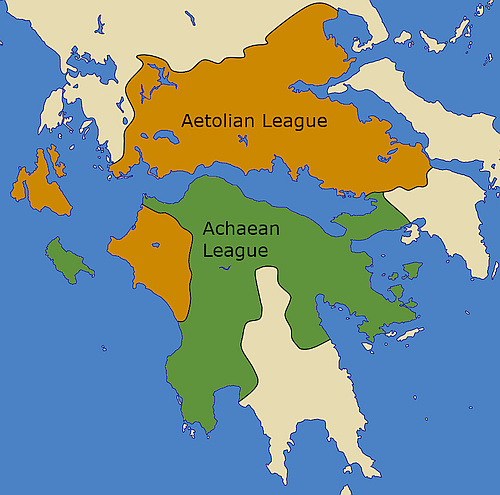
The Achaean League, or Achaean Confederacy, was a political and military coalition of
Peloponnesian cities in Hellenistic times (280 -
146 BC). It developed into the greatest power in Greece during the 2nd century BC.
Achaeans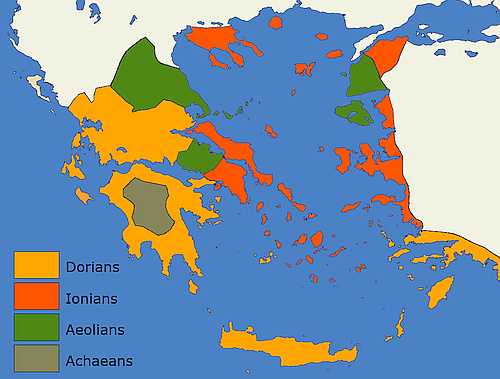
A pre-Dorian Hellenic tribe, better known as
Mycenaeans. Originally they settled in southern
Thessaly, in the Argolid and
Messenia, founding kingdoms like Mycenae with strongly fortified palaces, writing in
Linear B and producing remarkable gold jewellery. Homer
usually calls all Greeks fighting in the Trojan War Achaeans. Their civilization
reached a peak around 1300 BC and began to decline around 1100 BC with the Dorian
Invasion. - In classical Greece the Achaeans were one of the four major ethnic groups, the others being the
Dorians, the Ionians, and the
Aeolians.
Achaia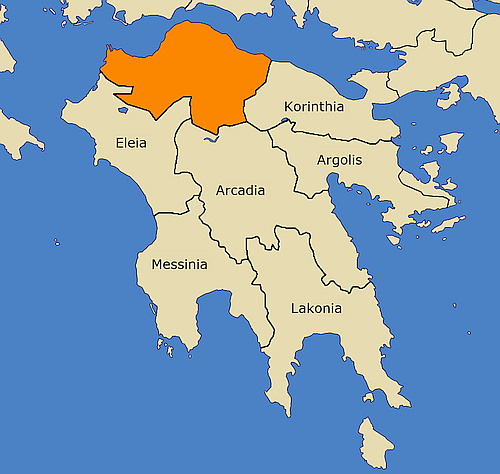
Achaia (Achaea) is a regional unit in the northwestern part of the
Peloponnese (3300 km2, 306,000 inhabitants). - See also:
site page.
Achaios
A son of Xuthos and Kreusa, and thus a brother of Ion and grandson of Hellen. The Achaeans regarded him as their ancestor and also derived the name of Achaia from him.
Acheloos
In Greek mythology a river god, son of Okeanos and Tethys, who could take the shape of a bull, a serpent, or a bullheaded man. In some accounts he is the father of the Sirens. He was defeated by Herakles.
Acheron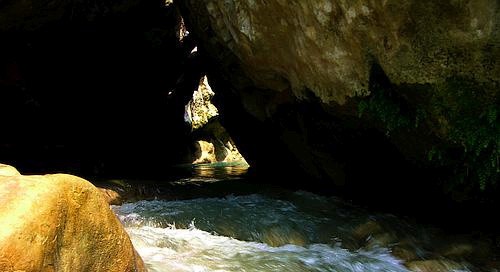
1) Mythological river in the underworld, the first one to be reached by the souls of the dead, which were ferried across by Charon.
2) A river in Epirus, passing near the
Nekromanteion, and emptying into the Ionian Sea near Parga.
Acherusia
A former lake near the Nekromanteion, mythical entrance to the underworld.
Achilles
Preeminent Greek hero in the Trojan War, son of king Peleus and the sea-goddess Thetis. Thetis tried to make Achilles invulnerable by anointing the infant in ambrosia, but before completing this process she was disturbed and therefore only the heels of Achilles remained vulnerable. Thetis had the gift of prophecy and knew that her son had two possible destinies. If he would not go to Troy he would live a long and eventless life as a farmer, forgotten soon after his death. If he decided to participate in the Trojan War he would find fame and glory. His name would be immortalised, but he would die young in battle. So, when the Greek troops gathered to sail to Troy, Thetis hid Achilles, disguised as a girl, at the court of Lykomedes. Cunning Odysseus was aware of a prediction by the seer Kalchas that Troy would only fall if Achilles took part in the campaign, saw through the disguise and so also Achilles set sail to Troy. On the way, he killed Tennes, king of Tenedos and son of Apollo, which is why the god later arranged Achilles' death. In the battles at Troy Achilles excelled as brave hero, but after a quarrel with the commanding Agamemnon withdrew from the fights. This 'wrath of Achilles' would later become the central theme of Homer's Iliad. After Patroklos, the young lover and friend of Achilles had been killed by Hektor, Achilles returned to the battlefield, avenged the death of his friend by killing Hektor, but soon after, Apollo guided an arrow, shot by Paris, to Achilles' vulnerable part, one of his heels, and he died.
Achilles Painter
The Achilles Painter (fl. ca. 460 BC - ca. 420 BC) was a significant Attic vase painter of the "red figure style". His pseudonym is derived from the outstanding depiction of Achilles on one of his vases. He is regarded as the most "classical" of all vase-painters of the Classical period in the mid 5th century. More than three hundred vases that have been found throughout the Mediterranean world have been ascribed to him.
acrolith
An acrolith (Greek: acros = "height" or "extremity" and lithos = "stone") is a composite sculpture made of stone and other materials. This could be figure whose clothed parts are made of wood (gilded or covered by drapery), while the exposed flesh parts such as head, hands, and feet are made of marble. Acroliths were widespread in Classical antiquity. - Compare: chryselephantine sculpture.
acropolis
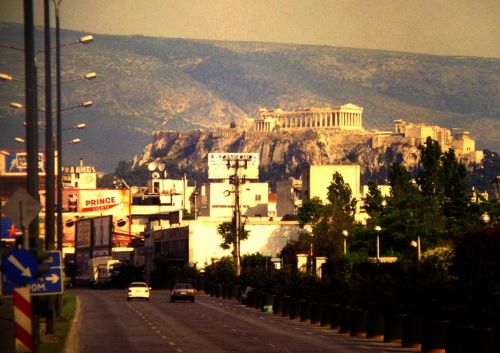
(Greek: akro = high, + polis = city) The upper part of an ancient city. Steep hills were
chosen by first settlers because they were more easy to defend. The later town developped on the surrounding lower
ground, with the most important sacred and civic buildings on the acropolis. - Speaking of "the Acropolis" without an
additional place name refers to the Athenian acropolis (-->
site page).
Actium
A promontory in Epirus, best known for the decisive naval battle on the Ionian Sea in 31 BC between Octavian and the combined forces of Mark Antony and Cleopatra. Octavian's victory consolidated his power over Rome and some years later he was was awarded the title of Augustus ("revered"), a name by which he is best known.
Admetos
In Greek mythology, Admetos ("untamed, untainable") was king of Pherai. He was one of the Argonauts and took part in the Kalydonian Hunt. - After Apollo had slain the Cyclops he had to serve a mortal for one year as punishment and he did this by working as herdsman at the court of Admetos. When Admetos fell in love with Alkestis, daughter of Pelias, he also needed the help of Apollo. Alkestis had so many suitors that Pelias set an apparently impossible task to the suitors: they should come to her in a chariot drawn by a lion and a boar. Admetos managed this with the help of Apollo and married Alkestis. The greatest aid, however, that Apollo gave to Admetos was to persuade the Moirai, after having made them drunk, to grant to Admetos deliverance from death, if at the hour of his death his father, mother, or wife would die for him. Alkestis did so, but Herakles brought her back to the upper world. - The story of Admetos and Alkestis has been told in various plays, among others by Euripides and more modern by Thornton Wilder.
Adonis
There are various myths about the ancestry but the common story is that Smyrna had neglected the worship of Aphrodite, and was punished by the goddess with an unnatural love for her father. With the help of a nurse she managed to share the bed with her father without being known to him. When her father discovered the crime and wanted to kill her she ran away and prayed to the gods to make her invisible. She was then transformed into a tree called smurna. After nine months the tree burst and Adonis appeared. When Aphrodite saw the boy she was so much charmed by his beauty that she concealed him in a chest to keep him for herself. Once, when she entrusted the chest to Persephone the latter discovered the treasure and refused to give it back. The case was brought to Zeus and he decided that Adonis should be left to himself for four months every year, during four months belong to Persephone, and four months to Aphrodite. Adonis was so fond of Aphrodite that he invested also his own four months in living with her. When he was deadly wounded during a boar chase, he had to go to the underworld but was allowed to spend six months every year with his beloved Aphrodite. - In later times the tale of Adonis, probably of Phoenician origin, was spread across all countries abround the Mediterranean.
Adrastos
King of Argos. He tried to establish his son-in-law, Polyneikos, as king of Thebes, from where he had been expelled. With six other heroes he started the campaign "Seven Against Thebes". This failed but ten years later Adrastos led the Epigoni against Thebes and captured it.
adyton
A most sacred area, an inner shrine, within the cella of an ancient
temple. Also called abaton, its name means "inaccessible" or "do not enter". It was
usually a small room or area at the farthest end of the cella from the entrance, reserved for the cult image of the
deity, oracles, priests and priestesses, but not for the general public. See also:
opisthodomos.
Aegina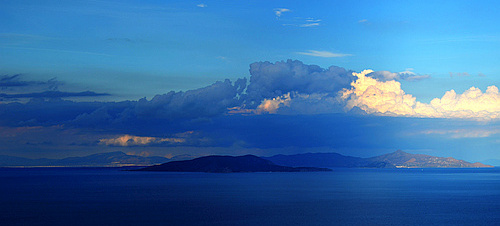
1) Island in the Saronic Gulf, about half-way between Athens and the Peloponnese (83 km2, about 10.000 inhabitants). It is especially known for its well-preserved Temple of Aphaia. - See also: site page.
2) Daughter of the river-god Asopos. Carried off by
Zeus to the island Oinone, which later was named after her. There, she bore him Aiakos.
aegis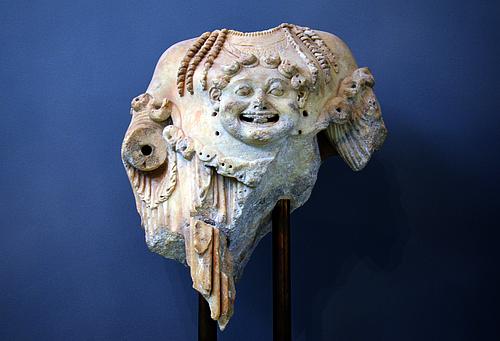
The protective shield of a religious figure in mythology. In the
Iliad it is the shield of Zeus, or of Athena. According to
Homer it was fashioned by Hephaistos and had a depiction
of Gorgo Medusa in the centre.
Aello
("Storm") One of the Harpies.
Aeneas
Trojan hero, son of Anchises and Aphrodite. His escape after the fall of Troy is handed down in the Aeneid. His son Askanios became the ancestor of Romulus and Remus, the fathers of Rome.
Aeneid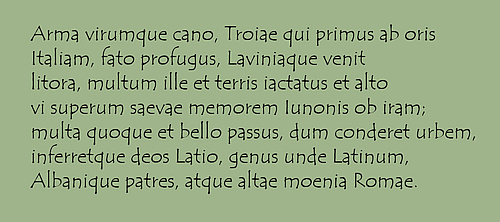
Latin epic poem by Virgil, written between 29 and 19 BC. It tells the
story of Aeneas, whom his mother Aphrodite helped to escape the
fall of Troy. He took his father Anchises on his back, his son Askanios by the hand,
and his wife Kreusa walking behind him. The Aenid describes their adventurous journey, until Aeneas safely
reaches Latium (Italy).
Aeolia
1) Region of west and northwestern Asia Minor includig islands like Lesbos.
2) --> Thessaly
Aeolian Order
A variation of the Ionic Order. It is characterized by the Aeolian column capital with a sculptured palmette between two volutes.
Aeolians
A Hellenic tribe which settled in Thessaly,
Boeotia, on the northern coast of Asia Minor and on the islands
of Lesbos and Tenedos. In classical Greece, the Aeolians were one of the four major
ethnic groups, the others being the Dorians, the Ionians,
and the Achaeans
Aerope
Wife of Atreus who had an affair with her brother-in-law, Thyestes. This led to a blood-drenched series of events.
Aether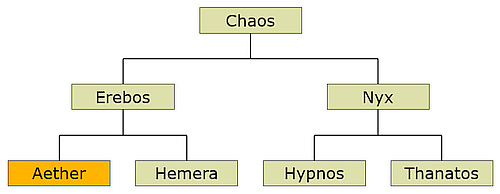
In Greek mythology the personification of the sky or the upper air breathed by the
Olympian Gods; son of Erebos.
Aetolia
An ancient Greek region north of the entrance to the Gulf of
Corinth, the eastern part of modern Aetoloacarnania. It bordered
Epirus and Thessaly in the north. - The Aetolians were not
very respected in the rest of Greece during the Classical period. They were considered
as semi-barbaric and reckless.
Aetolian League
The Aetolian League was a confederation of cities in ancient Greece centered in
Aetolia. In classical times, the League had a complex political and administrative
structure, but then gained territory and steadily developped to a serious opponent of
Macedonia and the Achaean League. During the Hellenistic
period, it emerged as a dominant state in central Greece, but in its fight against Macedonia it was driven to an
alliance with Rome, which resulted in the final conquest of Greece by the Romans.
Aetoloacarnania
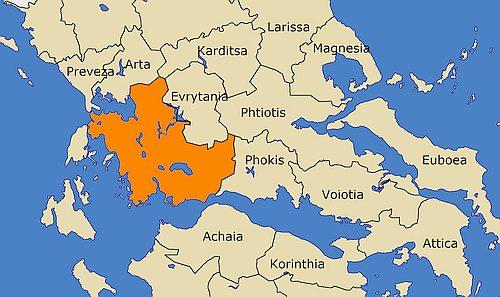
One of the regional units of Central Greece and the administrative region of West Greece. It is a
combination of the historical regions of Aetolia and Akarnania. Because of historical reasons its
capital is Mesolongi, but its biggest city and economic centre is Agrinion.
Agamemnon
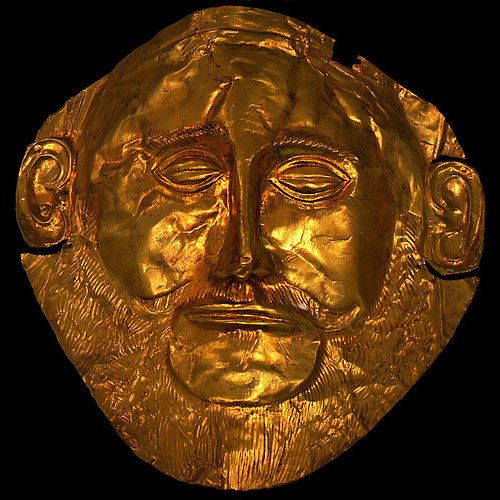
According to Homer and others a son of Atreus, ruler of Mycenae and Aerope, grandson of Pelops, and great-grandson of Tantalos. He was brought up together with his brother Menelaos and Aigisthos, the son of Thyestes, in the house of Atreus. When they had grown up, Atreus sent him and his brother to find Thyestes, with whom Atreus had a deadly feud. They found Thyestes in Delphi and brought him to Mycenae where Aigisthos was ordered to kill him. But Aigisthos recognized his father, killed Atreus instead and expelled Agamemnon and Menelaos. The brothers finally came to Sparta, where Agamemnon married Klytaimnestra, the daughter of Tyndareos, by whom he became the father of Iphigeneia, Chrysothemis, Elektra, and Orestes. There are different accounts of how he then became the king of Mycenae, but Homer relates that he had the sovereignty over a significant part of the Peloponnese.
When Helena, the wife of Menelaos, was abducted by Paris Agamemnon and Menelaos called upon all the Greek rulers for assistance against Troy. Agamemnon was chosen as their commander in chief and after two years of preparation the Greek forces assembled in Aulis. It is said that there Agamemnon killed a stag sacred to Artemis, provoking the anger of the goddess. As punishment she sent a plague to the Greek encampment and caused a perfect calm so that the ships could not depart. Seers declared that the goddess could only be soothed by Agamemnon sacrificing his daughter Iphigeneia. Odysseus and Diomedes were sent to bring her to Aulis under the pretext of a marriage with Achilles. Iphigeneia came, but at the last moment when she was to be sacrificed Artemis carried her off to Tauris. After that the winds rose again and the Greeks sailed to Troy.
In the ensuing Trojan War Agamemnon fought bravely and killed
several Trojans, but unlike Achilles in the Iliad he was not
one of the main heroes. His role was more that of a commander. After the fall of Troy he received
Kassandra, a daughter of Priam, as his prize and took her
with him to Argolis. Meanwhile at Mycenae, Aigisthos had seduced
Klytaimnestra during the absence of her husband, and during a welcoming feast
killed Agamemnon. At the same occasion Klytaimnestra murdered Kassandra. These tragic events have inspired the tragic
poets to various works.
Agapenor
In Greek mythology king of Tegea, son of Ankaios, and grandson of Lykurgos. He led sixty ships with Arcadians to the Trojan War and was one of the Greeks in the Wooden Horse. On his return from Troy he was cast by a storm on the coast of Cyprus and founded the town of Paphos.
Agathon
1) Athenian tragic poet (ca. 446 - 401 BC) whose works have been lost.
2) An ancient Greek architect (fl. 4th century BC). Together with Xenodoros he constructed the temple of Apollo at Delphi.
Agaue
1) A daughter of Kadmos, and wife of Echion, by whom she became the mother of Pentheus, who succeeded his grandfather Kadmos as king of Thebes. When Dionysos came to Thebes he enticed the women to celebrate a dionysian festival on Mount Kithairon, and Agaue joined them. Pentheus opposed the worship of Dionysos in his kingdom and went himself to Mount Kithairon to stop the orgiastic proceedings. There he was torn to pieces by his own mother and two other mainades who in their Bacchic frenzy believed him to be a wild beast.
2) One of the Nereids.
Ageladas
A celebrated sculptor from Argos (ca. 515 - 460 BC). His fame is also due to his role as instructor of three great masters: Phidias, Myron, and Polykleitos. Because of chronological problems it has been speculated that there were two sculptors of this name.
Agenor
1) Son of Poseidon and the nymph Libya. He was the father of Europa, Kadmos and Phineus.
2) According to the Iliad a son of Antenor.
3) Son of Phegeus.
Agesandros
The collective name of several sculptors from the island of Rhodos, working in the first centuries BC and AD, in a "baroque" late Hellenistic style. The famous group of "Laokoön and his Sons" in the Vatican Museums is signed by three sculptors including an Agesandros.
Agesilaos I
Agesilaos I (fl. 9th century BC) was the 6th king of the Agiad line at Sparta. He was succeeded by his son Archelaos.
Agesilaos II
Eurypontid king (ca. 444 - ca. 360 BC) of Sparta. Small in stature and lame from birth, Agesilaos somewhat unexpectedly became king in his forties. During his reign, Sparta made successful military incursions into various states in Asia Minor and had successes in the Corinthian War.
Agesipolis III
Agesipolis III (died 183 BC) was the 31st and last of the kings of the Agiad dynasty in ancient Sparta. He was elected king in 219 BC while still a minor, but soon deposed by his colleague Lykurgos.
Agiads
One of the two lines of Spartan kings. Ancient Sparta had two kings simultaneously, coming from two separate lines, the Agiads and the Eurypontids. They were believed to be descendants of the twins Eurysthenes and Prokles, sons of Herakles who, according to tradition, conquered Sparta two generations after the Trojan War. The Agiads are named after Agis I.
Agias
1) A Greek epic poet (fl. 8th century BC) from Troizen, author of the "Nostoi", which tells the history of the return of the Achaean heroes from the Trojan War.
2) An athlete who won the pankration in fourteen panhellenic games. His staue is shown in the Archaeological Museum of Delphi.
Agion Oros
--> Athos
Agis I
King of Sparta, son of Eurysthenes. The royal dynasty of the Agiads is named after him.
Agis IV
Agis IV (ca. 265 BC - 241 BC) was the 25th Eurypontid king of Sparta. He succeeded his father Eudamidas II at the age of about 20. At this time, the Spartans had greatly degenerated from the ancient simplicity and severity of manners, and arrived at an extreme inequality in the distribution of wealth and property. Since his earliest youth attached to the ancient discipline, he proposed the abolition of all debts and a new partition of the lands. This was met with different reactions, but he was betrayed by a friend and thrown into prison. The ephors then held a mock trial, in which he was quickly condemned to death and strangled. His mother Agesistrate and his grandmother were strangled on his body. - Agis was the first Spartan king to have been put to death by the ephors. Later, he was seen as an idealistic but impractical monarch.
Aglaia
(Greek: splendour) One of the Charites; she was also called Charis.
agon
An ancient Greek word denoting struggle, contest, competition.
agonothetes
In ancient Greece the president or superintendent of panhellenic games.
agora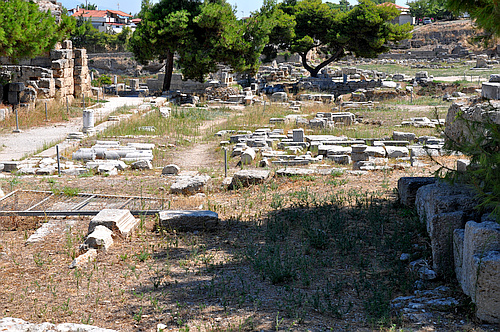
(Greek: ageiro = "I gather") In ancient Greece a large, open market or public space used for
the assembly of the citizens of a Greek city. It was the political, civic, religious and commercial center at the heart
of a polis.
Agorakritos
Agorakritos (fl. 5th century BC) was a Greek sculptor from Paros, a student of Phidias.
Agraulos
1) The wife of Kekrops, by whom she became the mother of Agraulos (2), Erysichthon, Herse, and Pandrosos.
2) A daughter of Kekrops and Agraulos (1), and mother of Alkippe by Ares. This Agraulos is an important personage with different versions in Attic tradition. According to Pausanias and Hyginus, Athena gave to her and her sisters a chest with Erichthonios covered in it, warning them not to open the chest. However, Agraulos and Herse could not resist their curiosity, opened the chest, were seized by madness at the sight of Erichthonios, and threw themselves from the steep rock of the acropolis.
Agrios
1) A son of Porthaon and Euryte, and brother of Alkathoos, Leukopeos, Melas, Oineus, and Sterope. He had six sons, one of them being Thersites. They deprived Oineus of his kingdom of Kalydon and gave it to their father, but were later slain by Diomedes, the grandson of Oineus.
2) He and Oreios were two gigantic sons born by Polyphonte after she mated with a bear. Being lawless cannibals, the gods transformed them into birds.
Aiaia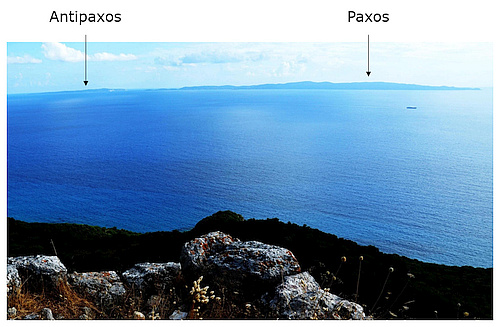
Island (also written as Aeaea) of the sorceress Kirke. Since the details
given in the Odyssey are not very clear, there have been many suggestions as to
the location of the island. They range from south of Elba to Mount Circeo in Italy, or at the Black Sea, one of the
Aeolian islands north of Sicily, or a Croation island. Recently, Tim Severin proposed the
Ionian island of Paxos (and in my humble opinion has good arguments for this).
Aiakos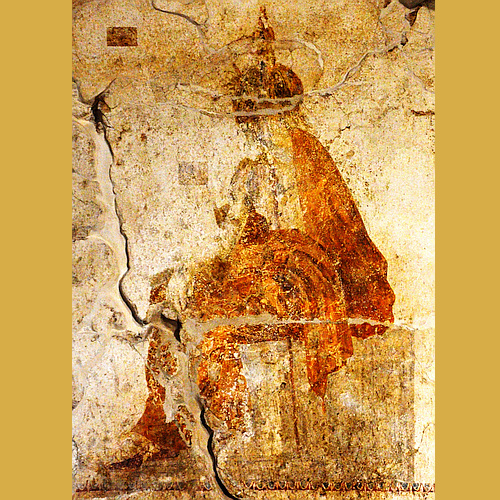
Mythological king on the island of Aegina; son of
Zeus and Aegina. By his wife Endeis he was the father of Telamon and
Peleus. When his kingdom suffered from a dreadful plague he prayed to his father Zeus and
he changed the ants of the island into people, the Myrmidones. Aiakos was widely
renowned for his just government and fair justice and therefore he was appointed after his death as one of the judges in
the underworld.
Aias
Two Greek heroes in the Trojan War; in the original myth perhaps identical.
1) ("the Telamonian") A son of Telamon, king of Salamis, by Periboia, and a grandson of Aiakos. According to Homer Aias joined the expedition of the Greeks against Troy, with twelve ships and was next to Achilles the most distinguished and the bravest among the Greeks. He is described as a huge and strong warrior, but slow in speach. He fought several times against Hektor, and they exchanged arms with one another as a token of mutual esteem. Like Achilles, Aias made excursions during the war into neighbouring countries and gained rich booty. In the contest about the armour of Achilles, he was conquered by Odysseus, and this, says Homer, became the cause of his death, although he provides no further details about this. It remains unclear if he killed himself in a fit of madness or if he was killed by others.
2) ("Aias the Lesser") The son of Oileus, king of the Lokrians. According to the Iliad he led his Lokrians in forty ships against Troy. He is one of the great Greek heroes and appears frequently in conjunction with the Telamonian Aias. He is especially skilled in throwing the spear, and, next to Achilles, the most swift-footed among all the Greeks. However, in the footrace during the funeral games of Patroklos, Athena made him stumble and fall so that her favourite Odysseus won the first prize. Returning from Troy, his vessel was wrecked, but he himself escaped upon a rock through the assistance of Poseidon, in spite of Athena, but then he uttered presumptuous words whereupon Poseidon split the rock with his trident and Aias was swallowed up by the sea.
Aietes
Son of Helios and the Okeanid Perse, father of Medea and Absyrtos; king of Kolchis. He took up the fleeing Phrixos, who then hung the Golden Fleece in the Garden of Ares in Kolchis. When the Argonauts later came to claim the Golden Fleece, Aietes demanded of Jason to fulfill seemingly impossible tasks. Jason succeeded with the help of Medea, who fled together with him, the Argonauts and the Golden Fleece. Aietes sent Absyrtos with the fleet to pursue, but Medea killed Absyrtos and cut him to pieces. When Aietes, following them, stopped to collect the pieces, the Argonauts had enough time to escape. Finally, Aietes found out that they were protected by Alkinoos and demanded of him the return of his daughter. Alkinoos refused because Medea was meanwhile married to Jason, and therefore subject to his will. In the end, Aietes was left without a son, without the Golden Fleece and betrayed by his daughter.
Aigeus
Mythical king of Athens, son of Pandion, grandson of Erichthonios. - When Aigeus visited Troizen he got princess Aithra pregnant in spite of the warning of an oracle. He left Troizen before their son, Theseus, was born, but placed a sword and a pair of sandals under a boulder for his yet unborn son. Meanwhile, Aigeus married the sorceress Medea, and when Theseus had grown up and arrived in Athens, she tried to poison him. However, Aigeus recognized the sword and the sandals, and when father and son celebrated their reunion Medea fled to Asia. - When Androgeos, the son of king Minos of Crete, attended the first Panathenaia in Athens he attracted the ire of Aigeus by winning all the prizes, and Aigeus had Androgeos killed. Minos waged war on Athens to avenge the death of his son, and peace was won only with the promise that Athens would send seven young men and seven young women every year (or every seventh year) to Minos to be killed by the bull-monster Minotauros. This tradition continued until Theseus defeated the Minotauros, but he had promised to set white sails if he should return successfully. He forgot so, and when Aigeus saw the black sails, he killed himself by throwing himself off a cliff into the sea, which from then on was called the "Aegean Sea".
Aigiale
The wife of Diomedes. When he returned from the Trojan War he found her living in adultery and was even expelled from Argos. Ovid describes her as the typical bad wife.
Aigialeus
1) A son of Adrastos. He was the only one among the Epigoni who fell in the war against Thebes.
2) A son of Inachos and the Okeanid Melia. The part of the Peloponnese which is now Achaia, was originally named Aegialeia after him. A local tradition calls him the first king of Sikyon (--> site page).
3) A son of Aietes.
Aigisthos
Aigisthos (Aegisthus) was a son of Thyestes and his own daughter Pelopeia. His mother exposed him immediately after the birth but the infant was saved by shepherds. Atreus, the brother of Thyestes, eventually found the child and raised him together with his own sons, Agamemnon and Menelaos. When they had grown up, Atreus ordered Aigisthos to find and kill Thyestes, but Aigisthos finally recognized his father and killed Atreus instead. While Agamemnon, son of Atreus, was away in the Trojan War, Aigisthos seduced Klytaimnestra, the wife of Agamemnon, and resided with her in Mycenae. When Agamemnon finally returned from Troy, Aigisthos invited him to a feast and had him treacherously murdered. Aigisthos reigned seven more years in Mycenae before Orestes, son of Agamemnon and Klytaimnestra, returned and, together with his sister Elektra, killed Aigisthos.
Aigle
1) The most beautiful of the Naiads, daughter of Zeus and Neaira. By Helios she became the mother of the Charites.
2) A daughter of Helios and Klymene. In her grief at the death of her brother Phaëton she and her sisters were changed into poplars.
3) One of the Hesperides.
4) A nymph, daughter of Panopeus, who was beloved by Theseus.
5) One of the daughters of Asklepios by Lampetie, the daughter of Helios, or by Epione. Her name Aigle, "brightness," or "splendour," refers to the beauty of the healthy human body, or to the honour paid to the medical profession.
Aigospotamoi
The ancient name of a small river in Thracia, the site of the "battle of Aigospotamoi" (405 BC). In this final battle of the Peloponnesian War the Athenians were decisively defeated by the Spartans and lost their navy. This lead to the siege and fall of Athens.
Aigyptos
Mythological king of Egypt, twin brother of Danaos. Father of fifty sons, one of them being Lynkeus.
Ainesidemos
A Greek skeptical philosopher of the first century BC, born in Knossos. He was probably a member of Plato's Academy, but rejected their teachings and revived the principle of epoché, or suspended judgement, originally proposed by Pyrrho and Timon, becoming an advocate of pyrrhonism. His main work, the Pyrrhoneia discusses the reasons for skepticism and doubt, as well as arguments against causality and truth. However, none of his works have survived.
Aiolos
There are different mythological personages of this name, some of whom may or may not be identical.
1) Son of Poseidon and god of the winds. He lived on the swimming island Aiolia, where one day he was visited by Odysseus. The god gave him a bag with all the strong winds and warned him, not to open the bag. The companions of Odysseus did and caused their shipwreck. - Other wind gods were Boreas (north wind), Zephyros (west wind), Notos (south wind), and Euros (east wind).
2) Son of Poseidon and Arne, the daughter of another Aiolos (No. 4). Arne told her father that she was pregnant by Poseidon, but he did not believe her and sent her to Metapontion in Italy. There she became mother of Boiotos and Aiolos (No. 2). When the two boys had grown up they took possession of Metapontion by force, but had to flee afterwards. Aiolos went to some islands in the Tyrrhenian sea which were then named Aeolian islands after him.
3) A son of Hellen and the nymph Orseis. He was king of Thessaly and ancestor of the Aeolians. By his wife Enarete he became father of Sisyphos, Athamas, Kretheus, and Salmoneus.
4) According to Diodorus this Aiolos was the great-grandson of a first Aiolus (No. 3).
Aipytos
1) The youngest son of the Heraklid Kresphontes, king of Messenia, and of Merope. Kresphontes and his other sons were murdered during an insurrection, and only Aipytos escaped. The throne was then occupied by the Polyphontes, who also forced Merope to become his wife. But when Aipytos had grown up, he returned to his kingdom, and killed Polyphontes and the muderers of his father.
2) Mythical king of Arcadia. His tomb was mentioned in the Iliad and still shown in the time of Pausanias.
3) King of Arcadia, a great-grandson of the Aipytos (2) above. During his reign Orestes, due to an oracle, settled in Arcadia. Aipytos was succeede by his son Kypselos on the throne.
Aischines
1) Athenian rhetorician (389 - 314 BC) and statesman, considered as one of the ten greatest Attic orators. He was a opponent of Demosthenes.
2) ("Aischines Sokratikos"; ca. 425 BC - ca. 350 BC), follower of Sokrates.
Aischylos
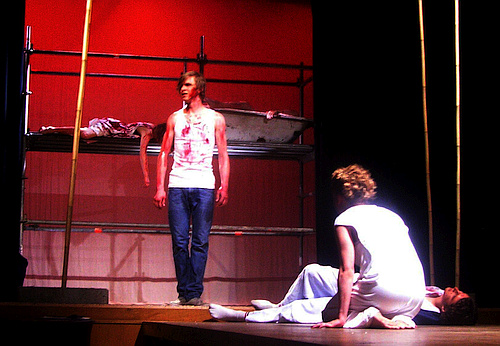
Ancient Greek playwright, recognized as the founder of tragedy, and
its most important representative, followed by Sophokles and
Euripides. He was born in Eleusis in 525 BC, was
initiated into the Eleusinian Mysteries, and fought in the
Persian Wars: 490 BC in Marathon and again 480 BC in
Salamis. His great fame is however due to his 70-90 plays, most of which he presented at
the dramatic competions of Athens' Dionysia. Thirteen times
Aischylos won the first prize with his works, but only a few of his tragedies have survived into modern times: "The
Persians" (472 BC), "Seven against Thebes" (467 BC), "The Suppliants" (463 BC), "The Oresteia" (458 BC; the only fully
preserved trilogy and probably his greatest work), and "Prometheus Bound" (authorship and date uncertain, but very
probably his latest tragedy). His work had a paramount influence not only on ancient Greek
drama but still has substantial importance until today. - Aischylos died in 455 BC when he visited Sicily a last
time. There is a legend that an eagle mistook his bald head for a stone and dropped a tortoise on it.
aisle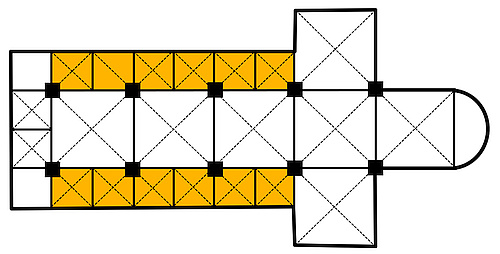
Oblong space along the length of the cella of a Greek
temple or of the interior of a Christian basilica. It is
delimited by a row of columns or pillars.
Aison
Son of king Kretheus of Iolkos; father of the hero Jason. After his father's death, Aison was supposed to become the rightful king of Iolkos, but his half-brother Pelias usurped the throne and sent Jason on the quest for the Golden Fleece.
Aisopos
A Greek story teller credited with the tales known as Aesop's Fables. In many of these tales animals and speaking inanimate objects appear that have human characteristics and solve problems. No writings by him have survived and his historicity is uncertain. In the accounts, which may be highly fictional, he is described as an utterly ugly slave who by his cleverness acquires freedom and even becomes an adviser to statesmen.
Aithalides
A son of Hermes and Eupolemeia. He was the herald of the Argonauts, and had received from his father the faculty of remembering everything, even in Hades.
Aithiopis
The Aithiopis is a lost epic of ancient Greek literature and belongs to the Epic Cycle. The poem consisted of five books of verse in daktylic hexameter. Relating the Trojan War, the story comes chronologically immediately after that of Homer's Iliad, and is followed by that of the Little Iliad. The Aithiopis was probably written in the seventh century BC, but there are also indications that it might be a later date.
Aithra
Princess of Troizen on the Peloponnese. She was impregnated by Aigeus, but he left her and went back to Athens before their son Theseus was born.
Aitolos
In ancient Greek mythology a son of Endymion, and grandson of Deukalion. He is said to be the mythical founder of Aetolia according to the following tradition. With his wife Pronoe he had two sons, Pleuron and Kalydon. After the death of Endymion, his brother Epaios took over the reign in Elis, and when he also died, he was followed on the throne by Aitolos. However, at the funeral games, he rsn with his chariot over Apis, son of Jason, and killed him. Therefore, Aitolos was expelled by the sons of Apis, left the Peloponnese and went to the country north of the Gulf of Corinth. There he slew Apollo's sons Doros, Laodokos, and Polypoetes, colonized the country and gave it the name Aetolia.
Ajax
--> Aias
Akamas
1) Son of Theseus and Phaidra. Virgil mentions him among the Greeks concealed in the wooden horse at the taking of Troy. After his return home he was killed by the bite of a snake (or he fell from his horse upon his own sword).
2) Son of Antenor and Theano, was one of the bravest Trojans in the Trojan War. With his brother Archelochos and his cousin Aeneas, Akamas led the Dardanian forces. He avenged the death of his brother, who had been killed by Aias, by slaying Promachos. He himself was slain by Meriones or Philoktetes.
3) One of the leaders of the Thracians in the Trojan War, slain by the Telamonian Aias.
Akarnan
He was a son of Alkmaion and Kallirhoe, and brother of Amphoteros. Their father was murdered by Agenor and Pronoos, the sons of Phegeus, when they were still very young. Kallirhoe prayed to the gods to make her sons grow quickly, so that they were able to avenge the death of their father. The wish was granted, and Akarnan with his brother slew Phegeus, his wife, and his two sons.
Akastos
Son of Pelias; cousin of Jason, whom he joined in his quest for the Golden Fleece. After the death of his father, he seized the throne of Iolkos and expelled Jason and Medea.
Akoites
According to Ovid the son of a poor fisherman who served as helmsman on a ship. After landing on the island of Naxos the sailors brought with them a handsome sleeping boy and intended to take him them. Akoites recognized in the sleeping boy the god Dionysos and objected, but the others did not listen to him. When they were out on the open sea the boy awoke and wished to be brought back to Naxos. The sailors agreed but did not keep their promise. Hereupon, Dionysos appeared in all his majesty, vines grew around the ship and lions appeared. The sailors, struck with madness, jumped into the sea and drowned. Only Akoites survived, brought the god back to Naxos, where he was initiated in the Dionysic mysteries and became a priest of the god.
Akrisios
Son of Abas, grandson of Lynkeus and great-grandson of Danaos. His twin-brother was Proitos, with whom he is said to have quarrelled already in the womb of his mother. When Abas died and Akrisios had grown up, he was forced to give Tiryns to Proitos, while he retained Argos for himself. Since an oracle had declared that Danaë, the daughter of Akrisios, would give birth to a son, who would kill his grandfather, Akrisios kept his daughter shut up in a subterranean brass cage. But Zeus came to her in the form of a golden shower and so Perseus was perceived. When Akrisios discovered that Danaë had given birth to a son, he threw both into a chest, and put them out to sea. However, Zeus caused the chest to land on an island where a fisherman saved mother and child. Later, during some games, the wind carried a disk thrown by Perseus against the head of Akrisios and killed him. - He is said to have founded the Delphic amphictyony, or more probably, to have reformed the already existing amphictyony.
akroterion
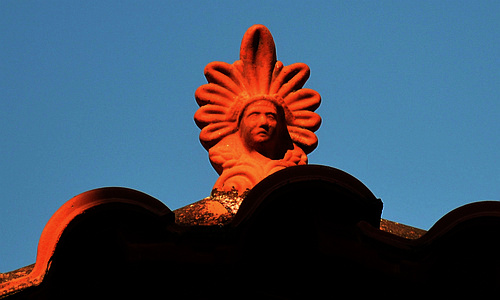
An ornament placed on a plinth (acroter) at the apex or at the outer angles of the
pediment of a building in the Classical style. Its form
may be a palmette, a figure or any other sculpted feature.
Aktaion
Son of Aristaios and Autonoe, the daughter of king Kadmos of Thebes. He was a great hunter and one day sees Artemis bathing naked in a lake. Thereupon Artemis turned him into a hart and he was torn apart by his own dogs.
Akté
The name of the Athos peninsula in classical times.
alabastron
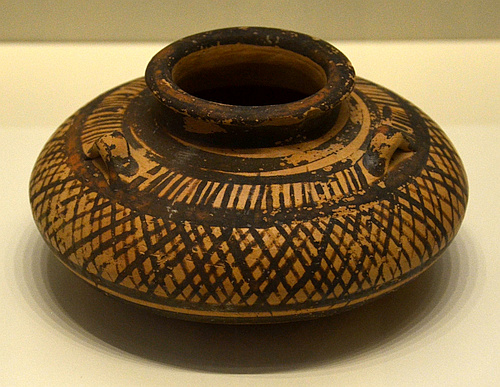
A small type of pottery or glass vessel used in the ancient world for holding oil, especially
perfumes. Originally, it was produced in Egypt since the 11th century BC from alabaster and spread from there to Greece
and other parts of the ancient world. Unlike the one shown here most alabastrons have a narrow body. They were often
left without handles.
Aleos
King of Tegea in Arcadia, and married to Neaira. He is said to have founded the town of Alea and the first temple of Athena Alea at Tegea.
Alexander II
Alexander II was king of Macedon in 371 - 369 BC, after the death of his father Amyntas III. Being quite young when he ascended the throne, the enemies of the dynasty saw their chances and attacked, but were defeated by Alexander with the help of the Athenian general Iphikrates. He then intervened in a civil war in Thessaly but when he gained control of Larissa, the Theban general Pelopidas drove him back and favoured the ambitions of Alexander's brother-in-law Ptolemaios of Aloros
Alexander the Great
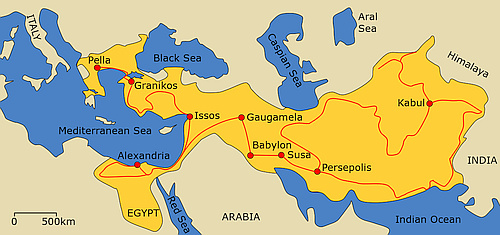
Alexander III (356 - 323 BC), king of Macedonia, was one of the
greatest military commanders in history. He was a son of Philip II of Macedon and his
wife Olympias. Until the age of 16 he was tutored together with other sons of noble
Macedonian families by Aristotle. After the assassination of his father he succeeded to the
throne in 336 BC at the age of 20, but he had to repeat the unification of the various Greek
city-states for which he did not refrain from using brute force. Having established himself as hegemon of an
anti-Persian league he started his campaign to conquer the Persian Empire in 334 BC. Within a few years he subdued not
only Persia including Anatolia, but also Syria, Phoenicia, Judea, Gaza, Egypt, Bactria and Mesopotamia, extending his
empire as far as into India, encompassing most of the world known by then. Exhausted by years of campaigning,
Alexander's troops mutinied before crossing the river Ganges and the army retreated to Babylon. Here, Alexander died in
323 BC perhaps by being poisoned. - By integrating non-Macedonians into his army he followed a policy of fusion. In this
sense he also encouraged marriages between members of his army and foreigners, and practiced it himself. Furthermore,
Alexander adopted some oriental customs like the proskynesis at his court,
rejected by many Greeks who saw it as indication of Alexander's attempts to deify himself. - The spread of Greek
language, culture, and population into Alexander's empire led to a Hellenization, but this was accompanied by an
opposite Orientalization of the successor states. Under the rule of the diadochi the
Macedonian empire finally fell apart.
Alexander IV
Alexander IV (323 - 309 BC) was the son of Alexander the Great (Alexander III of Macedon) and princess Roxana. He was born after the death of his father and then, together with his mother, Antipater brought them to Macedonia, where they were protected by Olympias, the mother of Alexander the Great. In 316 BC, when Olympias was assassinated, Kassandros controlled Macedonia and sought kingship. He had Alexander IV, the legitimate heir to his father's empire, and Roxana imprisoned in the citadel of Amphipolis and had them secretly poisoned in 309 BC.
Alexandria
Founded araound a small Egyptian village in 331 BC by Alexander the Great, Alexandria developped into an important center of the Hellenistic civilization, best known for its lighthouse (Pharos), one of the Seven Wonders of the Ancient World (destroyed by earthquake in 1303), and its Great Library, the largest in the ancient world (partly destroyed by fire in in 48 BC). Alexandria remained the capital of Hellenistic and Roman and Byzantine Egypt for almost 1000 years. Today, it is the second largest city and a major economic centre in Egypt.
Alia
--> Halia
 Alkaios
1) Mythical king of Tiryns; a son of Perseus and Andromeda, married to Hipponome, by whom he became the father of Amphitryon and Anaxo.
2) According to Diodorus the original name of Herakles, given him on account of his descent from Alkaios, the son of Perseus.
3) According to Diodorus a general of Rhadamanthys, who presented him the island of Paros.
4) A son of Herakles by a female slave of Iardanes, from whom the dynasty of the Heraklids in Lydia were believed to be descended.
5) Aeolian poet (ca. 600 BC) from Mytilene on Lesbos, contemporary of Sappho.
Alkathoos
1) A son of Pelops and Hippodameia, brother of Atreus and Thyestes. Pausanias relates that Megareus, king of Megara, offered his kingdom and his daughter Euaichme to him, who should slay the Kythaironian lion that had killed his son Euippos. Alkathoos succeeded in this task, married Euaichme and became king of Megara. It is said that he was assisted by Apollo in his efforts to restore the walls of the city.
2) A son of Porthaon and Euryte, who was slain by Tydeus (or Diomedes).
3) Husband of Hippodameia, the daughter of Anchises and sister of Aeneas. He was one of the Trojan leaders in the Trojan War, known as one of the bravest. He was slain by Idomeneus after Poseidon struck him with blindness.
Alkestis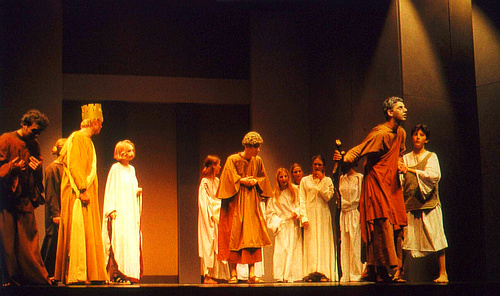
Daughter of king Pelias of Iolkos. She
married Admetos. Following an arrangement that Apollo made with the
Moirai, Alkestis volunteered to die in the place of her husband, but was rescued by
Herakles and brought back to the land of living. - The sacrifice of herself for
Admetos was highly celebrated in antiquity. It was the subject of a tragedy by
Euripides in 438 BC and of a modern version by Oscar Wilde.
Alkibiades
Athenian politician and general (ca. 450 - 404 BC). He was brought up in the house of his relative Perikles, a disciple of Sokrates, and became one of Athens' most admired and controversial personalities. During the Peloponnesian War he changed the sides several times. In Athens he advocated an aggressive foreign policy and was a promiment supporter of the Sicilian Expedition, but when his political opponents brought charges of sacrilege against him, he fled to Sparta, where he served as a strategic adviser and organized several major campaigns against his hometown Athens. But he made influential enemies also in Sparta and fled from there to Persia, where he advised the Achaemenid military. His political allies in Athens then managed his recall and he served again as an Athenian strategos for several years, before enemies eventually succeeded in exiling him a second time.
Alkinoos
Mythological king of the Phaiakians, father of Nausikaa. According to the Odyssey, Odysseus was brought to his house as an unknown castaway, friendly welcomed by Alkinoos and his wife Arete. When Odysseus then revealed his identity he was given a ship that brought him home to Ithaka. - Alkinoos is also known for giving sanctuary to the Argonauts when they were pursued by Aietes.
Alkmaeonids
A powerful noble family of ancient Athens, a branch of the Neleides who claimed descent from Nestor.
Alkmaion
Son of Amphiaraos and Eriphyle, one of the Epigoni. He took revenge for his father's death by killing his mother. He was first married with Arsinoe, then with Kallirhoe. When he took back Harmonia's cursed necklace from his first wife Arsinoe he was killed by her brothers.
Alkmene
Wife of Amphitryon, but just before they got married Zeus came to her in the guise of Amphitryon and seduced her. From Zeus she conceived Herakles and from Amphitryon she conceived Iphikles.
Alkmenes
The 9th king (ruled ca. 740 - ca. 700 BC) of the Agiad dynasty of Sparta, succeeding his father Teleklos. He was a commander in the expedition against Ampheia, which began the First Messenian War, but died before its 4th year.
Alkyone
1) One of the Pleiades.
2) A Thessalian princess who married Keyx. Ovid and others recount the story that when Keyx was at sea he was killed in a shipwreck. When Alkyone learned of his death, she threw herself into the sea. The gods, out of compassion, turned both into "halcyon birds" (common kingfishers), named after her.
3) There are six more mythological personages of this name.
Alkyoneus
1) A giant, who controlled the Isthmus of Corinth at the time when Herakles drove away the oxen of Geryon. The giant threw a huge block of stone, crushing twelve waggons and twenty-four men, but Herakles parried the attack and slew Alkyoneus. - The block, which the giant had thrown, was shown on the Isthmus down to a very late period.
2) A youth of Krissa in Phokis, the son of Diomos and Meganeira. When the monster Sybaris was ravaging the countryside, he was to be sacrificed to the beast. The hero Eurybaros loved him and volunteered to go in his place.
Alkyonides
The daughters of the giant Alkyoneus. Their names are Alkippe, Anthe, Asteria, Drimo, Methone, Pallene, and Phthonia. After their father's death, they threw themselves into the sea, and were metamorphosed into ice-birds.
Alpheios
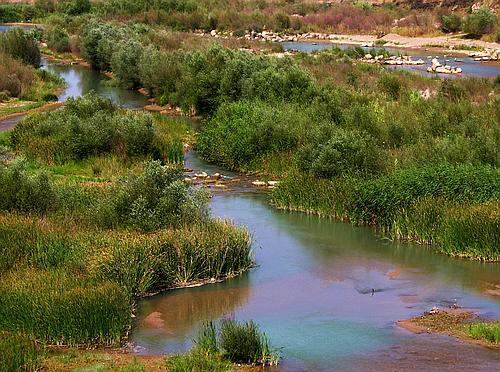
1) With a length of 110 km it is the longest river in the Peloponnese, flowing through the regional units of Arcadia and Eleia before it emties into the Ionian Sea. - In Greek mythology it was one of the rivers that Herakles redirected to clean the Stables of Augeas as his Fifth Labor.
2) The god of the river Alpheios was a son of Okeanos and
Tethys. He fell in love with the nymph
Arethusa, but she fled from him and metamorphosed into a well on the island of
Ortygia, Sicily.
altarpiece
A painted or sculptured panel, situated above and behind an altar.
Althaia
A daughter of the Aetolian king Thestios and Eurythemis, and sister of Leda, Hypermnestra, Iphikles, and others. By her husband Oineus, king of Kalydon, she became the mother of Toxeus, Thyreus, Klymenos, and Meleagros, and of two daughters, Gorge and Deianeira. She is best known because of the tragic fate of her son Meleagros, which made her kill herself.
altis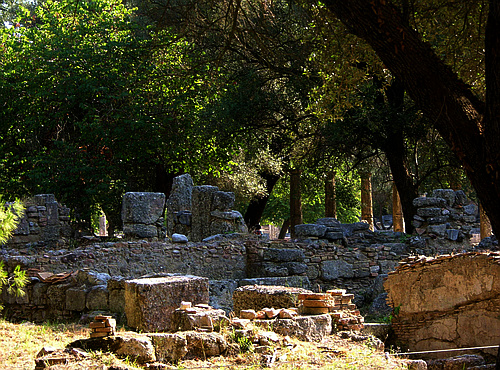
Sacred precinct in Olympia.
Alyattes
Alyattes, king of Lydia (619 - 560 BC), was considered to be the founder of the Lydian empire. After fighting the Greek colony of Miletos for several years he turned against the Medes and Babylonians. There is also a not very reliable account of the Battle of Halys reportedly ended when a solar eclipse occured on May 28, 585 BC. Historically confirmed is however his conquest of several Ionian cities.
Alyzeus
A son of Ikarios and brother of Penelope and Leukadios. After his father's death, he reigned Akarnania together with his brother.
Amaltheia
There are many very differing accounts of Amaltheia. The most popular one is that she was a nymph, daughter of the Cretan king Melisseus, who fed the infant Zeus with the milk of a goat. One day the goat broke one of its horns, or it was broken by Zeus who gave it to the daughters of Melisseus and endowed it with such powers that whenever the possessor wished, it would instantaneously be filled with whatever might be desired. This is the origin of the horn of plenty or cornucopia, in later tradition the symbol of plenty in general.
Amazon
Amazons were mythical female warriors, believed to live in the area of the Black Sea. Only once every year they had contacts to men of neighboring tribes in order to preserve their people. Only girls were brought up, boys being expelled. Under the command of Penthesilea they fought in the Trojan War on the side of the Trojans.
amazonomachie
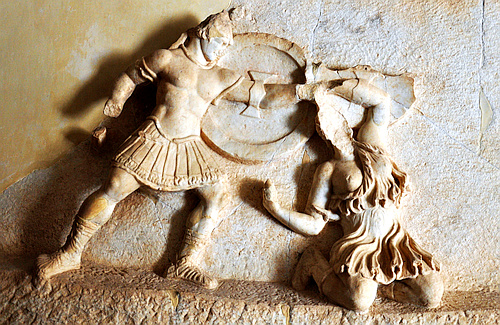
The battle between Greeks and Amazons. It was a very popular theme in Greek
art.
ambo
In Early Christian and Byzantine churches a stone-built circular or polygonal exedra from where sermons were delivered.
ambrosia
Ambrosia ("immortality") is sometimes the food or drink of the Olympian Gods. In Greek mythology it bestows longevity or immortality upon whoever consuming it.
ambulatory
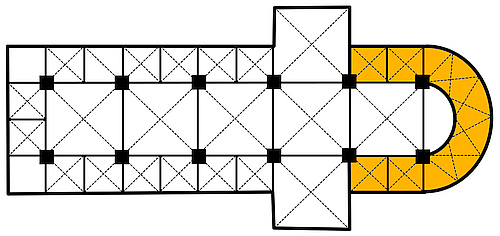
The ambulatoryis a covered walkway. It is especially the passageway around the
apse and the choir of a church.
Amphiaraos
A son of Oikles and Hypermnestra, on his father's side descendant of the famous seer Melampus. Amphiaraos himself was a renouned seer and hero: he took part in the Kalydonian Hunt and was one of the Argonauts. He reigned Argos for some time together with Adrastos, and the latter gave him his sister Eriphyle in marriage. By her, he became the father of Alkmaion, Amphilochos, Eurydike, and Demonassa. When Adrastos summoned him to join the expedition of the Seven Against Thebes, Amphiaraos foresaw its failure but was persuaded by his wife to take part. Eriphyle took this step because she had been bribed by Polyneikos, who gave her the necklace of Harmonia. Before Amphiaraos left Argos he requested his sons to avenge his death on their heartless mother. When during the war against Thebes Tydeus was severely wounded by Melanippos and Athena was on the point to render him immortal, Amphiaraos cut off the head of Melanippos and gave Tydeus his brains to drink, whereupon Athena was horrified and withdrew. In the end, only Adrastos and Amphiaraos survived of the attacking heroes, Amphiaraos being pursued by Periklymenos. When Amphiaraos fled towards a river he was, by the command of Zeus, swallowed up by the earth. Zeus made him immortal and he was thenceforth worshipped as hero in all parts of Greece.
amphictyony
(From Greek amphiktyones, "dwellers around") In ancient Greece an association of neighbouring states formed around a religious centre. The most important was the Delphic Amphictyony.
Amphiktyon
A son of Deukalion and Pyrrha. He usurped the throne of Attica where he reigned for twelve years until he was overthrown by Erichthonios.
Amphilochos
1) A son of Amphiaraos and Eriphyle, and brother of Alkmaion. When his father joined the Seven Against Thebes he was still an infant, but ten years later he was one of the Epigoni, and he also helped his brother to kill their mother. He was one of the suitors of Helena and took part in the Trojan War. When he returned to Argos he was not satisfied with the state of affairs and founded the town of Mallos in Cilicia together with Mopsos, a seer like himself. Since they could not agree on a sharing of power they fought a single combat in which they killed each other. However, there are very differing narratives of Amphilochos' time after the Trojan War.
2) There are two other mythological persons of this name.
Amphion
Mythical musician of Thebes, son of Zeus and Antiope. He and his twin brother Zethos were exposed on a mountain after their birth. Hermes gave Amphion a lyre, taught him to play upon it, and it is said that when he played the stones moved of their own accord. When their mother had been treated cruelly by Lykos, usurping king of Thebes, and her wife Dirke, she informed her sons of their parentage and summoned them to help. The brothers attacked, slew Lykos and tied Dirke with her hair to a bull and let him drag her until she was dead.
amphiprostyle
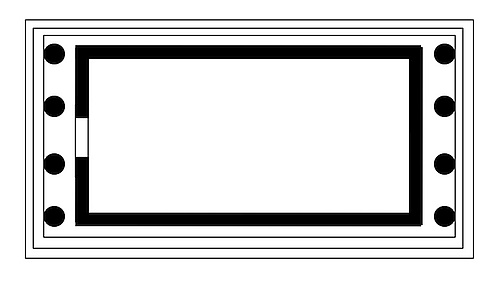
Similar to a prostyle temple, but
amphiprostyle refers to a construction with columns on both the narrow sides of the
temple.
amphitheatre
A circular architectural structure with rising tiers of stone seats. It was used in the Roman period for circus events and fights of gladiators. - The Greek counterpart is the theatre.
Amphitrite
Daughter of Nereus and Doris according to one version of the mythos. Married to Poseidon, mother of Albion, Benthesicyme, Charybdis, Rhode, and Triton. Like his brother Zeus, Poseidon had many affairs with mortal women and nymphs. But unlike Hera, Amphitrite apparently was not jealous and vindictive, but came along with Poseidon's children by other women, especially with Theseus.
Amphitryon
In Greek mythology son of Alkaios, married to Alkmene.
amphora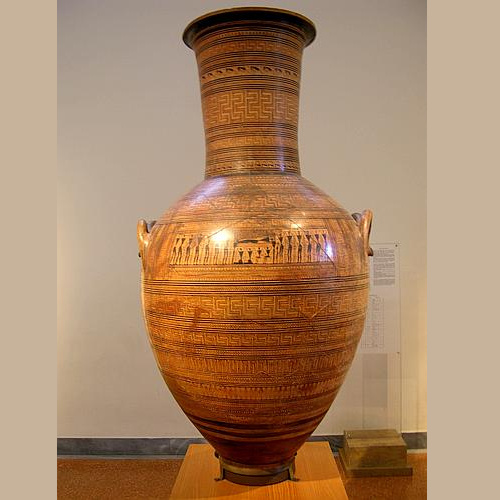
A container, usually ceramic, for the transportation and storage of olive oil or other liquids,
especially wine. Amphorae have a characteristic shape with a pointed bottom and two handles. They were produced on an
industrial scale, mostly plain in appearance, while those used for votive purposes would be decorated with figures.
Some well preserved amphorae still contain traces of the original contents, giving valuable clues to ancient diet. In
contrast to the much larger pithoi, amphorae typically held less than 50 kg.
Amyklas
A son of Lakedaimon and Sparta, and father of Hyakinthos by Diomede. He was a king of Lakedaimonia.
Amyntas III
Amyntas III (died 370 BC) is considered the founder of the unified Macedonian state and was its king from 393 to 370 BC. Since his kingdom was permanently threatened by the Illyrians he allied with the Chalkidian League led by Olynthos. In return, Amyntas granted them rights to Macedonian timber, which was sent to Athens to help enlarge their fleet. Bothered about the growing power of Olynthos, Amynthas sought new allies and established relations with Kotys. The latter had just married his daughter to the Athenian general Iphikrates, whom Amyntas soon adopted as his son. After 387 BC, Amyntas sought Spartan support and in 379 BC they eagerly helped to destroy Olynthos, which was backed by Athens and Thebes, rivals to Sparta for the control of Greece. With Olynthos neutralised, Amynthas was now free to conclude a treaty with Athens and keep the timber revenues for himself. - About 390 BC, Amynthas married Eurydike, by whom he became the father of three sons, all of whom became kings of Macedonia one after the other, and a daughter: Alexander II, Perdikkas III, Philip II (father of Alexander the Great), and Eurynoe.
Amyntor
In ancient Greek mythology, Amyntor ("defender") was a son of Ormenos of Eleon in Thessaly. Autolykos broke into his house and stole the beautiful helmet, which Meriones later wore in the Trojan War. Amyntor was the father of Krantor, Euaimon, Astydameia, and Phoinix. When Amyntor forsook his wife, Hippodameia, for Phthia, Hippodameia out of jealousy encouraged her son Phoinix to have sex with his father's concubine. Thereupon, Amyntor called upon the Erinyes to curse Phoinix with childlessness and expelled him. According to a later tradition, Phoenix was falsely accused by Amyntor's mistress and was blinded by his father, but Cheiron restored his sight. - Ovid relates that Amyntor took part in the Kalydonian Hunt, and was king of the Dolopes. When conquered by Peleus, king of Phthia, Amyntor gave Krantor to Peleus as a pledge of peace. - When Amyntor refused Herakles permission to pass through his dominions, Herakles killed him and later fathered a son, Ktesippos, by Amyntor's daughter Astydameia.
Amythaon
King of Pylos in Messenia, son of Kretheus and Tyro, and brother of Aison and Pheres. By Eidomene he became the father of Bias, Melampus, and Aiolia. Pindar relates that Amythaon went to Iolkos to intercede with Pelias on behalf of Jason, and according to Pausanias he was involved in the restoration of the Olympic Games.
analemmata
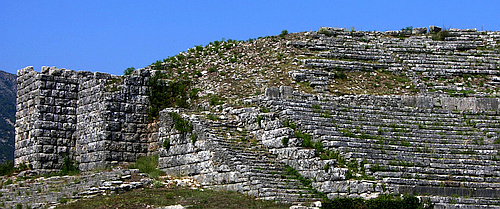
Exterior walls supporting the koilon, the seating area of an ancient
Greek theatre.
Ananke
--> Atropos
anapaest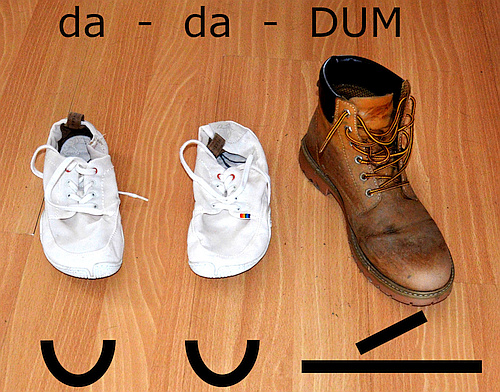
A metrical foot used in formal poetry. It consists of two short, unstressed syllables, followed by
one long, stressed syllable. The word comes from the Greek anápaistos, literally "struck back", and indeed it is
a reversed daktylos (one long, followed by two short syllables).
Anaxagoras
Pre-socratic philosopher (ca. 500 - 428 BC), who taught 30 years in Athens until his teachings upset the public. Anaxagoras explained the world as the result of a whirl caused by nous, the universal reason, which organized the atoms and created order. He claimed that the heavenly bodies were made of the same material as Earth, that the Sun was a glowing mass at least the size of the Peloponnese, and that there might be life on the Moon. This was so disturbing that he was was charged with impiety and sentenced to death. Perikles managed to change the penalty to ostracism, and Anaxagoras returned to Asia Minor where he died. - Aristotle and Demokritos were inspired by his teachings.
Anaximander
Greek nature philosopher (610 - 546 BC) from Miletos, probably a disciple of Thales. He explained the world as deriving from an ultimate matter, the apeiron, the "indefinable".
Anaximenes
Greek nature philosopher (570 - 500 BC) from Miletos, disciple of Anaximander, whose apeiron, to which everything could be reduced, was the air.
Anchises
Member of the royal family of Troy, treated in the Aeneid. By him, Aphrodite became mother of Aeneas.
Andokides
A famous potter (fl. 6th century BC) of ancient Athens. The painter of his pots was an anonymous artist, the Andokides Painter.
Andokides Painter
An ancient Athenian vase painter (fl. ca. 530 - ca. 515 BC), believed to be the inventor of the red-figure style of vase painting. He is named after Andokides, the potter with whom he worked. - He was a student of Exekias, one of the greatest masters of the black-figure style. However, the technical limits of this technique with the incision of details onto a silhouette of a figure, were reached in the late 6th century BC. Consequently, the Andokides Painter reversed the process by using black for the background and red for the figures. In this way, details could be painted in black with a fine brush, allowing greater precision and more details than before. The first evidence of this technique dates to 530 BC. In a transitional phase, perhaps to get his customers used to the new art, he produced "bilingual vases": one side black-figure and the other side red-figure technique. - He worked together with the Lysippides Painter and it has been speculated that the two were identical.
Andreus
A son of the river-god Peneios in Thessaly. It is said that the region of Boeotia around Orchomenos was called Andreis after him. Other traditions say that he was one of the generals of Rhadamanthys, from whom he received the island of Andros that was named after him.
Androgeos
Son of king Minos of Crete. When he attended the first Panathenaia in Athens he won all the prizes and thereby attracted the ire of Aigeus, who sent him to fight a bull at Marathon, which caused his death. As a consequence, Minos waged war on Athens and this was only ended when Athens agreed to send seven young men and seven young women every nine years (other intervals are also given) to Crete to be devoured by the bull-monster Minotauros; the tradition continued until Theseus defeated the Minotauros.
Andromache
The noblest and most amiable female characters in the Iliad. She was the wife of Hektor, and together they had a beloved son, Skamandrios. Homer describes the heartbreaking scene when she takes leave of Hektor as he is going to battle, and her lamentations after his death. At the fall of Troy Achilles killed her father Eetion and her seven brothers. Her son Skamandrios was hurled down the walls of the city to prevent the prophecy that he should restore the kingdom of Troy. She herself was given to Neoptolemos, who took her to Epirus, where she bore him three sons, Molossos, Pergamos, and Pielos. After the death of Neoptolemos, she married Helenos, a brother of Hektor, and when he also died, she followed her son Pergamos to Asia Minor.
Andromeda
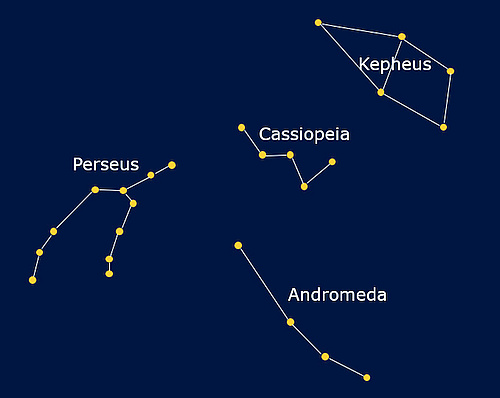
A daughter of the Aethiopian king Kepheus and
Cassiopeia. When Cassiopeia boasted that her daughter was fairer than the
Nereids Poseidon was enraged and sent a sea-monster to
ravage the land. An oracle foretold that this could only be ended by sacrificing
Andromeda and so she was chained to a rock at the shore. There she was found and saved by
Perseus, who slew the monster and obtained her as his wife. - Today, Andromeda is seen as a constellation in the
night sky, together with Perseus and her parents.
andron
In the ancient Greek house a room where male drinking parties (symposia) were held. It had a raised base for the couches of the symposiasts on all four sides and usually a mosaic pavement in the rectangular area left in the middle.
anemoi
The winds, conceived as natural phenomena or personified. The master and ruler of all the winds is Aiolos. Homer mentions four winds: Boreas (north wind), Euros (east wind), Notos (south wind), and Zephyros (west wind). Later writers, especially philosophers like Aristotle, refined this system by adding additional winds between the four principal ones. - Remarkable in this context is the octagonal "Tower of the Winds" of the first century BC in Athens (see: site page).
Ankaios
1) Arcadian hero, son of Lykurgos and father of Agapenor. He was one of the Argonauts and also took part in the Kalydonian Hunt, in which he was killed by the boar. Often confounded with Ankaios (2).
2) A son of Poseidon. Perhaps it was him who became the helmsman of the Argonauts and not the other Ankaios (1).
3) Another Ankaios appears in the Iliad.
anta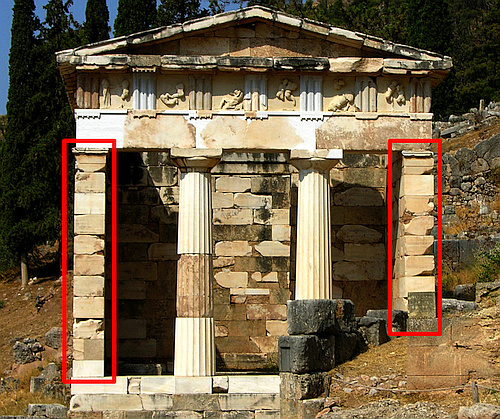
An anta (pl. antae) is an architectural element like posts or
pillars on either side of a doorway or entrance of a Greek temple - i.e. the slightly
projecting piers terminating the walls of the cella. Unlike
columns or pillars, antae are directly connected with the walls of a temple. They were
originally necessary as load-bearing structures to carry the roof timbers, but in later construction they became more
decorative. When there are columns between antae, as in the facade of a
porch, rather than a solid wall, the columns are said to be "in antis" (see:
distyle). If antae are used on two opposing sides of the temple it is called "double
antae".
antae temple
--> distyle
Antaios
Giant son of Poseidon and Gaia. When Herakles, during his Eleventh Labor, was on his way to the Hesperides, he had to fight Antaios. He was believed to be invincible as long as he was in contact with his mother, i.e. Earth. Herakles lifted him off the ground and thus defeated him.
antechamber
--> anteroom
antefix
--> akroterion
Anteia
Mythological queen of Argos, married to Proitos. She is best known for her plot against Bellerophontes. When he refused her seductive advances, she told her husband Proitos the lie that Bellerophontes had tried to seduce her and that he must die for this. Fearing the anger of the gods that protected Bellerophontes he sent him away to be killed by his father-in-law Iobates. - In later myths Anteia's name is given as Stheneboia.
Antenor
1) He was one of the wisest of the Trojan elders and counsellor of King Priam before and during the Trojan War. He was married with Theano, who bore him many children, among them Archelochos, Akamas, Glaukos, Laodokos, Koon, Polybos, Agenor, Laodamas, Demoleon, and Eurymachos, most of whom were killed in the Trojan War.
2) Athenian sculptor of the 6th century BC.
anteroom
An anteroom (or antechamber or vestibule) is a small room leading into a larger space. The function of this entrance hall, or passage, is for waiting before access to the main room is given.
anthemion
--> palmette
Antigenes
A general of Alexander the Great, who already served under Philip II of Macedon. After the death of Alexander he was satrap of Susiana (in modern-day Iran) and in the war of the diadochi took the side of Eumenes. When Eumenes was defeated, Antigenes fell into the hands of his enemy Antigonos, who had him burnt alive in 316 BC.
Antigone
1) The daughter of Oedipus, the tragic king of
Thebes and his mother, Iokaste. When they discovered that
they had unwittingly lived in a incestuous relationship, Iokaste hanged herself, Oedipus blinded himself and left
Thebes. Antigone and her sister Ismene served Oedipus as guides in exile until his death. When
Eteokles and Polyneikos, the sons of Oedipus, had
killed each other over the throne of Thebes, Oedipus and his daughters returned. Kreon, now
Theban king, honoured Eteokles with an elaborate funeral, but forbade a burial of Polyneikos. Antigone, moved by love
for her brother and obeying the laws of the gods, buried Polyneikos secretly. Kreon ordered her to be immured in a cave,
where she hanged herself. Her lover, Haimon, son of Kreon, found her dead and committed
suicide. - Antigone was the main character in a tragedy by
Sophokles, then by Euripides, and in modern times by Jean Cocteau, Jean Anouilh,
and Bertolt Brecht.
2) A daughter of Eurytion of Phthia, and wife of Peleus, by whom she became the mother of Polydora.
3) A daughter of Laomedon and sister of Priam. When she boasted of excelling Hera in beauty she was changed into a stork.
4) Mother of the Argonaut Asterion.
Antigonos
Antigonos Monophthalmos (Antigonos the One-eyed, 382 - 301 BC) was a Macedonian general under Philip II and Alexander the Great. He played a major role in the wars of the diadochi and declared himself king in 306 BC.
Antikleia
1) The mother of Odysseus. She died while her son was away in the Trojan War, but Odysseus saw Antikleia as a "shade" when he evoked the spirits of the dead during his odyssey. According to Hyginus Antikleia had an intimate relationschip with Sisyphos before she married Laertes and this is why Euripides calls Odysseus a son of Sisyphos.
2) Mother of Periphetes by Hephaistos or by Poseidon.
3) Pausanias mentions another Antikleia who married Machaon, son of Asklepios.
Antilochos
In ancient Greek mythology a son of Nestor and one of the suitors of Helena. He went with his father and his brother Thrasymedes to the Trojan War, where he was the youngest among the Greek princes. He was a favorite of the gods and a friend of Achilles but was killed during the siege of Troy.
Antinoos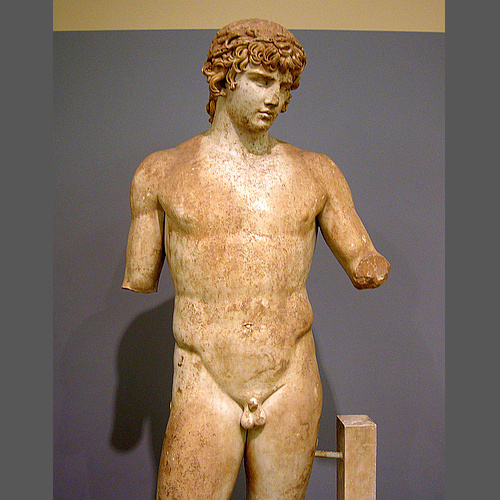
Born around AD 111 in the Roman province of Bithynia, northwestern
Asia Minor, the youth was introduced to the Roman emperor
Hadrian probably in AD 123, before being taken to Italy for a higher education. He had become the favourite and
lover of Hadrian by 128, when he was part of Hadrian's personal retinue on a tour of the Roman Empire. In October 130,
as they were sailing the Nile, Antinoos died under mysterious circumstances. - After his death, Hadrian deified the
youth and founded a cult of Antinoos that spread all over the Empire.
Antinous
One of the two most prominent suitors of Penelope according to the Odyssey, the other one being Eurymachos. Homer describes Antinous as violent and mean-spirited, disregarding guest-friend hospitality (xenia). When Odysseus returns, Antinous is drinking in the great hall and is the first victim of Odysseus, who kills him by an arrow shot to the throat.
Antiope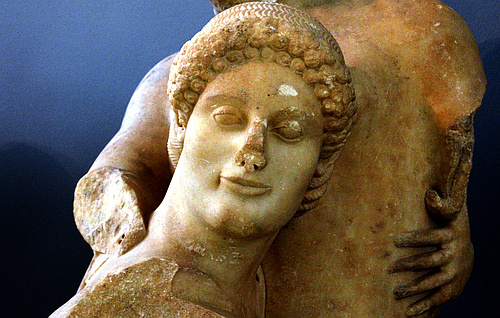
1) Amazon warrior, a sister (or a daughter) of Hippolyte, and first wife of Theseus. According to Diodorus Theseus received her as a present from Herakles. When later Attica was invaded by the Amazons she fought with Theseus against them and died by his side.
2) Daughter of king Nykteus of Thebes. By Zeus, she became mother of the twins Amphion and Zethos. When Lykos, who followed Nykteus on the throne, and his wife Dirke tormented Antiope, she was revenged by her sons.
3) There are five other mythical personages of this name.
Antipater
(ca. 398 - 319 BC) Macedonian general under Philip II and Alexander the Great. When Alexander started his campaign against Persia he made Antipater "general (strategos) of Europe". Consequently he put down an uprising by the Spartans and after the death of Alexander he had to fight a revolt by the southern Greek states (Lamian War, 323 - 322 BC).
Antiphos
1) A son of Priam and Hekabe. When tending the flocks on Mount Ida he was captured by Achilles, but freed after a ransom was paid. Later he was slain by Agamemnon.
2) A son of Thessalos. He and his brother Pheidippos joined the Greeks with thirty ships in the Trojan War.
3) In Homer's Iliad and the Odyssey another four mythical personages of this name are mentioned.
Antisthenes
Greek philosopher (ca. 440 - 371 BC). He founded the school of cynicism, where Diogenes of Sinope was his most famous disciple. Believing luxury and comfort undesirable, he despised life to the degree that he recommended suicide. To demonstrate his vision, he used to walk around in an old cloak. When Sokrates met him in the streets of Athens and told him that his vanity shone through the holes of his dress, Antisthenes closed his own school and became Sokrates' disciple.
Anyte
Anyte (fl. early 3rd century BC) was a poetess from Tegea in Arcadia. She was known for her epigrams and for introducing rural themes in poetry, but nearly nothing is known about her life.
Anytos
1) A powerful Athenian upper-class politician (ca. 5th - 4th century BC), one of the newly rich. He served as a general in the Peloponnesian War, and was later a prominent opponent of the Thirty Tyrants. Anytos is especially noted as one of the primary prosecutors of Sokrates, and according to a legend, he was later banished when the Athenians felt guilty about having Sokrates executed.
2) In ancient Greek mythology, one of the Titans.
Apella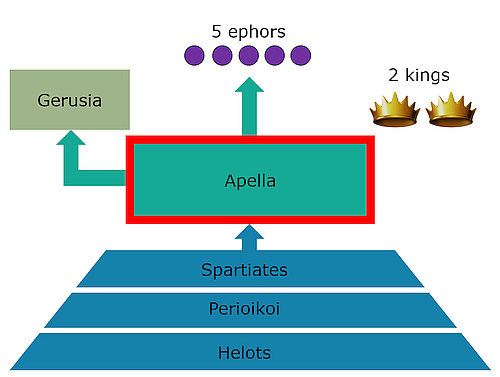
The general assembly of citizens in ancient Sparta, i.e. the
Spartiates. Their empowerment was much less than in other
city-states: the Apella could not decide on its own agenda but was only authorized to vote on proposals presented to
them by the Gerousia.
Apelles
Apelles (ca. 352 - 308 BC) was one of the most praised painters of the ancient world. Nothing of his work has survived, but we know from contemporary accounts that he painted Alexander the Great many times, but also scenes from mythology and is credited with having painted the first self portrait in the world.
Aphareus
A son of the Messenian king Perieres and Gorgophone, the daughter of Perseus. His sons were Idas and Lynkeus, who are celebrated in ancient myths for their fight with the Dioskouroi. Aphareus welcomed Neleus and Lykos, who had to flee from their countries, to his kingdom. He assigned to Neleus a part of Messenia and learned from Lykos about the orgiastic worship of the great gods.
Apharetides
--> Idas
Aphrodite
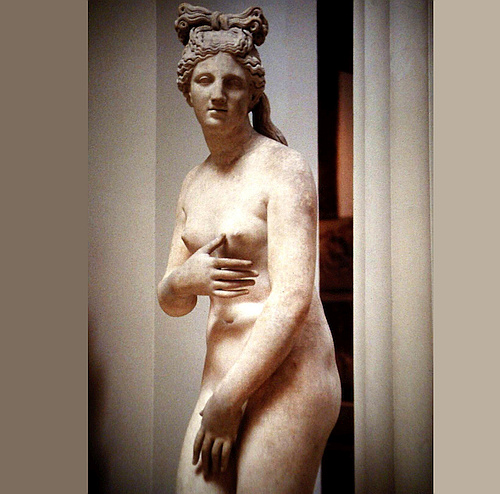
Greek goddess of love and beauty, eternally young woman with a perfect body of sublime beauty and
sexual attractiveness. In Greek mythology, Aphrodite rose from the waves off of the island of Cyprus after
Kronos castrated Uranos and tossed his genitals into the
ocean. In another version she is the daughter of Zeus and
Dione. She is married with Hephaistos, but also associated with
Ares. Her son was Eros, god of Love. - Best known is the story of her contest with
Hera and Athena, where Paris chose her as
the fairest of the three goddesses. As a "reward" Aphrodite gave him the love of Helena,
which then led to the Trojan War.
Apis
1) In ancient Egyptian religion, a sacred bull, son of Hathor, a primary deity in the pantheon of ancient Egypt.
2) A son of Phoroneus by the nymph Laodike, and brother of Niobe. As king of Argos he set up a tyrannical government and was so powerful that the Peloponnese was called after his own name Apia; but he was killed in a conspiracy headed by Thelxion and Telchis. It is said that after his death he was worshipped under the name of Serapis, showing a convergence of Greek and Egyptian mythology at this time. This is also shown in another tradition according to which he gave his kingdom of Argos to his brother, and afterwards reigned in Egypt.
3) King of Sikyon, son of Telchis, and father of Thelxion. Also of him it is said that previous to the arrival of Pelops, the Peloponnese was called after him Apia.
4) A son of Asklepios.
5) A son of Jason.
apobate
An apobate ("trick-rider) is a fully armed Greek warrior, jumping on and off the moving chariot.
Apollo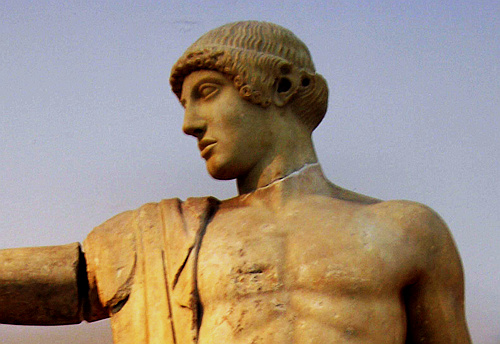
One of the most important Greek deities; god of the blessed light. According to
Homer son of Zeus and the nymph
Leto; his twin sister was Artemis. His mythical birthplace was the
"swimming" island of Delos because Hera, the outraged wife of
Zeus refused the earth to allow Leto to give birth anywhere on its surface. - Apollo was the
deity of healing (later replaced by his son Asklepios) and prophecy. His most important
oracle was in Delphi, where he was worshipped as "Apollon
Pythios". Since Archaic times, Apollon was worshipped as a
panhellenic deity of cultic order, leader of the muses ("Apollon Musagetes"), and
therefore benefactor of fine arts, music and poetry. Known for the flawless beauty of his body, he was enjoying the
charms of nymphs, and - like his father - had numerous affairs:
Kassandra, to whom he gave the gift of prophecy; Daphne,
who fled from his embrace and turned into a laurel tree; and Kalliope, with whom he had
a child, Orpheus. - In art, Apollo is often presented with a laurel wreath on his head or
with a kithara.
Apollodorus
1) "Apollodorus of Athens" was a scholar of the second century BC with a wide field of interests. Best known is "The Library of Greek Mythology", but this is meanwhile attributed to a Pseudo-Apollodorus.
2) "Apollodorus Skiagraphos" was an influential ancient Greek painter of the 5th century BC, but all of his works have been lost.
apse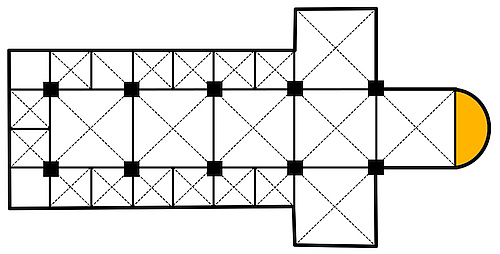
A curved architectural structure. In an Early Christian basilica it
is the semicircular or polygonal conch in the sanctuary.
apsidal building
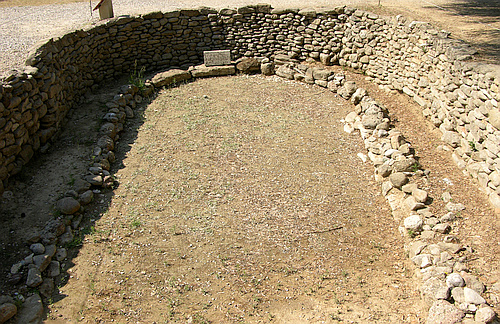
An oblong building where the wall on one of the short sides is an apse. Examples
are the "longhouses" erected in the Bronze Age.
Aratos
1) Aratos of Soli (ca. 315/310 BC - 240 BC) was a Greek didactic poet. In his poem Phenomena ("Appearances"), a hexameter version of a lost work by Eudoxus of Knidos, he describes the constellations and other celestial phenomena, although himself not very familiar with the astronomy of his time. In the second part, called the Diosemeia ("Forecasts"), he mainly deals with weather lore. Aratos' work was quite popular in the Greek and Roman world.
2) Aratos (271 - 213 BC) was a statesman of the ancient Greek city-state of Sikyon. He was an advocate of Greek unity and brought Sikyon into the Achaean League, which he led to its maximum extent. As strategos, he led the Achaeans against Macedonia, Aetolia and Sparta. When the Spartans had defeated the Achaean League, he sought assistance from Antigonus Doson of Macedonia, but after his death in 222 BC, he did not get along with Philip V of Macedon, who wanted to put the Achaean League under Macedonian control. Is is said that Philipp V had Aratos poisoned.
arcade
A walkway covered over by a succession of arches supported by columns or pillars.
Arcadia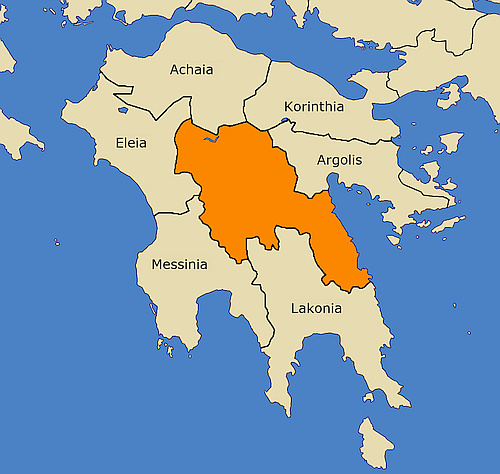
Mountainous region of Greece, situated in the central and eastern part of the
Peloponnese (4400 km2, 78,000 inhabitants), the home of the god
Pan. Especially in the arts of European Renaissance, Arcadia was celebrated as an unspoiled,
harmonious wilderness. - See also: site page.
Archaic period
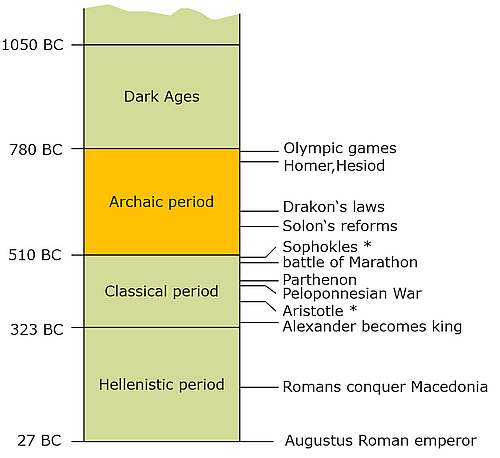
The period of Greek history between ca. 700 and 510 BC, following the
"Dark Ages". It is charactericed by an increasing power of the city-states and the beginning of a
colonisation of the Mediterranean. Other prominent events of this period are the
development of a Greek alphabet, Homer's Iliad and
Odyssey, the first Olympic Games, the rise
of philosophy, and the first steps to democracy in
Athens.
Archelaos
1) Archelaos (reigned ca. 790 - ca. 760 BC) was the 7th Agiad king of Sparta. During his reign he conquered Elis and the city of Aegys and sold its inhabitants into slavery.
2) Archelaos (fl. 5th century BC) was an ancient Greek philosopher of the Ionian School. He was a pupil of Anaxagoras, and perhaps a teacher of Sokrates. Archelaos saw the separation of hot from cold as the principle of motion and with this tried to explain the formation of the Earth and the creation of animals and humans.
3) Archelaos I was king of Macedon from 413 to 399 BC. He was known as a capable and beneficent ruler, contributing to the rising power of his state.
Archelochos
According to the Iliad a son of Antenor. Together with his brothers Akamas and Aeneas he commanded the Dardanoi who supported king Priam in the Trojan War. He was killed by Aias, the son of Telamon.
Archemoros
A son of the Nemean king Lykurgos, and Eurydike. His real name was Opheltes, but his death during the visit of the "Seven against Thebes" was seen by Amphiaraos as an omen boding the failure of their expedition and therefore the child was called Archemoros, "the forerunner of death".
Archidamos II
King of Sparta since 476 BC. Being a friend of Perikles, he tried to avoid war with Athens but was finally forced to lead expeditions against the Athenians in the first years of the Peloponnesian War.
Archidamos III
King of Sparta (reigned 360 - 338 BC), son of Agesilaos II. He was a commander when the Spartans were defeated by the Theban army under the command of Epaminondas in 371 BC. In the second Sacred War (355 - 346 BC) he supported Phokis against Thebes.
Archidamos V
Archidamus V (reigned 228 - 227 BC) was the 27th Eurypontid king of Sparta. After his brother Agis IV was murdered in 241 BC, he fled to Messenia. In 228 he was ordered back to Sparta by the Agiad king Kleomenes III, who had no counterpart on the throne by then. Shortly after this he was assassinated, according to Polybios by Kleomenes.
Archidike
A celebrated hetaira from Egypt, whose fame spread throughout Greece, and of whom Herodotus says that she "became a notorious subject of song throughout Greece". She was said to be arrogant and avaricious and to have charged high prices for her favors. In one anecdote a young Egyptian became greedy after her and offered all his possessions for a single night with her. She refused, and so the lover asked Aphrodite to send him in a dream what Archidike had refused in reality. The wish was fulfilled but when Archidike heard of it, she had the young man taken before the judges to make him pay for the voluptuous dream. The judges decided that Archidike should, in turn, pray to Aphrodite for a dream of silver in repayment for a fictitious lover.
Archilochos
1) Archilochos (ca. 710 - 676 BC) was a satirical poet. Perhaps identical with (2).
2) Archilochos (ca. 680 - ca. 645 BC) was a Greek lyric poet and mercenary. He was widely praised for his innovative use of poetic meters and was the earliest known Greek author to compose almost entirely on the theme of his own emotions and experiences, where he presented himself as a man of few illusions either in war or in love. As the typical poet of blame, his invectives were even said to have driven his former fiancee and her father to suicide.
Archimedes
Archimedes (287 - 212 BC) was one of the most renowned inventors and mathematicians of the ancient world. Among his contributions to physics and technology are the foundations of hydrostatics, statics, explanation of the lever ("give me a place to stand and I will move the earth"), the screw pump, and siege engines. Well known is his experiment to test the purity of the gold crown of Hieron II of Syracuse by immersing it in water and measuring the specific weight. Archimedes was killed by a Roman soldier during the siege of Syracuse when the scientist asked him not to disturb the diagrams he was drawing in the sand.
architectural Order
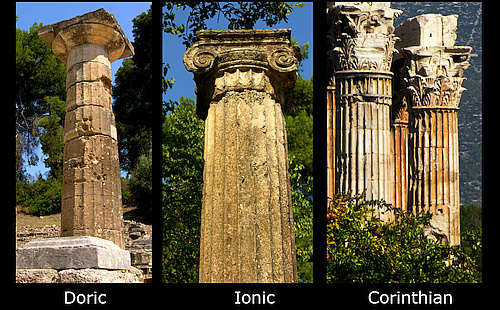
The classification system used to define styles of ancient architecture; in ancient Greek
temples the Doric,
Ionic, and Corinthian order. Usually the architectural order is most easily
recognized by the columns.
architrave

In Greek temple architecture the beam resting on the
capitals of the columns. It is the lowest part of the
entablature. Doric architraves are simple and
unadorned, in the Ionic order it features three parallel bands.
archon
(Greek: "ruler", "lord") In ancient Greece the title of a specific public office, the chief magistrate in various Greek city states. In Athens, the power of the king eventually evolved into a system of three concurrent archons, the archon eponymos as the chief magistrate, the polemarchos as head of the armed forces, and the archon basileus who was responsible for civic religious arrangements. This group was complemented by thesmothetai to form an administrative body of nine archontes. Originally these offices were filled from the aristocratic, wealthier classes by elections every ten years; after 683 BC the offices were held for only a single year and after 487 BC the archonships were assigned by lot to any citizen while the military duties of the polemarchos were taken over by a new class of generals, the strategoi. After 457 BC ex-archons were automatically enrolled as life members of the Areopagus, though this assembly had meanwhile lost much of its political importance.
Areopagus
1) ("District of Ares" or "district of curse") A hill in Athens west of the Acropolis.
2) The council meeting on this hill. Originally, it was the highest political and judicial body of Athens, but since the 5th century BC only the law-court for homicide.
areostyle
Columns set at an intercolumniation of four column diameters. Vitruvius warned that with columns set this far apart, stone architraves break.
Ares
Greek god of war, described as bloodthirsty and brutal. In mythology, Ares is a son of Zeus and his wife Hera. His first love is war but he still has some children: Diomedes, by the nymph Kyrene, Kyknos by Pyrene, and Oinomaos by Sterope. When Ares deceived Hephaistos by making love to his wife Aphrodite the sun god Helios saw them and revealed it to the other Olympian Gods. - Ares was especially worshipped in Thracia, but he is seldom depicted in art and temples dedicated to him are very rare.
Arete
1) Wife of Alkinoos and mother of Nausikaa. She and her husband welcomed the Argonauts and Odysseus.
2) Arete of Kyrene (5th - 4th century BC) was the daughter of Aristippos of Kyrene and also herself a philosopher. While in her time many women studied philosophy, she was one of the very few for whom it was a career.
arete
Excellence, virtue; also indicating courage and military prowess in ancient Greece. It is a keyword in Greek ethics and in the philosophy of Sokrates and Plato.
Arethusa
1) The nymph of the famous well Arethusa in the island of Ortygia, Sicily. Coins of Syracuse represented her head surrounded by dolphins.
2) One of the Hesperides.
Arges
("brightener") One of the Cyclopes, son of Gaia and Uranos, mentioned by Hesiod.
Argive Heraion
--> Heraion
Argo
The ship that carried the Argonauts on their expedition to Kolchis.
Argolic Gulf
A gulf of the Aegean Sea off the east coast of the Peloponnese. It
is about 50 km long and 30 km wide. Its main port is Nafplion at its northwestern end.
The gulf is surrounded by two regional units: Argolis to the north and east,
Arcadia to the southwest. The surrounding mountains protect it from the strong summer Meltemi wind.
Argolis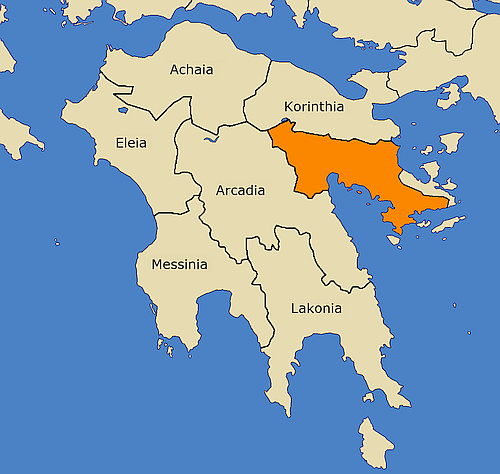
A part of northeastern Peloponnese, also called 'Argolid'. The
population is 93,000 and the area 2150 km2. It took its name from Argos, the dominant
city of this region in the Archaic and Classical periods. - See
also: site page.
Argonauts
Greek heroes, named after their ship, the Argo, who accompanied Jason to Kolchis in his quest for the Golden Fleece. Except for Jason and Medea they were: Admetos, Aithalides, Akastos, Aktor (?), Amphion, Askalaphos, Atalante (?), Autolykos, Boutes, Echion, Erginos, Euphemos, Euryalos, Herakles, Hylas, Idas, Idmon, Iolaos, Iphikles (?), Kalais, Kanthos, Kastor, Kytissoros, Laertes, Lynkeus, Melas, Meleagros, Nestor, Oileus, Orpheus, Palaimon, Peleus, Periklymenos, Philoktetes, Phlias, Phrontis, Poias, Polydeukes, Polyphemos, Talaos, Telamon, Theseus (?), Tiphys, and Zetes. - For their adventures: see Jason.
Argos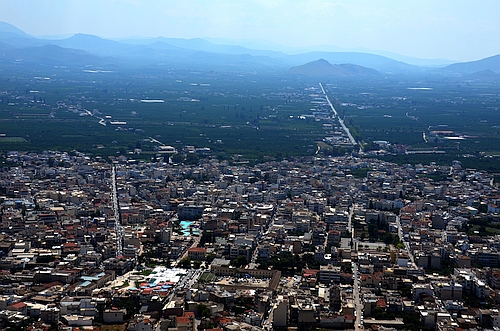
1) City in the Argolis with a population of 26,000 and an area of 138,000
km2. It is one of the oldest continuously inhabited cities in the world, and certainly the oldest in
Europe (--> site page).
2) ("Argus-Pelasgus") The third king of Argos, a son of Zeus and Niobe. He renamed the city after himself.
3) The faithful dog of Odysseus who recognized his master when he returned after twenty years.
4) (Argos Panoptes, the "all-seeing") In Greek mythology a giant with hundred eyes. After he had slain a fierce bull which ravaged Arcadia, a satyr who robbed and violated persons, the serpent Echidna, and the murderers of Apis, who was according to some accounts his father, Hera appointed him guardian of the cow into which Io had been metamorphosed. Hermes, instructed by Zeus to take away the cow, killed Argos. Thereafter, Hera transplanted his eyes to the tail of the peacock
5) A son of Phrixos and Chalkiope. After the death of his father, he and his brothers set out to avenge her father's ill treatment by Athamas. They stranded on an island in the Euxine (Black Sea), from where they were rescued by the Argonauts and returned with them to Kolchis.
6) There are two more mythological figures of this name.
Ariadne
A daughter of king Minos and Pasiphaë. When Theseus arrived in Crete as one of the youths to be delivered to Minotauros, she fell in love with him and gave him a thread with which he could find his way out of the labyrinth. When Theseus had killed the Minotauros and fled, she came with him but was abandoned on the island of Dia. According to Plutarch, her further fate is quite unclear.
Arimaspians
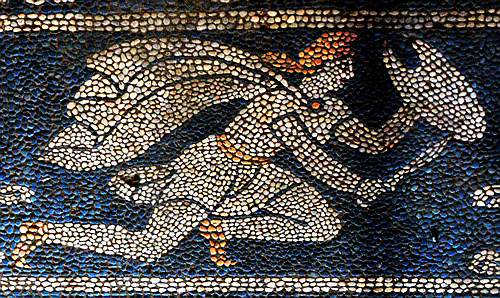
Legendary warriors of Skythia, north of the
Black Sea. According to Greek writers, the Arimaspians had a single eye in the center of
their foreheads (Skythian: arima = "one" and spou = "eye"). They were said to steal gold from the
griffins, causing battles between the two groups.
Arion
1) A legendary poet and singer (end of the 7th / beginning of 6th century BC) from Methymnia on Lesbos. Herodotus calls him the greatest kithara player of his time and the inventor of the dithyrambos. - A nice anecdote relates that he, a wealthy man, was traveling by ship when the crew wanted to rob him and throw him overboard. They allowed him, however, to sing a last song and when he ended, he jumped into the sea. Meanwhile his music had attracted dolphins and the friendly mammals carried him ashore. When the ship arrived he was already there and the crew was arrested.
2) The magical horse of king Adrastos of Argos, a product of an affair that Poseidon had with his sister Demeter.
3) The chariot horse of Iolaos.
4) A king of the Leleges in Miletos.
Aristaios
Minor pastoral deity and protector of the beekeepers; son of Apollo and Kyrene. From his father, he had the skill of prophecy and healing, but he was also an excellent hunter and became skilled in bee-keeping and growing olives. His tutors were the centaur Cheiron, the muses, and the dryads. Aristaios fell in love with the dryad Eurydike, but she was already married with Orpheus, and when he pursued her she fled and was bitten by a deadly adder. Later, he married Autonoe, the daughter of Kadmos, king of Thebes. By her, he became the father of Aktaion.
Aristagoras
1) The tyrant of Miletos in the late 6th century BC and early 5th century BC, ruling as a Persian satrap under the reign of king Darius I. He was a key figure during the early years of the Ionian Revolt.
2) The tyrant of the city of Kyzikos in Mysia around 495 BC.
Aristarchos of Samos
Greek astronomer (ca. 310 - 230 BC) from Samos. He proposed the heliocentrism, i.e. a system in which the earth and the other planets revolve around the sun. His contemporaries did not accept this theory and Aristarchos had to fear for his life because of offending the gods. He also developped a method to measure the distances to the sun and the moon, but the accuracies of measurements at his time were not sufficient.
Aristarchos of
Samothraki
Aristarchos of Samothraki (ca. 216 - 144 BC) was a Greek philologist and critic. From ca. 180 until 145 BC he was head of the Library of Alexandria in Egypt.
Aristides
Athenian general and statesman (ca. 530 - 467 BC), called "the Just". In his early years he was a follower of Kleisthenes and sided with the aristocratic party in Athenian politics. He is noted as one of the ten generals (strategoi) at the battle of Marathon (490 BC). As a consequence of this distinction he was elected archon for the following year. His main aim was to strengthen Athens as a land power and thus became the most prominent opponent of the naval policy advocated by Themistokles. This conflict led to the ostracism of Aristides, but he was soon recalled to help Athens against the Persian threat, serving again as strategos in 480-479. In the Battle of Salamis he was a loyal supporter of Themistokles and crowned the victory by landing Athenian infantry on the island of Psyttaleia and annihilating the Persians stationed there. Being re-elected as strategos, he was given special powers as commander of the Athenian forces at the Battle of Plataiai. He continued to hold a prominent position in Athenian politics and played an important role in the formation of the Delian League. - Sokrates praised him as the shining example of good leadership.
Aristippos
Aristippos of Kyrene (ca. 435 - ca. 356 BC) was said to be the founder of the Kyrenaic school of Philosophy. He was a pupil of Sokrates, but followed a different philosophical approach, teaching that the goal of life was to seek pleasure by adapting circumstances to oneself and by maintaining proper control over both adversity and prosperity. One of his students was his daughter Arete.
aristocracy
(From Greek aristos "excellent," and kratos "power"; i.e. "rule of the best") A form of government where all the ruling power is in the hands of a small, privileged class. In ancient Greece, monarchy - rule by an individual - was superseded by aristocracy - rule by the best qualified citizens. It may be seen as a progenitor of democracy.
Aristodemos
1) In ancient Greek mythology one of the Heraklids, a great-great-grandson of Herakles and brother of Kresphontes and Temenos. Together with his brothers, he was involved in an attack on the Peloponnese but was struck by lightning, or shot by Apollo, because one of the Heraklids had slain a soothsayer. Only his brothers were later able to conquer the Peloponnese.
2) A Spartan coward and hero. As a soldier he accompanied Leonidas to the Thermopylae. However, he and another soldier named Eurytos had an ailment of the eye and could not fight. Leonidas released both men from their duty, but when the Persians broke through, Eurytos joined the fighting and was killed. Aristodemos was the sole survivor and returned to Sparta where he was treated as a coward. - The Persian army marched on and devastated Athens. After its fleet was defeated in the sea battle of Salamis, the Persians retreated to central Greece. Here, in the following year, the battle of Plataiai took place. The same Aristodemos now attacked the Persians like a madman, appearing as the bravest of the Spartans on that day. It is said that he wanted to die in battle to prove his bravery.
Aristogeiton
Together with Harmodios he killed the Athenian tyrant Hipparchos in 514 BC. After the assasination he was arrested, tortured and later killed. Although the murder of Hipparchos apparently had a personal background, he and Harmodios, the Tyrannicides, became a symbol of ancient Athenian democracy.
Aristomachos
1) Son of Kleodaios, a great-grandson of Herakles. Like his father, he failed to conquer the Peloponnese and fell in battle.
2) Father of Hippomedon, one of the Seven against Thebes.
Aristophanes
1) Greek Old Comic dramatist (ca. 445 - ca. 385 BC). Famous for writing comedies, with which he was at least four times victorious at the Athenian dramatic festivals. Many of his comedies had a political background, like e.g. "Lysistrata", which he wrote during the Peloponnesian War. In this play, the women of two states arouse the men but refuse to have sex until they stop fighting. - Since he wrote for the Athenian audience of his days, the works are difficult to translate, lacking the contextual meaning. Aristophanes wrote about forty works, of which only some have survived: "The Acharnians" (425 BC), "The Knights" (424 BC), "The Clouds" (423 BC), "The Wasps" (422 BC), "Peace" (421 BC), "The Birds" (414 BC), "Lysistrata" (411 BC), "Thesmophoriazusae" (ca. 411 BC), "The Frogs" (405 BC), "Ecclesiazousae" (ca. 392 BC), and "Plutus" (388 BC).
2) Aristophanes of Byzantium (ca. 257 - ca. 185/180 BC) was a Hellenistic Greek scholar, particularly renowned for his studies of Homeric works. He succeeded Eratosthenes as head librarian of the Library of Alexandria.
Aristotle
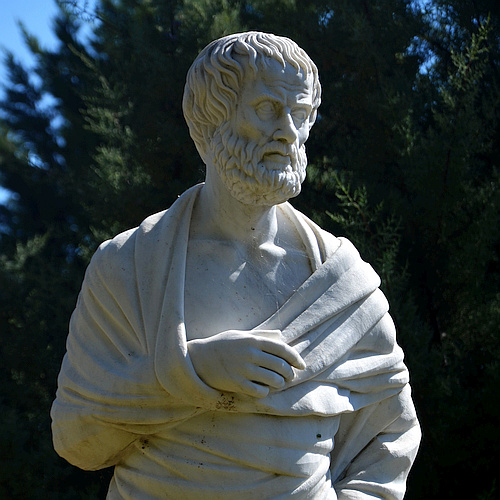
One of the most important philosophers and scientists of ancient
Greece. Born in Stageira (Macedonia) in 384 BC, he moved to
Athens at the age of 17 and studied under Plato at his academy. After Plato's death he
went back to Macedonia and became the tutor of Alexander the Great. In 335 BC he did not follow
Alexander into Persia but returned to Athens and founded his own philosophical school, known as the Peripatetic school.
After the death of Alexander, when anti-Macedonian resentments broke out in Athens in 323, Aristotle fled to Chalkis
where he died the following year. - Aristotle classified the various fields of knowledge into physics, metaphysics,
psychology, rhetoric, poetics, and logic, forming the basis of most of the sciences of today. "... credit must be given
to observation rather than theories, and to theories only in so far as they are confirmed by the observed facts"
(Aristotle, On Generation of the Animals). - Although most of Aristotle's works were scattered and lost after his
death, he was to be the main philosophical authority in the Middle Ages.
Arkas
The ancestor and eponymic hero of the Arcadians. He was a son of Zeus by Kallisto, and after the death and metamorphosis of his mother, Zeus gave the child to Maia.
Arkeisios
A son of Zeus and Euryodia (or of Kephalos and Prokris, according to Hyginus), husband of Chalkomedusa and father of Laertes.
Arkesilaos
1) A son of Lykos and Theoboule, who led the Boeotians in ten ships to the Trojan War, where he was slain by Hektor.
2) A son of Odysseus and Penelope mentioned by Eustathius.
3) Greek philosopher (316/5 - 241/0 BC) and founder of the Second Academy. - He became a disciple of Theophrastos and later of Krantor. In ca. 264 BC he succeeded Krates as the sixth head (scholarch) of the Academy. He was the first Academic to adopt a position of philosophical skepticism, that is, he doubted the ability of the senses to discover truth about the world, thereby opposing the Stoics. Arkesilaos did not preserve his teachings in written form so we only know it from later writers.
Arktinos
Arktinos of Miletos (fl. ca. 775 BC - 741 BC) was a Greek epic poet, perhaps a pupil of Homer. As one of the cyclic poets he is credited with the authorship of the epics Aithiopis and Iliou persis.
Arsinoe
In one myth she is the mother of Asklepios, daughter of Leukippos, in another version she is the first wife of Alkmaion.
Artaxerxes I
Artaxerxes I was the third son of Xerxes I and the fifth King of Persia (ruled 465 - 424 BC).
Artaxerxes II
Artaxerxes II Mnemon (Old Persian: "whose reign is through truth") was a son of Darius II and Parysatis and was king of Persia from 404 BC until his death in 358 BC. At the beginning of his reign he had to fight a revolt by the Egyptians, then defended his position as king against his brother Cyrus the Younger. Later, he was waging war against the Spartans, who, under Agesilaos II, invaded Asia Minor. He sought support from Sparta's enemies: especially Athens, Thebes and Corinth received his subsidies, which then led to the Corinthian War. In 386 BC, Artaxerxes II came to an arrangement with Sparta, which restored his control of the Greek cities of Ionia and Aeolia. - Artaxerxes II is said to have had more than 115 sons from 350 wives.
Artemis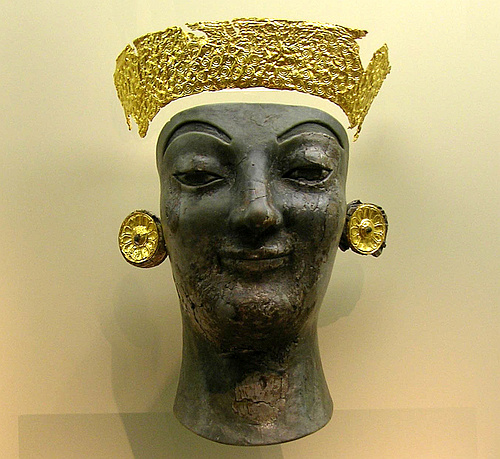
Greek virgin goddess of wildlife and hunting, daughter of Zeus and
Leto, born with her twin brother Apollo on
Delos. She was imagined as a young woman, beautiful and vigorous, wearing a short costume leaving her legs free, and
freely running with her maidens in the forests. - In Greek art, she is presented with her bow and her hounds. In
Brauron, Attica, a sanctuary was dedicated to her.
Artemisia
1) Artemisia I of Karia (fl. 480 BC) was a Greek queen of the ancient Greek city-state of Halikarnassos. She fought as an ally of the Persian king Xerxes I during the second Persian invasion of Greece, and personally commanded her contingent of five ships at the naval battles of Artemision and Salamis in 480 BC. In his writings, Herodotus, himself a native of Halikarnassos, praised her courage.
2) Artemisia II of Karia (died 350 BC) was the sister, the wife, and the successor of Mausolos, ruler of Karia. After the death of her brother-husband, her grief took bizarre forms and in his memory she ordered the construction of the Mausoleum, which was to become one of the Seven Wonders of the Ancient World.
Artemision
Cape Artemision is located on the northern tip of Euboea, opposite
Mount Pelion. It is known as the site of the Battle of Artemision, a series of naval engagements over three days in
August or September 480 BC during the second Persian invasion of Greece. According to
a proposal by the Athenian general Themistokles, the Greek
coalition of Athens, Sparta, Corinth, and others tried to
block the advancing Persian army at the pass of Thermopylae and the Persian navy at
Cape Artemision. There, the Greek 271 triremes awaited the 1200 Persian ships, one third
of which were lost in a gale off the coast of Magnesia. After arriving at Artemision,
the Persians sent a detachment of 200 ships around the coast of Euboea trying to trap the Greeks, but these were caught
in a storm and shipwrecked. The remaining fleets a battle with heavy losses on both sides which the smaller allied
forces could not afford and they withdrew after the Greek defeat at Thermopylae.
aryballos
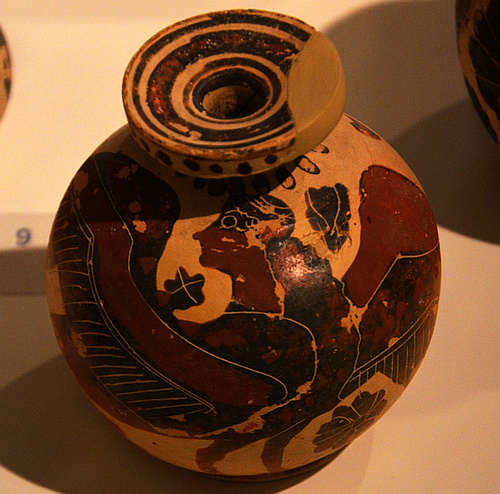
A perfume pot, usually made of ceramic.
ashlar masonry
A masonry that uses square, smooth cut (dressed) blocks of stone in regular courses. It was first
used in ancient Egypt, then appears in Bronze Age Greece and becomes an important
feature of Classical Greek architecture.
Asia Minor
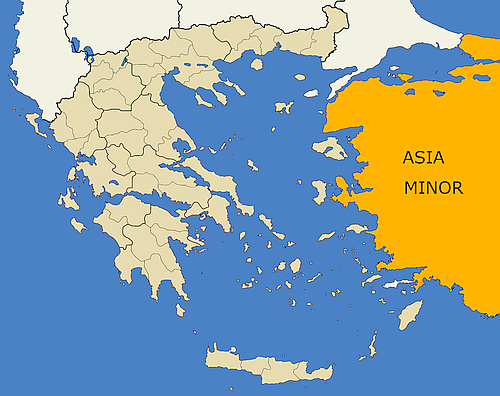
The peninsula between the Black Sea and the Aegean, i.e. most of modern Asiatic Turkey.
Askalaphos
Son of Ares and Astyocheia. He was one of the Argonauts. Killed in the Trojan War.
Askanios
Son of Aeneas, who successfully fled with his father after the fall of Troy. Later he became the ancestor of Romulus and Remus, the founders of Rome.
Asklepieion
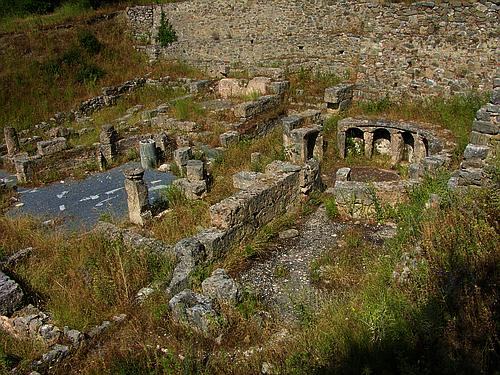
Sanctuary and healing centre dedicated to Asklepios. Most prominent is the
one in Epidaurus (--> site page) but there are also
others all over Greece.
Asklepios
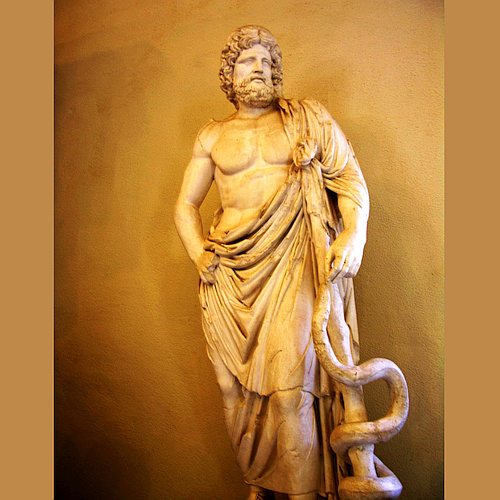
Greek god or demigod of medicine and healing. Mythology provides different versions of who his
parents were, but they agree that the Centaur Cheiron
became his tutor and taught him the art of healing. When successfully exercised this art and even learned to restore
dead to life, he was killed by Zeus with a thunderbolt. It is unclear if this was because
Zeus did not want the natural order upset, or because Hades complained about the reduced
number of the dead. Children of Asklepios were Machaon,
Podaleirios, and Hygieia. - Since snakes were an important part of the healing cult,
Asklepios is depicted in art with a serpent-entwined staff. He is also among the stars as the constellation Ophiuchus
(the serpent-bearer). His cult places or healing centres were all over Greece, the most important one in Epidaurus
(--> site page).
askos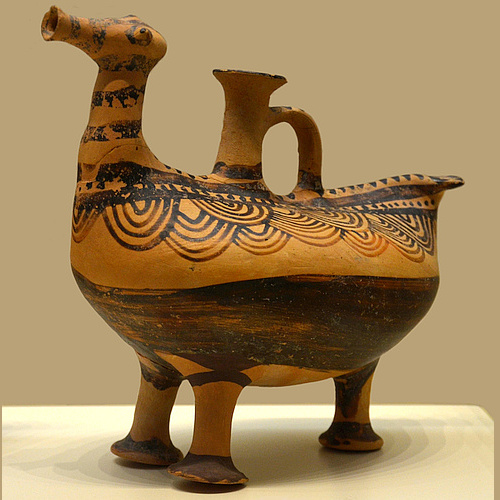
A ceramic vessel in the shape of a sack, a skin, or an animal.
Asopos
1) ("Never silent) A river-god, son of Okeanos and Tethys, father of Aegina, Antiope, Asopis, Kerkyra, Sinope, and Thebe. He is the deity of the springs of Asopos in southern Boeotia.
2) Lord of the river Asopos in Argolis, which flows northward to the Gulf of Corinth.
Aspasia
Aspasia (ca. 470 - 410 BC) was of humble birth and came to Athens shortly after 450 BC, where she became the mistress of the famous general Perikles. She was known to be keen and intelligent who could converse with politicians and philosophers with ease.
Asphodel
The fields of Asphodel are a region of the underworld where the ordinary souls live as formless shadows.
aspis
An aspis, sometimes also called a hoplon, was the heavy shield used by the infantry in ancient Greece. It was primarily made of wood, sometimes with a thin sheet of bronze on the outer face, with a diameter of about 1 m, weighing about 7 kg. In some periods, the shield had a decoration, the most famous one being the capital lambda, for Lakedaimonia, on Spartan aspides.
Asteria
1) A daughter of the Titans Koios and Phoibe; sister of Leto. Hesiod narrates that she was married to Perses, by whom she became the mother of Hekate. According to Greek mythology she dwelt on Olympos, where Zeus fell in love with her. She fled from him and threw herself into the sea, where she became the island Asteria - the island that fell from heaven like a star.
2) One of the Danaides.
3) A daughter of Hydis, who became by Bellerophontes the mother of Hydissos.
4) There are three other mythological personages of this name.
Asterion
1) Mythological king on Crete, who married Europa after she had been carried to Crete by Zeus. He also brought up the three sons, Minos, Sarpedon, and Rhadamanthys whom she had by the father of the gods.
2) One of the Argonauts.
3) A river-god, father of Akraia.
4) A son of Minos, who was slain by Theseus.
Astraios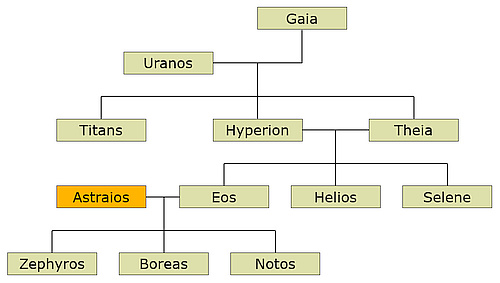
1) In Greek mythology husband of Eos, father of Boreas, Notos, and Zephyros.
2) A silen mentioned as companion of
Dionysos.
Astyanax
--> Skamandrios
Astydameia
1) A daughter of Amyntor, king of the Dolopians in Thessaly, by Kleoboule or Hippodameia. In some accounts she became by Herakles the mother of Ktesippos, others call her son Tlepolemos. In still other accounts, Tlepolemos was the son of Astyocheia.
2) The wife of Akastos, who was one of the Argonauts and the son of Pelias. When the Argonauts returned with the Golden Fleece to Iolkos, Medea instigated Akastos' sisters to kill their father, king Pelias. At the funeral games, Astydameia became infatuated with Peleus, also an Argonaut, but when her advances were rejected, she lied to Akastos. Thereupon Peleus was abandoned on Mount Pelion to die, but was saved by Cheiron.
Astynome
1) A daughter of Niobe.
2) A daughter of Talaos and mother of Kapaneus.
3) --> Chryseis
Astyocheia (Astyoche)
1) A daughter of Aktor, by whom Ares begot the sons Askalaphos and Ialmenos.
2) A daughter of Phylas, king of Ephyra, by whom Herakles, after the conquest of Ephyra, begot Tlepolemos.
3) A daughter of Laomedon or, in other traditions, of Priam. She married Telephos, by whom she became the mother of Eurypylos.
4) A daughter of the river-god Simoeis and the mother of Tros by Erichthonios.
5) The wife of Iphikles.
6) The wife of Strophios.
Astypalaia
A daughter of Phoinix and Perimede, the daughter of Oineus. She was a sister of Europa, and by Poseidon became the mother of the Argonaut Ankaios and of Eurypylos, king of the island of Kos.
Atalante
A virgin huntress who promised to marry the man who could win a foot race against her. Hippomenes accepted the challenge and dropped three golden apples from the garden of the Hesperides in Atalante's path as Aphrodite had suggested; when Atalante stopped to pick up the golden apples, Hippomenes won the race and married her. - Atalante also took part in the Kalydonian Hunt where she was the first to wound the savage boar and afterwards received his skin.
Ate
In ancient Greek mythology the personification of moral blindness leading to divine punishment; daughter of Zeus and Eris. She could blind the mind of both gods and men leading them astray. Zeus threw her out of Olympos when she aided Hera so that Eurystheus would be the future king of Mycenae, instead of his own son, Herakles. In the Iliad, she causes Agamemnon's folly to deprive Achilles of his war prize, the slave Briseis.
Athamas
King of Orchomenos. He was a son of Aiolos and Enarete, and thus a brother of Kretheus, Sisyphos, Salmoneus and others. By the nymph Nephele, he became the father of Phrixos and Helle. But secretly he was in love with the mortal Ino, the daughter of Kadmos, by whom he begot Learchos and Melikertes. When Nephele discovered that Athamas had more affections for Ino than to her, she left in anger. A period of misfortunes and famines followed, so the city consulted the oracle of Delphi. Ino bribed the messengers so that they brought back the oracle that Phrixos must be sacrificed. Before he was to be killed, Phrixos and Helle escaped on a golden ram sent by Nephele. Athamas and Ino drew upon themselves the anger of Hera, but the consequences are reported differently by the different authors.
Athena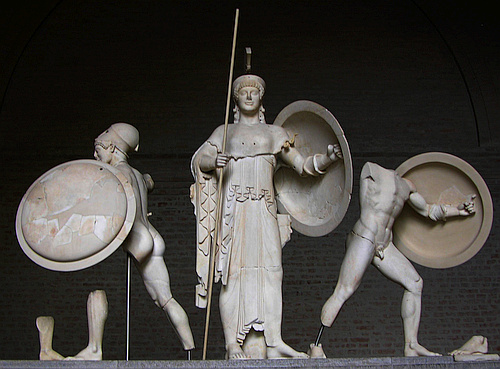
Goddess of wisdom, of arts and crafts, and of prudent warfare; patron goddess of
Athens, where a huge statue of Athena stood in the Parthenon. In mythology Athena
has sprung fully grown and fully armed from the forehead of Zeus. Although Zeus's daughter,
she could also oppose his plans and conspire against him. Athena was the champion of several heroes like
Herakles, Jason, Odysseus
and his son Telemachos. - In art, Athena is depicted as a young woman wearing a helmet
and holding a shield, the aegis with a depiction of the head of
Medusa. Her attribute is the owl, signifying watchfulness and wisdom. - In mythology Athena and the sea god
Poseidon competed for the affections of the Athenians. Poseidon provided a spring of
salt-water spring whereas Athena provided the olive tree, giving shade, oil, and olives. The Athenians preferred her
gift and named the city after her. - One of her titles is "Grey-eyed". The underside of the olive tree's leaf is grey,
and when the wind lifts the leaves, it shows Athena's many "eyes".
Athena Parthenos

A gold plated, 11.5 m high statue of Athena, the Maiden. It stood inside the
Parthenon and was the work of the legendary sculptor
Phidias during the reign of Perikles, i.e. 469-429 BC. - The "Varvakeion Athena"
pictured on the right, a marble statuette found in 1880 in Athens, is believed to be the truest
and best preserved copy (at one-twelfth of the original).
Athenian League
--> Delian League
Athens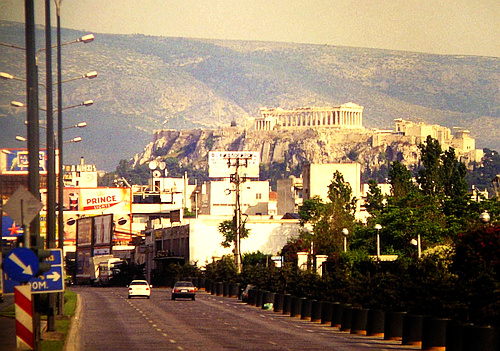
Largest city and, since 1834, capital of modern Greece. The population within its urban area is over
3.6 millions. Athens is one of the oldest cities of the world, being continuously inhabited for at least 5000 years. In
the first century BC it cecame the leading city of ancient Greece and evolved into the most powerful
polis with its own government, laws, army and navy in
Classical times. It was a centre for democracy, the arts, education and
philosophy - the cradle of Western civilization. - In antiquity, it was debated
whether Athens took its name from its patron goddess Athena or vice vera. Modern scholars have
etymological reasons to believe that Athena took her name from the city (-->
site page).
athloi
(Greek: "Labors") The Twelve Labors of Herakles:
1. Killing the Lion of NemeaThe incidents happening during the completion of the Twelve Labors are known as parerga.
2. Killing the Hydra
3. Capturing the Keryneian Hind
4. Capturing the Erymanthian Boar
5. Cleaning the Stables of Augeas
6. Killing the Stymphalian Birds
7. Capturing the Cretan Bull
8. Capturing the Mares of Diomedes
9. Retrieving the Belt of Hippolyte
10. Taking the Cattle of Geryon
11. Retrieving the Golden Apples of the Hesperides
12. Bringing Kerberos from the Underworld
Athos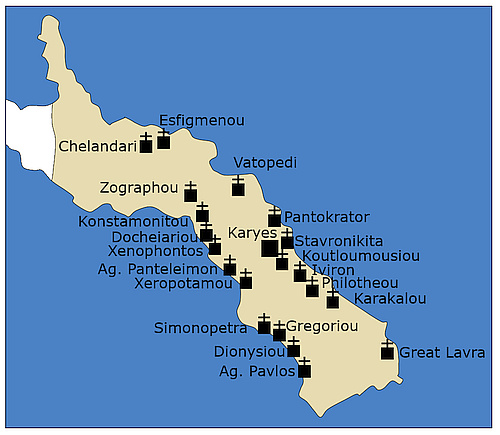
Mount Athos is the mountaineous easternmost peninsula of
Chalkidike. It is an autonomous polity within the Greek Republic. In Greek, it is commonly referred to as the "Holy
Mountain" (Agion Oros). It is an important centre of Eastern Orthodox monasticism with its 20 monasteries under
the direct jurisdiction of the Ecumenical Patriarch of Constantinople. Mount Athos has been inhabited since ancient
times and in the classical era the peninsula was known as Akté. It has a long monastic
tradition, which dates back to at least 800 AD. Today, over 2,000 monks live an ascetic life in Athos, isolated from the
rest of the world. Remarkable is a rich collection of well-preserved artifacts, rare books, ancient documents, and
artworks of priceless historical value in the monasteries. In 1988 Mount Athos was listed as a World Heritage
Site.
Atlantis
Atlantis ("island of Atlas") is a fictional island mentioned in Plato's works Timaeus and Kritias. There it is the antagonist power of "Ancient Athens", seen as an approach of Plato's "ideal state". In the story, the attack of Atlantis fails, showing the superiority of Plato's state. Also the gods no longer favour Atlantis and so the island submerges into the Atlantic Ocean. - Although Plato makes it clear that Atlantis is only part of an allegory, giving very vague indications of its period and location, it inspired the imagination of many historians, resulting in wild speculations. It is, however, possible that Plato's story was loosely inspired by the devastation of the Peloponnesian town of Eliki by a tsunami in 373 BC.
Atlas
1) In Greek mythology a son of Iapetos. Unlike his brothers Prometheus and Epimetheus, Atlas supported Kronos with the other Titans in their fight against Zeus. Since he led the Titans in battle he was singled out by victorious Zeus for a special punishment: he had to hold up the heaven on his shoulders. - The Atlas mountains in modern Marocco were named after him.
2) The eldest of five pairs of twin boys born to Poseidon and Kleito. He was the first king of Atlantis, but it is unclear if he was named after Atlantis or vice versa. Anyway, the name of the Atlantic Ocean is derived from him.
atomism
(From Greek atomon = "uncuttable", "indivisible") The concept in natural philosophy that nature is made up of two fundamental entities: atoms and void. Unlike modern physics, these theories conceived atoms as appearing in an infinite variety of shapes and sizes, each indestructible and immutable. They are surrounded by a void where they can collide with other atoms, forming new forms or clusters of new shapes and arrangements. This would explain the various macroscopic substances in the world. - The concept of atoms appears in ancient India and emerges in ancient Greece in the 5th century BC with Leukippos of Milet and Demokritos.
Atreus
A son of Pelops and Hippodameia,
grandson of Tantalos. Together with his brother,
Thyestes, killed an illegitimate son of Pelops to please their mother. Together they went to
Mycenae where Atreus gained control of the kingdom and with his wife
Aerope had two sons: Agamemnon and Menelaos. After Atreus
found out that Thyestes had seduced his wife he was exiled. Years later, when Thyestes thought that Atreus had forgiven
him, Atreus killed all the children of Thyestes except Aigisthos and served him his children at
a banquet. Later, it was Aigisthos who killed Atreus.
atrium
The internal court in a Greek or Roman house.
Atropos
("the Inexorable") One of the Moirai, the goddess of necessity, the Fate who cuts the thread of life. Along with her father and consort, Chronos, she was imagined at the beginning of the world, the most powerful dictator of all fate, respected by gods and mortals.
Attica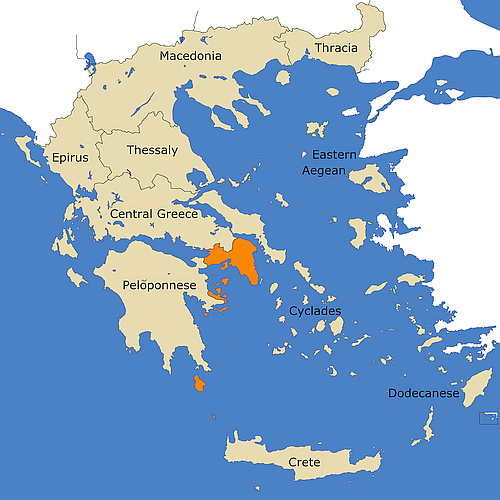
In classical Greece the peninsula encompassing the city of Athens. The
modern prefecture of Attica (3800 km2, 3800 inhabitants) also includes the
Saronic Islands, a part of northeastern
Peloponnese, Kythera and Antikythera.
Auge
Auge, also called Augeia, was a daughter of Aleos and Neaira. Being a priestess of Athena, and having become by Herakles the mother of a son, she concealed him in the temple of the goddess. As a consequence, the country was afflicted with a drought. An oracle informed Aleos that this was due to a profanation of the sanctuary, so he searched and found the child in the temple. Upon his order, the child was exposed on mount Parthenion, where he was suckled by a stag (elaphos), and therefore the boy received the name of Telephos. - Auge was given to Nauplios to be killed by him, but he sent her to Teuthras, king of Mysia, who made her his wife.
Augeas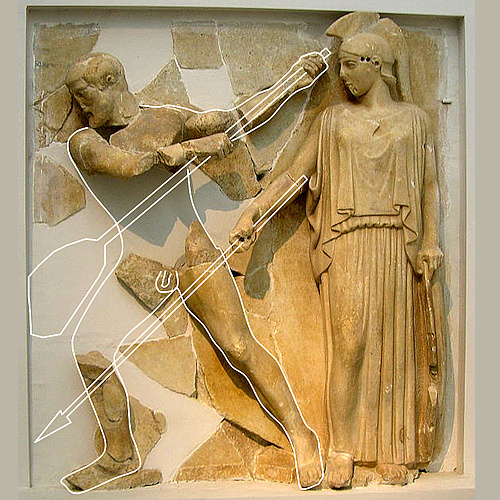
King of Eleia who owned the stables that
Herakles was to clean in only one day as his Fifth Labor. This seemed impossible because
Augeas had 3,000 cattle and the stables had not been cleaned for 30 years. Supported by Athena,
Herakles diverted the rivers Alpheios and Pineios and made their
waters flush out all the accumulated filth.
Augustus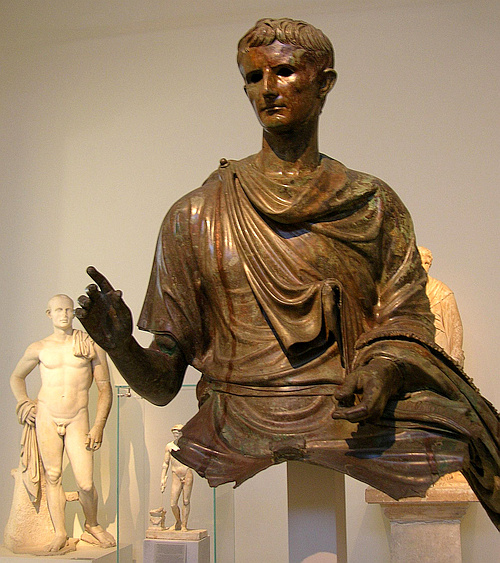
Gaius Julius Caesar Augustus (born Gaius Octavius; 63 BC - AD 14), also known as Octavian, was the
founder of the Roman Empire. He reigned as the first Roman emperor from 27 BC until his death in AD 14. His reign saw an
imperial cult and an era of imperial peace (Pax Romana) in which the Roman world was largely free of armed
conflicts.
Aulis
Ancient Aulis was a Greek port-town, located in Boeotia, at the Euripus Strait, opposite the island of Euboea. According to the Iliad it was here that the Greek fleet gathered to sail for Troy. The departure was however delayed by Artemis, who caused a dead calm because Agamemnon had killed a deer in her sacred grove. The fleet could only leave after Agamemnon had sacrificed his daughter Iphigeneia. - In 396 BC, the Spartan king Agesilaos II tried to imitate Agamemnon's plan and assembled his army in Aulis to sail to Asia. On the eve of sailing this was prevented by the Thebans, resulting in the rivalry between Sparta and Thebes in the following 25 years. It was only settled in the decisive battle of Leuktra in 371 BC.
aulos
A wind instrument with a reed. It is similar to a modern oboe.
Aurora
--> Eos.
autochthon
(Ancient Greek autos "self," and khthon "soil"; i.e. "people sprung from earth itself") In ancient Greece a concept denoting the original inhabitants of the country as opposed to settlers with whom they don't mix. Mythology describes them as mortals who have sprung from the soil, rocks and trees. - Not to be confused with the offsprings of Gaia, called gegenes (earth-born).
Autolykos
1) Master thief, son of Hermes, father of Antikleia and thus grandfather of Odysseus. He could change the shape of whatever he stole or make it disappear.
2) One of the Argonauts. Autonoë
1) A daughter of Kadmos and Harmonia. She was the wife of Aristaios, by whom she became the mother of Polydoros. In their Bacchic fury, Autonoë together with her sister Agaue, tore Pentheus, king of Thebes, to pieces.
2) One of the fifty daughters of Nereus, the Nereids.
3) There are four other mythical personages of this name.
awl
A pointed tool of stone, bone, or of bronze set in a handle, used for boring small holes in various materials.
Axenos
In ancient Greece the name of the Black Sea, later called Euxine.
Axiothea
Axiothea (ca. 350 BC) was a female philosopher from Phlious in Korinthia. It is said that she read Plato's Republic and then travelled to Athens to be his student. In order not to be seen as a hetaira, she dressed as a man at Plato's Academy.
