
GREECE
 GLOSSARY
| A | B | C | D |
| E | F | G | H |
| I | J | K | L |
| M | N | O | P |
| Q | R | S | T |
| U | V | W | X |
| Y | Z |
2026-01-22
color code:  = mythology;
 = history & culture;
  = geography;
  = archaeology &
architecture
= archaeology &
architecture
ecclesia
--> ekklesia
Echemos
Mythological king of Arcadia. He married Timandra, daughter of Leda and Tyndareos of Sparta. When Hyllos invaded the Peloponnese, he was killed by Echemos in single combat.
Echestratos
A son of Agis I and the third Agiad king of Sparta from about 900 to 870 BC.
Echidna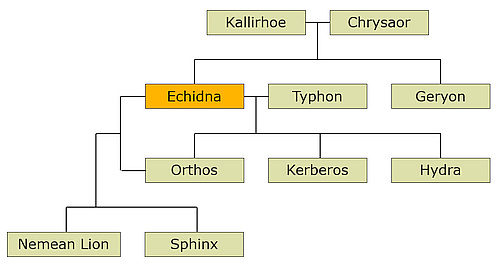
(echis = viper) A female monster, described as half nymph with
the body of a gigantic snake; daughter of Kallirhoe and
Chrysaor. She lived in a cave, snatching and eating everyone who came by. She mated with
Typhon and produced Orthos (the two-headed watchdog of
Geryon), Kerberos (the savage watchdog of Hades) and
the Hydra of Lerna; all three had a fatal encounter with
Herakles during his Labors. With her son Orthos she became mother of the
Nemean lion and the Sphinx. She was killed by the
many-eyed giant, Argos Panoptes.
echinus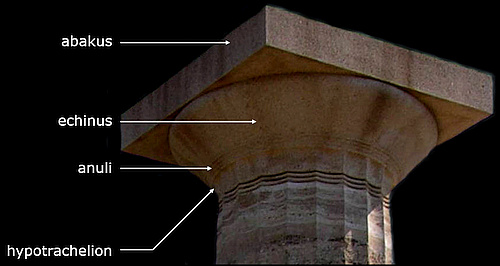
The lower part, formed like a cushion, of a Doric
capital. It lies above the round shaft of the
column and the square abakus. In the
Ionic order it has an egg-and-dart decoration.
Echion
1) One of the five surviving Spartoi who had grown up from the dragon's teeth sown by Kadmos. By his wife Agaue he became the father of Pentheus.
2) A son of Hermes and Antianeira. Together with his twin-brother Eurytos he took part in the Kalydonian Hunt, and in the expedition of the Argonauts, where he - as a son of Hermes - was a cunning spy.
3) One of the Gigantes.
egg-and-dart
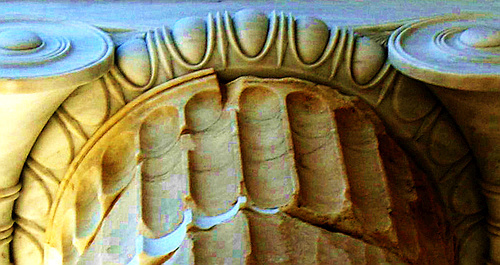
Egg-and-dart, also known as egg-and-tongue, egg-and-anchor, or egg-and-star, is an ornamental
feature of ovoid shapes (the egg) and serrated leafs (the dart), especially used in the
Ionic order.
 eggshell ware
Vases of the Kamares type with very thin bodies.
Eidyia
--> Idyia
Eileithyia
Goddess of childbirth, patroness of midwives. Eileithyia was the daughter of Zeus and Hera. She played a role when Leto was pregnant by Zeus with Apollo and Artemis, and she (or Hera) delayed the birth of Herakles so that Herakles' cousin, Eurystheus, would become king of Mycenae. - Eileithyia was very popular in pre-Hellenic times, when she appeared on Linear B tablets as E-RE-U-TI-JA, revered especially in Crete since the Middle Minoan period (2100 - 1700 BC). Her importance in Greek mytholgy diminished after the Dorian Invasion.
Eioneus
1) Father of Dia, the wife of Ixion. When Eioneus refused his son-in-law the bridal gift, Ixion had him thrown into a pit of burning coals and thereby killed him. He is also called Deioneus.
2) A son of Magnes, and one of the suitors of Hippodameia, was slain by Oinomaos.
3) There are two other mythical personages of this name.
Eirene
("Peace"; Latin: Irene) Greek goddess of peace, one of the Horai. Worshipped in Athens after the conclusion of peace with Sparta in 374 BC that ended the Peloponnesian war.
eisodos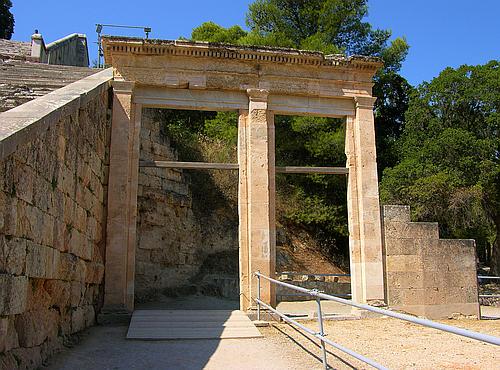
(pl. eisodoi) One of two side entrances to the orchestra in
the ancient Greek theatre. Also called parodos.
ekecheria
The sacred truce that was kept during the period of the Olympic games so that athletes could travel from their cities to the games in safety. In this period, attempts were made to settle wars and conflicts between the poleis.
ekklesia
The principal assembly of the citizens in ancient poleis, especially in ancient Athens during the period of democratic government. In 594 BC, Solon opened it to all male Athenians over the age of 18 which in the 5th century BC amounted to about 43.000 people. However, only those wealthy enough to spend much of their time away from home would have been able to participate. The assembly on the Pnyx hill was originally held once every month, later three or four times per month. The agenda having been set up by the boule, the ekklesia elected officials and decided by a show of hands over questions like declaration of war or military strategy.
Eleatics
A pre-Socratic school of philosophy founded by Parmenides in the early fifth century BC. Other members of the school included Zenon of Elea and Melissos of Samos. Xenophanes is also often mentioned in this context, since much in his speculations formed part of the later Eleatic doctrine. The school took its name from the ancient town of Elea, the home of its chief exponents, Parmenides and Zenon.
elegiac couplet
The elegiac couplet is a poetic form used by Greek lyric poets for various themes usually of smaller scale than the epic. Each couplet consists of a hexameter verse followed by a pentameter verse, while forming part of a larger work. This form was felt by the ancients to contrast the rising action of the first verse with a falling quality in the second. - Friedrich Schiller:
"Im Hexameter steigt des Springquells silberne Säule,
Im Pentameter drauf fällt sie melodisch herab."
Or in Ovid's Amores:
"Sex mihi surgat opus numeris,
in quinque residat."
The elegiac couplet is thought to be the oldest Greek form where a later verse is sung in response or comment to a previous one. Originally perhaps used in Ionian funeral songs, its use was expanded by Archilochos and later used by Mimnermos, Tyrtaios, and Theognis of Megara. Even Solon, Plato and Aristotle dabbled in elegies. By the Hellenistic period, elegy reached its most highly developed form.
Eleia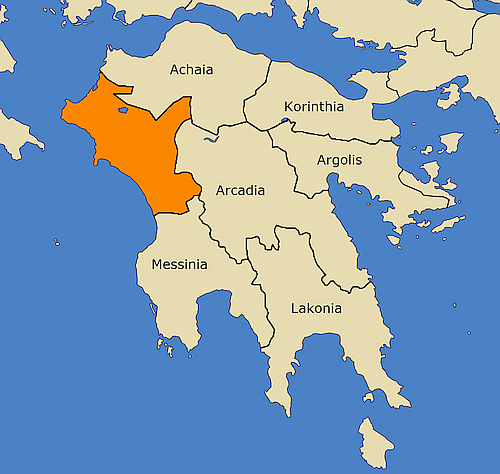
Eleia or Elis is a regional unit in western Peloponnese (2600
km2, 150,000 inhabitants). The district is best known for ancient Olympia. -
See also: site page.
Elektra
1) Daughter of Agamemnon and Klytaimnestra, sister of Orestes and Iphigeneia. She helped her brother Orestes to avenge Agamemnon's death by killing her mother and Aigisthos. Elektra then married Pylades, her brother's best friend. - Tragedies by Aischylos, Sophokles and Euripides.
2) One of the Pleiades.
3) An Okeanid, mother of the goddess Iris and of the Harpies.
Elektryon
1) A son of Perseus and Andromeda. King of Mycenae or Midea, married to Anaxo, the daughter of Alkaios.
2) Diodorus mentions another personage of this name.
Eleusinian
Mysteries
The annual celebration at Eleusis and Athens in memory of the abduction and return of Persephone and in honor f Demeter and Dionysos. It was believed to secure life after death to the participating adepts, but since the rites were strictly secret we know nothing more about it.
Eleusis
Attic city on the Saronic Gulf, linked to Athens by the Sacred Road. Eleusis was a centre of the fertility cult of Demeter and Persephone, which evolved into the Eleusinian Mysteries around 700 BC.
Elgin Marbles

The "Elgin Marbles" are a collection of Classical Greek marble
sculptures made under the supervision of the architect and sculptor Phidias and his
assistants. They were originally part of the temple of the Parthenon and other
buildings on the Acropolis of Athens. - In 1801, Thomas
Bruce, 7th Earl of Elgin obtained a permit from the Ottoman Sublime Porte, which then ruled Greece. From 1801 to 1812,
Elgin's agents removed about half of the surviving sculptures of the Parthenon, as well as sculptures from the
Propylaea and the Erechtheion and transported them
by ship to England. There, the acquisition of the marbles was supported by some, while others like
Lord Byron condemned Elgin's actions for what they were, namely brute vandalism and
looting. After a public debate in Parliament, the marbles were purchased from Elgin by the British government in 1816
and were passed to the British Museum, where they are on display until today. - After gaining its independence from the
Ottoman Empire, Greece began a series of projects to restore its historic monuments, and has doubted the legitimacy of
Elgin's removal of the marbles from the Acropolis and especially the Parthenon. Ever since then has Greece demanded the
return of the collection for their unification in Athens. Although supported by international archaeologists this has
not yet been successful. Also an attempt of the UNESCO in 2014 to mediate has been turned down by the British
Museum.
 Elis
Elis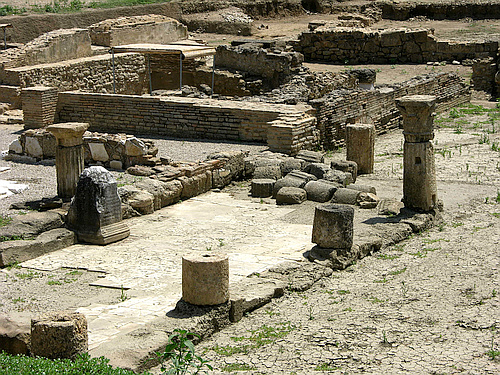
1) The polis of Elis controlled much of the region of Eleia in the Archaic and Classical periods. Since 570 BC it also controlled Olympia, but after the Peloponnesian War (431-404 BC), Elis was subjugated by Sparta and never regained its former status. - See also: site page.
2) Elis may also refer to the region of Eleia as a whole.
Elpis
In ancient Greek mythology the personification of hope. There is the beautiful allegory, that when Epimetheus opened the vessel brought to him by Pandora, from which all sorts of evils were scattered over the earth, Elpis alone remained behind in order to make the world and its sorrows bearable.
Elysium
In ancient Greek religion and mythology, Elysium or the Elysian Fields were a region of the underworld where mortals favoured by the gods and heroes lived a blessed and happy afterlife.
Empedokles
A Greek pre-Socratic philosopher (ca. 490 - ca. 430 BC) from Akragas in Sicily. He was a vegetarian, believed in reincarnation and was the last philosopher who recorded his ideas in verse. He is however best known for introducing the cosmological idea of the four classical elements. He added the forces he called Love and Strife which would mix and separate these elements. His suicide by throwing himself into Mount Etna was variously treated in literature.
Endymion
A beautiful shepherd, with whom Selene, the moon goddess, fell in love. When Zeus gave him the choice of either remaining mortal or of eternal youth, he decided to stay forever young. However, this meant that he went to sleep forever.
Enipeus
A river-god in Thessaly, who was beloved by Tyro, but who refused her advances. Poseidon then assumed the appearance of Enipeus, thus visited her, and she became by him the mother of twins, Pelias and Neleus. - Another river-god of the same name occurs in Eleia, who is also connected with the legend about Tyro.
enkoimeterion
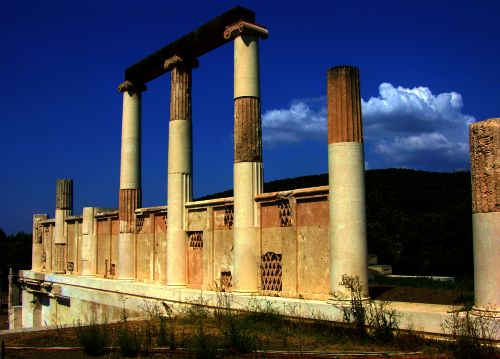
The enkoimeterion was a stoa-like building in the sanctuaries of
Asklepios, in which the sick devotees of the god slept. He appeared to them in their
dream, either curing them instantly or at least recommending the appropriate therapy.
entablature
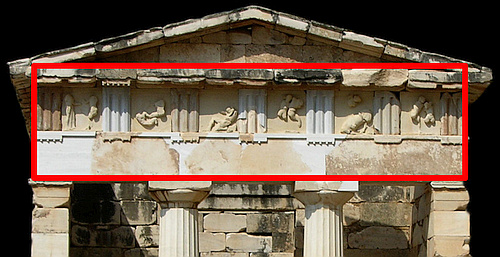
The element of classical temple architecture that lies directly above
the columns, resting on their capitals. An entablature is
divided into the architrave, the frieze, and the
geison.
entasis
Straight columns with a fixed spherical cross-section appear thinner in the middle when viewed from below. Entasis is employed in classical architecture to counteract this by introducing a slight bulge in the lower third of the column. Clearly present in Doric columns, this is later much reduced. Entasis adds stability to the column but it is not clear if the Greeks were aware of this. More probably, entasis was used for aesthetical reasons as part of the optical corrections that make Greek temples appear more organic.
Enyo
1) A Greek goddess of war, originally perhaps a Minoan war goddess, who finds delights in bloodshed and the destruction of cities. In the Iliad she rides into battle on a chariot together with Ares. It is reported that a statue of Enyo was made by the sons of Praxiteles and stood in the temple of Ares at Athens.
2) According to Hesiod one of the Graiae.
Eos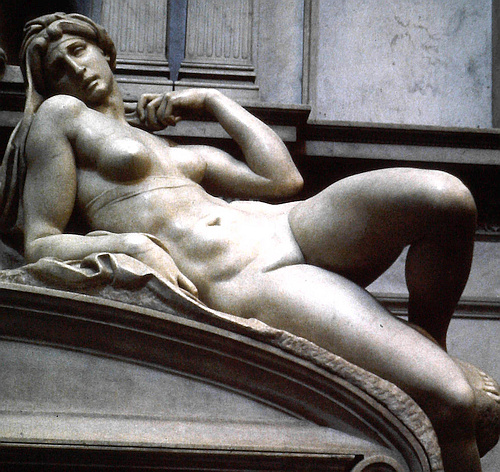
The "rosy-fingered" Greek goddess of dawn that she brings by riding her chariot across the sky. She w
as the daughter of Hyperion and Theia, sister of
Helios and Selene. To
Astraios she bore the winds Boreas, Notos and
Zephyros. Aphrodite punished her for making love to her
consort Ares by inflicting her with an amorous desire for mortals, and so she fell in love
with Tithonos, Kephalos and
Orion. - The Romans called her Aurora.
Epaios
1) He went with thirty ships from the Cyclades to the Trojan War. The most plausible account of the final stage of this war is that Epaios manufactured the Wooden Horse, for which Odysseus had the idea. In the Homeric poems he appears as a mighty warrior but in later traditions he became a proverbial coward.
2) Son of King Endymion of Elis. In a race at Olympia, he ran against his brothers Aitolos and Paion and won his father's kingdom.
Epaminondas
A Theban general and statesman of the 4th century BC, largely praised in his time as an idealist and liberator. He invented and implemented several major battlefield tactics and thus enabled the Theban victory over Sparta in the battle of Leuktra in 371 BC. After the Peloponnesian War Sparta had gained the supremacy in Greece, which was now ended and Thebes emerged as the leading power. Epaminondas achieved another major success by liberating the helots of Messenia, who had been enslaved under Spartan rule for more than 200 years. Apart from transforming Thebes, he re-shaped the political map of Greece. The Roman orator Cicero called him "the first man of Greece", and Michel de Montaigne called him one of the three "worthiest and most excellent men" that had ever lived. Epaminondas was killed in the battle of Mantineia in 362 BC. - The changes that Epaminondas accomplished in Greek politics did not last long. Only 27 years after his death, Alexander the Great razed Thebes to the ground.
Epaphos
In ancient Greek mythology son of Io and Zeus. He was the father of the nymph Libya and founder of the city of Memphis in Egypt.
ephebeum
A large hall in the ancient palaistra furnished with seats, which was used for the exercises of epheboi.
ephebos
A Greek word that designates an adolescent, around the ages of 17-18, or the social status associated with that age. It was mainly used for members of that age group who were trained as soldiers. To this end the ephebe was isolated from his prior community as a child, usually the world of his mother, and subjected to a training, in which he had to hunt, rely on his senses, on aggression, stealth, and trickery to survive. These skills were thought to be needed by a citizen to be able to defend his polis. At the end of the initiation, the ephebe was reincorporated back into society as a man.
 Ephialtes
1) One of the Gigantes. In the war against the gods Apollo took his left eye and Herakles the right one.
2) A son of Poseidon and Iphimedeia.
3) When the Persians made their second invasion of Greece and the Spartans blocked the passage at Thermopylae in 480 BC, it was Ephialtes of Malis who showed the Persians a mountain path to circumvent the Spartan defenses and attack the outnumbered Greeks from the rear. After the defeat of the Greeks, the Spartans put a price on Ephialtes' head and he was eventually killed, but for other reasons.
ephor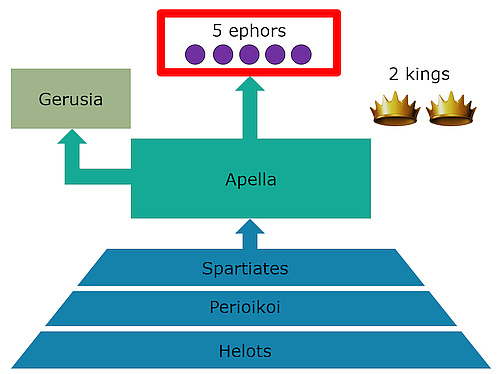
Member of a council of five that ruled ancient Sparta. The ephors were
elected by the Apella to serve for one year. They could not be re-elected and only
Spartiates were eligible. They swore "on behalf of the city", had more power than
anyone else in Sparta and even had some control over the two kings. According to
Herodotus the institution of five ephors goes back to the legendary Lykurgos, while
Plutarch claims that it was a later institution.
 Ephyra
1) The capital of ancient Thesprotia mentioned by Homer. Thukydides describes it as situated in the district Elaeatis in Thesprotia, away from the sea. Near its site is the famous Nekromanteion. First settled during the Bronze Age and resettled in the 14th century BC by colonists most probably from the west Peloponnese.
2) A daughter of Okeanos. Ephyraea, the ancient name of Corinth was derived from her.
Epic Cycle
A collection of Ancient Greek epic poems in daktylic hexameter relating the story of the Trojan War and thus complementing Homer's Iliad. The Epic Cycle contains the Cypria, the Aithiopis, the Little Iliad, the Iliou persis, the Nostoi, and the Telegoneia. Unlike the Iliad, the poems of the Epic Cycle only survived as fragments or summaries from Late Antiquity and the Byzantine period.
Epicharmos
Epicharmos of Kos or Epicharmus Comicus or Epicharmus Comicus Syracusanus (ca. 540 - ca. 450 BC) was a Greek dramatist and philosopher, often credited with being one of the first comic writers. He is mentioned by Aristotle, and Plato refers to him as "the prince of comedy".
 Epidaurus
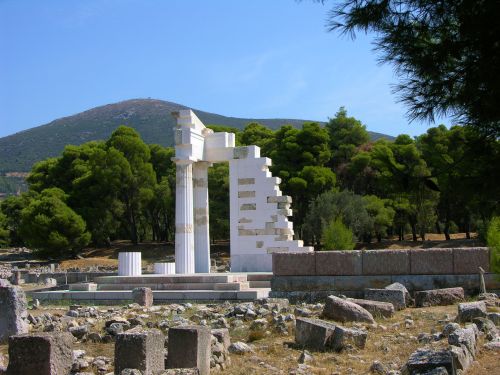
Ancient city in the Argolis. Its
Asklepieion was the most famous healing center and cultic site for Asklepios in the
ancient Greek world. It also features the best-preserved ancient theatre which is still
used for performances today. - See also: site page.
Epigoni
("After-Born") In Greek mythology the children of the Seven Against Thebes. They were: Aigialeus, Alkmaion, Diomedes, Polydoros, Promachos, Sthenelos, and Thersandros. Ten years after the Seven Against Thebes failed, the Epigoni finally conquered Thebes.
Epikaste
1) Another name of Iokaste, the mother of Oedipus
2) There are two other personages of this name.
Epikouros
Ancient Greek philosopher (341 - 270 BC), founder of the school of epikureanism. Of his about 300 written works only some fragments have survived so that much of his teachings are only known from later commentators. For Epikouros the highest goal in life was "pleasure" and that the way to attain this was to live modestly, to gain knowledge of the workings of the world, and to limit one's desires. This would lead to a state of tranquility (ataraxia) and freedom from fear as well as an absence of bodily pain (aponia). The combination of these two states constitutes happiness in its highest form. - Epikouros was an atomic materialist, following in the steps of Demokritos, and this led him to a general attack on superstition and divine intervention. He taught that gods neither reward nor punish humans, that events in the world are ultimately based on the motions and interactions of atoms moving in empty space and that the universe is infinite and eternal.
epikureanism
A system of philosophy based upon the teachings of Epikouros, founded around 307 BC. Although epikureanism is a form of hedonism insofar as it declares pleasure to be its principal goal, the concept that the absence of pain and fear constitutes the greatest pleasure, and its celebration of a simple life, make it a quite different school of philosophical thought. As a consequence, Epikouros and his followers shunned politics because it could lead to frustrations and ambitions conflicting with their pursuit of virtue and peace of mind. - Epikureanism was originally a challenge to platonism, though later it became the main opponent of stoicism. Epikurean societies flourished in the Late Hellenistic era and during the Roman era.
Epimenides
Epimenides of Knossos was a semi-mythical 7th or 6th century BC Greek seer and philosopher-poet.
Epimetheus
("Afterthought") A son of the Titan Iapetos, and the Okeanid Klymene; the brother of Prometheus, Menoitios and Atlas. Prometheus had warned him to be suspicious if Zeus should offer a gift, but Epimetheus did not listen and when Zeus offered him the god-made woman, Pandora, Epimetheus was stupid enough to accept her, thus bringing all the evils into the world.
epinaos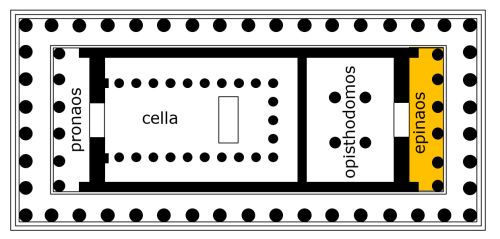
Open vestibule of a Greek temple. The term was not used by ancient
authors but is a modern coinage to distinguish this feature from the opisthodomos.
epinikion
The epinikion (Greek: epi- = "on," and nikê = "victory") is a genre of poetry also known as a victory ode. In ancient Greece it was performed to celebrate an athletic victory in the Panhellenic Games and sometimes in honor of a victory in war. Especially Simonides, Bacchylides, and Pindar contributed to this genre.
Epirote League
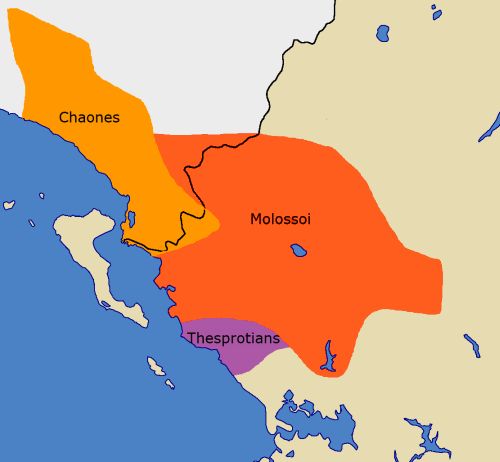
The Epirote League (ca. 370 - 170 BC) was an ancient Greek coalition, or koinon, of the three main
tribes of Epirus, i.e. Molossoi,
Thesprotians, and Chaones. The political, economic, and cultural center of the
Epirote League was Dodona. In the Third Macedonian War (171 - 168 BC), the League broke
up, when the Molossoi sided with the Macedonians and the Chaones and Thesprotians
supported the Roman Republic.
Epirus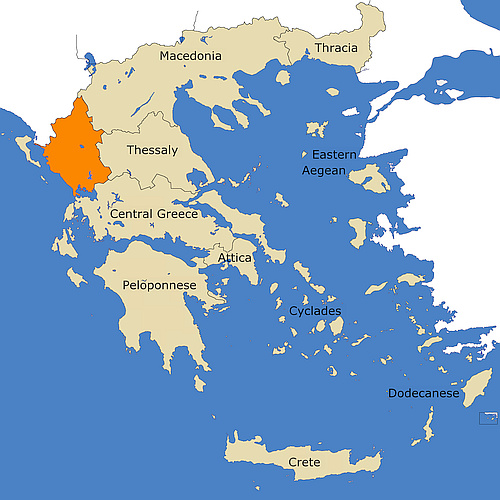
Administrative region of Greece (9200 km2, 320,000 inhabitants) including Arta, Ioannina,
Preveza, and Thesprotia. In antiquity, it was a kingdom, later a republic, in
north-western Greece and southern Albania.
Erasistratos
1) Erasistratos (ca. 304 - ca. 250 BC) was a Greek anatomist and royal physician under Seleukos I Nikator. Together with his colleague Herophilos, he founded a school of anatomy in Alexandria, where they carried out anatomical studies. From these, Erasistratos concluded that the heart was not the center of sensations, but instead it functioned as a pump.
2) One of the Thirty Tyrants who ruled Athens after the end of the Peloponnesian War (431 - 404 BC).
Erato
1) ("The Lovely") One of the nine muses, associated with love poetry.
2) One of the Nereids, the fifty daughters of Nereus and Doris.
Eratosthenes
1) Eratosthenes of Kyrene (ca. 276 - ca. 195 BC) was a Greek mathematician, geographer, astronomer, music theorist, and poet. With his profound knowledge in every area of learning he became the chief librarian at the Library of Alexandria. - He was the first person to calculate the circumference of the Earth (with an astonishing accuracy), the first to calculate the tilt of the Earth's axis (again with remarkable accuracy), he calculated the distance from the Earth to the Sun and invented the leap day. He invented the discipline of geography, created the first map of the world, incorporating parallels and meridians based on the available geographic knowledge of his time, and was the founder of scientific chronology. In number theory, he introduced what is now known as the "sieve of Eratosthenes", a still popular and efficient method of identifying prime numbers.
2) One of the Thirty Tyrants who ruled the city of Athens after the end of the Peloponnesian War (431 - 404 BC).
Erebos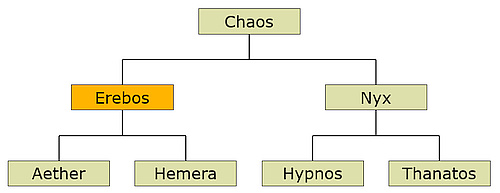
Greek god of darkness, appearing early in the creation of the world. Personified he is a son of
Chaos and father of Aether (the upper air) and
Hemera (day). It is said that he lived in the underworld
- below the earth but above the tartaros.
Erechtheion
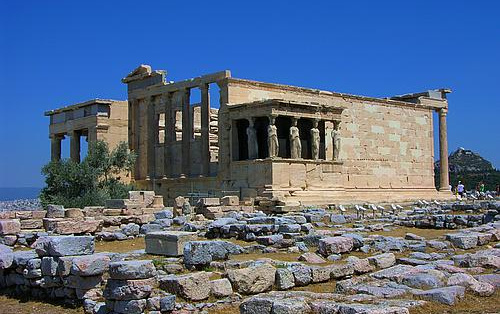
Ionic temple on
Athens' acropolis, dedicated to Athena. There were also
cults of Poseidon, Erechtheus and
Hephaistos. - See also:
site page.
Erechtheus
Mythical king of Athens, son of Pandion, grandson of Erichthonios. Little else is known of Erechtheus or his predecessors.
Eretria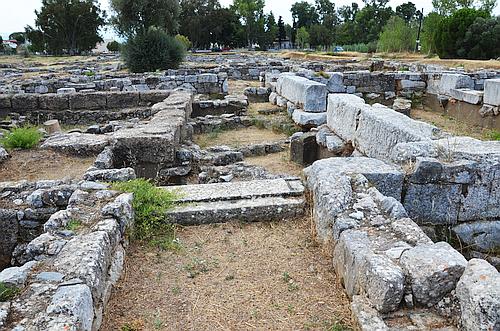
("City of the rowers") A town in Euboea, facing the coast of
Attica. At the beginning of the 8th century BC, Eretria became one of the most important
cities in Greece, with commercial ties around the whole Mediterranean. In 490 BC it was
sacked by the Persians because it had supported the Ionian Revolt and then
became a member of the Delian League. In 411 BC, the Euboean cities freed themselves
from Athenian domination, and in the 4th century Eretria flourished again. At the end of
the 4th century BC, Eretria came under the domination of Macedonia. In 198 BC it was
captured by the Romans and was abandoned in late antiquity. - See also: site page.
erga
--> athloi
Ergotimos
A Greek potter, active in Athens, circa 570 - 560 BC. Seven works signed by him are known, six of which were painted by Kleitias, showing the close collaboration of the two craftsmen.
Eriboia
--> Periboia
Erichthonios
1) Legendary king of Athens, son of Hephaistos and Gaia. He was the father of Pandion and had a snake-like appearance.
2) The son of Dardanos and the second ruler of Troy. His son was Tros, from whom the Trojans derived their name.
Erigone
1) A daughter of Ikarios, seduced by Dionysos, who came into her father's house.
2) A daughter of Aigisthos and Klytaimnestra, and by Orestes the mother of Penthilos. According to some traditions, she killed herself when she heard that Orestes was acquitted by the Areopagus.
3) There is a third personage of this name.
Erigyios
Erigyios was a general in the army of Alexander the Great, and brother of Laomedon of Mytilene. He was banished by Philip II, king of Macedon, because of his close attachment to Alexander, and returned after the death of Philip in 336 BC. Later he accompanied Alexander on his campaign in Asia, commanded his cavalry and was killed in a battle in 328 BC.
Erinna
An ancient Greek poetess (fl. first half 4th century BC). She is best known for her long poem, the Distaff, a three-hundred line hexameter lament for her friend Baukis, who had died shortly after marriage.
Erinyes
("the Mist-Walking") In Greek mythology the three Furies Alekto, Megaira, and Tisiphone. They sprang
up from the blood of Uranos when he was castrated by Kronos.
They pursue evildoers, especially murderers, relentlessly to drive them into madness and suicide. As an euphemism they
were also called Eumenides ("the Kindly Ones").
Eriphyle
Wife of Amphiaraos, and the mother of Alkmaion. Bribed by Polyneikos with the cursed necklace of Harmonia, she induced her husband to join the Seven Against Thebes where Amphiaraos lost his life, and thence Eriphyle was killed by Alkmaion avenging the death of his father.
Eris
In ancient Greek mythology the goddess of discord; friend and sister of Ares. By Zeus, she was the mother of Ate; she is also associated with a variety of beings representing man's misfortunes. With Ares she delights in the havoc of war, increases the moaning of men on the battlefield and is insatiable in her desire for bloodshed. - When she was the only goddess not invited to the wedding of Peleus and Thetis, she threw a golden apple with the inscription "to the fairest" into the midst of the party. Three mighty goddesses - Hera, Athena and Aphrodite - each claimed to be the fairest, so Zeus chose Paris to decide the contest. Paris decided in favour of Aphrodite, who promised him the fairest woman, and when Paris carried off Helena from Sparta, he provided the mythological basis of the Trojan War.
eromenos
In ancient Greece the younger and passive (or 'receptive') partner in a male homosexual relationship.
Eros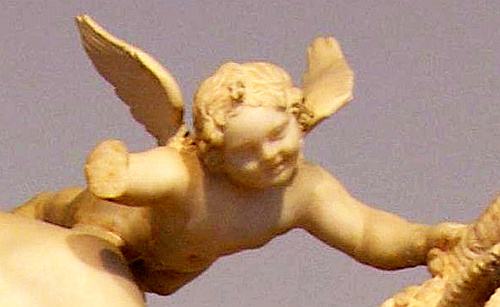
In mythology, the god of love. However, the ways in which he was conceived are so different that we may almost speak of two different personages. While Homer does not mention Eros, Hesiod describes him as a cosmogonic Eros. First, he says, there was Chaos, then Gaia, Tartaros, and Eros, the fairest among the gods. Eros was one of the fundamental causes in the formation of the world, the uniting power of love, which brought order and harmony among the conflicting elements of which Chaos consisted. In this metaphysical sense he was also conceived by Aristotle and other philosophers.
The Eros of later poets is, on the contrary, one of the youngest gods.
Ersa
--> Herse
Erymanthian Boar
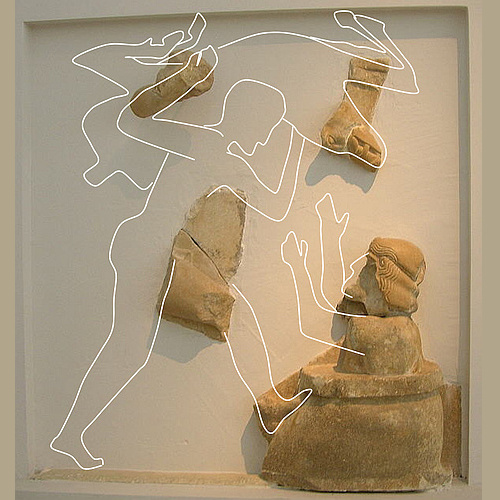
Wild boar roaming in Arcadia. Herakles
had to capture the boar alive as his Fourth Labor. When he brought the boar to
Eurystheus he was so frightened that he hid in a jar.
Erysichthon
(Greek: "the tearer up of the earth")
1) A son of Triopas, who cut down trees in a grove sacred to Demeter. The goddess punished him with insatiable hunger.
2) A son of Kekrops and Agraulos.
Eteocretans
The earliest autochthonous inhabitants of Crete. After the arrival of the Dorian Greeks on the island they were pushed back to eastern Crete.
Eteokles
1) The eldest son of king Oedipus and Iokaste of Thebes. The sisters of Eteokles were Antigone and Ismene. - Before Oedipus was born, the oracle at Delphi predicted that he would kill his father and marry his mother. The prophecy came true and the children of this incestuous relation were also cursed. In a sense, Eteokles was the son and brother of Oedipus. - After Oedipus blinded himself and went into exile Eteokles seized the power in Thebes and expelled his brother Polyneikos. When Polyneikos returned with the Seven against Thebes the two brothers killed each other in personal combat. Their uncle Kreon now became king of Thebes and ordered a heroe's funeral for Eteokles and that the body of Polyneikos was to be left unburied.
2) A son of Andreus and Euippe. He was said to have been the first to offer sacrifices to the Charites at Orchomenos in Boeotia.
Eteonicus
Eteonicus was a Spartan commander during the Peloponnesian and Corinthian Wars. He participated in many key engagements, held important commands, but his contributions appear not particularly influential.
ethics
Ethics or moral philosophy is a branch of philosophy that investigates the questions "What is the best way for people to live?" and "What actions are right or wrong in particular circumstances?" Thereby, it seeks to resolve questions of human morality, by defining concepts such as good and evil, right and wrong, virtue and vice, justice and crime.
Euadne
1) A daughter of Poseidon and Pitane. Immediately after her birth, she was carried to king Aipytos, who brought her up. By Apollo she became the mother of Iamos.
2) A nymph, daughter of the river Strymon and Neaira. She was the wife of Argos and mother of Ekbasos, Peirasos, Epidaurus and Kriasos.
3) There are three other mythical personages of this name.
Euandros
1) A son of Hermes by an Arcadian nymph. He is said to have led a Pelasgian colony from Arcadia into Italy, where he taught his neighbours milder laws and the benefits of peace and social life, and especially the art of writing, with which he himself had been made acquainted by Herakles, and music. According to Virgil, he allied with Aeneas when the latter arrived in Italy.
2) A son of Priam.
3) A son of the Lykian king Sarpedon, who fought in the Trojan war.
Euboea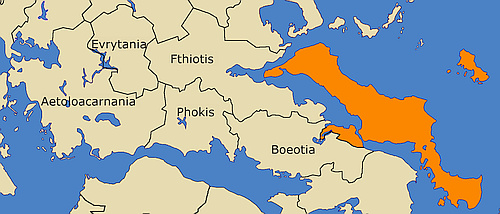
1) (Euboia, Evvia) The second largest Greek island and a regional unit (4200 km2, 211,000
inhabitants) of Greece. The island is located close to the eastern coast of mainland Greece, from which it is separated
by the Euripus Strait. In antiquity inhabited by Ionians, Euboea joined the
Athenian League in the 5th century BC, was independent 411 - 338 BC, then under
Macedonian rule.
2) A daughter of the river-god Asopos, from whom the island of Euboea was believed to have derived its name.
3) A nymph, daughter of the river Asterion.
4) There are two more mythical personages of the same name.
Euboulos
1) Euboulos (ca. 405 - ca. 335 BC) was an Athenian statesman, quite influential in the city's politics during the period 355 BC to 342 BC. In this time he controlled the finances of Athens and is credited with bringing a remarkable degree of prosperity. As member of the "peace party", he opposed the politics of Demosthenes.
2) In Greek mythology, a surname of several divinities indicating their good counsel.
eudaimonia
(Greek: eu = "good" and daimon = "spirit") A Greek word meaning "human flourishing" which was considered in ancient Greek philosophy as the highest human good and therefore the aim of ethics and political philosophy. Among the many forms of ancient eudaimonism are two most influential. For Aristotle, arete ("virtue" or "excellence") and phronesis ("practical or ethical wisdom") are the main constituents in eudaimonia, but he also acknowledges the importance of external goods such as health, wealth, and beauty. For the Stoics, on the other hand, virtue alone is necessary and sufficient for eudaimonia, thus denying the necessity of external goods.
Eudamidas II
The 24th king of Sparta of the Eurypontid dynasty. He ruled from 275 BC to 244 BC. Two of his sons, his successor Agis IV and Archidamos V, were later Eurypontid kings of Sparta.
Eudemos
Eudemos of Rhodos (ca. 370 - 300 BC) was an ancient Greek philosopher. He went to Athens to study philosophy at Aristotle's Peripatetic School. He was generally considered to be one of Aristotle's most brilliant pupils: in fact, he and Theophrastos were regularly called not Aristotle's "disciples", but his "companions". Eudemos's collaboration with Aristotle was long-lasting and close, and it is his merit to have formalized Aristotle's philosophical legacy.
Eudora
1) On of the Hyades.
2) One of the fifty daughters of Nereus and Doris, known as the Nereids.
3) An Okeanid.
Eudoxus
Eudoxus of Knidos (ca. 390 - ca. 337 BC) was a Greek astronomer and mathematician, student of Plato. All of his works are lost, only fragmentary comments are preserved. Attributed to him is the novel idea of the 4th century BC that describes the seemingly chaotic wandering of the planets by reducing this to a combination of uniform circular orbits, centered around a spherical earth in a geocentric system.
Eugammon
Eugammon of Kyrene (fl. 567/6 BC) was an early Greek poet. The epic Telegoneia was ascribed to him. According to another source, he stole it from the legendary early poet Mousaios, which could mean that Eugammon wrote down a version of a long-existing traditional epic.
Euhemeros
Euhemeros (Greek: "happy", "prosperous"; fl. late 4th century BC), was a Greek mythographer at the court of the Macedonian king Kassandros. He was convinced that many mythological tales can be attributed to historical persons and events, the accounts of which have become altered and exaggerated over time. In antiquity, he was therefore seen as an atheist.
Eukleia
In Greek mythology the female personification of honor, glory, and good repute. She was said to be a member of the "younger Charites".
Euklid
Euklid ("renowned, glorious") was a Greek mathematician who lived around 300 BC. Often called "father of geometry" he spent his career in Alexandria. In his Elements he deduced theorems from a small set of axioms, establishing what is now known as Euclidean geometry. This treatise is one of the most influential works in the history of mathematics, dominating the field of geometry from its publication until the late 19th or early 20th century. He also wrote works on perspective, conic sections, spherical geometry, and number theory. Many of his texts must be counted among the lost works.
Eumaios
In the Odyssey the faithful swine-herd of Odysseus. - When Odysseus returned home to Ithaka in the disguise of a beggar, Eumaios welcomed "the stranger" and later fought by Odysseus' side to reclaim his wife and home.
Eumelos
1) Eumelos of Corinth is a semi-legendary early Greek poet to whom several epic poems were attributed. Later writers also ascribed the Nostoi to Eumelos.
2) A son of Admetos and Alkestis. He was one of the suitors of Helena and led the Achaean forces of Pherai and Iolkos in the Trojan War.
Eumenes
Eumenes of Kardia (ca. 362 - 316 BC) was a Greek general. In the wars of the diadochi he supported the Macedonian Argeads.
Eumenides
--> Erinyes
Eunomia
("Order") One of the Horai.
Eupalinos
Eupalinos of Megara (fl. 6th century BC) was an ancient Greek engineer. To bring water to the city-state of Samos he constructed a 1,036 meters long tunnel, the "Tunnel of Eupalinos" still to be seen today, by digging from both sides through a limestone hill in 550 - 530 BC. It is regarded as a major feat of ancient engineering.
eupatridai
Eupatridai (Greek: "good fathered") refers to the ancient nobility of Attica. Tradition ascribes to Theseus the synoikismos, i.e. the civic union of Attica and the division of its population into three classes: eupatridai, geomoroi and demiourgoi. Although the eupatridai were very probably not all autochthonous, they were the descendants of the royal stock and in very early times, being members of a phratria, were the only full citizens of Athens with a monopoly on political rights.
Euphemos
1) A son of Poseidon by Europa; he was married to Laonome, the sister of Herakles. Euphemos took part in the Kalydonian Hunt and was the helmsman of the Argonauts. When the Argonauts carried their ship in Libya to the coast of the Mediterranean, Triton wanted to do them a favour and offered a clod of Libyan earth. Euphemos accepted and with this received for his descendants the right to rule over Libya.
2) A descendant of the river Axios; father of Eurybaros.
3) The Iliad mentions another personage of this name.
Euphorbos
A son of Panthoos and brother of Polydamas, was one of the bravest among the Trojans. He wounded Patroklos in a fight but was then slain by Menelaos, who later dedicated the shield of Euphorbos in the Argive Heraion. - The story goes that Pythagoras claimed to be the reincarnation of Euphorbos, having changed from a warrior to a philosopher.
Euphorion
1) Euphorion was the son of the Greek tragedian Aischylos, and himself an author of tragedies. In the Dionysia of 431 BC, Euphorion won the first prize, defeating both Sophokles (second prize) and Euripides (third prize). There are some indications that he may be the author of Prometheus Bound, previously attributed to his father.
2) Euphorion of Chalkis (fl. 3rd century BC) was a Greek poet and grammarian. In Athens, he achieved much prosperity, studied philosophy with Lakydes, and then became the student and eromenos of the poet Archeboulos. Around 221 BC he was invited by Antiochus the Great to the court of Syria, where he contributed to the formation of the royal Library of Antioch, of which he held the post of librarian till his death. Euphorion's elegies were highly esteemed by the Romans.
3) Euphorion (Greek: "the abundant") in Greek mythology was, according to a less known tradition, the son of Achilles and Helena, born after the death of his parents. For unknown reasons, Zeus killed him with a thunderbolt.
Euphranor
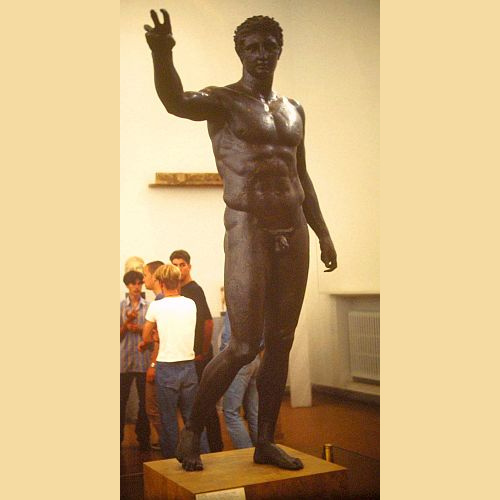
Euphranor of Corinth (fl. middle of the 4th century BC) was the only
known Greek artist who excelled both as a sculptor and as a painter. The "Ephebos of Antikythera" (ca. 340 BC) is
tentatively ascribed to him. However, no known existing statues could be ascribed to Euphranor with certainty, although
Pliny the Elder provides a list of his works.
Euphronios
Euphronios (ca. 535 - after 470 BC) was an ancient Greek vase painter and potter active in Athens at the transition from Late Archaic to Early Classical art. He was one of those artists who effected the change from the black-figure to the red-figure style, and in the latter he became one of the most important vase painters and one of the first known artists in history to have signed his work.
Euphrosyne
("Mirth") One of the Charites.
Eupolis
Eupolis (ca. 446 - ca. 411 BC) was an Athenian poet of the Old Comedy.
Euripides
One of the greatest ancient Greek dramatists from Athens (ca. 485 - 406 BC). There are 92 dramas ascribed to him, 75 are known by title, and 19 are preserved: "Alkestis", "Medea", "Herakleidae", "Hippolytus", "Andromache", "Hekuba", "The Suppliants", "Elektra", "Herakles", "The Trojan Women", "Iphigenia in Tauris", "Ion", "Helen", "Phoenician Women", "Orestes", "Bacchae", "Iphigenia at Aulis", "Rhesus" (authorship disputed), "Cyclops". - Euripides used historical themes for his plays to present their characters in situations of high drama and noble sacrifice. His influence on western literature exceeded even that of Aischylos and Sophokles.
Euripus Strait
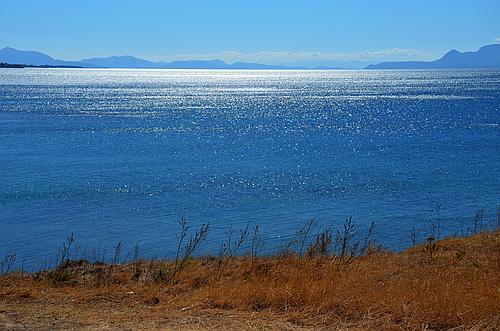
A narrow channel of water between the island of Euboea and
Boeotia in mainland Greece. At the strait's narrowest point lies Chalkis, the strait's
principal port. Remarkable about the strait is the presence of strong tidal currents, unlike elsewhere in the Eastern
Mediterranean.
Europa
1) A daughter of Agenor; Zeus, who had metamorphosed himself into a bull, carried her off from Phoenicia to Crete. There she bore him three sons: Minos, Sarpedon and Rhadamanthys. After his daughter Europa had been carried off, Agenor sent out his sons Kadmos, Kilix, Phineus, Phoinix, and Thassos to search her and told them not to return without their sister. Since Europa could not be found, none of them returned and all settled in foreign countries.
2) A daughter of Okeanos and Tethys.
3) The mother of Euphemos by Poseidon.
4) A surname of Demeter.
Euros
The personification of the east wind. See also: anemoi.
Eurotas
1) The main river of Lakonia and one of the major rivers of the Peloponnese. It is fed by tributaries from Mt. Taygetos and Mt. Parnon. The river is 82 km long, flows in a north-south direction and empties into the Lakonian Gulf.
2) Father of Sparta, the wife of Lakedaimon. He is said to have drained the the plain of Lakedaimonia by building a canal, calling the river which originated from this after his own name, Eurotas.
Euryale
("Wide-Wanderer") One of the three Gorgons, daughters of Phorkys and Keto. She and her sister Stheno chased Perseus after he beheaded Medusa, but he escaped.
Euryalos
1) Mentioned by Apollodorus as one of the Argonauts, he also took part in the conquest of Thebes as one of the Epigoni, and he accompanied Diomedes to Troy where he was one of the bravest heroes, and slew several Trojans.
2) One of the suitors of Hippodameia.
3) A son of Odysseus.
4) There are four other mythical personages of this name.
Eurybaros
A son of Euphemos, who killed the monster Sybaris that terrorized the region of Krissa in Phokis.
Eurybiades
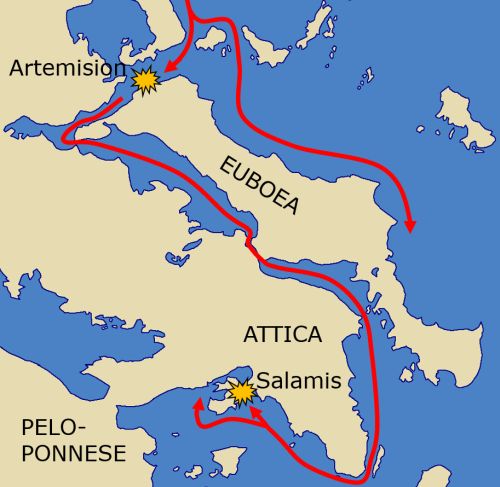
Eurybiades was the Spartan commander in charge of the Greek navy
during the Second Persian invasion of Greece (480-479 BC). In spite of the
Athenians' superior naval skill, the Peloponnesian
city-states led by Sparta, did not accept an Athenian superior command, fearing the growing power of Athens. For all the
enmity between the two, Eurybiades was ultimately assisted by the Athenian naval commander
Themistokles. - The decision was to sail to Cape
Artemision on the northern tip of Euboea to await the
Persians there. When the Greek fleet arrived, the Persians were already there, so Eurybiades ordered a retreat,
although the Euboeans begged him to stay. The Euboeans then bribed Themistokles to keep the fleet there and according to
Herodotus he used some of his bribe to pay off Eurybiades. The ensuing sea Battle of
Artemision was indecisive, but the Greeks could not bear further losses and sailed south, heading for Piraeus. A part of
the Persians fleet was sent eastward around Euboea, but a terrible storm destroyed almost the complete contingent. The
other Persian ships followed the Greeks through the Euripus Strait. - Eurybiades wanted to
continue the battle at the isthmus of Corinth, but Themistokles saw better naval tactical
advantages at Salamis. He threatened to withdraw the Athenian fleet, the largest
contingent of the Greek forces. After Themistokles tricked the Persian king Xerxes I into
sending part of his fleet around the island of Salamis to blockade the Greek fleet in the south, Eurybiades had no
choice. The Battle of Salamis then was a decisive victory for the Greeks. After the battle Eurybiades did not want to
chase the retreating Persian fleet, but wanted Xerxes to be able to escape rather than have him remain in Greece where
he would possibly renew the land war. - Back in Sparta Eurybiades was rewarded with an olive wreath for his success at
Salamis and Themistokles received a similar award in Athens.
Eurydike
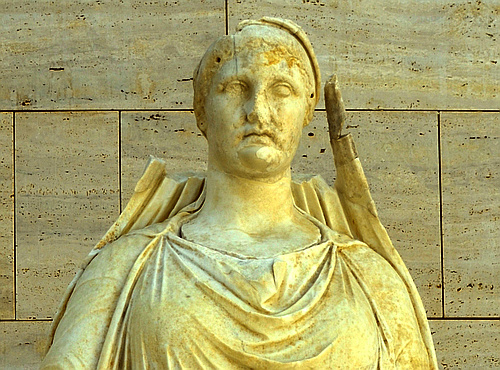
1) Eurydike I was an ancient Greek queen from Macedon, wife of king
Amyntas III of Macedon. She was the mother of four children:
Alexander II, Perdikkas III,
Philip II, all of whom would be crowned kings, and of a daughter Eurynoe. Through her
son Philip, she was the paternal grandmother of Alexander the Great. She is the first
known royal woman who actively took political influence, playing an important role in Macedonian public life according
to inscriptions and literary documents. Her aggressive political agenda marks a turning point in Macedonian
history.
2) A dryad, married with the magical musician Orpheus. When she was pursued by amorous Aristaios she fled and was bitten by a deadly adder.
3) One of the Danaides.
4) A daughter of Adrastos and mother of Laomedon.
5) A daughter of Lakedaimon and wife of Akrisios.
6) A daughter of Klymenos and wife of Nestor.
7) The wife of Lykurgos and mother of Archemoros / Opheltes.
8) In the tragedy Antigone by Sophokles the wife of Kreon, king of Thebes.
9) In the Cypria the wife of Aeneas.
Eurykleia
1) According to a Thessalian tradition, a daughter of Athamas and Themisto, and the wife of Melas.
2) A daughter of Ops, was purchased by Laërtes, brought up Telemachos and nursed Odysseus. When he returned home in the disguise of a beggar, she was the first person to recognized him by a scar.
Eurymachos
1) In the Odyssey, Eurymachos, son of Polybos, is one of the main suitors of Penelope, next to Antinous. Homer describes him as arrogant, disrespectful, and not cherishing Greek hospitality. He also arranges for the death of Odysseus' son, Telemachos, but fails. When Odysseus returns and first kills Antinous, Eurymachos appeals to Odysseus and puts all the blame on Antinous. But Odysseus is not to be deterred, so Eurymachos runs at him with his sword and Odysseus kills him with an arrow shot into his chest.
2) A son of Antenor and Theano.
Eurynome
1) A daughter of Okeanos, and by Zeus the mother of the Charites. When Hera expelled Hephaistos from Olympos she and Thetis received him in the depths of the sea.
2) A daughter of Okeanos. Prior to Kronos and Rhea, Eurynome and Ophion had ruled in Olympos over the Titans, but after the leadership went to Kronos, she disappeared into tartaros.
3) A surname of Artemis used at Figalia in Arcadia.
4) There are four more mythical personages of this name.
Eurypontids
One of the two lines of Spartan kings. Ancient Sparta was ruled by two kings simultaneously, representing two different lines: the Agiads and the Eurypontids. According to tradition they were the descendants the twins Eurysthenes and Prokles, who themselves were descendants of Herakles. He is said to have conquered Sparta two generations after the Trojan War.
Eurypylos
1) A Greek hero, son of Poseidon and Kelaino, presented in the Iliad. He led forty ships to Troy and was one one of those who offered to fight with Hektor. He slew many a Trojan, and when he himself was wounded by Paris, he was cured by Patroklos. According to tradition, he was married to Sterope, the daughter of Helios, by whom he became the father of Lykaon and Leukippos.
2) A son of Poseidon and Astypalaia, was king of the island of Kos. There are different traditions of why he was killed by Herakles.
3) A son of Telephos and Astyocheia, was king of Moesia or Cilicia. He assisted the Trojans against the Greeks, killed Machaon, but was himself slain by Neoptolemos.
Eurysthenes
1) In ancient Greek mythology one of the Heraklids, a great-great-great-grandson of Herakles, and a son of Aristodemos. Together with his twin brother Prokles he received the land of Lakedaimonia and became the mythic founder of the Agiad dynasty of the kings of Sparta, and father of his successor, Agis I.
2) A son of Aigyptos. He was killed by his wife, one of the Danaides.
Eurystheus
King of Mycenae (or Argos?), cousin of Herakles. Zeus had promised that the next son born in the line of Perseus would rule Argos (and / or Mycenae), convinced that this would be Herakles, the son he would have with Alkmene. But jealous Hera delayed Herakles' birth so that Eurystheus was born first and became king. As such, he required the seemingly impossible Twelve Labors ("athloi") from Herakles. Later, Eurystheus persecuted the Heraklids, whom no one offered refuge except Iolaos, who finally beheaded Eurystheus.
Eurytion
 1) A
centaur who began the fight against the Lapiths during the
wedding of Peirithoos and Hippodameia. He was
killed by Herakles.
1) A
centaur who began the fight against the Lapiths during the
wedding of Peirithoos and Hippodameia. He was
killed by Herakles.
2) A giant, who herded the cattle of Geryon. Herakles killed him when he accomplished his tenth Labour.
3) Possibly one of the Argonauts.
Eurytos
1) A Spartan soldier who accompanied Leonidas to the Thermopylae. However, he and another soldier named Aristodemos had an ailment of the eye and could not fight. Leonidas released both men from their duty, but when the Persians broke through, Eurytos joined the fighting and was killed in accodance with the Spartan ideals of bravery and manhood.
2) King of Oekhalia, a son of Melaneus and Stratonike. He was a skilful archer and is even said to have instructed Herakles in his art. According to the Homeric poems Eurytos was killed by Apollo whom he presumed to rival in using the bow.
3) A son of Hermes and Antianeira, and brother of Echion, was one of the Argonauts.
4) There are three more mythical personages of this name.
eustyle
A colonnade with an intercolumniation of two-and-a-half column-diameters. In classical architecture this spacing was regarded as the most aesthetic.
Euterpe
("Delightful") The muse of music and lyric poetry.
Euxine
An old Greek name of the Black Sea.
Euxitheos
A master potter from the late sixth century BC.
Evans
Sir Arthur Evans (1851-1941) was an English archaeologist, most famous for his excavation of the palace of Knossos. He followed Heinrich Schliemann's concept of a Mycenaean civilization in the Bronze Age, but in the course of his work he realized that on the basis of the structures and excavated artifacts a separate Minoan civilization must be recognized. As a pioneer of the study of Aegean civilizations in the Bronze Age he also found and recognized the scripts Linear A and Linear B as well as an earlier pictographic writing. - Evans was no politician or official statesman but unofficially participated in negotiations with foreign powers in the Balkans. As representative of revolutionary organizations he played an important role in the formation of Yugoslavia.
Evvia
--> Euboea
ewer
A jug with a wide spout, used to carry water.
exedra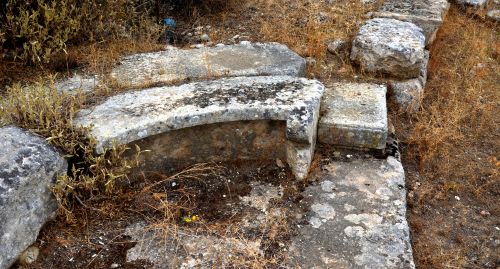
An often semicircular structure of moderate size with seats. It was used in ancient Greece as a place
for discussions.
Exekias
An ancient Athenian vase painter and potter (fl. ca. 545 - 530 BC). He worked in the black-figure style and is regarded as an artistic visionary by art historians. His masterful use of incisions in his paintings and the superb compositions make him one of the greatest of all Attic vase painters. The Andokides Painter and the Lysippides Painter were his students.
exomis
The exomis (Greek: exo = "outside" + omos = "shoulder") was a Greek tunic used by workers and light infantry since the late 5th century BC.
exonarthex
--> narthex
extramural
Outside the walls; a term especially applied to burials outside the city walls.

