
GREECE
 GLOSSARY
| A | B | C | D |
| E | F | G | H |
| I | J | K | L |
| M | N | O | P |
| Q | R | S | T |
| U | V | W | X |
| Y | Z |
2026-01-21
color code:  = mythology;
 = history & culture;
  = geography;
  = archaeology &
architecture
= archaeology &
architecture
Macedonia
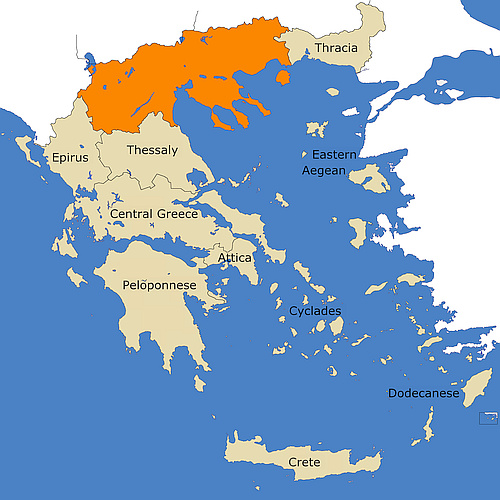
A geographic region of north-central Greece (34,000 km2, population 2,400,000). It
includes the Chalkidiki, Drama, Emathia, Florina, Grevena, Kastoria, Kavala, Kilkis, Kozani, Pella, Pieria, Serres,
Thessaloniki, and the autonomous region of Mount Athos. - Throughout history, the definition and boundaries of Macedonia
have changed considerably. In antiquity, its heyday was under the rule of Philip II
and his son, Alexander the Great.
Machaon
A son of Asklepios (or of Poseidon). He went to the Trojan War with thirty ships, together with his brother Podaleirios. There both appear as the surgeons of the Greeks. In the fights, Machaon was wounded by Paris, and was carried from the battlefield by Nestor. He is also mentioned as one of the Greek warriors hiding in the Wooden Horse and to have cured Philoktetes. Machaon was killed by Eurypylos, and Nestor brought his remains to Messenia, where a sanctuary and healing center was erected in his honour.
magazine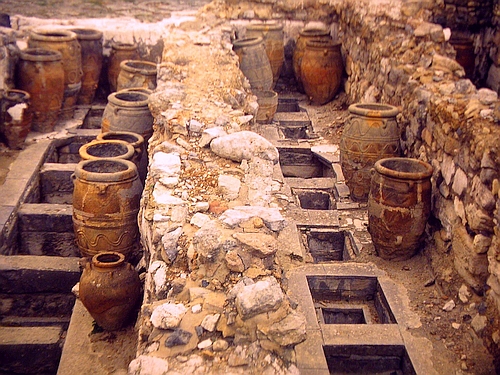
A room in a palace or house, or a separate building, used for storing and containing large jars for
cereals or liquids.
 Magna Graecia
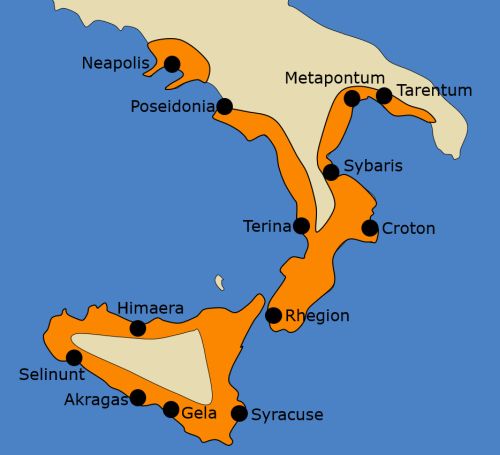
(Latin: "Great Greece") The name given by the Romans, especially Ovid, to
the coastal areas of Southern Italy including Sicily. Since the 8th century BC this territory was extensively
colonized by the Greeks who founded there settlements like Croton, Sybaris, Cumae,
Neapolis, and Syracuse.
Magnesia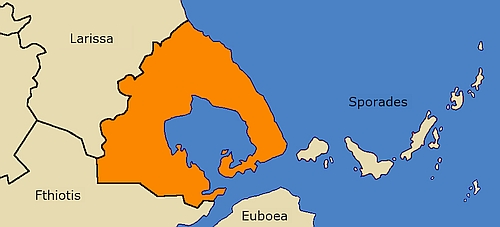
One of the regional units of Greece, part of the region of Thessaly.
The capital is Volos. It surrounds the Pagasetic Gulf, a bay of the Aegean Sea, leaving only a narrow channel. The
wooded Pelion mountain range (highest altitude 1,624 metres) closes off the Gulf on the east and south side.
magoula
--> toumba
Maia
A daughter of Atlas and Pleione. She was the eldest of the Pleiades, and by Zeus became the mother of Hermes. She also nurtured Arkas, the son of Zeus by Kallisto.
mainades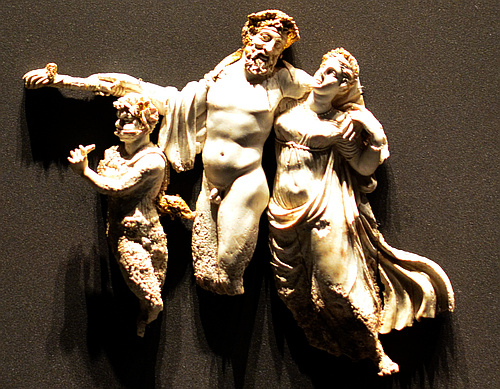
The female devotees of Dionysos.
Maira
1) The faithful dog of Ikarios, placed amongst the stars as the constellation Canis Major.
2) A daughter of Nereus.
3) A daughter of Proitos and Anteia. She was one of the companions of Artemis, who killed by her after she had become by Zeus the mother of Lokros.
4) A daughter of Atlas. She married Tegeates, the son of Lykaon.
5) There is another mythical personage of this name.
Manto
1) A daughter of the Theban soothsayer Teiresias, having herself prophetic powers. When the Epigoni captured Thebes, she and other captives were dedicated to Apollo at Delphi, and the god sent them to Asia, where they founded another sanctuary of Apollo. - Previoulsy, according to Euripides, Manto had become mother of Amphilochos and Tisiphone, by Alkmaion, leader of the Epigoni.
2) A daughter of the soothsayer Polyeidos.
3) A daughter of Herakles, is likewise described as a prophetess.
Marathon
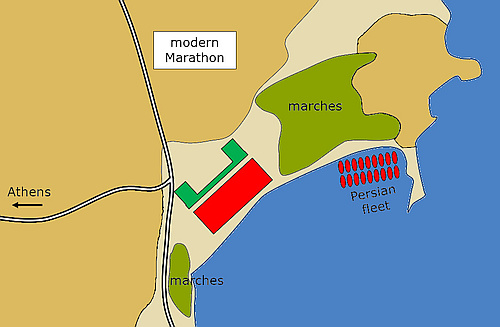
1) A town in Attica, the site of a famous battle in 490 BC during the
first of the Persian Wars. - When Darius had crushed
the Ionian Revolt in 494 BC, he was resolved to burn
Athens and Eretria, and to subjugate all of Greece. The Persian invasion began in
490 BC under the command of Datis and Artaphernes. After capturing the Cyclades and
Eretria, the Persians landed in the bay of Marathon, where they were awaited by the Athenians under the command of
Miltiades, accompanied by a few hoplites from Plataiai. The
Athenian side with some 10,000 men was heavily outnumbered by the Persians with 25,000 infantry. Their cavalry of 1000
men could not be deployed because of the marshes on the sides of the battlefield and more than 100,000 armed oarsmen
were left to defend the ships. Miltiades ordered the attack with heavily reinforced flanks, luring the Persians into his
center. There, they were enveloped by the inward wheeling Athenian flanks and fled in panic to their ships. On their
flight a large number of Persians were killed. According to Herodotus 192 Athenians
were killed and 11 Plataians with 6,400 casualties on the Persian side, who also lost seven ships. This defeat marked
the end of the first Persian invasion of Greece, and the Persian force retreated to Asia. - The heroic tale of the
runner who was sent from Marathon to Athens to announce that the Persians had been defeated, and died from exhaustion,
is a later invention. The name of the athletic long-distance endurance race of 42 km, the "marathon", comes from this
legend.
2) The hero eponymous of the town of Marathon. According to tradition he originated in the Peloponnese, perhaps Arcadia, and emigrated from there to Attica.
Mardonios
A Persian military commander during the Persian Wars with Greece in the 5th century BC. He fell at the Battle of Plataiai in 479 BC.
 Marine style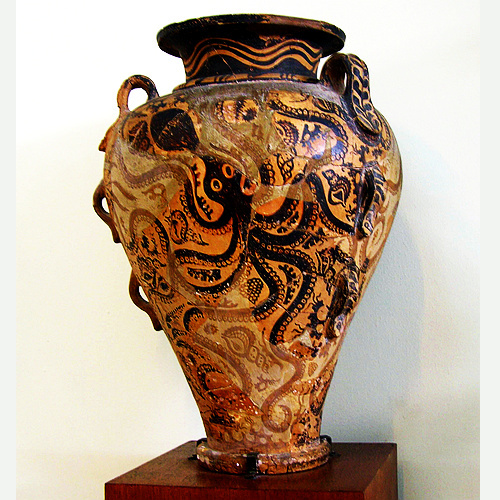
A style of vase painting developped in the
Late-Minoan period (LMIB). In this style the complete surface of a vessel was covered with sea creatures, mainly
octopusses, but also fish or dolphins, sometimes against a background of seaweed. It was the final Minoan style, ending
with the violent destruction of the Minoan palaces.
Marpessa
The daughter of the river god, Evenos, and Alkippe, and wife of Idas. Marpessa was once carried off by Apollo, and lamented over the separation from her beloved husband like Alkyone had once wept about Keyx. Therefore, they called their daughter, whose real name was Kleopatra, also Alkyone, i.e. sea bird.
Mausoleum
The Mausoleum at Halikarnassos was a tomb built between 353 and 350 BC at Halikarnassos (present Bodrum, Turkey) for Mausolos, at the instance of his sister-wife Artemisia II of Karia, who was then also buried there. The 45 m high tomb was decorated with scultpural reliefs by four eminent Greek sculptors - Leochares, Bryaxis, Skopas and Timotheos. It was one of the Seven Wonders of the Ancient World, but was destroyed by successive earthquakes from the 12th to the 15th century, the last surviving of the six destroyed wonders.
Mausolos
Ruler of Karia, at Halikarnassos (365 - 355 BC), nominally a Persian satrap, but actually with the status of a king, embracing Hellenistic culture. After his death, his sister and widow, Artemisia II, had a monumental tomb erected for him, the Mausoleum.
Mavrogenous
Manto Mavrogenous (1796 - 1848) was a Greek heroine of the Greek War of Independence. Being a rich woman she spent her money to support the Hellenic cause and encouraged her European friends to contribute money and guns to the revolution. She was engaged with Alexandros Ypsilantis until his death in 1828. After the war, Ioannis Kapodistrias awarded her the rank of Lieutenant General and granted her a house in Nafplion. Later she moved to Paros, where she died in July 1848, in oblivion and poverty, having spent all her fortune for the War of Independence.
Medea
Daughter of king Aietes of Kolchis. She was a priestess of Hekate, and being a niece of Kirke, she possessed magical powers. When Jason and the Argonauts arrived in Kolchis, Medea helped them to retrieve the Golden Fleece, and when they fled, she joined Jason. Her half-brother Absyrtos was sent with the fleet to bring her back, but Medea killed him and cur him in pieces. Aietes continued the pursuit, but when he stopped to collect the pieces of his son, the fugitives could escape. They went to Medea's niece, the sorceress Kirke, on her island Aiaia, but when Kirke found out that Medea had killed her own brother, she expelled them. Medea and the Argonauts now sought refuge on the island of the Phaiakians. Their king, Alkinoos, rejected Aietes' demand to deliver Medea because she was meanwhile married to Jason. - When Medea and Jason finally reached Iolkos with the Golden Fleece, they learned that king Pelias was responsible for the death of Jason's father Aison. Therefore, Medea told the daughters of Pelias that she could give the aging king eternal youth if the girls would only boil their father in a magical potion. The girls did so, thereby killing their father, but he was not brought back to life as Medea had promised. After this, Akastos, son of Pelias, seized the throne and Medea and Jason had to leave the country. They now went to Corinth, where they were protected by king Kreon. Many years later, when Medea had born Jason two children, Jason fell in love with Kreon's daughter Glauke. Medea's revenge was cruel: she killed Kreon, Glauke, and even her own children with Jason, and fled to Athens. There, her plot to poison Theseus failed, whereupon she fled to Asia Minor and became the ancestress of the Medes.
Medusa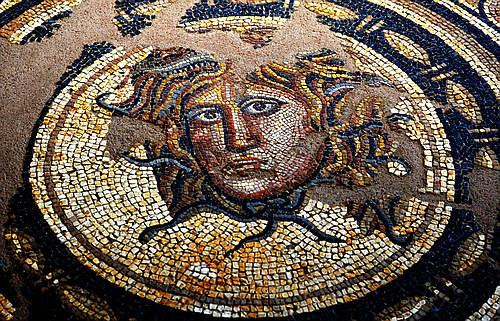
1) A daughter of Phorkys and Keto, and one
of the three Gorgons, the only mortal one of the sisters. She is said to have been a fair
maiden initially but when she became the mother of Chrysaor and
Pegasus by Poseidon in one of
Athena's temples, Athena changed Medusa's hair into serpents. Her appearance was now so terrifying that everyone who
looked at her was changed into stone. This was a problem for Perseus when he approached
to behead her.
2) A daughter of Sthenelos and Nikippe, and a sister of Eurystheus.
3) A daughter of Priam.
4) A daughter of Pelias.
Megapenthes
1) A son of Proitos, king of Argos. He exchanged his dominion for that of Perseus, so that the latter received Tiryns instead of Argos.
2) A son of Menelaos by an Aetolian slave. Menelaos arranged the marriage of his son with a daughter of Alektor.
 Megara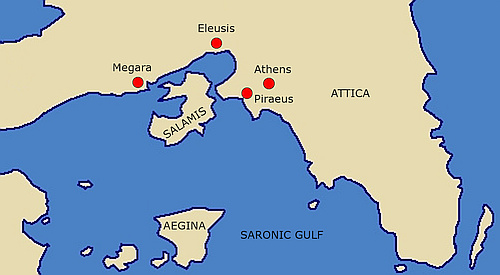
1) City in Attica at the western end of the
Saronic Gulf, opposite the island of Salamis. It was a
mighty polis during the 7th and 6th century BC, founding a large number of
colonies. After continuous disputes with Athens,
Megara lost its independence.
2) Daughter of king Kreon of Thebes; first wife of Herakles, whom she bore several children. Jealous Hera, still furious that Herakles was the product of an affair that her husband Zeus had with Alkmene, struck Herakles with madness and in this state he killed Megara and their children.
Megareus
A mythical personage with very different accounts of his descent. A Boeotian tradition relates that he assisted Nisos, king of Megara, against Minos, but that he fell in battle and was buried in Megara, which was named after him. - In Megara, a different story is told: according to this tradition, Megareus was the husband of Iphinoe, the daughter of Nisos, and succeeded his father-in-law in the government of Megara, which he then left to Alkathoos.
Megaris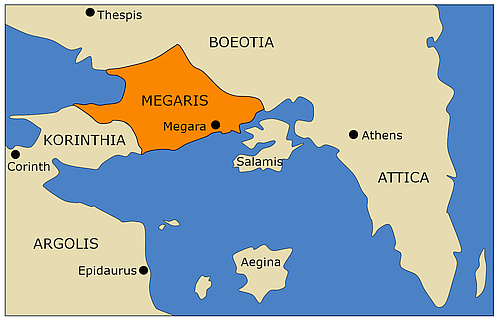
A small but populous state of ancient Greece, between Attica and
Korinthia, whose inhabitants were known as adventurous seafarers. The capital was
Megara.
megaron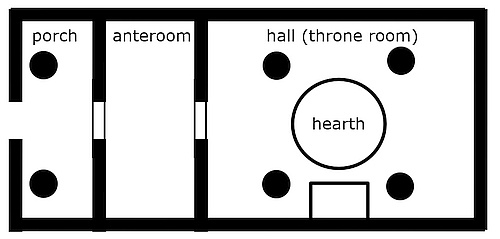
Long-house of a Mycenaean king or ruler. In its earliest form it
just consisted of one hall with a central hearth and four columns to support the ceiling. Later an open
porch with an axially located doorway in the middle of one short side was added and an
anteroom. In Mycenaean palaces there were many
other rooms grouped around the megaron: archive rooms, offices, oil-press rooms, workshops, potteries, shrines,
corridors, and storerooms for various goods. - The megaron is a predecessor of later Greek
temples.
Melampus
1) A son of Amythaon by Eidomene (or Aglaia or Rhodope), and a brother of Bias. According to ancient tradition, he was the first mortal with prophetic powers, the person that first practised the medical art, and the one who established the worship of Dionysos in Greece, with which he perhaps became acquainted by the Phoenicians and the Egyptian influence of Kadmos. According to Diodorus, Melampus also brought with him from Egypt the myths about Kronos and the fight of the Titans. - There are countless stories about how Melampus acquired his powers (serpents cleaning his ears, a talk with Apollo etc.) and how he used them.
2) Virgil mentions another mythical personage of this name.
Melaneus
1) A son of Apollo, king of the Dryopes, father of Eurytos and a famous archer.
2) Two other mythical personages of this name are mentioned by Homer and by Ovid.
Melanippe
1) A daughter of Cheiron. Being impregnated by Aiolos, she fled to Mount Pelion, but Cheiron searched for her. In order to hide her condition, she prayed to be metamorphosed into a mare and Artemis granted her wish.
2) The wife of Hippotes and the mother of Aiolos.
3) A daughter of Aiolos (or of Hippotes or Desmontes).
4) A queen of the Amazons, daughter of Ares, and sister of Hippolyte, Penthesilea and Antiope. In his fight with the Amazons, Herakles captured her and only released her in exchange for Hippolyte's girdle.
5) There are two other mythical personages of this name.
Melas
1) A son of Poseidon by a nymph of Chios.
2) A son of Phrixos and Chalkiope. After the death of his father, he and his brothers set out to avenge her father's ill treatment by Athamas. They stranded on an island in the Euxine (Black Sea), from where they were rescued by the Argonauts and returned with them to Kolchis.
3) A son of Porthaon and Euryte, and brother of Oineus.
4) A son of Antassos, who joined the Dorians on their march against Corinth.
5) There are four other mythical personages of this name.
Meleagros
A son of Oineus and Althaia, brother of Agelaos, Deianeira, Eurymede, Gorge, Melanippe, Periphas, Phereus or Thyreus, and Toxeus. He was married to Kleopetra, by whom he became the father of Polydora. Meleagros is one of the most famous Aetolian heroes of Kalydon, and is said to have been one of the Argonauts and to have taken part in the Kalydonian Hunt. When Oineus once neglected to offer up a sacrifice to Artemis, the angry goddess sent a monstrous boar into the fields of Kalydon which ravaged the land. Finally, Meleagros and a band of heroes set out to hunt the beast. When Meleagros had killed it, a quarrel arouse among the participating Kalydonians and Kouretes about who should get the boar's skin. Meleagros gave it to Atalante, who had inflicted the first wound to the animal. This sparked off a long-lasting fight against the Kouretes in which the Kalydonians prevailed as long as Meleagros was with them, but on one occasion he killed his mother's brothers. Therefore, his mother cursed him, and when he went out again to fight, he was seized by the Erinyes and never returned.
Melikertes
A son of Athamas and Ino. After his death, he was metamorphosed into a marine divinity, Palaimon.
Melissos of Samos
Melissos of Samos (fl. 5th century BC) was the third and last member of the ancient school of Eleatic philosophy, whose other members included Parmenides and Zenon of Elea. Like Parmenides, he argued that reality is ungenerated, indestructible, indivisible, changeless, and motionless. In addition, he sought to show that reality is wholly unlimited, and infinitely extended in all directions, from which follows that existence must be a single entity.
Melpomene
("Singing goddess") One of the nine muses, associated with tragedy.
Menandros
1) Greek dramatist (ca. 342 - ca. 290 BC). He was one of the most popular playwrights of antiquity, a famous representative of the Athenian New Comedy. His work was lost during the Middle Ages and is now only known from few fragments.
2) An officer (4th century BC) of Alexander the Great. In 331 BC, Alexander appointed him to the government of Lydia. He held this position until 323 BC, when he led a reinforcement of troops to Babylon just before Alexander's death. In the subsequent diivision of the provinces he received his former government of Lydia.
Menelaos
Younger brother of Agamemnon, and mythical king of Sparta. His wife, Helena, was abducted by Paris, or she came with him to Troy on her own will. This, allegedly led to the Trojan War.
Menestheus
An early Athenian king who is said to have driven Theseus from his kingdom. He participated with fifty ships in the campaign against Troy and was praised for his outstanding ability in arranging battle orders.
Menoikeus
1) A Theban, grandson of Pentheus, and father of Hipponome, Iokaste, and Kreon.
2) A grandson of (1), and a son of Kreon. When the "Seven against Thebes" attacked the city Teiresias predicted that Thebes would only be saved if Menoikeus would sacrifice himself. Consequently, Menoikeus killed himself outside the city gates.
Menoitios
1) A son of Iapetos and Klymene; brother of Atlas, Prometheus and Epimetheus. In the fight of the Titans he was killed by Zeus with a flash of lightning, and thrown into tartaros.
2) A son of Aktor and Aegina, a step-brother of Aiakos, and husband of Polymele, by whom he became the father of Patroklos. He was a friend of Herakles and one of the Argonauts.
3) There is another mythical personage of this name.
Mentes
1) The leader of the Kikonians in the Trojan war. Apollo assumed his appearance when he went to encourage Hektor.
2) King of the Taphians north of Ithaka who was connected by ties of hospitality with the house of Odysseus. Athena assumed his appearance when she visited Telemachos.
Meriones
A son of Molos. Together with his friend Idomeneus, he led 80 ships from Crete against Troy. There, he slew many Trojans, offered to fight with Hektor, and wanted to accompany Diomedes on his exploring expedition into the Trojan camp; but when Diomedes chose Odysseus for his companion, Meriones gave him his famous helmet. Together with Aias he protected the body of Patroklos, and in his funeral games won several prizes. Together with Idomeneus he was worshipped as a hero in Knossos.
Merope
1) A daughter of Okeanos, and by Klymenos the mother of Phaëton.
2) A daughter of Atlas, one of the Pleiades, and the wife of Sisyphos of Corinth, by whom she became the mother of Glaukos. In the constellation of the Pleiades she is the seventh and the least visible star, because she is ashamed of having had intercourse with a mortal.
3) A sister of Phaëton.
4) A daughter of Oinopion. She was beloved by Orion, who was thereafter blinded by her father.
5) Wife of Megareus, who became by him the mother of Hippomenes.
6) Daughter of Kypselos, and wife of Kresphontes, mother of Aipytos.
7) There is another personage of this name.
Messenia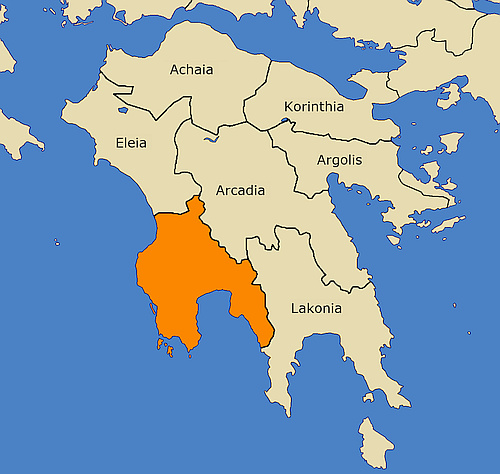
Messenia or Messinia is a regional unit in southwestern
Peloponnese (3000 km2, 146,000 inhabitants). It has the same name and almost identical territory as
ancient Messenia. - See also: site page.
Messenian Wars
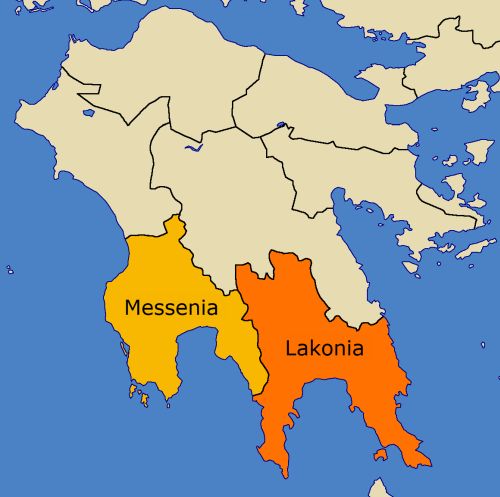
The First Messenian War (743 - 724 BC) was a war between Messenia and
Sparta. It continued the rivalry between the Achaeans and
the Dorians. The war ended with a victory of Sparta, which now controlled the fertile
plains of Messenia. Its Achaean population emigrated to other states or was subjugated as
helots. Later, their uprising caused two more Messenian Wars in 660 - 650 BC and in 464 BC.
metaphysics
A branch of philosophy evolving in ancient Greece. It studies the fundamental nature of "being" and the world, trying to answer two basic questions: 1) What is there? 2) What is it like? Topics covered by metaphysics and its subdiscipline ontology include existence, objects and their properties, space and time, cause and effect, and possibility. In general, there are two principal conceptions about what "world" is. The first one assumes that the objects studied by metaphysics exist independently of any observer. The second assumes that the objects exist inside the mind of an observer, so the subject becomes a form of conceptual analysis (a view quite near to modern quantum physics).
Metaphysics is also one of the principal works of Aristotle in which this philosophical branch is treated for the first time in same depth. For Aristotle, the principal subject is "being qua being". Therefore, metaphysics examines what can be asserted about anything that exists just because of its existence and not because of any special qualities it has.
Metope
1) A daughter of the Arcadian river-god Ladon. She was married to Asopos, and the mother of Thebe.
2) A daughter of the river-god Asopos.
3) The wife of the river-god Sangarios and mother of Hekabe, the wife of Priam.
metope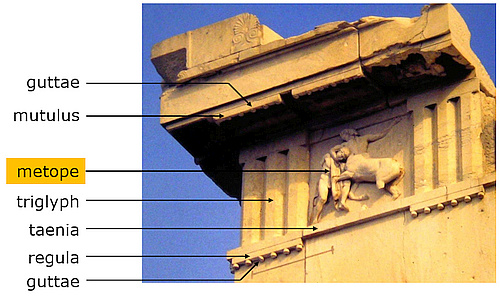
Square panel in the frieze of a Doric
temple. It is often decorated with a relief sculpture and accompanied on either side by
triglyphs.
 Midas
Midas
1) The Lydian "king with the golden touch" in ancient Greek mythology. - When Silenos and other followers of Dionysos were once captured by the Thracian king Lykurgos, Midas freed Silenos from prison and for this Dionysos granted him a wish: everything that he touched would turn to gold. Soon Midas recognized the disaster and the god withdrew the gift. - Another episode was told about Pan challenging Apollo for a musical contest and Midas being the judge. Although Apollo, playing the lyre, was better, Midas decided in favour of Pan. In his anger, Apollo changed the ears of Midas into those of an ass, which Midas tried to conceal under the "Phrygian Cap", but his barber discovered the secret.
2) King Midas (8th century BC), under whose rule Phrygia reached its greatest extension, dominating most of western and central Anatolia. It is said that Midas committed suicide when the Cimmerians sacked Gordion around 700 BC.
 Midea
Midea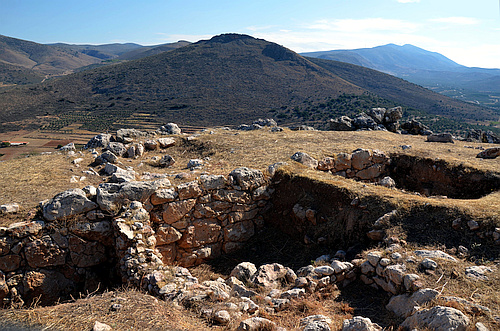
An important archaeological site dating to the Bronze Age. Midea has
a prominent position among the Mycenaean centres of the Argolid;
it is considered the third fortified Mycenaean acropolis after Mycenae and
Tiryns. - See also: site
page.
Miltiades
Miltiades the Younger (ca. 554 - 489 BC) was an Athenian general and tyrant of Thracian Chersonesos. He joined king king Darius I of Persia in a war against the Skythians, but later fought on the Athenian side against the Persians. He was the commanding general of the Athenian army, joined by some soldiers from Plataiai, in the Battle of Marathon, where he defeated the superiour numbers of Persians. - When he failed in a later expedition, he was charged with treason by the Athenian court and sentenced to death. The sentence was converted to an astronomical fine which Miltiades could not pay and therefore went to jail where he died.
Mimnermos
A Greek elegiac poet (fl. 630 - 600 BC), strongly influenced by Homer, but known as author of short love poems. He in turn exerted a strong influence on Hellenistic poets such as Kallimachos.
Minoan civilization
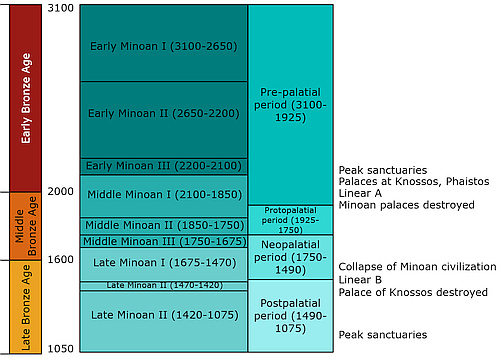
An Aegean Bronze Age civilization that arose on the island of
Crete, but also some other Aegean islands. The Minoan period encompasses various cultural
periods between about 3100 BC and 1400 BC. It complements two parallel terms: Cycladic
for the culture of the Cycladic islands in this period and Helladic for the Greek
mainland. - The Minoan civilization was rediscovered at the beginning of the 20th century through the work of the
British archaeologist Arthur Evans. He dubbed it "Minoan", referring to the mystic king
Minos, whose palace he identified with Knossos, the largest Minoan
site. - The Minoan period is characterized by extensive contacts between Crete, the Aegean and the Mediterranean,
especially the Near East. As traders and artists, their cultural influence reached far beyond the island of Crete -
throughout the Cyclades, to Egypt's Old Kingdom, to copper-bearing Cyprus, Kanaan and
the Levantine coasts beyond, and to Anatolia. Their language and writing system (Linear
A) remain mainly undeciphered, but seemingly use a language entirely different from the Greek dialects in later
periods. The collapse of Minoan civilization around 1400 BC is not very well understood, but likely ended with the
Mycenaean occupation of Crete.
Minoan pottery
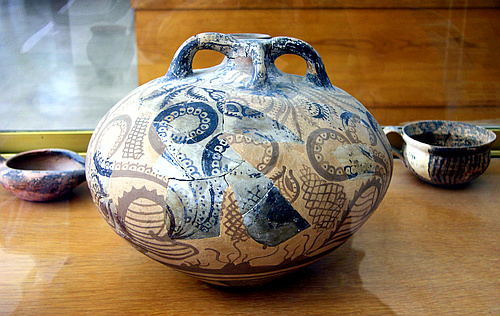
The pottery produced by the Minoan civilization is characterised by a
tremendous series of quickly alternating artistic styles, reflecting the Minoan pleasure in novelty. This circumstance
helps archaeologists in the relative dating of strata in excavated sites. Remarkable is also the wide distribution of
this pottery in the Mediterranean from mainland Greece and the Aegean islands to Egypt, Cyprus, and coastal Syria,
showing the vast trading contacts of the Minoans. Highlights of Minoan pottery certainly are the
"Kamares ware" and the marine style.
Minos
Son of Zeus and Europa, brother of Rhadamanthys and Sarpedon. He was the legendary king of ancient Knossos in Crete, and received his laws directly from Zeus in regular consultations. However, when he refused to sacrifice the Cretan Bull to Poseidon, the sea god in his anger caused Minos' wife, Pasiphaë, to fall in love with this bull and to give birth to the Minotauros. Minos ordered Daidalos to build the labyrinth, where the Minotauros was kept and fed with 7 youths and 7 maidens, sent every nine years by Athens as tribute for causing the death of Minos' son Androgeos. When Daidalos, together with his son Ikarus, fled from Crete, Minos chased them and died in Sicily. After his death, he was appointed judge in the underworld.
Minotauros
A monster with the body of a bull and a human head (or the other way round). Avenging Poseidon caused Pasiphaë, the wife of the Cretan king Minos, to fall in love with a bull, so she made Daidalos construct an artificial cow in which she could hide and have intercourse with the bull, and as a consequence gave birth to Minotauros. He was kept in the labyrinth and fed with youths and maidens from Athens (see above). - With the help of Ariadne, the Minotauros was finally defeated and killed by Theseus.
Minyans
A prehellenic tribe settled in Boeotia in the area of ancient Orchomenos. Others locate them in Thessaly around Iolkos.
Minyan ware
A particular style of monochrome burnished pottery, produced in the Aegean in the Middle Helladic period. Heinrich Schliemann introduced the term after he discovered a distinct variety of dark-burnished pottery at Boeotian Orchomenos. John L. Caskey, excavating in Lerna in the Argolis, found that Minyan ware was the direct descendant of the fine gray burnished pottery of the Early Helladic III Tiryns culture. This evolved type of pottery arrived in Greece between 2200 and 2150 BC and was used mainly for open vessels such as goblets and kantharoi.
Minyas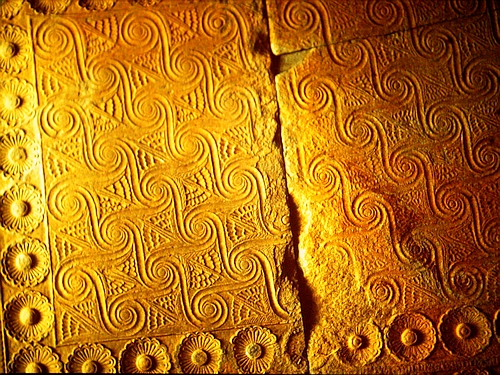
The ancestral hero of the race of the Minyans, whose ancestry varies very much
in the different traditions. Heinrich Schliemann named the
tholos tomb at Orchomenos in Boeotia after him
(pictured: the ceiling in the side chamber of this tholos).
Mnemosyne
One of the Titanides, daughter of Gaia and Uranos. She became by Zeus the mother of the muses. Pausanias mentions a statue dedicated to her at Athens.
Moirai
Moira is the personification of "the deity who assigns to every man his fate or his share," i.e. the Fates. - Homer speaks of only one Moira that, at the birth of man, spins out the thread of his future life. However, the Homeric Moira is not to be seen as an inflexible fate, to which the gods themselves must bow. Zeus, being the father of gods and men, weighs out their fate to them. Even so, Fate does not abruptly interfere in human affairs, but herself makes use of intermediate causes. Even man himself, in his freedom, is allowed to exercise a certain influence upon her. - Hesiod describes three Moirai, daughters of Nyx: Klotho, the spinning fate; Lachesis, the one who assigns to man his fate; and Atropos, the fate that cannot be avoided.
Molos
1) A son of Ares and Demonike, and a brother of Thestios.
2) A son of Deukalion, and father of Meriones. In Cretan tradition he has a different ancestry and is said to have tried to violate a nymph, whereafter he was found without a head.
Molossoi
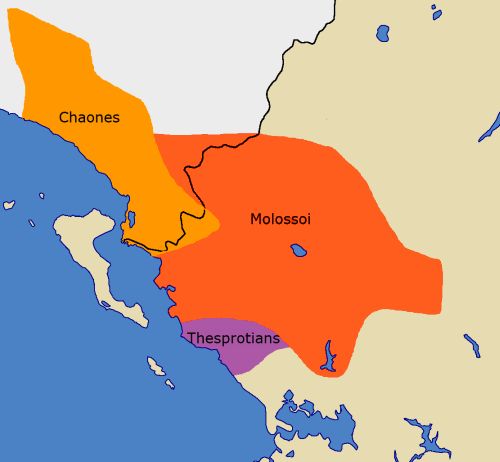
An ancient Greek tribe and kingdom in Epirus since
Mycenaean times. Together with the neighbouring Chaones and
Thesprotians, they formed the Epirote League
around 370 BC. In the Third Macedonian War (171 - 168 BC) they sided against Rome and were defeated. Their territory was
thereafter annexed into the Roman Republic and 150,000 of its inhabitants enslaved.
monarchy
A form of government in which a single person, the monarch, reigns as the head of state. This monarch usually rules for the rest of his life, the succession being hereditary, the families thereby forming dynasties. - In Greece, this was the usual form of government in the Archaic period. However, ancient Greeks were concerned with such fundamental questions as: Should sovereignty (kyrion) lie in the rule of laws (nomoi), the constitution (politea), officials, or the citizens? Without deciding on a definite answer, the Greek world saw a multitude of government forms in the course of the centuries and across the different city-states: political power could rest in the hands of a single individual (monarchies and tyrannies) or in a select few (the oligarchies) or in every male citizen (democracy).
monism
The philosophical view that attributes oneness or singleness (Greek: monos) to a concept like existence. This may mean that only one thing is basic or prior to everything else (priority monism). According to substance monism or stuff monism, only one kind of stuff (e.g., matter or mind) exists, although many things may be made out of this stuff. In existence monism or thing monism, on the other hand, there exists only one single thing (e.g., the universe), which can only be artificially and arbitrarily divided into many things.
Mopsos
1) One of the Lapiths who was involved in the fight at the wedding of Peirithoos. He is mentioned among the Kalydonian hunters, but especially he is the famous seer of the Argonauts. He is said to have died in Libya after the bite of a snake, and that the Argonauts buried him there.
2) A son of Apollo and Manto, the daughter of Teiresias.
Morpheus
The son of Hypnos (Sleep), and the god of dreams. According to Ovid, he shaped or formed the dreams which appeared to the sleeper.
Mount Athos
--> Athos
Mount Olympos
--> Olympos
Mount Parnassos
---> Parnassos
Mousaios
1) A semimythological poet. He was regarded as the author of various poetical compositions, especially in connection with the rites for Demeter in the Eleusinian Mysteries. Except for a few quotations by Pausanias, Plato, Clemens Alexandrinus, Philostratos, and Aristotle, nothing of his work survived.
2) An ancient Theban lyric poet, who is said to have lived long before the Trojan War.
mudbrick
--> brick
muse
In Greek mythology, muses are goddesses inspiring arts, literature and science. Originally, only three muses, daughters of Uranos and Gaia, were known in Boeotian tradition. In the later and better known version they are the daughters of Zeus and the Titaness Mnemosyne. After Zeus had slept with her for nine consecutive nights, she bore nine daughters: Erato ("love poetry"), Euterpe ("lyric poetry"), Kalliope ("epic poetry"), Kleio ("history"), Melpomene ("tragedy"), Polyhymnia ("sacred poetry"), Terpsichore ("choral songs" and "dance"), Thaleia ("comedy"), and Urania ("astronomy"). - Known for their skills in dancing and music, they were often seen in the company of Apollo. But they were also quite revengeful when challenged by mortal musicians, whom they often blinded.
mutulus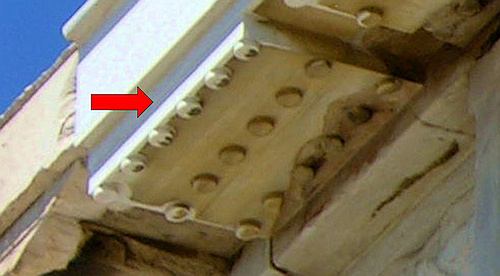
Rectangular block below the geison in
Doric temple architecture with a set of three rows of six
guttae underneath.
Mycenae
A site in Argolis, which was one of the major centres of Greek
civilization in the second millennium BC, a military stronghold which dominated much of southern Greece. The period of
Greek history from about 1675 BC to about 1050 BC is called Mycenaean in reference to this
citadel. At its peak in 1350 BC, the acropolis and lower town of Mycenae had a population of 30,000 and an area of 32
hectares. - The first correct identification of Mycenae in modern times used the description of the
Lion Gate by Pausanias to identify the ruins of
Mycenae. After the Greek archaeologist Kyriakos Pittakis restored the Lion Gate in 1841,
Heinrich Schliemann excavated in Mycenae since 1874. He found the ancient
shaft graves of "Grave Circle A" with their royal skeletons and spectacular
grave goods. When uncovering a human skull beneath a gold death mask in one of the
tombs, he declared: "I have gazed upon the face of Agamemnon". Further excavations were
conducted by Christos Tsountas, Alan Wace, William Taylour,
and the Archaeological Society of Athens under the direction of George Mylonas and
others, which are still ongoing today. - See also: site page.
Mycenaean civilization
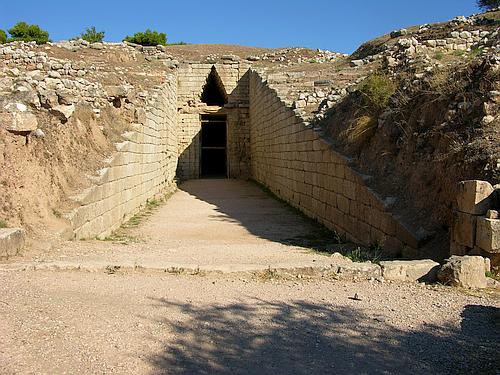
Another name for the Late Helladic period, the last phase of the
Bronze Age in ancient Greece (c. 1675 - 1050 BC). With its palace oriented states,
urban organization, writing system and works of art it represents the first advanced civilization in mainland Greece.
The emerging centers of power were especially those of Mycenae,
Pylos, Tiryns and Midea in the
Peloponnese, Orchomenos,
Thebes and Athens in Central Greece and
Iolkos in Thessaly. Probably the most important of these
was Mycenae, to which this culture owes its name, but there were also Mycenaean settlements or those influenced by these
in other parts of the mediterranean world as far away as the Levant, Cyprus and Italy. The Mycenaean civilization
practiced trade over vast areas of the Mediterranean and brought a number of innovations in the fields of engineering,
architecture and military development. The network of independent Mycenaean palace states was dominated by a warrior
elite. The political, social and economic systems were strictly hierarchical with a ruler, the
wanax, at the head of each state. The syllabic script, Linear B, is the first written
record of Mycenaean Greek. Mycenaean religion, though not well understood, includes several deities that can also be
found among the Olympian Gods. - Various explanations have been proposed for the
destruction of palaces and the decline of Mycenaean civilization in the 11th century BC. These include the
Dorian invasion, the advent of the "Sea
Peoples", natural disasters and climate changes. - The Mycenaean period was immortalised by much ancient Greek
literature, primarily by the Epic Cycle around the
Iliad and the Odyssey.
Mykale
Mount Mykale lies on the coast of Ionia, present-day Turkey, opposite the island of Samos. It was the site of the last decisive battle of the Persian Wars, when in 479 BC, one year after the Battle of Salamis, the allied Greeks completely destroyed the remaining rest of the Persian fleet.
Mylonas
George Mylonas (1898 - 1988) was a prominent Greek archaeologist. He taught at Washington University from 1933 to 1968 and directed the university's excavations at Mycenae for many years. After retiring from teaching in 1968, he returned to Greece where he served as Secretary General of the Archaeological Society of Athens and managed the dig at Mycenae until his death.
Myrmidones
1) When king Aiakos of Aegina asked his father Zeus for help during a terrible plague on the island he changed all local ants into people. They were called Myrmidones and became the fiercest Greek warriors. In the Trojan War they were under the command of Achilles.
2) An ancient Greek tribe in Thessaly.
Myron
Myron of Eleutherai (working ca. 480 - 440 BC) was an Athenian sculptor, according to Pliny a student of Ageladas. Myron worked exclusively in bronze, and although he made some statues of gods and heroes, he was especially celebrated for his sculptures of athletes, a diskobolos being the most famous one. Already ancient commentators noted his revolutionary introduction of a greater boldness of pose and a more perfect rhythm in his sculptures. Of his works only copies of the Roman period in marble remain.
Myrtilos
A son of Hermes, and charioteer of Oinomaos, the king of Eleia. He was bribed by Pelops to loosen the lynchpins of Oinomaos' chariot, which led to the death of Oinomaos in the race. Being a dangerous witness, Myrtilos was thrown into the sea by Pelops. Before he died, he pronounced a curse upon the house of Pelops, which was from then on harassed by the Erinyes.
Mysia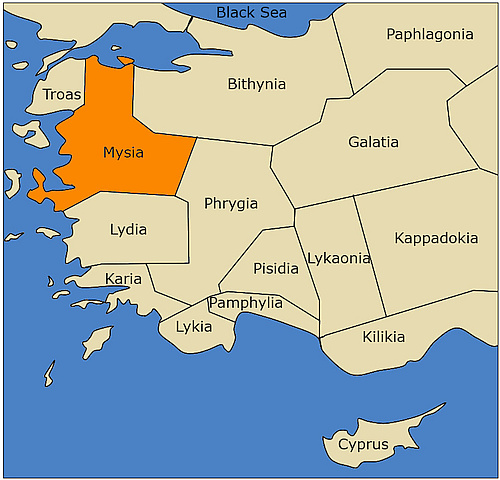
A region in the northwest of ancient Asia Minor (part of modern
Turkey), located on the southern coast of the Sea of Marmara. It was bounded by Phrygia
on the southeast, Troas on the west, and Lydia on the south.
In ancient times it was inhabited by the Mysians, Phrygians, Aeolian Greeks, and other
groups. In the Iliad, Homer represents the Mysians as
allies of Troy. Homeric Mysia appears to have been much smaller in extent than in
historical times.

