
GREECE
 GLOSSARY
| A | B | C | D |
| E | F | G | H |
| I | J | K | L |
| M | N | O | P |
| Q | R | S | T |
| U | V | W | X |
| Y | Z |
2026-01-14
color code:  = mythology;
 = history & culture;
  = geography;
  = archaeology &
architecture
= archaeology &
architecture
Sacred Band of Thebes
In the 4th century BC a troop of picked soldiers from Thebes, consisting of 150 pairs of male lovers. They were the elite force of the Theban army and played a crucial role in the victory of Thebes in the Battle of Leuktra in 371 BC that crushed the Spartan hegemony. The Battle of Chaironeia in 338 BC saw their annihilation by the Macedonians under Philip II and Alexander the Great.
Sacred Wars
A series of wars carried out by members of the Delphic Amphictyony: the First Sacred War (595-585 BC) against Kirrha, the Second Sacred War (449-448 BC) against Phokis with an indirect confrontation between Athens and Sparta, the Third Sacred War (356-346 BC) against Phokis with a major step in the rise of Macedonia, and the Fourth Sacred War (339-338 BC) with the final domination of the Macedonians over Greece.
 Salamis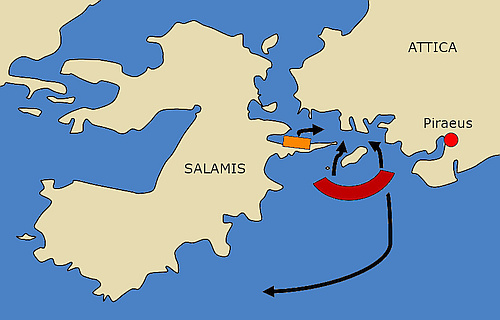
1) Largest island (96 km2, population 37,000) at the western end of the
Saronic Gulf. - It was the site of a decisive naval battle in 480 BC during the second
invasion of Greece in the Persian Wars, fought between an alliance of Greek
city-states under Themistokles and the Persian Empire
under King Xerxes. After the Persians could not be stopped at
Thermopylae, the Greek navy withdrew from the battle of
Artemision. When the Persians marched south, conquering Boeotia and
Attica, Themistokles ordered the evacuation of Athens. Women
and children found refuge in Troizen on the Peloponnese, the rest manned the
warships. As apprehended, the Persians devastated the abandoned Athens, and then by subterfuge Xerxes was informed that
the Greek navy assembled in Salamis to retreat to the Peloponnese. Xerxes ordered a detachment of his ships to block the
southern side of Salamis and the rest of the Persian navy to sail into the Straits of Salamis. He himself watched from a
promontory the probably largest naval battle of antiquity. The 378 Allied ships were confronted by 1200 Persian ships
according to all ancient sources (600-800 according to modern estimates). The Greek ships, secretly anchored in a bay of
Salamis, now proceeded in perfect battle formation to the Persians whose great numbers were an active hindrance in the
cramped waters, as ships struggled to maneuver and became disorganized. The Greeks scored a decisive victory, losing 40
ships with 300 Persian ships destroyed. As a consequence, Xerxes retreated to Asia, leaving
Mardonios to complete the conquest of Greece, but the Persians experienced their final
defeat in the following year in the battles of Plataiai and
Mykale.
2) A daughter of Asopos, and by Poseidon the mother of Kychreus.
Salmoneus
In ancient Greek mythology a son of Aiolos by Enarete, and a brother of Sisyphos. He was especially known for his presumption and arrogance which went so far that he deemed himself equal to Zeus, ordered sacrifices to be offered to himself and even imitated the thunder and lightning of Zeus. Thereupon, the father of the gods killed the presumptuous man with his thunderbolt, destroyed his town, and punished him in the underworld.
 sanctuary
The delimited area, also called temenos and often enclosed with a wall, in which temples and other sacred buildings are located and deities are worshipped.
Sappho
A Greek lyric poetess from the island of Lesbos. She was born sometime between 630 and 612 BC, and died around 570 BC, but little is known about her life. She probably wrote around 10,000 lines of poetry, of which only 650 survive today as fragments. Her lyric poetry, designed to be accompanied by music, was highly esteemed and admired throughout antiquity, so that several ancient sources refer to her as the "tenth Muse". The scholars of Alexandria included Sappho in the canon of nine lyric poets, and she was sometimes referred to as "The Poetess", just as Homer was "The Poet". It is said that the Athenian lawmaker and poet Solon asked to be taught a song by Sappho "so that I may learn it and then die". - Today, Sappho is a symbol of female homosexuality; the common term lesbian is an allusion to Sappho. This assertion is, however, quite doubtful since it is not until the Hellenistic period that the first testimonia appear which discuss Sappho's homoeroticism.
 Sarantavli
--> Korykian cave
sarcophagus
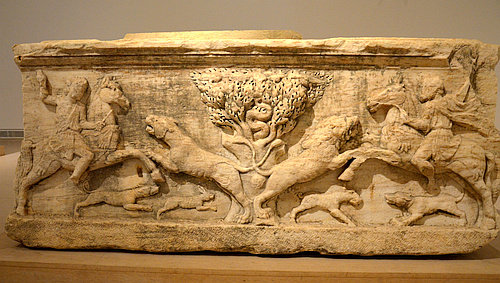
A coffin, made of stone, terracotta, or wood.
Saronic gulf
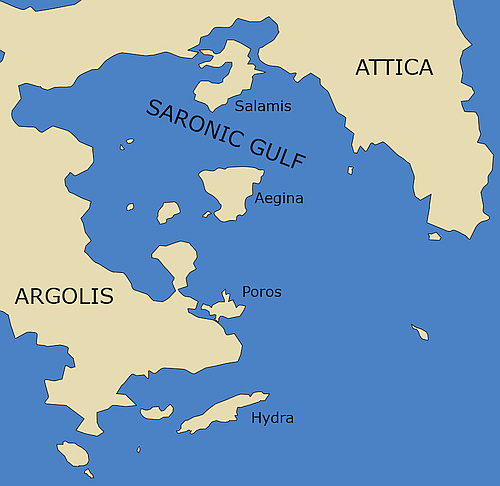
The part of the sea between Attica and the
Peloponnese.
Saronic islands
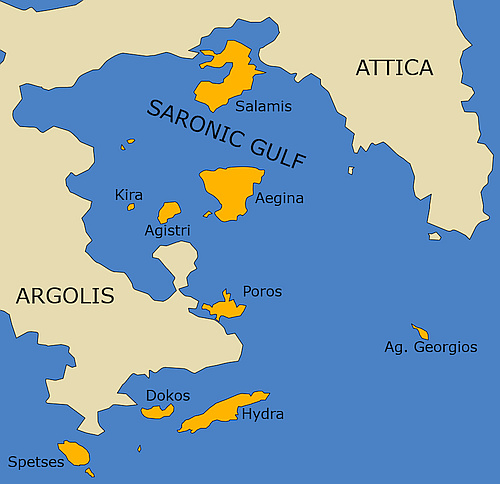
A group of Greek islands, named after the Saronic Gulf in which they are
located. The main inhabited islands of this group are Salamis, Aegina, Agistri, and Poros. The islands of Hydra and
Dokos, which lie off the northeastern Peloponnese, are sometimes included as part of
the Saronic Islands.
Sarpedon
1) A son of Zeus by Europa, and a brother of Minos and Rhadamanthys. He assisted Kilix in his fight against the Lykians and afterwards became their king. Zeus granted him the privilege of living three generations.
2) A son of Zeus by Laodameia, or in other accounts of Euandros by Deïdameia. He was a Lykian prince, and a grandson of No. 1. In the Trojan war he was a brave fighter on the side of the Trojans, but was slain by Patroklos. With the help of Apollo, Hypnos and Thanatos, Zeus made sure that his body was honourably buried in Lykia.
satrap
The governor of one of the large administrative districts into which the Persian kingdom was divided.
satyr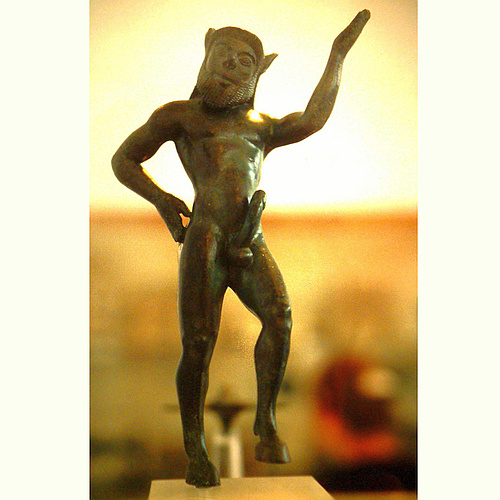
Satyrs are mythological figures inseparably connected with the worship of
Dionysos, representing the vital powers of nature. They are fond of wine and every kind
of sensual pleasure. In art, they are presented partly evocative of goats or rams.
satyr play

Satyr plays were an ancient Greek form of tragicomedy, featuring choruses of
satyrs and sileni, the companions of Dionysos. Based on Greek
mythology, they were full of shameless sexuality including phallic props, mock drunkenness and all sorts of pranks. Next
to tragedy and comedy, satyr plays were one of the three
varieties of Athenian drama. - In the Athenian
Dionysia, each playwright usually entered four plays into the competition: three
tragedies and one satyr play to be performed either at the end of the festival or between the second and the third
tragedy of a trilogy. The short satyr plays, half the duration of a tragedy, were a comic relief to break the oppression
of hours of gloomy tragedies.
sauceboat
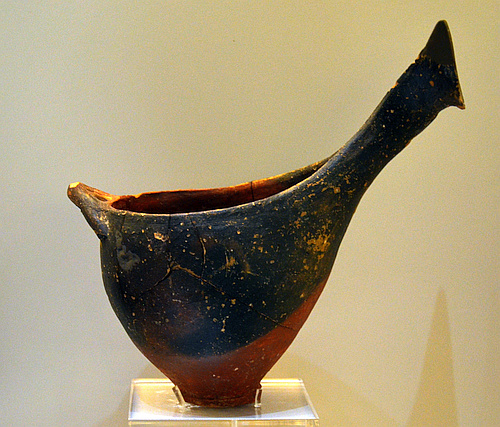
The modern name for a special type of vessels of the Early Helladic
and Early Cycladic cultures. They are characterized by a prominently rising spout on one
side and a handle opposite the spout, with a pedestal foot. Thus, they resemble modern sauce- or gravy-boats. They were
probably used for pouring liquids like wine or oil.
Schliemann
Heinrich Schliemann (1822 - 1890) was a German merchant and archaeologist. As a merchant in Amsterdam and St. Petersburg he made a fortune which he then used to live up to his dream since childhood: the rediscovery of the places of ancient Greek mythology and the Homeric epics, which to his conviction were historical records. In 1868 he settled in Athens, excavated 1870 - 1890 in Asia Minor, where he found ancient Troy, 1874 - 1876 in Mycenae, 1880 - 1886 in Orchomenos in Boeotia, 1884 - 1885 in Tiryns, since 1882 with the scientific assistance of Wilhelm Dörpfeld. He discovered traces of the Late Helladic culture, opening a new field of research. His stubbornness presented him the luck to unearth some of the richest treasures in archaeology: the gold of Troy and the unbelievably rich grave goods of the royal tombs in Mycenae.
Sea Peoples
A purported seafaring confederation of groups used to explain attacks in ancient Egypt prior to the Late Bronze Age collapse and subsequent invasions in Asia Minor. They were also made responsible for the seemingly simultaneous downfall of the Mycenaean city-states in the late 13th and early 12th century BC. This view is however highly controversial since there are no written records or other archaeological evidence indicating a large-scale migration at this time. Also, the destructions within Greece were not quite as simultaneous as it first seemed. Therefore, it has been conjectured that the rivaling great families of the Mycenaean kingdoms destroyed each other in a disastrous series of conflicts lasting several decades. This could have been triggered by causes like prolonged droughts and resulting famines.
Seirens
The Seirens, or Sirens, were mythical beings who were said to have the power of enchanting by their song anyone who heard them. Homer does not mention their names or numbers, while later writers mention two to three Seirens, with or without wings. - When the Argonauts passed by them, they began to sing, but in vain, for Orpheus rivalled and surpassed them. And when Odysseus came near their island (perhaps Antipaxos, one of the Ionian islands), on the advice of Kirke, stuffed the ears of his companions with wax, and tied himself to the mast of his vessel, until he was so far off that he could no longer hear their song. - In accordance with a decree that they should live only until someone hearing their song should pass by unmoved, they threw themselves into the sea, and were metamorphosed into rocks.
Selene
The Greek goddess of the moon, daughter of Hyperion and Theia, sister of Helios and Eos. Ancient Greek mythology relates that she fell in love with the shepherd Endymion, whom she made fall asleep to kiss him undisturbedly. Later she bore him fifty daughters. Usually she was imagined driving a chariot across the sky like her brother and sister. Homer, however, describes her as having large wings with which she could fly. In art, she is presented with a crescent as her attribute.
Seleukos
Seleukos I Nikator (c. 358 BC - 281 BC) was one of the diadochi and established the Seleukid Empire in the Near East. - Seleukos served as an infantry general under Alexander the Great and after his death in 323 BC, he initially supported Perdikkas, the regent of Alexander's empire. When the wars of the diadochi broke out in 322 BC, Perdikkas failed with his military actions against Ptolemaios in Egypt, his troops mutinied and Seleukos joined Peithon and Antigenes in a conspiracy in the course of which Perdikkas was assassinated in 321 or 320 BC. Seleukos was appointed satrap of Babylon under the new regent Antipater, but was made to flee by Antigonos. With the support of Ptolemaios, Seleukos was able to return to Babylon in 312 BC and from then on ruthlessly expanded his dominions to the entire eastern part of Alexander's empire. He even invaded India and after two years of war (305-303 BC) made peace with the Indian Emperor, exchanging his eastern satrapies for 500 war elephants. These played an important role in the battle of Ipsus in 301 BC against Antigonos, and against Lysimachos at the battle of Corupedium in 281 BC. Unopposed in Asia, Seleukos proceeded to Thracia where he was assassinated in 281 BC.
Selinous
A son of Poseidon, was the father of Helike.
Selloi
Priests of Zeus at Dodona. There they served the very old oracle by interpreting the rustling of the leaves of the sacred oak tree.
Semele
A daughter of Kadmos and Harmonia, and therefore a sister of Agaue, Autonoë, Ino, and Polydoros. She was beloved by Zeus, but jealous Hera induced her to pray to Zeus to visit her in all his splendour. Zeus, who had promised that he would grant her every wish, did as she desired and appeared to her as the god of thunder and Semele was consumed by the fire of lightning, but Zeus saved her child Dionysos, with whom she was pregnant.
Semonides
Semonides of Amorgos (fl. ca. 7th century BC) was a Greek iambic and elegiac poet. Only fragments of his work survive, reflecting his pessimistic view of the human experience.
Serapis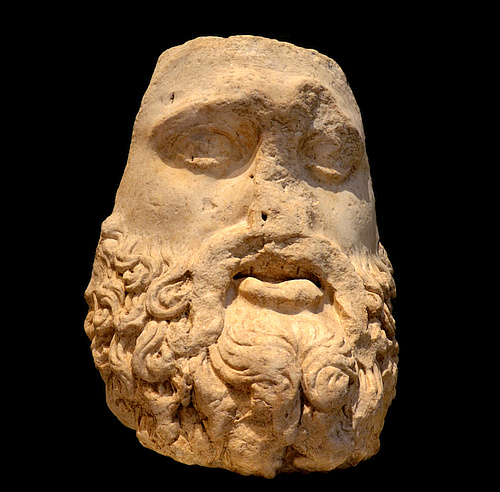
Originally a dualistic Egyptian deity associated with the sacred bull
Apis, which, after his death, became Osiris-Apis. In Hellenistic times, Serapis
also appears in the ancient Greek pantheon, associated with fertility, the sun, healing and keeper of the dead. Finally
during the Greek dominated Ptolemaic Period of Egyptian history (around 330 BC), the dual nature of Osiris-Apis merged
into the singular deity of Serapis.
 Sestos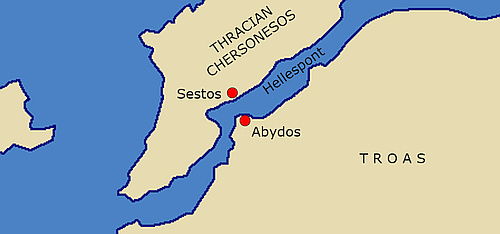
An ancient Greek town founded by colonists from Lesbos on the
modern Gallipoli peninsula. It is best known from the legend of Hero and
Leiandros as the town where Hero served in a temple of
Aphrodite. In 480 BC, Xerxes' army crossed the
Dardanelles at this point on two temporary pontoon bridges, and Alexander the
Great's forces went the other way here by boat in 334 BC. - In 1810 Lord Byron swam
from Sestos to Abydos in four hours to commemorate Leiandros' achievement.
Seven against Thebes
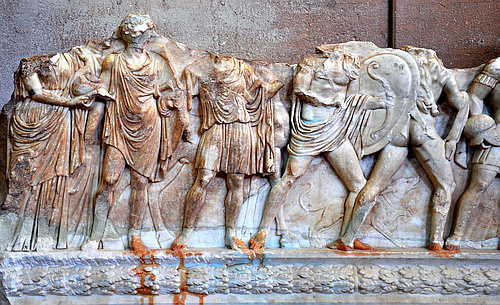
When Oedipus, king of Thebes, found out
that he had married his own mother and had two sons and two daughters with her, he blinded himself and cursed his sons
to divide their inherited kingdom by the sword. To avoid bloodshed, the two sons,
Eteokles and Polyneikos, agreed to rule Thebes in alternate years. However,
Eteokles refused to step down after the first year, and therefore Polyneikos raised an Argive army to take Thebes by
force. This army was made up of seven groups because Thebes had seven gates, each to be attacked by one of the groups.
Leaders were seven heroes: 1) Adrastos, 2) Amphiaraos,
3) Hippomedon, 4) Kapaneus, 5) Parthenopaios, 6)
Polyneikos, and 7) Tydeus. The defenders of Thebes included: 1) Aktor, 2) Eteokles, 3)
Hyperbios, 4) Lasthenes, 5) Megareus, 6) Melanippos, and 7) Polyphontes. The battle ended when the brothers
simultaneously run each other through. Only the Epigoni were successful to conquer Thebes
ten years later. - "Seven against Thebes" is the third play of a trilogy centered around Oedipus. It was written by
Aischylos in 467 BC and won the first prize at the City
Dionysia.
Seven Sages
Seven Sages or Seven Wise Men was the title given by ancient Greek tradition to seven
early-6th-century BC philosophers, statesmen, and law-givers who were renowned in the following centuries for their
wisdom. Each of these sages represents an aspect of wisdom which is traditionally summarized in an aphorism. There is
some variation but the list of the seven sages usually include:
- Kleoboulos of Lindos: "Moderation is best in all things",
- Solon of Athens: "Nothing in excess",
- Chilon of Sparta: "Do not desire the impossible",
- Bias of Priene: "Most men are bad",
- Thales of Miletos: "Know thyself",
- Pittakos of Mytilene: "Know thy opportunity",
- Periandros of Corinth: "Be farsighted with everything".
Seven Wonders of the
Ancient World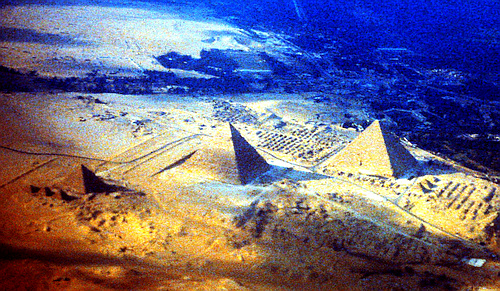
The 'Seven Wonders of the Ancient World' refers to remarkable constructions of Classical antiquity,
of which only the pyramids still exist today. They were listed by various authors in guidebooks which were popular among
ancient Hellenic tourists, particularly in the 1st and 2nd centuries BC. They are:
- Great Pyramids of Gizeh, Egypt,
- Hanging Gardens of Babylon (existence questioned),
- Temple of Artemis at Ephesos (finally destroyed in AD 401),
- Statue of Zeus at Olympia (destroyed by fire in
Constantinople),
- Mausoleum at Halikarnassos (destroyed by earthquakes),
- Colossus of Rhodos (destroyed by earthquake in 226 BC)
- Lighthouse of Alexandria (destroyed by earthquake in 1303).
shaft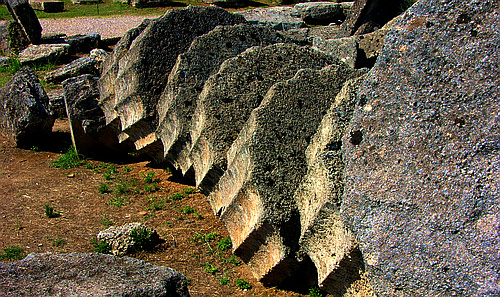
The large middle part of a column. It may be monolithic or made up of
a number of column drums; only the earliest Greek temples had wooden shafts. All
columns of classical Greece have varying numbers of flutes
and a more or less pronounced entasis.
shaft grave
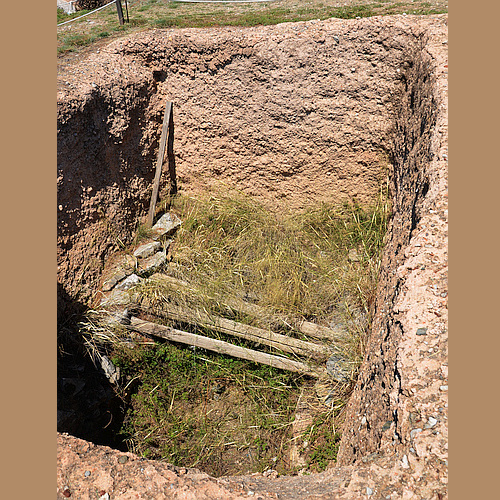
A deep rectangular burial structure, similar in shape to the much shallower
cist grave. Shaft graves have a floor of pebbles, walls of
rubble masonry, and a roof constructed of wooden planks covered by earth and
stones. The most famous examples are the shaft graves at Mycenae.
sherd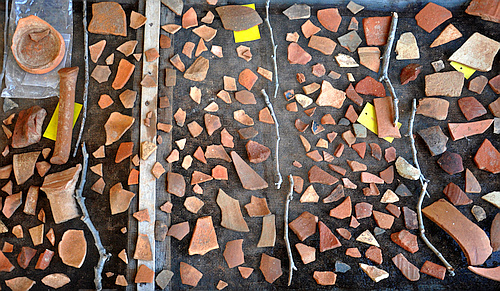
A sherd, or more precisely, potsherd, is commonly a historic or prehistoric fragment of
pottery. Sometimes the term is also used for fragments of stone and glass vessels. On the
other hand, fragments of glass vessels are referred to as shards, but this can also be pottery fragments. Depending on
the part of the ceramic vessel from which the sherd came, archaeologists categorize them as rim sherds, body sherds, and
base sherds. - Sherds play a vital role in archaeology. Their abundance due to their high resistance to natural,
destructive processes makes them a crucial tool to date archaeological sites and develop chronologies.
sibyl
Prophetic women who occur in various countries and at different times in antiquity. Some authors mention only four sibyls, but in the more common tradition there are ten. Most celebrated of these is the Cumaean sibyl, who is mentioned under various names. Aeneas is said to have consulted her before he descended into the lower world.
Sicilian Expedition
Military campaign (415 - 413 BC) of Athens during the Peloponnesian War against Syracuse, a Spartan ally, on Sicily. One source of conflict was the close relationship of Syracuse to Corinth, Athens's great commercial rival. The plans for a major blow against Syracuse were especially propagated by Alkibiades, the leader of the "war party". His political opponent, Nikias of the "peace party", although a skeptic of the plan, was appointed as leader of the Sicilian Expedition together with Alkibiades. However, before the campaign started, Alkibiades was accused of sacrilege by his political opponents and fled to Sparta. There, he coordinated ventures against Athens including massive aid to be sent to Syracuse. In Sicily, Athenian forces originally besieged Syracuse until the Spartan general Gylippos arrived with reinforcements. In the end, the Sicilian Expedition was a complete desaster for Athens, the whole expedition force, thousands of soldiers - a significant number of Athenian manpower - being lost, either killed or sold into slavery, and Nikias executed by his captors. - According to some historians, the Sicilian Expedition was the turning-point of the Peloponnesian War in favour of Sparta.
sileni
Elder satyrs in the train of Dionysos.
Silenos
Old satyr-like companion of Dionysos, who taught the young god how to cultivate grapes and make wine. Silenos and other devotees joined Dionysos in orgiastic rites and drunken revelries. - Once, when he was captured by the Thracian king Lykurgos, he was liberated from prison by Midas, who was then rewarded by the wine-god.
sima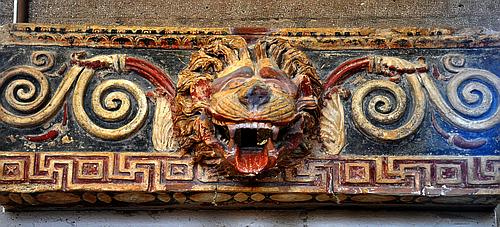
(Greek: simos = "bent upwards") In classical architecture the upturned edges of a roof serving
as a gutter. The "horizontal sima" lies beneath the roof on the long sides of a temple,
and is represented by the geison beneath the pediment. The
"raking sima", on the other hand, lies above the triangular pediment. It was not only there to catch the rainwater from
the roof, but also was a decorative element with ornamental painting, relief decorations or lion-head water spouts.
 Simoeis
Ancient river of the plain of Troas and also the name of its god in Greek mythology. Like other river-gods, Simoeis was the son of Okeanos and Tethys.
Simonides
Simonides of Keos (ca. 556 - 468 BC) was a Greek lyric poet, born at Ioulis on the island of Keos. Together with his nephew Bacchylides and his rival Pindar, he was included in the canonical list of nine lyric poets by the scholars of Hellenistic Alexandria. Apart from his innovative approach to lyric poetry, his fame was due to his influence on the sophistic enlightenment of the Classical era, but also traditional accounts of his colourful life, as one of the wisest of men, and as a greedy miser. Today, he is known for his epitaphs commemorating fallen warriors, especially the Lakedaimonians at the Battle of Thermopylae.
Sinis
A robber who lived on the isthmus of Corinth. He used to kill the travellers whom he had conquered, by fastening them to the top of a fir-tree, which he curbed, and then let spring up again, thereby tearing his victims to pieces. He himself was killed in this manner by Theseus.
Sinope
A daughter of Asopos by Metope. Others call her a daughter of Ares by Aegina or Parnassa. Sinope was abducted by Apollo from Boeotia to Paphlagonia on the Black Sea, where she gave birth to Syros.
Sirens
--> Seirens
Sisyphos
Legendary king and possibly founder of Corinth. According to common tradition he was a son of Aiolos and Enarete, and thus a brother of Alkyone, Athamas, Deïon, Kalyke, Kanake, Kretheus, Magnes, Peisidike, Perieres, Perimede, and Salmoneus. There are different accounts of who his wife and children were. It is however tradition that he found the body of Melikertes on the coast of Corinth, to have buried it on the isthmus, and to have founded the Isthmian Games in his honour. He also promoted navigation and commerce, but had a bad repute of being fraudulent, avaricious, and devious. For various crimes he was punished in the underworld, where he had to roll a huge block of stone up-hill, but as soon as it reached the top always rolled down again. One example of his wickedness and treachery is the tale that he requested his wife not to bury him after his death. She complied with his request, but when Sisyphos was in the underworld he complained of being neglected, and asked Hades to allow him to return to the upper world to punish his wife. When this request was granted, he refused to return to the lower world, so that Hermes had to carry him off by force.
Sithon
A son of Poseidon and Assa, and king in Macedonia. His beautiful daughter Pallene had many suitors, and Sithon challenged them and killed many. At length he allowed Dryas and Kleitos to fight for her, promising to give her to the conqueror. Pallene, who loved Kleitos, caused the chariot of Dryas to be manipulated so that it broke down during the race, whereupon Kleitos slew him. Sithon learned of the fraud and erected a funeral pile to burn the corpse of Dryas and his own daughter. At last, Aphrodite appeared, a shower of rain extinguished the fire, and Sithon gave his daughter to Kleitos.
Sithonia
The peninsula, in antiquity known as Longos, located south of the central part of
Chalkidike. To the west lies the Kassandra peninsula
(ancient Pallene) and the Mount Athos peninsula at the east.
Skamandrios
1) The son of Hektor and Andromache. The people of Troy called him Astyanax because his father was the protector of the city of Troy. At the fall of Troy the Greeks hurled him down the city walls to prevent the prophecy that he should restore the kingdom of Troy.
2) A Trojan, the son of Strophios.
Skamandros
The god of the river Skamander in Troas.
skene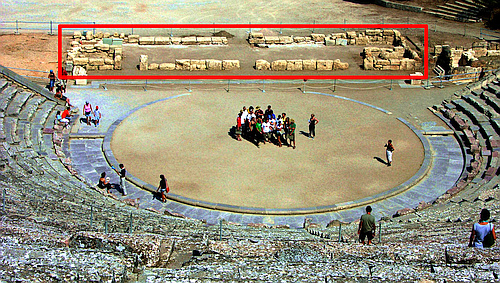
The stage building in an ancient Greek theatre where the actors
performed. Originally it was only a curtain or a tent behind the orchestra, where the
chorus acted. In later constructions, a proskenion was
added and a paraskenion on each side.
skepticism
A philosophical position that refrains from making truth claims. A philosophical skeptic does not claim that truth is impossible (which itself would be a truth claim), but instead recommends "suspending belief". Although skepticism was often accused of denying the possibility of truth, in fact it appears to have been a critical school which merely claimed that logicians had not discovered truth. - Greek sophists of the 5th century BC were partially skeptics, but the actual founding of the "school of skepticism" is usually attributed to Pyrrho of Elis. He traveled to India, studied with the "gymnosophists" (naked lovers of wisdom), and from there he brought back the idea that nothing can be known for certain. The senses are easily fooled, and reason follows too easily our desires. Subsequently, in the "New Academy" Arkesilaos and Karneades developed more theoretical approaches by which conceptions of absolute truth and falsity were refuted as uncertain. Pyrrho's follower Ainesidemos then founded a school of pyrrhonism in the first century BC. In essence, the logical mode of argument was untenable for the skeptics, as it relied on propositions which could not be said to be either true or false without relying on further propositions, thus creating a circular argument that leads nowhere.
Skiron
1) A famous robber, who was up to mischief at the frontier between Attica and Megaris. He not only robbed the travellers who passed by, but forced them, on the Skironian rock to wash his feet, and whilst doing this he kicked them with his foot into the sea where a tortoise devoured the bodies of the robber's victims. He was slain by Theseus, in the same manner in which he had killed others.
2) The husband of a daughter of Pandion, who disputed with her brother Nisos the government of Megara. Aiakos, who was asked as arbitrator, decided that Nisos should have the government of Megara, and Skiron the command in war.
3) The North-West wind; see: anemoi.
Skopas
Skopas (ca. 395 - 350 BC) was an ancient Greek architect and sculptor from Paros. He worked with Praxiteles and was best known for building the new temple of Athena Alea at Tegea and his contribution to the Mausoleum at Halikarnassos.
Skylla
1) In Greek mythology a monster attacking ships. Homer describes her as a fearful monster, barking like a dog, with twelve feet, six long necks and mouths, each of which contained three rows of sharp teeth. She lived on one side of a strait and picked up people from ships that passed by and devoured them. As to her lineage and how she was turned into a monster there are various accounts in mythology. - On the opposite side of the strait lived Charybdis, equally dangerous, who used to suck down the waters thrice every day into her maw and then spew them out causing gigantic waves. Skylla and Charybdis were usually believed to be located in the Strait of Messina (northeast of Sicily), but this has been questioned convincingly by new proposals, favouring the strait between Lefkada and mainland Greece, where there is still a cape Skylla.
2) A daughter of king Nisos of Megara, who fell in love with Minos and caused the death of her father.
skyphos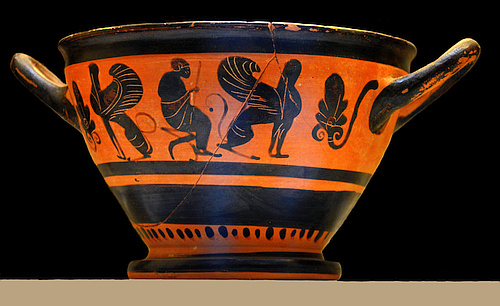
A two-handled deep wine-cup with or without a low base. The handles may project horizontally from the
rim or looping upwards. There are also skyphoi with one horizontal and one vertical handle, a type called glaux
(owl).
Skythians
A large group of Iranian nomads who inhabited large areas in the central Eurasian steppes from about the 9th century BC until about the 1st century BC. The "classical Scythians" described by ancient Greek historians were located in the region north of the Black Sea.
snake goddess
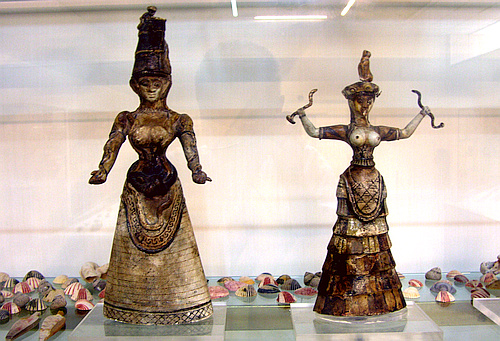
A term introduced by Sir Arthur Evans after finding the two terracotta
figurines reproduced here during his excavations of Knossos. The figurines were quite
imcomplete and Evans' "reconstructions" were not undebated. Meanwhile a few similar images were found but their
significance for Minoan religion is utterly unclear.
soffit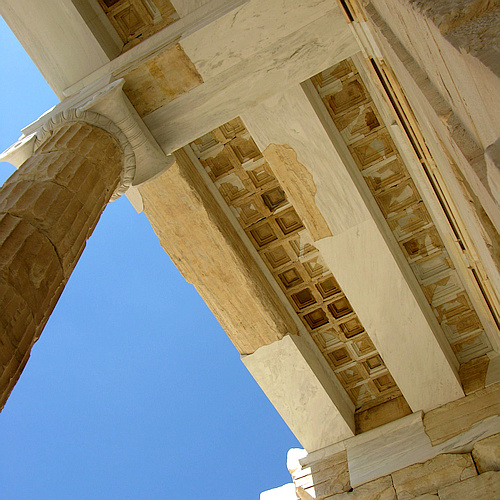
(Latin: suffigere = to fix underneath) In architecture, the underside of any construction
element. This can be the underside of anything like an arc, an architrave, an
entablature, or a projecting cornice.
Sogdianus
illegitimate son of Artaxerxes I and King of Persia (424 - 423 BC). He was murdered by Darius II.
Sokrates
A seminal Athenian philosopher (470/469 - 399 BC) credited as one of the founders of Western philosophy. He is an enigmatic figure mainly known through the accounts of classical writers, but especially of his students Plato, his 'best disciple', and Xenophon, but also in the plays of his contemporary Aristophanes. The main source about Sokrates are Plato's 'dialogues', notwithstanding the fact that it remains unclear how much of it is Sokrates or hidden behind Plato. The dialogues show Sokrates' contributions in the field of ethics, epistemology, and especially the 'Sokratic method', or elenchus. This is understood as a type of pedagogy in which questions are asked not only to draw individual answers, but moreover to encourage own fundamental insight into an issue. - Sokrates lived during the time when Athen's power declined in the Peloponnesian war and Athenians struggled to find stability and to recover from the humiliating defeat by Sparta. In this time it was utterly irritating that Sokrates appeared as a social and moral critic, propagating ideas of justice and the pursuit of goodness. Plato refers to Sokrates as the "gadfly" of the state (as the gadfly stings the horse into action, so Sokrates stung various Athenians), and consequently, perhaps as the result of political infighting, Sokrates was accused of both corrupting the minds of the youth of Athens and of impiety ("not believing in the gods of the state"). The court found him guilty and sentenced him to death by drinking a mixture containing poisonous hemlock. He rejected pleas of his friends to attempt an escape from prison and drank the poison. His last words were: "Crito, we owe a rooster to Asklepios. Please, don't forget to pay the debt."
Solon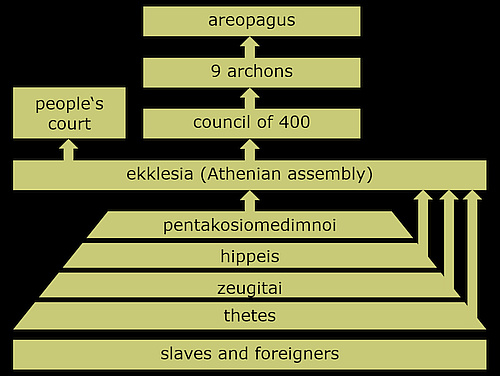
An Athenian statesman, lawmaker, and poet (ca. 638 - 558 BC). Fighting
the political and moral decline of archaic Athens he
reduced the power of the old aristocracy by making wealth rather than birth a
criterion for holding political positions. To this end he introduced four classes of citizenship depending on their
annual production: pentakosiomedimnoi, hippeis,
zeugitai, and thetes. Only members of the first (perhaps
also the second) class were eligible for the highest offices. With this form of
timocracy Solon is often credited with having laid the foundations for the Athenian
democracy.
sophist
Sophist is a term applied to a special kind of teachers in ancient Greece and in the Roman Empire. Sophism actually is not a specific school of philosopy, although many sophists used the tools of philosophy and rhetoric. Other sophists taught subjects such as music, athletics, and mathematics. In general, they claimed to teach arete ("excellence" or "virtue") applied to various contexts. The early sophists charged money for education and providing wisdom only to those who could pay, thereby adressing especially young statesmen and the nobility. This practice has been condemned by Sokrates through Plato in his Dialogues, as well as by Xenophon in his Memorabilia and by Aristotle. - Sophism flourished especially in the late Hellenistic and the Roman period.
Sophokles
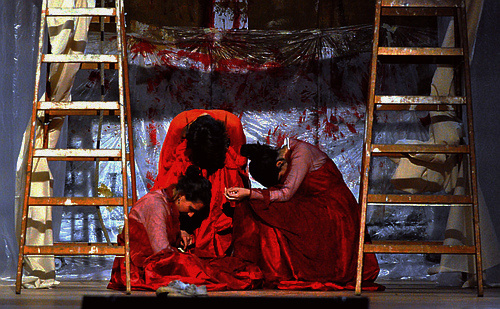
One of the three great ancient Greek tragedians (ca. 497/6 - 406/5 BC)
whose plays have survived. His first plays were written later than those of Aischylos,
and earlier than or contemporary with those of Euripides. Sophokles substantially
influenced the development of Greek drama among other innovations by introducing a third
actor and thus reducing the importance of the chorus. Sophokles wrote 120 plays in the
course of his life, but only seven have survived in a complete form: Ajax (before 442 BC), Antigone (441 BC), The Women
of Trachis (ca. 450 BC?), Oedipus the King (ca. 429 BC?), Elektra (ca. 420 BC), Philoktetes (409 BC), and Oedipus at
Colonus (ca. 405 BC). For almost 50 years, Sophokles was the most celebrated playwright in the dramatic competitions of
the city-state of Athens during the religious festivals of the
Lenaia and the Dionysia. He competed in 30 competitions, won 18, and was never
judged lower than second place. For comparison: Aischylos won 14 competitions, and was sometimes defeated by Sophokles,
while Euripides won 5 competitions.
Sparta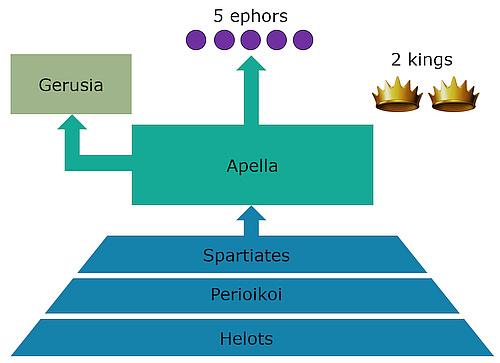
1) One of the most important city-states in ancient Greece, at that time
known as Lakedaímonia. Due to its constitution and social system that focused on military strength it was unique in the
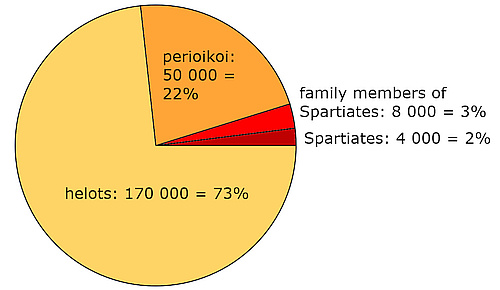
Greek world. Its population, including helots and perioikoi, was about 50,000 at its peak in the 5th century BC, making
it one of the largest Greek cities, but still Athens was about ten times larger. In the
late Archaic period the monarchic system of Sparta was
replaced by an aristocratic constitution favouring the elite warrior class, perhaps
an achievement of the legendary lawmaker Lykurgos around 770 BC. The inhabitants of
Sparta were thus classified in Spartiates (Spartan citizens, who enjoyed full rights), mothakes
(non-Spartan free men raised as Spartans), perioikoi (freedmen), and
helots (state-owned slaves, non-Spartan local population). Spartiates underwent a rigorous
military training to form the backbone of the Spartan army. Other classes had less or no civil rights but it is
remarkable that Spartan women enjoyed considerably more rights than elsewhere in the classical world. - Around 650 BC
Sparta had become the dominant military land-power and was leading the combined Greek forces in the
Persian Wars (499-449 BC). During the
Peloponnesian war (431-404 BC) against Athens it was victorious in the end, but was
defeated by Thebes in the battle of Leuktra (371 BC). With
the Roman conquest of Greece in 146 BC Sparta lost its independence and its decline started.
2) A daughter of Eurotas, and wife of Lakedaimon, by whom she became the mother of Amyklas, Eurydike, and Asine. From her the city of Sparta was believed to have derived its name.
Spartiates
Privileged male citizens of Sparta with full civic rights, the elite warrior
class. Already at a very young age they were trained for battle, sustaining gruesome exercises and challenges to form
brave and fearless soldiers as part of Sparta's famed hoplite forces. Their code of
honour required that they return from battle either "with the shield (victorious) or on the shield (dead)". They were
exempt from manual labor, contributed to the government of the state and were expected to be ready for an armed conflict
at all times. Actually, the Spartiates were only a small fraction of Sparta's population, only some 8000 at the peak of
Sparta's history, but fearfully respected by Sparta's adversaries.
Spartoi
The "sown men", i.e. the armed men who sprang from the dragon's teeth sown by Kadmos, and according to legend the ancestors of the five oldest families at Thebes.
Sphinx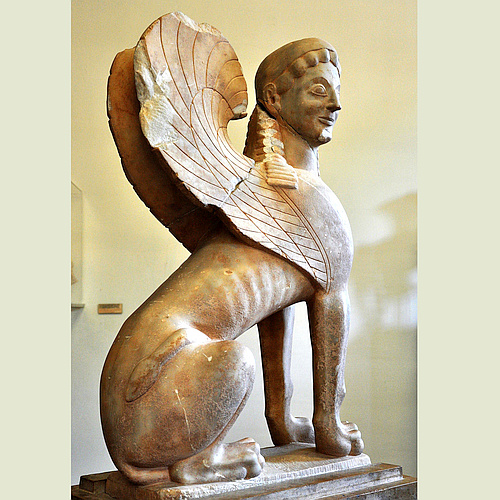
In Greek tradition, a mythical creature, treacherous and merciless, with the head of a human, the
body of a lion, and sometimes the wings of a bird. According to Hesiod, she was a daughter
of such chthonic figures from the earliest of Greek myths such as
Orthos and either Echidna or the
Chimaira, or perhaps even Keto. In ancient lore the Sphinx
had a foreign origin, but is best known from the myth and drama of Oedipus, where she
guards the entrance to the city of Thebes. There she asked all passersby the most famous
riddle in history, and strangled and devoured anyone who could not answer. According to later tradition, the riddle was:
"Which creature has one voice and yet becomes four-footed and two-footed and three-footed?" Oedipus solved the riddle by
answering: Man - who crawls on all fours as a baby, then walks on two feet as an adult, and then uses a walking stick in
old age. Consequently, the Sphinx then threw herself from her high rock and died. - In a much later tradition, there was
a second riddle: "There are two sisters: one gives birth to the other and she, in turn, gives birth to the first. Who
are the two sisters?" The answer is "day and night" (both words are feminine in Ancient Greek).
stadion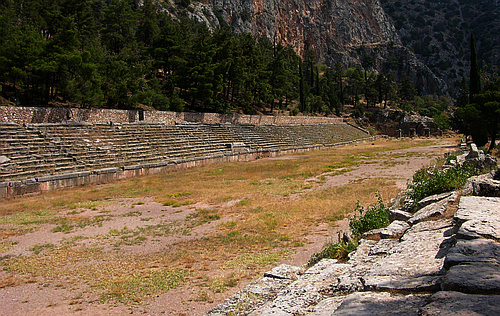
1) A stadion (Latin: stadium) is the outdoor construction for competitions in running, part of the ancient Olympic Games and the other panhellenic games. It consists of a long and relatively narrow dirt track with markers for the runners in a marble strip of pavement at both ends. It was usually built into a hillside or sloped area to provide seating for the spectators, often with stone benches.
2) An ancient Greek unit of length, based on the typical length of a stadion. According to
Herodotus, one stadion was equal to 600 Greek feet (pous). However, the length
of the foot varied in different parts of the Greek world, so that the actual length of one stadion was much debated.
Sometimes an average length of 157 m is given, but this is considerably less than the 213 m length of the stadion in
Olympia, and also less than the 178 m in Nemea or the 177 m
in Delphi.
Staikopoulos
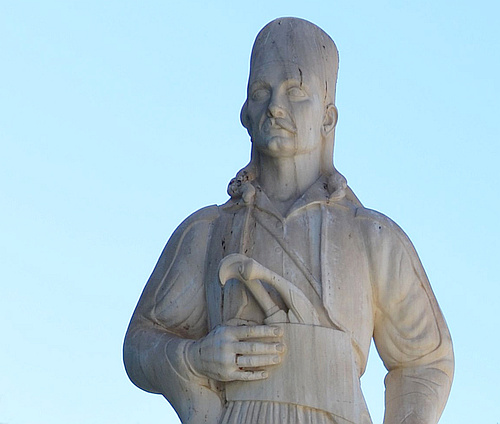
Staikos Staikopoulos (1799-1835) was a leader in the Greek War
of Independence. When the war broke out in 1821, he gathered his own troops and immediately marched to
Nafplion, and after a siege captured the fortress of Palamidi on 29 November 1822. After
this victory he was promoted to strategos (general) and then laid siege to Acrocorinth, the mighty fortress
towering above ancient Corinth, which finally fell under his occupation. After the war,
he had a seat in the Second National Assembly but, being opposed to the government of King
Otto, was sent to prison. He died on the day of his release from the wounds and hardships of war. - Today, there is
a Staikopoulos Park with his statue in Nafplion, where every year on November 29 a ceremony is held in his honour.
Staphylos
In ancient Greek mythology a son of Dionysos and Ariadne, or of Theseus and Ariadne. He is mentioned as one of the Argonauts.
stele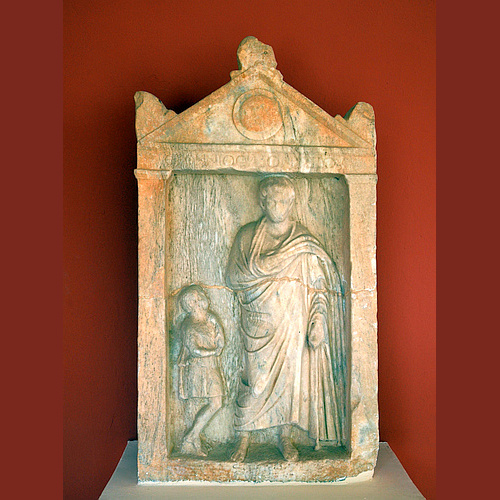
Vertically standing gravestone.
stereobate
--> stylobate
Sterope
1) A Pleiad, daughter of Atlas and wife of Oinomaos.
2) A daughter of Akastos.
3) A daughter of Pleuron and Xanthippe.
4) A daughter of Kepheus of Tegea.
5) Proposed mother of the Sirens.
6) A daughter of Porthaon and Euryte.
Steropes
("flasher") One of the Cyclopes, son of Gaia and Uranos, mentioned by Hesiod.
Stheneboia
--> Anteia.
Sthenelos
1) A son of Aigyptos and husband of Sthenele.
2) A son of Melas, who was killed by Tydeus.
3) A son of Perseus and Andromeda. By his wife Nikippe he became the father of Alkinoë, Medusa, and Eurystheus. He was slain by Hyllos, the son of Herakles.
4) A son of Androgeos and grandson of Minos. He accompanied Herakles on his expedition against the Amazons, and was rewarded by being appointed ruler of the island of Thassos together with his brother Alkaios.
5) A son of Aktor. Also he was a companion of Herakles in his expedition against the Amazons.
6) A nobleman of Argos, a son of Kapaneus and Euadne. He was one of the Epigoni who conquered Thebes, and in the Trojan War commanded the Argives under Diomedes. He was also one of the Greeks concealed in the Wooden Horse.
7) The father of Kyknos.
Stheno
("forceful") The eldest of the Gorgons.
Stilbe
A daughter of Peneios and Kreusa. By Apollo she was the mother of Lapithes and Centaurus.
stirrup jar
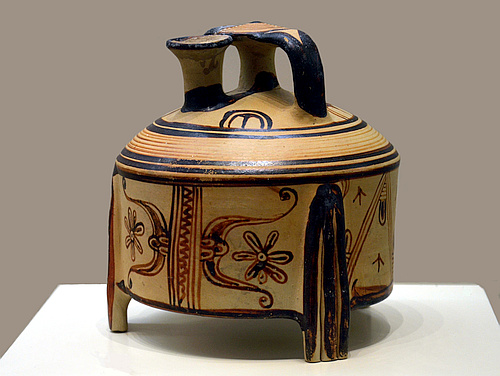
A Mycenaean vase with globular body, used for carrying liquids. In
the middle of the upper surface is a false spout as part of an arched handle. Adjacent to this is the real
spout.
stoa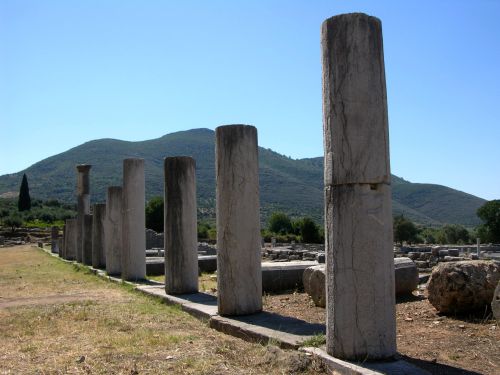
In ancient Greek architecture, an oblong building with one long side open, i.e. a covered walkway or
portico. Early stoas had Doric
columns on the open side, thus creating an enveloping, protective atmosphere. Later
examples followed the Ionic architecture and had two stories with a roof supporting
the inner colonnades. Commonly, stoas were for public use, where shops could be located
or where religious gatherings could take place. They usually surrounded the agora of larger
cities and were used as a framing element.
stoicism
A school of Hellenistic philosophy founded in Athens by Zenon of Kitieus in the early 3rd century BC. For the Stoics, everything is rooted in nature, and in the active relationship between cosmic determinism and human freedom it is virtuous to maintain a will (prohairesis) that is in accord with nature. Therefore, the philosophy of the Stoics is actually a way of life, indicated not by what a person said but how that person behaved.
stomion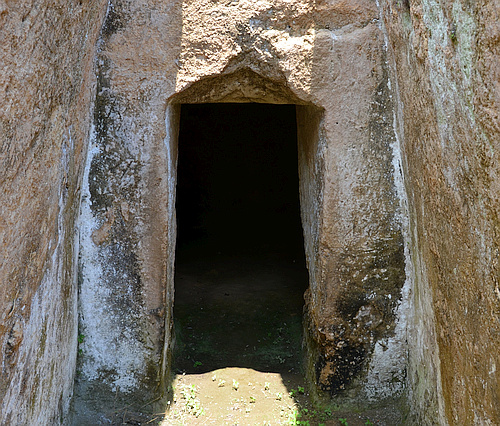
The doorway of a tholos tomb or a
chamber tomb in the Mycenaean period.
Stone Age
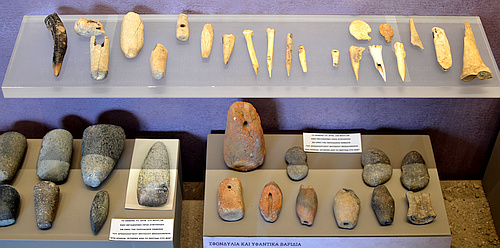
A long period of prehistory, characterized by the use of stone
tools. Also bone tools were used in this period, but because of their reduced durability, these are not found so often.
The Stone Age lasted for about 3 million years and is roughly subdivided into three periods:
- Palaeolithic: 2.600.000 - 300.000 BCThe Stone Age ended with the advent of metalworking in the Bronze Age and the Iron Age.
- Mesolithic: 300.000 - 50.000 BC
- Neolithic: 50.000 - 3.000 BC
Strabo
Strabo (64/63 BC - ca. 24 AD) was a Greek geographer, philosopher, and historian who lived in Asia Minor. He is best known for his Geographica, an encyclopedia describing the history of people and places from different parts of the then known world.
strategos
Strategos (Greek: "army leader") denotes in Greek a military general. In ancient Athens, the office of strategos existed already in the 6th century BC. With the reforms of Kleisthenes in 501 BC, it received its best known form: annually ten strategoi were elected, one from each tribe (phyle). This board of ten strategoi with equal status replaced the polemarchos, the supreme military commander of earlier times.
strigil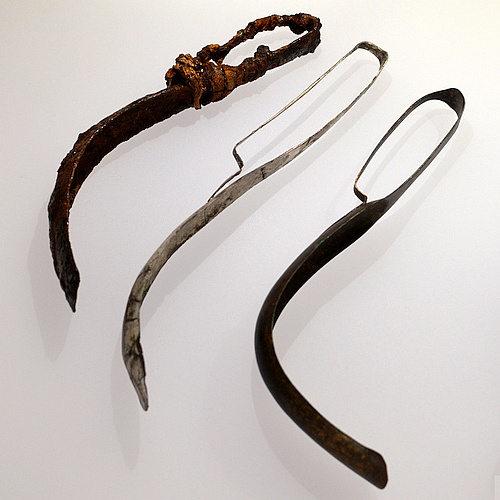
A tool for the cleansing of the body by scraping off dirt, perspiration, and oil that were applied
before bathing. It is usually a metal curved blade with a handle, used by athletes, soldiers, and more. Strigils are
often found in tombs.
Strymon
1) A river in Bulgaria and Greece, now called Strymónas.
2) A son of Okeanos and Tethys. He was a river god of Thracia.
stylobate
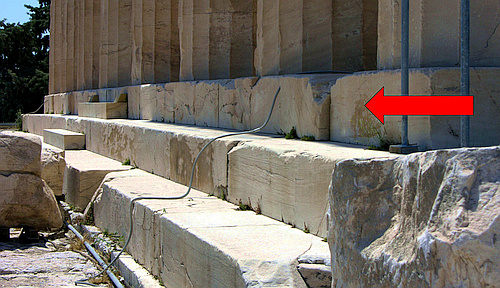
Also called stereobate, the uppermost of the three steps of a temple
foundation. The columns stand on this stylobate.
Stymphalian Birds
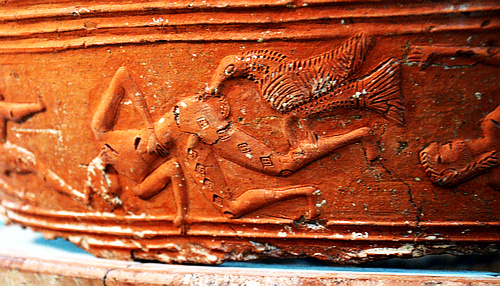
Fierce, carnivorous birds that inhabited Lake Stymphalos in
Korinthia and shot their deadly feathers at people. As his Sixth Labor
Herakles killed the birds with his poisoned arrows.
Stymphalos
1) Modern Stymfalia lies in a mountain valley of Korinthia. Just south of the modern village are the remains of ancient Stymphalos, famous as the site of the Stymphalian Birds killed by Herakles.
2) A son of Lykaon.
3) King of Arcadia, a son of Elatos and Laodike, and thus a grandson of Arkas. He was the father of Parthenope, Agamedes, and Gortys. When Pelops was unable to defeat him in war, he treacherously killed him and cut him in pieces.
Styx
1) ("Shuddering") A river in the underworld.
2) In mythology, the eldest daughter of the Titans Okeanos and Tethys. When war broke out between the Titans and the Olympian Gods Styx and her children sided with Zeus. As a reward, Zeus decreed that the solemn oaths of the gods be sworn by her name.
Sybaris
A monstrous Lamia which terrorized the region near Krissa in Phokis. When Alkyoneus was to be sacrificed to the beast, Eurybaros volunteered to go in his place and destroyed Sybaris by pushing her off a cliff.
Syleus
In ancient Greek mythology Syleus was a nefarious man from Lydia where he had a vineyard and forced all passers-by to dig it. When he tried the same with Herakles, he was killed by Herakles with his own hoe.
symposium
An all male drinking party. Small, private symposia were held in private homes (andron), but when numbers increased, public buildings were used.
synoikismos
(Greek: syn = "together" + oikos = "house"; i.e. "dwelling together in the same house") The merging of villages in ancient Greece into poleis, or city-states, or any act of civic union between polities of any size. - According to tradition, Theseus initiated the synoikismos of Attica around Athens as its political centre.
Syracuse
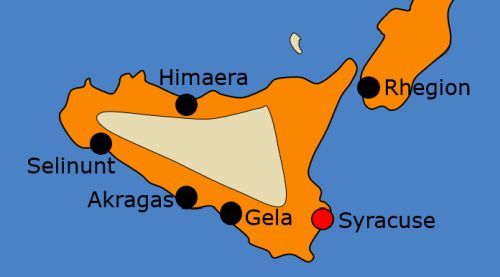
A historic city in the southeast corner of Sicily. In antiquity it was allied with
Sparta and Corinth, had much influence in all
Magna Graecia and was one of the major powers of the Mediterranean world. It is also
known as the birthplace of Archimedes.
Syrinx
A nymph who fled from the lustful advances of Pan. When she came to a river and saw no escape, she prayed to the gods, who then turned her into reed in the river marsh. Pan broke off some of the reeds, tied them together and used it as the music instrument that he called "syrinx".
syrinx
A musical instrument, the first set of pan pipes. According to Greek tradition it goes back to the reeds into which the nymph Syrix was changed.
systyle
Columns rather thickly set, with an intercolumniation where the space between columns corresponds to two column diameters.

