GREECE
 PELOPONNESE
ARGOLIS
MYCENAE
PERIPHERY
PELOPONNESE
ARGOLIS
MYCENAE
PERIPHERY

2024-12-03
Mycenaean burials
Mycenaean burials are known from many Greek sites, especially on the Peloponnese. They are often organized in large cemeteries and shed light on Mycenaean burial practices, religion, culture and social life. In the following I try to give a short outline of the different types of tombs and their chronological sequence.
The main type of burial in the Middle Bronze Age was the cist grave, a box-shaped burial structure. It could be either sunk below ground level and the interior lined with stones or mudbrick, or it could be built above the ground with stone slabs set on edge and covered by a protective capstone. The body of the deceased was placed on the ground, usually accompanied by some grave goods.
Although prevalent in the Middle Bronze Age, cists graves were also used much later, perhaps especially by the poorest social groups. There was also a significant reappearance in quantity towards the end of the Mycenaean period, the reasons of which have been much debated.
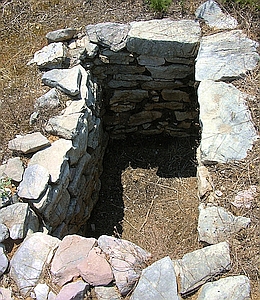
Around 1600 - 1500 BC the "Grave Circle A" was constructed and the later discovered "Grave Circle B". Both grave circles contained shaft graves, dug some 7.50 m deep into the rock. They contained the burials of royal families, accompanied by extremely rich grave goods like jewellery and numerous gold items.
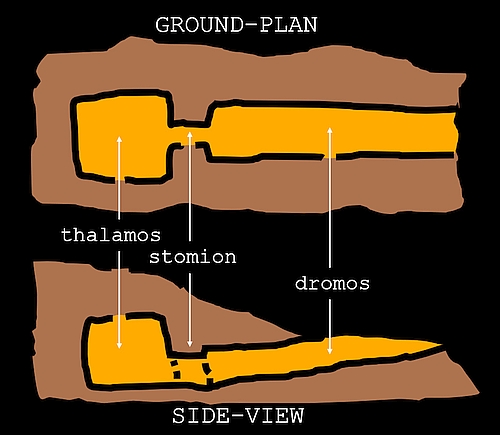
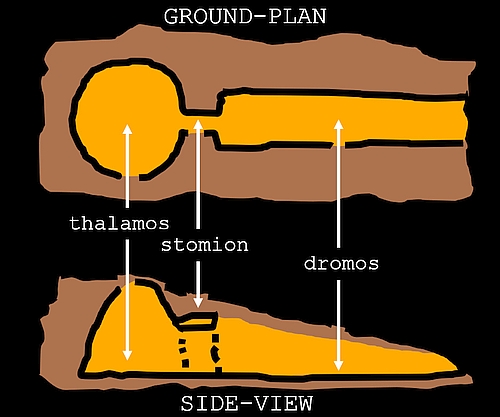
The next stage are the chamber tombs, appearing between 1600 and 1100 BC as the most common mortuary architecture. They have a tripartite structure consisting of dromos (entrance corridor), stomion (doorway) and thalamos (burial chamber). They were built in hillsides from where the dromos with a length of some 5 - 10 m slopes down until the necessary depth is reached. The cross-section of the dromos usually shows a characteristic tapering towards the top. At the end of the dromos comes the narrower entrance of the stomion. This was closed off after a burial by a wall of rubble masonry. The thalamos, the actual burial chamber can have a more or less rectangular or circular groundplan. The chamber tombs e.g. of Voudeni or Aidonia show a wide variety of shapes. This includes for example tomb chambers formed like the interior of Mycenaean houses complete with ridge pole. - Inside the tomb chamber the dead were laid on the ground or deposited in burial pits dug into the floor. Each tomb was used for many successive burials of members of the same family, apparently of higher and middle social classes, each accompanied by precious grave goods. When the corpse was decomposed the bones and the grave goods were pushed aside to gain place for the new burials.
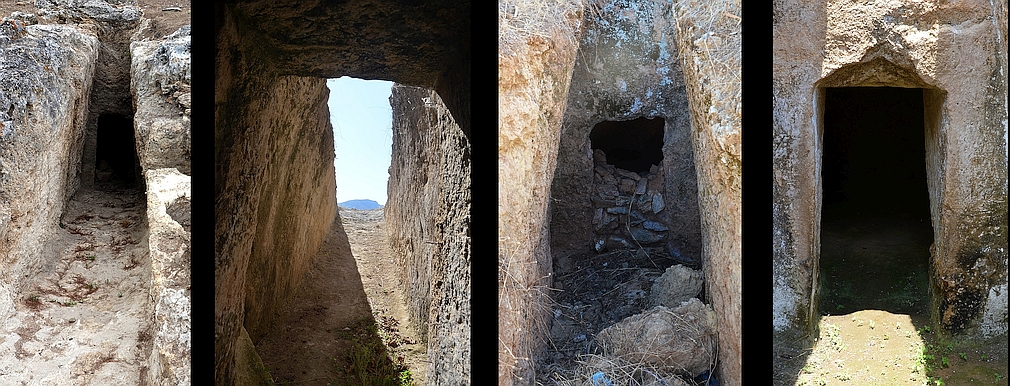
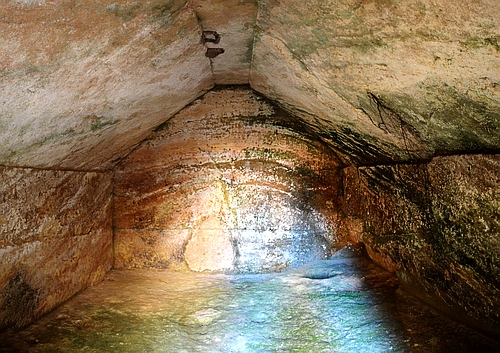
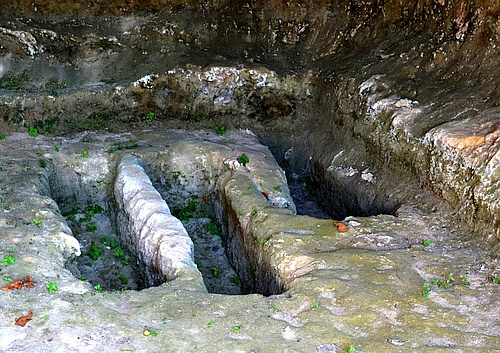
Above from left to right: Dromos of a chamber tomb with the tapering walls. Looking out to the dromos. A stomion with remains of the dry masonry wall that originally blocked the entire entrance. The stomion of another chamber tomb. - Below left: The burial chamber formed like the interior of a Mycenaean house. - Below right: Burial pits and a bench around the walls of a chamber tomb.
This was followed by tholos tombs, exclusively for rulers and royal families or in any case high ranking officials. You see here principally the same tripartite scheme as with the chamber tombs. The main difference, however, is that tholos tombs (also called "beehive tombs" because of their form) are built of large stones whereas chamber tombs are merely cut into the rock.
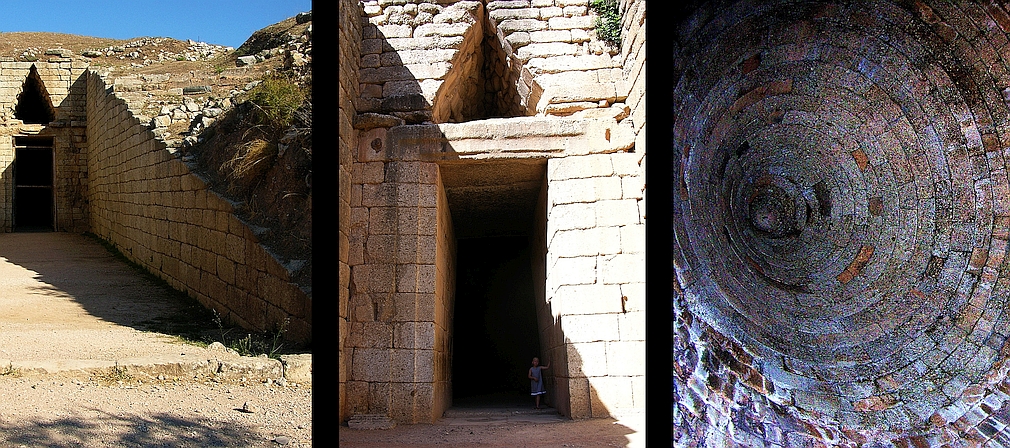
Usually tholos tombs are also set into slopes or hillsides, but the dromoi of tholos tombs are horizontal and broader than in chamber tombs. They lead to the stomion that was very elaborated in later periods. Above the doorway sit massive lintel blocks, later surmounted by a relieving triangle that may also have included a relief decoration. The thalamos always has a circular groundplan roofed by a corbelled vault. Burials were laid out on the floor of the thalamos or placed in pits cut into the floor.
Mycenaean tholos tombs appear in the period from LH IIA to early LH IIIB (i.e. ca. 1525 to 1300/1275 BC) and may have descended from the Mesara type tholoi on Crete.
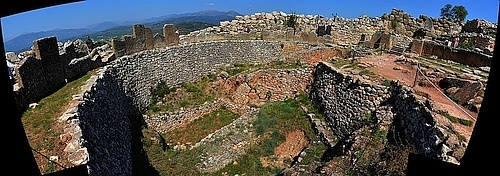
Below from left to right: Dromos of a tholos tomb. A stomion with lintel and relieving triangle. Corbelled vault of a tholos tomb.
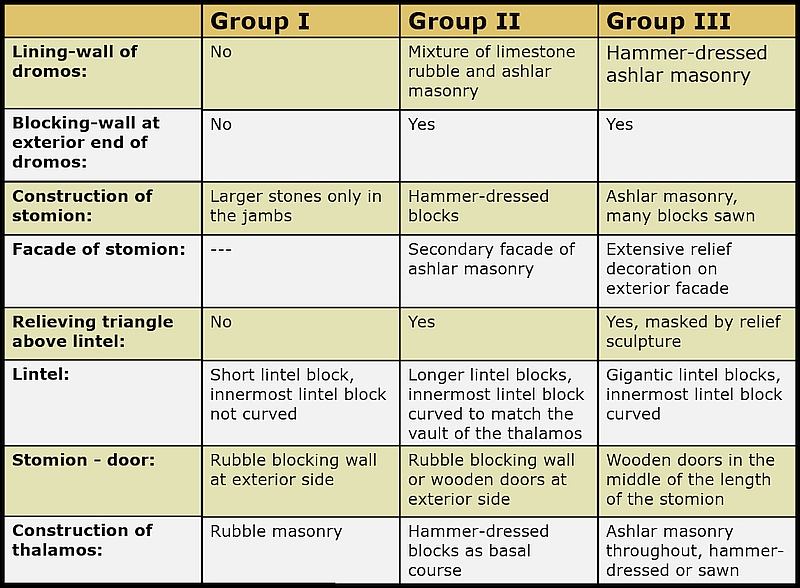
There are nine tholos tombs at Mycenae which is the largest concentration of such mortuary architecture on a single site. This enabled Alan Wace to establish a chronological grouping of these tombs purely based on architectural criteria. In principle this applies only to the tholoi in Mycenae, and because all of these tombs were found robbed an absolute dating is difficult.