
GREECE
 PELOPONNESE
KORINTHIA
ISTHMIA
CYCLOPEAN
PELOPONNESE
KORINTHIA
ISTHMIA
CYCLOPEAN

2025-01-03
Section 'Sp'
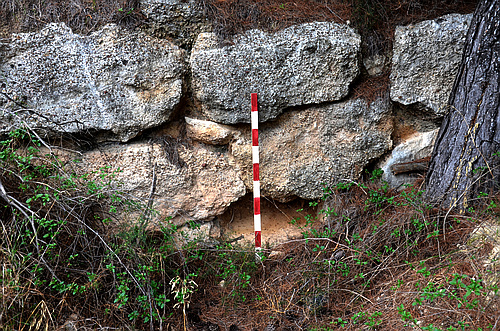
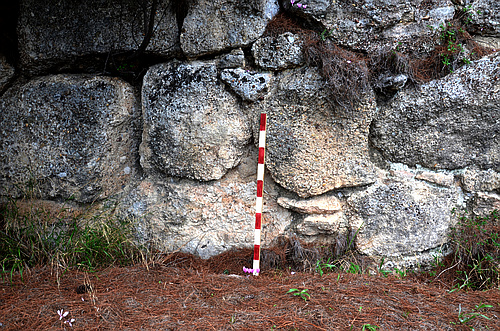
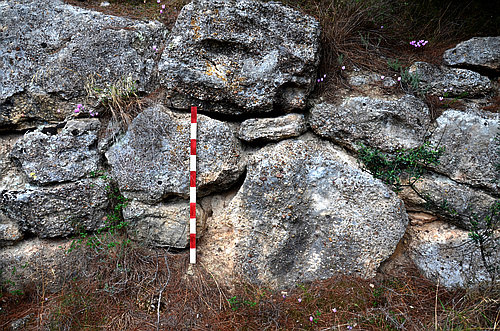
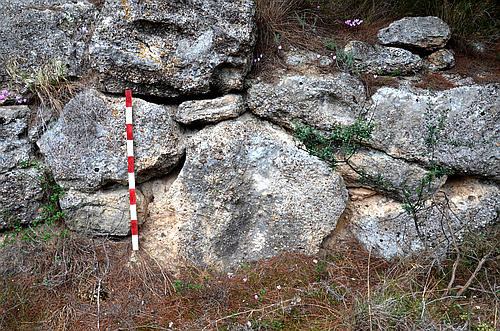
Above and below: Next comes section 'Sp', which is the easiest to find just next to the road. This part of the wall shows the most typical Cyclopean masonry with large 1m-wide irregular stones, interstices not very carefully filled with smaller stones. In this early form of Cyclopean masonry there are no clear indications of the wall being built in courses. - Because of its location near the bottom of the ridge this could very well be a retaining wall. On the other hand, assuming that all sections belong to the same building project of defensive nature it would fit in the general course of the wall.
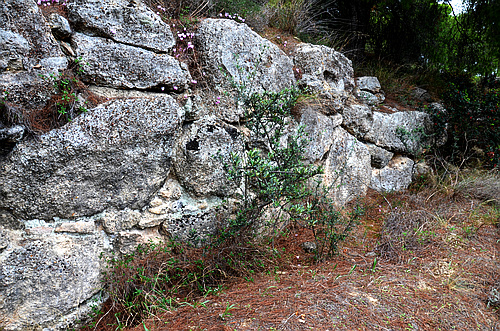
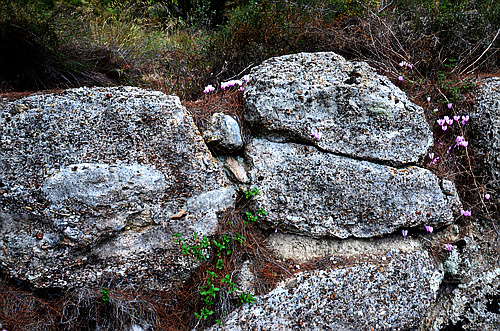
Section 'Zo'
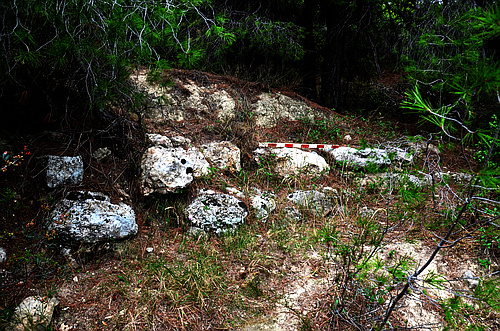
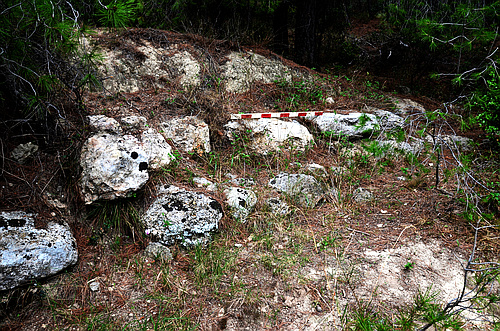
Below: Section 'Zo' lies in the valley. It is preserved only over a length of about 4 m and is curved, the convex side on the South. It is not very well preserved but you can see irregular stones strangely arranged in three consecutive steps. My impression is that it more likely belongs to the ancient stadium.
Sections 'Vl' and 'Pa'
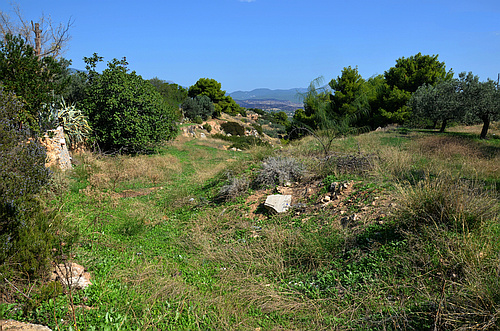
Proceeding further south we come to the head of a gully which is quite difficult to enter from the East, so I missed section 'Vl' in this area. This is quite unfortunate because this part of the wall is quite long and very poorly documented.
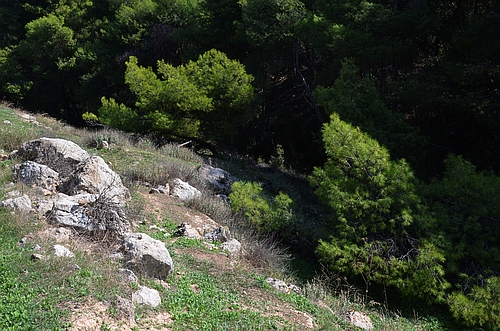
However, it is possible to enter the valley from the South (photographs left and below). Here it should be possible to go down to the streambed where section 'Pa' was excavated. This would require more time than I had at my disposal during my visit in September 2023, so I can only show the landscape here.
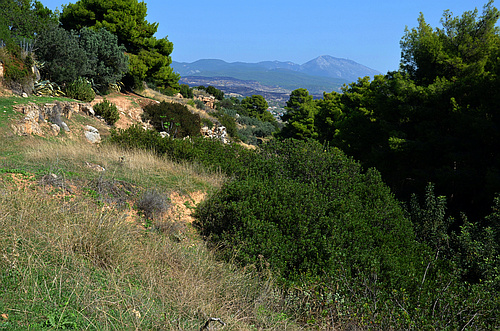
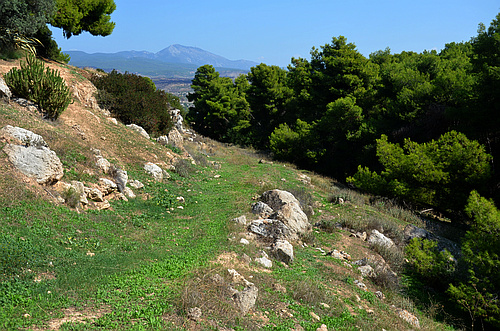

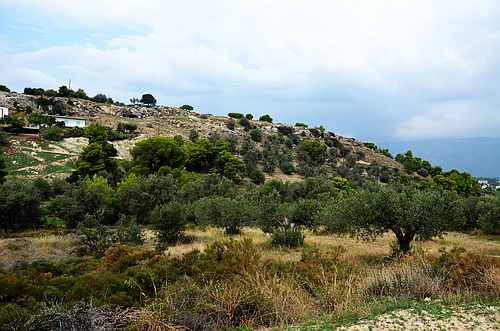
Left: View from the Southeast to the northern end of the Rachi ridge. It is strange that no remains of the 'Cyclopean Wall' have been found on the top or the eastern side of Rachi, assuming that the wall had a continous course between sections 'Pa' in the South and 'Mi' in the North. I don't have the impression that the slope of Rachi is steeper than that of Mytikas on the other side of the valley. So why is there no wall? Broneer assumes that there also was a wall on this side and that the large stones used in the modern terrace walls come from there.
Section 'Ge'
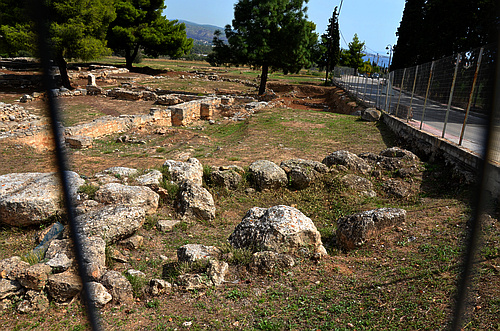
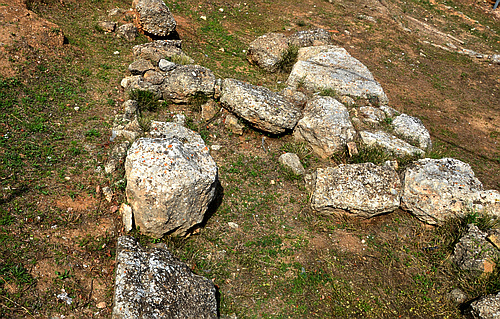
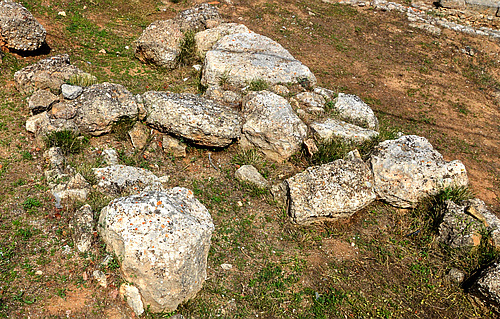
Left and below: Section 'Ge' is the most northern part of the 'Cyclopean wall'. It lies on the site of the Sanctuary of Poseidon just next to the museum and can be seen from the road leading to it.
This section of the 'Cyclopean wall' is not very long, part of it having been destroyed when the modern road was built - at a time when the wall had not yet been recognized as such.
According to the excavation report "the structure had two faces of fairly large uncut stones packed with smaller stones and earth." Today only the topmost layer of stones can be seen.
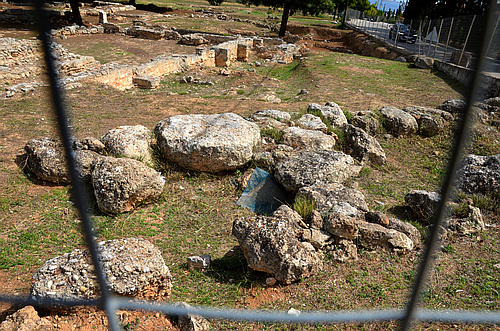
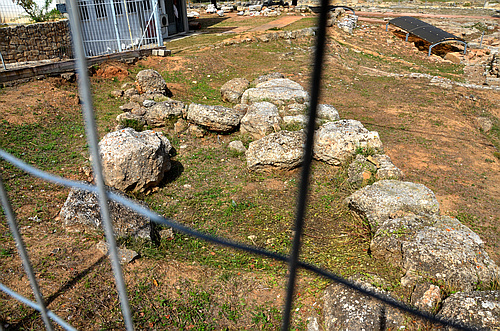
What do we learn from all this? In total I could study the masonry of four sections of the supposed wall. Below from left to right: Parts of 'Sk', 'Sp', 'Zo' and 'Ge' at about the same scale.
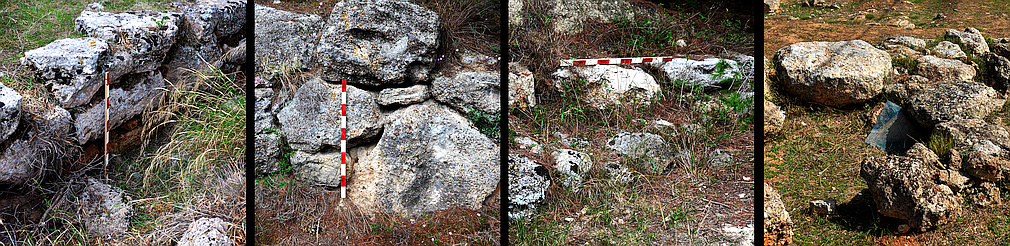

Surely section 'Sp' is the most Cyclopean, but the masonry of the other parts does not look much different, concerning the form and size of the stones. The only exception is the strange form of the wall in section 'Zo', of which I don't have a substantiated opinion yet. Furthermore, the location and orientation of the sections seem to indicate a unifying character, although this has been questioned. Still, many questions remain unanswered. It cannot be ruled out that these are sections of a wall stabilizing a Mycenaean road. But from where to where did it lead?