GREECE
 PELOPONNESE
KORINTHIA
CORINTH
SITE
PELOPONNESE
KORINTHIA
CORINTH
SITE

2024-12-30

history of Corinth
Mythical founder of ancient Corinth was Sisyphos, the cunning son of Aiolos. Actually, the place was already inhabited in the Neolithic period and in the Bronze Age (ca. 5000 - 3000 BC). According to mythology, Corinth was the home of Bellerophontes, master of the winged horse Pegasus, and of Medea.
In the 8th century BC, Corinth flourished already as a major centre of trade with the Aegean. The dramatic increase of its population caused the founding of colonies in Kerkira (Corfu), Potidaia (Macedonia) and Syrakus (Sicily). In the 7th century BC, during the reign of Kypselos and his son Periander, Corinth reached a remarkable prosperity, founded still more colonies and crushed the insurrection of Kerkira.
When Athens emerged as a major commercial power, robbing Corinth of her foreign markets, the rivalry between these two cities increased. As a result, Corinth was on the Spartan side in the Peloponnesian War (431 - 404 BC) and supported the Syracusians against the Sicilian expedition of Athens. In 395 BC, Corinth changed sides and caused the Corinthian War (395 - 387 BC), from which the city suffered badly. As a participant in the battle of Chaironeia (338 BC), Corinth was defeated like her allies and received a Macedonian garrison, but flourished again under the foreign rule.
The inhabitants of ancient Corinth always were notorious for their vices, quite remarkable in a period of general licentiousness. The worship of Aphrodite in Corinth was accompanied by religious prostitution, and it is related that a thousand courtesans served the temple on Acrocorinth. - In this most sensual and profligate city of ancient Greece, the philosopher Diogenes ended his days propagating the ascetic, frugal principles of the Cynics.
In 224 BC, Corinth expelled the Macedonian garrison and joined the Achaean League. After its defeat in 146 BC, the Romans destroyed Corinth down to its foundation-walls. But when Julius Caesar re-founded a colony of his veterans just at this place in 44 BC, Corinth experienced another period of luxury and dissipation. It appears as a counterbalance, that Saint Paul founded a church here in AD 51/52 during his stay in Corinth. Later, Hadrian's building activities further added to the charm of the city, which was then utterly destroyed by earthquakes in AD 375 and 551.
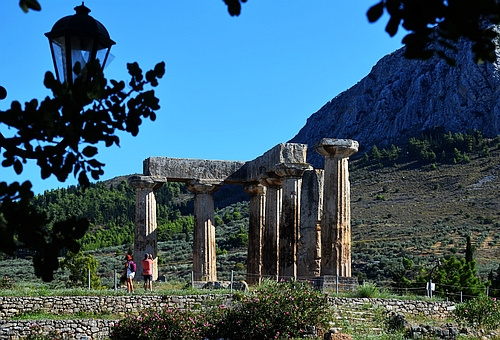
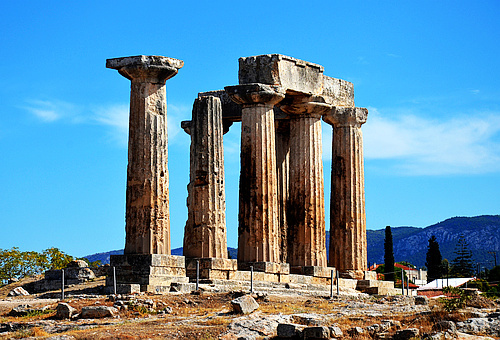
Today, ancient Corinth is one of the major archaeological destinations in the Peloponnese. The very extensive site is full of ancient remains: temples, the forum, fountains, shops, porticoes, cemeteries, a stadium, latrines, baths, Roman lawcourts and various other buildings.
Below left: My students at the temple of Apollo in 1997. Today this would not be possible since you have to stay behind the barrier.
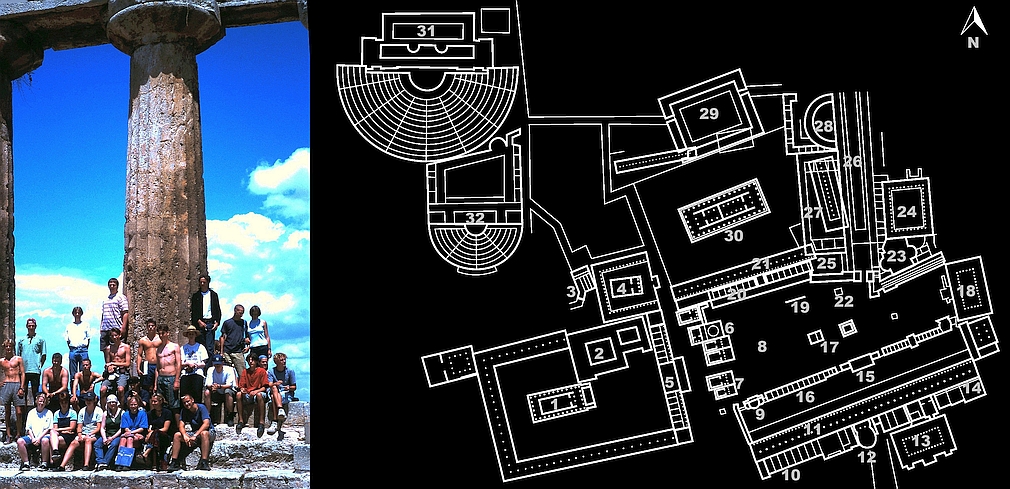
Above right: Plan of ancient Corinth. - 1.Temple of Octavia - 2. Archaeological museum - 3. Fountain of Glauke - 4. Temple C - 5. West stores - 6. Temples of Hermes, Apollo, Poseidon and Herakles - 7. Pantheon and Temple of Venus Fortuna - 8. Forum - 9. Sanctuary of Dionysos - 10. South stores - 11. South stoa - 12. Bouleuterion - 13. Southern basilica - 14. Hall of the Agonothetes - 15. Bema - 16. Central stores - 17. Altar - 18. Julian basilica - 19. Wall of Triglyphs - 20. Northwest stores - 21. Northwest stoa - 22. Sacred Spring - 23. Fountain of Peirene - 24. Peripteros of Apollo - 25. Captives fassade - 26. Lechaion Road - 27. Basilica of the Lechaion Road - 28. Roman marketplace - 29. Northern agora - 30. Temple of Apollo - 31. Theatre - 32. Odeion