
GREECE
 PELOPONNESE
ELEIA
OLYMPIA
MUSEUM
PELOPONNESE
ELEIA
OLYMPIA
MUSEUM

2024-12-21
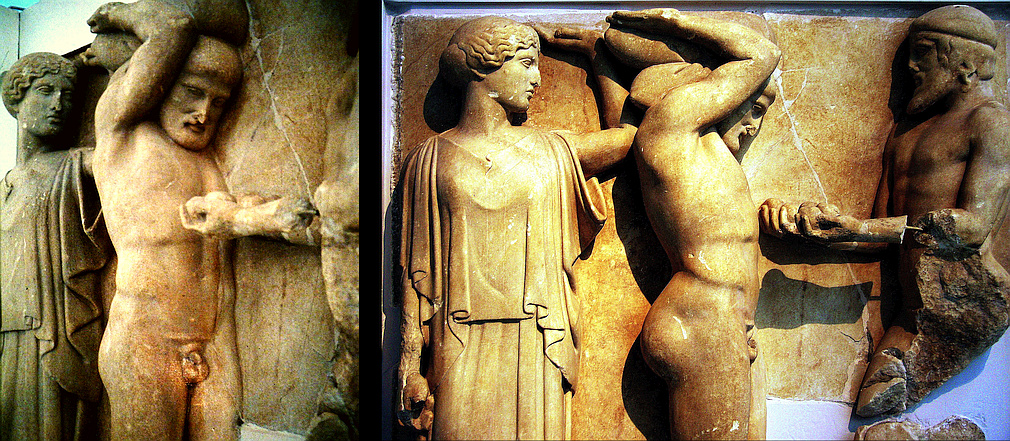
It is quite natural that the sculptured metopes from the temple of Zeus are exhibited around the walls of the same hall as the pediments, illustrating the Twelve Labours ("athloi") of Herakles, son of Zeus. In most of them, Zeus' daughter, Athena, also appears, the patron goddess of Herakles.
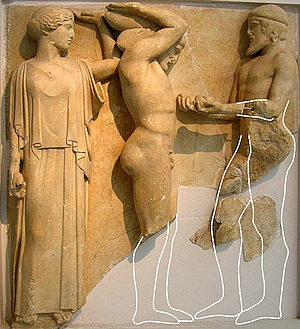
In the pictures above, my favourite relief, she lends a hand as Herakles bears the firmamant while Atlas brings the golden apples of the Hesperides.
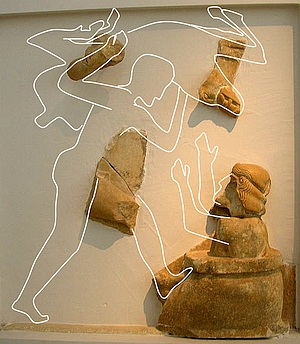
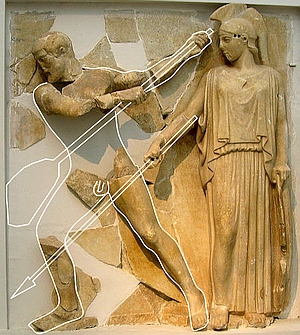
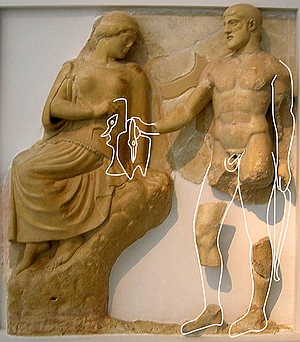
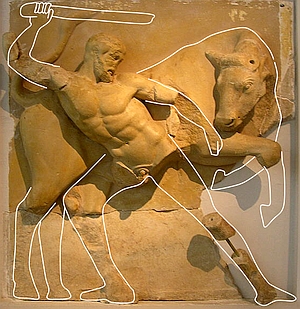
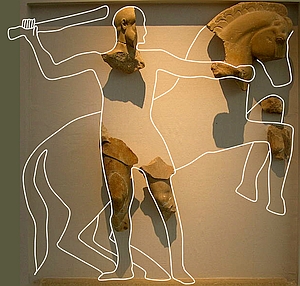
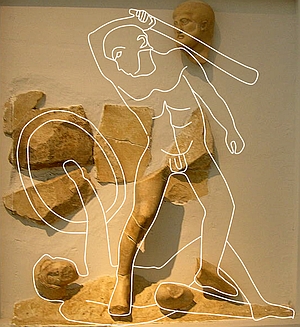
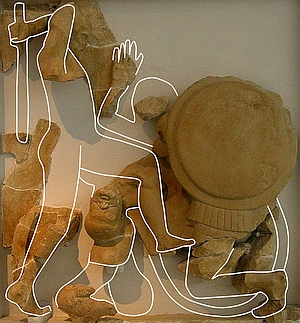
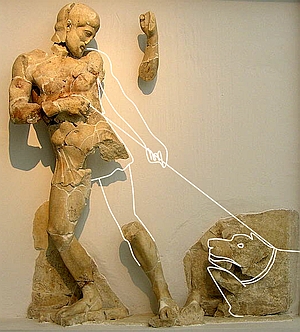
Of some metopes, only few fragments have survived, requiring much imagination and the helpful drawings of reconstructions accompanying the exhibited pieces. On the following pictures I have added my own outline drawings, mainly based on the museum reconstructions. Texts are as presented in the museum.
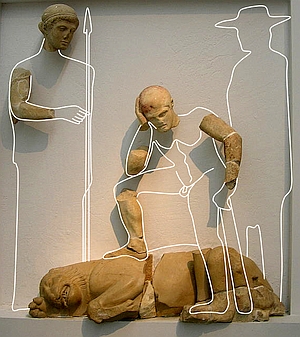
1. The Lion of Nemea
As his first labour Heracles had to slay the Lion of Nemea. In the scene the young beardless Heracles, tired, rests his foot on the lion's body. His right hand holds his head and his left one would have been leaning on his club. Near him is Athena, who supported and protected him. A small part of the foot of a figure visible behind Heracles could belong to Hermes. The figure of the weary hero is unprecedented in the art of that period, in which heroic figures were usually portrayed in an epic manner, full of strength.
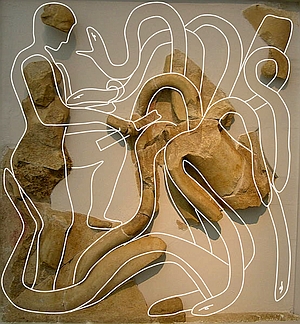
2. The Hydra of Lerna
Heracles at the left end of the metope overcomes the Hydra of Lerna, holding in one hand a small sickle with which he cuts off its heads, and in his other hand a torch to sear the wounds to prevent them sprouting new heads. The thick body of the monster, which fills the greater part of the scene, lies on the ground as it attacks the hero with its snake's heads.
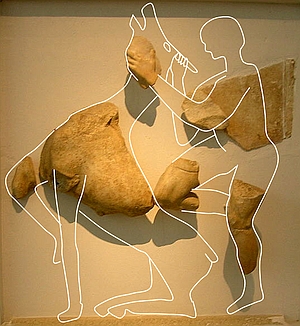
3. Capturing the Keryneian Hind
Only a few fragments of this metope were found and it is thus difficult to reconstruct. Heracles has seized the Ceryneian hind of the goddess Artemis by its golden antlers after forcing it down.
4. Capturing the Erymanthian Boar
Heracles is shown carrying the live Erymanthian boar on his shoulders as Eurystheus, who is seen hiding in a large jar, looks at Heracles with both hands (although not preserved) raised in terror. Only few parts of the figures of Heracles and the boar have survived.
5. Cleaning the Stables of Augeas
This metope depicts the labour of the cleansing of the Augean Stables. Heracles holds a large broom by its handle and endeavours to clean away the dung. Beside him Athena, wearing a helmet, points with her right hand to the spot where he must unite the waters of the Peneios and Alpheios in order to cleanse the dung from Augeas' stables. Athena wearing a Doric peplos leans with her left arm on her shield.
6. Killing the Stymphalian Birds
In this metope the labour has already been completed and Heracles has killed the Stymphalian Birds. Standing at the right end of the metope with his bow in his left hand, he offers some of the dead carnivorous birds to Athena, who is seated barefoot on a rock and wearing the aegis. With singular grace the goddess turns her head to the hero as she accepts his offering. Unfortunately neither the dead birds nor Heracles's bow is preserved, leaving this to the imagination of the visitor.
7. Capturing the Cretan Bull
Here, Heracles is taming the Cretan Bull. The two figures are placed diagonally in this composition, the bull trying to escape to the right. The hero, with his club (not preserved, but imagined) in his right hand, holds the bull's head with a rope tied to its muzzle (also to be imagined).
8. Capturing the Mares of Diomedes
Heracles is shown here taming the man-eating horses of Diomedes, king of the Thracians. The hero grasps with his left hand what were probably the bronze reins of a galloping horse, while his raised right hand would have been holding his club. Only the head of the horse has survived in the upper right corner. All of the rest is left to the vivid imagination of the visitor, aided by the reconstruction drawing of the museum.
9. Retrieving the Belt of Hippolyte
This metope depicts the slaying of the Amazon Hippolyte in order to get her famous girdle. The fallen Amazon tries to protect herself with her shield in her left hand as Heracles prepares to strike her a blow with his club. The metope is in a very fragmentary condition, making a reconstruction of the overall composition difficult. However, Heracles' head as it is now mounted in the metope, is very probably in a wrong position.
10. Taking the Cattle of Geryon
Heracles is striking a mortal blow at the three-bodied monster, Geryon, whose cattle he must take to Eurystheus. The scene shows Heracles in the left part of the metope about to strike off the third head of Geryon, whom he has not yet vanquished. Geryon is portrayed with three joined bodies, each of them armed with a shield, helmet and breastplate.
11. Retrieving the Golden Apples of the Hesperides
One of the finest metopes, my favourite, portrays the myth of the Apples of the Hesperides. Heracles turns to the right as he carries the Sky on his shoulders. On the left, behind Heracles, Athena with a tranquil expression assists him, supporting the Sky with one raised arm, and perhaps holding her spear with her right hand. In front of them Atlas, who has brought back the golden apples guarded by the Hesperides Nymphs, presents them with both hands. The divine and at the same time tranquil figure of Athena is superb.

12. Bringing Kerberos from the Underworld
The metope depicts Heracles wearing a short cloak and dragging Cerberus with a not preserved (or maybe imaginary?) rope out of Hades, the Underworld. Hermes, the conductor of souls, may also have been present. Kerberos is portrayed with only one head, which was usual in the iconography of this period. The metope is very fragmentary, but the left arm of Heracles is probably misplaced.
