GREECE
 CRETE
LASITHI
MOCHLOS
ISLAND
CRETE
LASITHI
MOCHLOS
ISLAND

2024-10-28
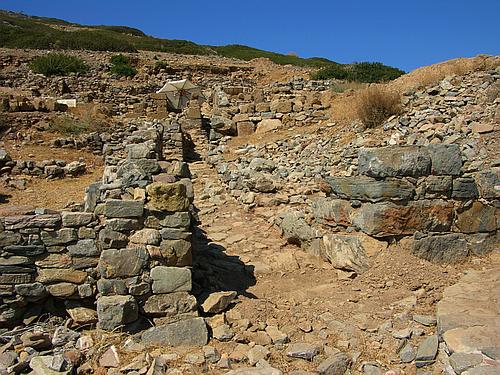
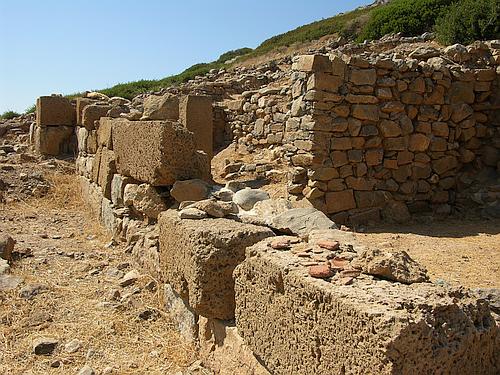
Above: There is a Late Minoan I street between buildings B and C. On the right is the ashlar masonry of the "Ceremonial Center", building B2. It is much larger than the contemporary Late Minoan I houses and was the residence of the ruling elite. It was three storeys high with projecting wings around an open court. The building, distinguished by ashlar blocks in the east and south facades, also served as the "Ceremonial Center" of the town. - This function is indicated by the discovery of a number of figurines and two pillar crypts (below) where the pillar in the Eastern crypt has been damaged by earthquake.
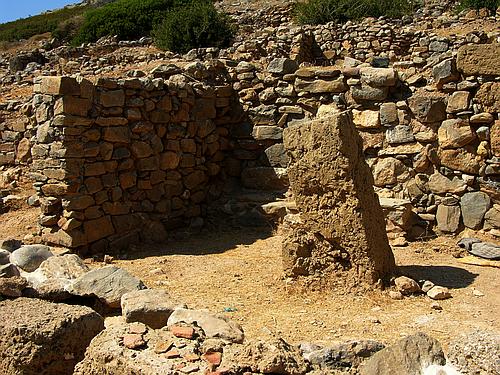
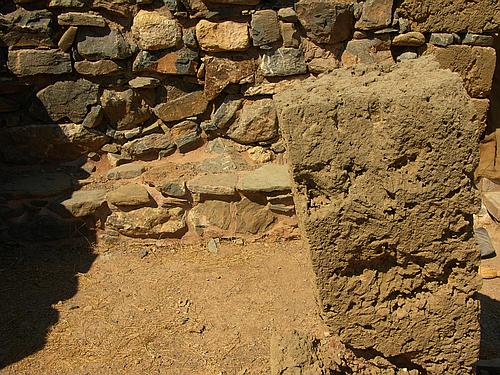
At the end of LM IB, the Neopalatial town in Mochlos was destroyed by fire, as were many other Minoan sites all over Crete. The cause of this apparently simultaneous destruction is still not clear. Was it caused by the eruption of the volcano on the island of Santorini (Thera), by earthquake or by military actions? In the Mochlos excavations, volcanic ashes from Santorini have been found as well as earthquake damage on LM I buildings and human skeletons in the destruction debris.
During the following Late Minoan I B period (ca. 1500-1425 BC), the town was rebuilt on a grander scale. It extended not only over much of the south side of the island, but there were further buildings on the opposite mainland (Artisans' Quarter) and at Chalinomouri.
During the Postpalatial Period (1400-1200 BC), the site was again settled. Houses of the LM IIIA - LM IIIB period have been excavated, and on the hill overlooking Mochlos an important cemetery of the same period is known.
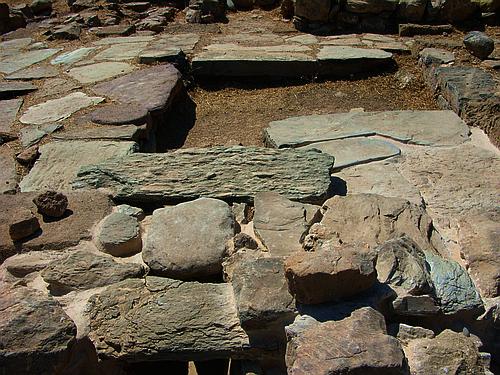
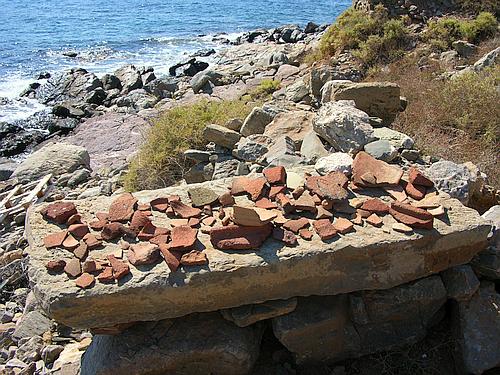
In the Late Hellenistic period (1st century BC), a fort was built above the cliffs on the north side of the island with a defensive wall around the whole island, garrisons and towers. It is not yet clear who controlled this strategic point - both Ierapytna (modern Ierapetra) and Praisos being good candidates. In any case, Mochlos was occupied by Roman troops in 67 BC when Caecilius Metellus conquered Crete. - Much later, in the Early Byzantine period (600 to 827 AD), the fort was again occupied, perhaps as a defence against Arabian raids.