GREECE
 CRETE
LASITHI
MOCHLOS
GENERAL
CRETE
LASITHI
MOCHLOS
GENERAL

2024-10-28
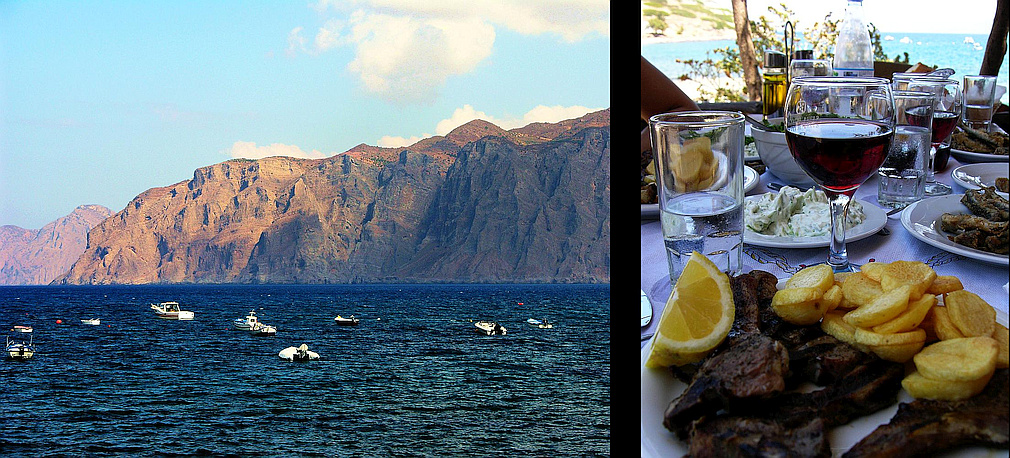
Delicious food right at the sea front at the eastern end of the Gulf of Mirambello with Minoan remains in sight - what a treat.
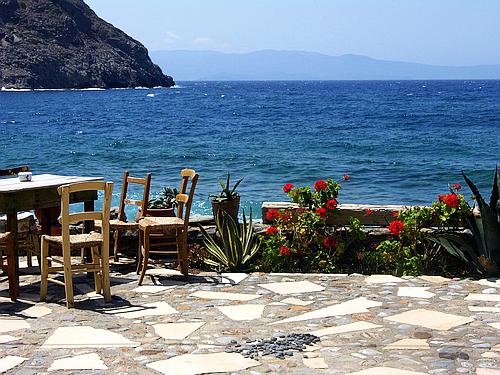
The small coastal village of Mochlos is a place with a very long history. This area was extensively occupied during the Bronze Age (ca. 3100-1200 BC), having a Prepalatial settlement (3rd millenium BC), an important administrative center in the Late Minoan IB period (16th / 15th century BC), and an agricultural settlement in the Mycenaean era (1370-1190 BC). Archaeological evidence shows the reoccupation during the Late Hellenistic (1st century BC) and the Early Byzantine (600-827 AD) period.
First excavations on the island of Mochlos were carried out in 1908 by the American archaeologist Richard Seager, who uncovered a Prepalatial cemetery at the west end of the island with grave goods (now in the Archaeological Museum of Agios Nikolaos) of such exceptional quality that this pointed to the emergence of a ruling class of Minoan Crete. Seager also excavated part of the contemporary settlement as well as remains from the Neopalatial, Mycenaean and later periods.
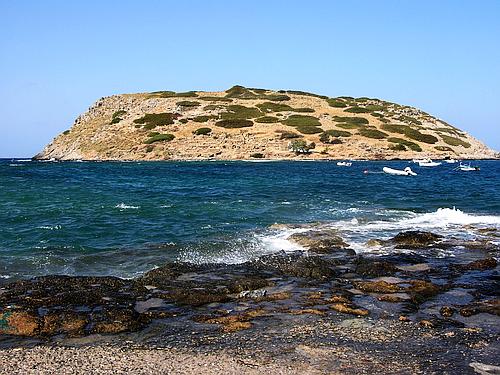
In the 1950s, Nicholas Platon discovered tombs of the EM III, MM I and LM III periods at different places on the coastal plain around Mochlos and Myrsini, east of Mochlos. - Underwater exploration of the coast at Mochlos by J. Leatham and S. Hood in 1955 revealed the existence of fish tanks, built in the Late Hellenistic / Roman period. Their position shows that the sea level was 1-2 m lower at the time of their construction, which means that the islet was actually a peninsula then. The isthmus connecting it to the mainland of Crete would have made Mochlos one of the best protected natural harbours on the north coast.
Work was resumed in the 1970s and early 1980s by Costis Davaras and Jeffrey Soles. Previously excavated places were reexamined, the first detailed map of the island was drawn and some new sites located. Another stimulus came in 1986 when building activities in Mochlos brought to light chamber tombs of the Mycenaean period, seven of which were then excavated by N. Papadakis.
In 1989 a joint Greek-American excavation project under the direction of Professor Jeffrey Soles from the University of North Carolina at Greensboro and Costis Davaras from the University of Athens began and since then produced a wealth of new information about the different civilisations in Mochlos throughout the centuries. Detailed results of this ongoing UNCG project have been published on an excellent web site, strongly recommended to anyone interested in more details.
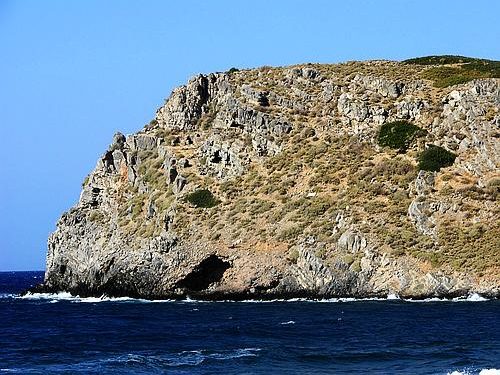
Below: Looking to the islet of Mochlos and its royal tombs.