GREECE
 CRETE
LASITHI
GOURNIA
CRETE
LASITHI
GOURNIA

2024-10-28
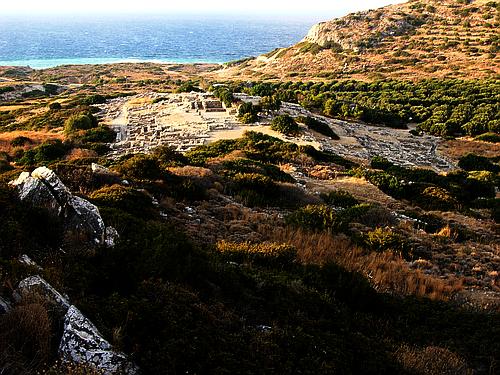
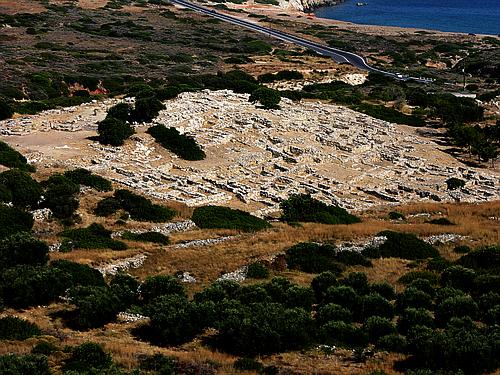
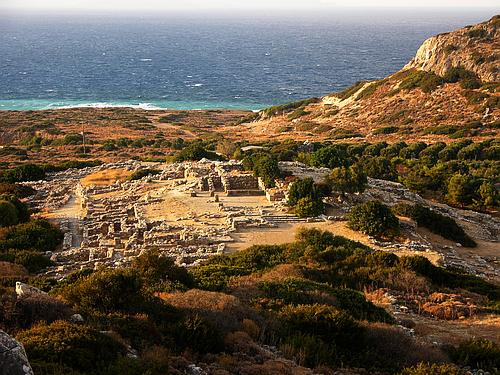
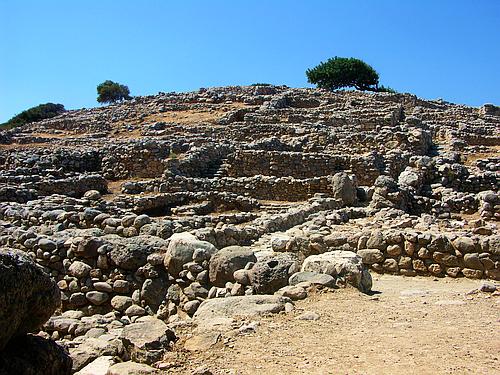
The archaeological site of Gournia lies on a low hill near the north end of the isthmus of Ierapetra, only a few hundred meters from the sea. It is one of the few Minoan settlements that were fully excavated, and it appears in a quite good state of preservation (hence the "Pompeii of Minoan Crete"). At least the eastern part of its impressive maze of building foundations and paved streets can be seen from the road connecting Agios Nikolaos and Sitia.
The site was already settled in the Early Minoan period (EM III, ca. 2300 BC), with remains also from the Middle Minoan period (MM, ca. 2000-1600 BC). The peak of its development coincides however with that of the Minoan culture as a whole (Late Minoan I period; ca. 1550-1450 BC), beginning with the erection of the palace about 1600 BC. Although occupying a strategic position near the isthmus, the town was never fortified. And despite its area of only 15,000 square meters, it must have been a crowded and very busy town, also profiting from the merchants who transported their goods by land to the South rather than sailing around the perilous Cape Sideros. The town, a typical specimen of the medium-sized Minoan settlement, was destroyed in 1450 BC like all other Minoan centres. It was partly reoccupied about 50 years later and continued to exist on a smaller scale until 1200 or 1100 BC, when it was finally destroyed by fire.
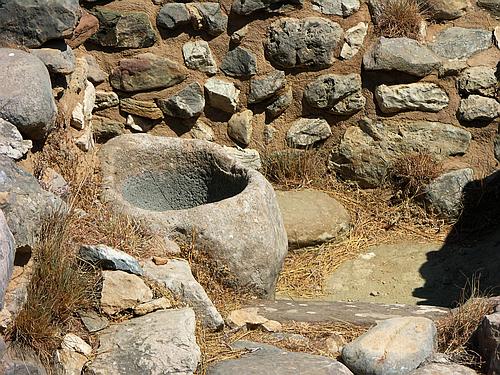
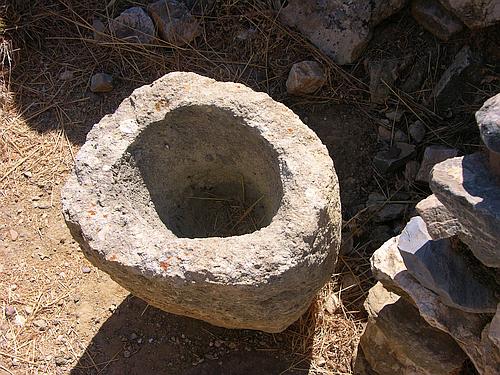
Above: Hollow stone vessels (called "gournes" in Greek, which then led to the name Gournia) were already known to the farmers in the area, before the American archaeologist Harriet Boyd-Hawes explored the site in 1901-1904 (after Arthur Evans preferred to dig in Knossos). She was the first woman in archaeology to supervise a major excavation. - Many of these vessels can still be seen today in the excavated houses of Gournia.
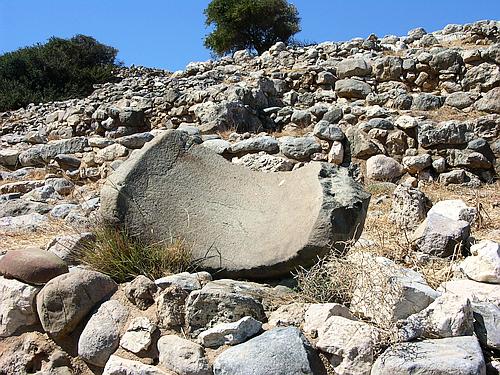
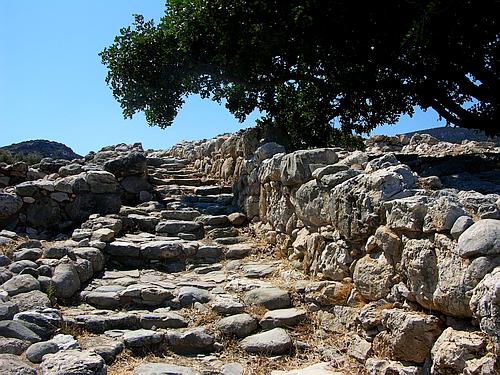
Above right: Interesting is the system of early town planning. Two paved streets encircle the hill, intersecting narrow, stepped streets at right angles that lead to the top.
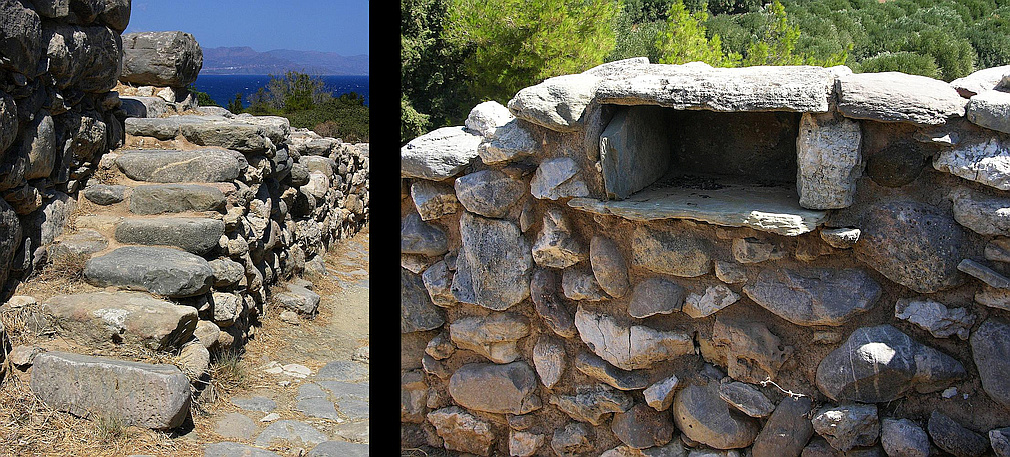
Below: Many houses were two-storeyed with stairs leading from the street to the entrance at the upper floor. And in the walls of several houses Minoan "refrigerators" are preserved.