GREECE
 ATTICA
SARONIC ISLANDS
TROIZEN
ATTICA
SARONIC ISLANDS
TROIZEN

2024-10-28
The region of ancient Troizen already had a sparse population in the Early Helladic period since 2500 BC and later evolved into a powerful city-state with one of the earliest cult centres of Poseidon (with interesting parallels in Agios Konstantinos and Oga). Throughout most of the historical times it allied with another powerful city-state, Athens. Both cities are linked by Theseus, one of the major heroes of Greek mythology, and this is the first of three remarkable stories associated with Troizen.
When Aegeus, king of Athens, visited Troizen he got princess Aethra pregnant in spite of the warning of an oracle. One version of the myth relates that Aethra was led by Athena in the same night to the sea where she also had a sexual encounter with Poseidon so that Theseus had two fathers: a mortal and a deity. Theseus grew up in Troizen without father but before Aegeus returned to Athens he hid a sword and sandals under a large stone and declared that if his son could move the stone and get the sword he would become King of Athens. When Theseus had grown up he retrieved the gifts of his father and headed to Athens. But instead of choosing a boat he decided to take the land route around the Saronic Gulf and achieved his six heroic deeds: overcoming robbers, murderous highwaymen and beasts terrorizing travellers on their way to Athens since years. Theseus finally arrived at the palace of the king, who was meanwhile married to Medea, the former wife of Iason. With her magical power Medea recognized Theseus and feared that he as firstborn would be king and not her son Medus and tried to poison him. However, Aegeus recognized his sword and sandals and when they celebrated their reunion Medea fled to Asia. - Of Theseus' later deeds the best known is the defeat of Minotaurus with the help of Ariadne. His burial place is probably one of the tholos tombs near Galatas.
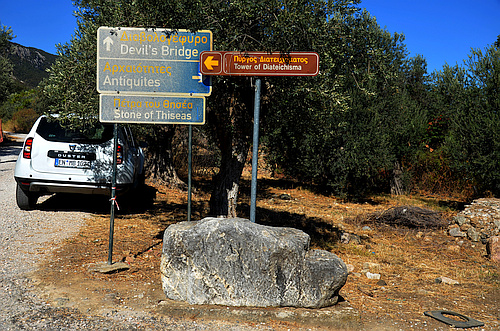
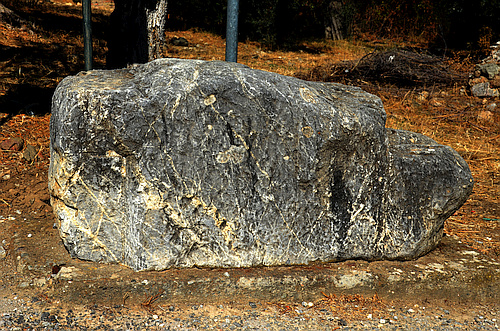
Above: The 'Stone of Theseus', a weathered shell limestone weighing about one ton. Aegeus, the legendary king who hid sandals and a sword under it, may have made use of a lever, and his equally shrewd son may have done the same.
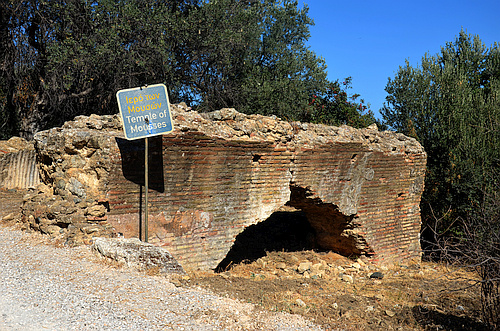
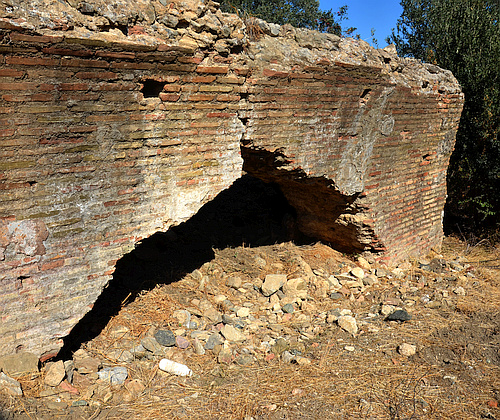
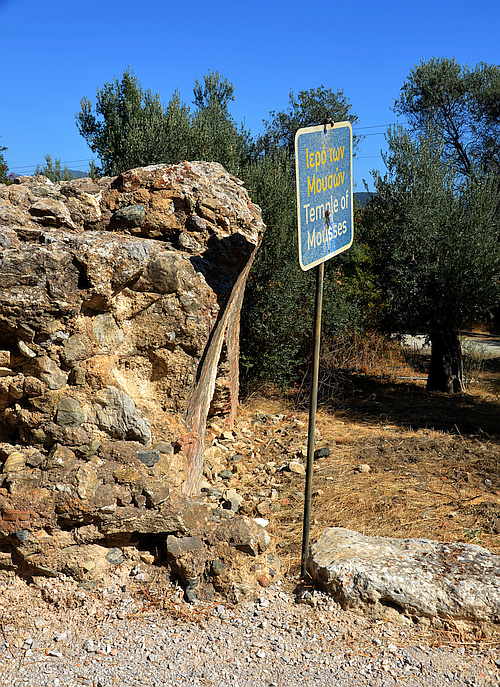
Left and above: The arched Temple of the Muses with the typical brick masonry of the Roman period.
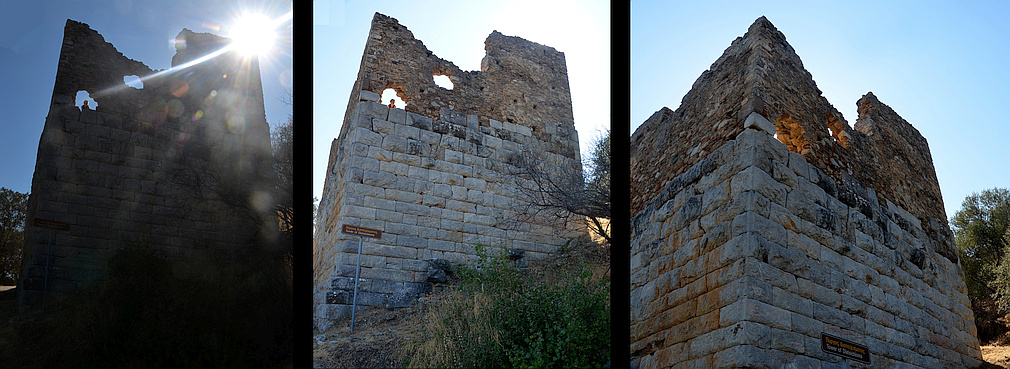
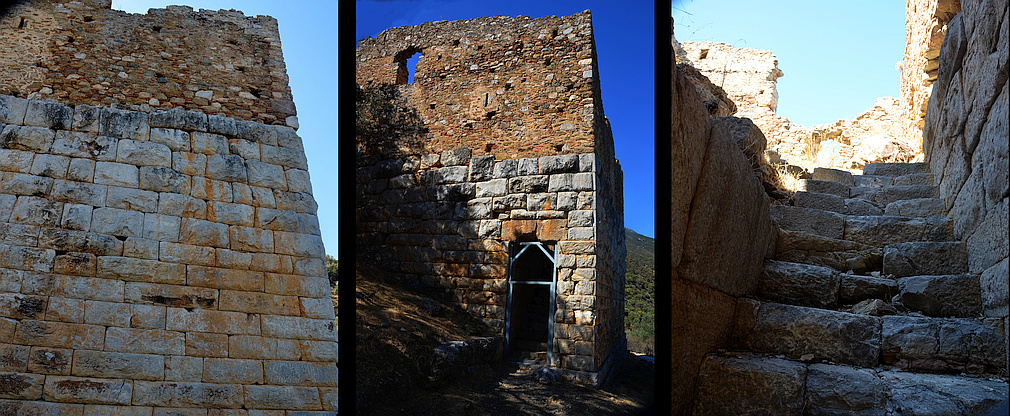
Above and below: The 'Tower of Diateichisma', also known as the 'Tower of Damalas' or the 'Palace of Theseus', is a Hellenistic watchtower of the mid-first century BC with a floor area of 13 × 9.70 m. The ancient masonry of large isodomic blocks with vertical grooves accentuating the corners is preserved to a height of some 6 m. During the Byzantine-Frankish era this was augmented by walls of smaller irregular stones. In the interior a staircase of 17 steps leads to an upper plateau.