GREECE
 PELOPONNESE
ARCADIA
MEGALOPOLIS
PELOPONNESE
ARCADIA
MEGALOPOLIS

2024-11-16
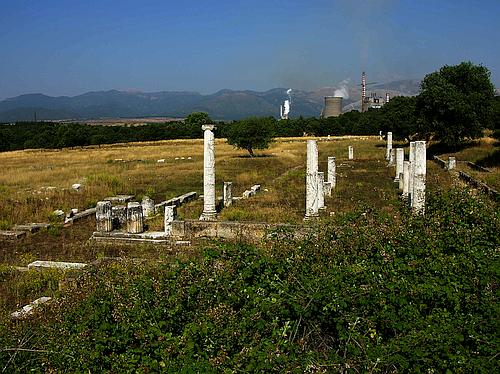
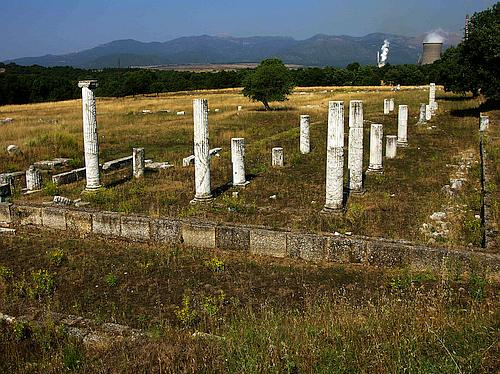

Modern Megalópoli is a town in south-west Arcadia with ca. 5000 inhabitants. It lies on a plateau (ca. 12 x 18 km, 400 m above sea-level), known to be a rich lignite-bearing region. Much of the landscape has already been disfigured by the surface mining of brown coal. It fuels the Megalopoli Power Plant, located 5 km north-west of Megalopoli, that produces electricity for southern Greece and the islands. Its construction began in the mid-1960s just after the town was struck by an earthquake in 1965. Today, the plant employs 500 to 1,000 people, most of them from Megalopoli, and is a major economic factor in the region. Since its opening, heavy pollution has been a problem. Smokestacks loom over Megalopoli as sulphur and carbon dioxide (CO2) are emptied. They are visible from as far as 20 km, where ecological damage not only on the plateau but also high up in the Arcadian mountains is evident. The main concern is however dumping used-up coal into the Alfeios which ruins its water supply and nature as well as the ancient city of Megalopoli which saw marble and stone begin to rust.
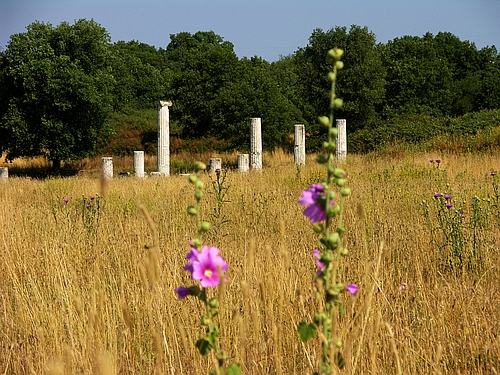

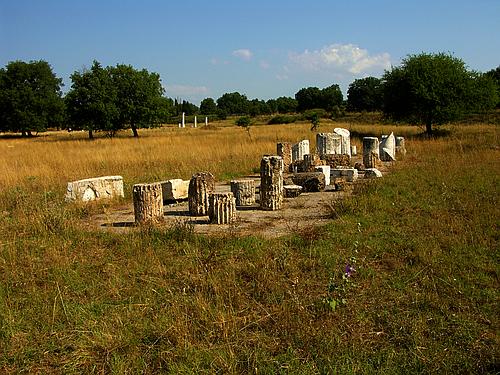
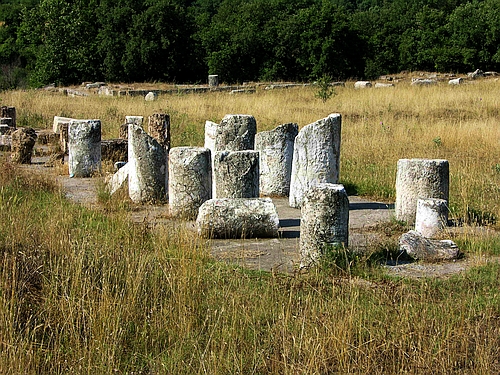
Ancient Megalopolis (greek: megale polis, 'the big city'), was one of the most ambitious building projects of the Classical age. Like Messene, it owed its origin to the Theban general Epaminondas. In 370 BC, one year after Epaminondas' tremendous victory over the Spartans at Leuktra, Megalopolis was founded on the banks of the Helisson River, its citizens being transplanted from forty local villages. It was to be the capital of the Arcadian League, the finest of a chain of Arcadian settlements designed to contain the Spartans. Plato is said to have been invited by Epaminondas to draw up the constitution and code of laws, but to have declined. It was one of the largest cities in the Peloponnese, and although no expense was spared on its construction, nor on its extent - nine kilometres of walls alone - the city never took root.
When Epaminondas, who oversaw construction from 371 to 368 BC, left the city, Megalopolis suffered from sporadic Spartan aggression. It consequently entered into friendly relations with Philip of Macedon. Twenty years later, when the Spartans and their allies rebelled against the power of Macedon, Megalopolis remained firm in its allegiance, and was subjected to a long siege. After the death of Alexander (323 BC), Megalopolis was governed by native tyrants. In 234 BC Lydiades, the last tyrant of Megalopolis, voluntarily resigned his power, and the city joined the Achaean League. In consequence of this it was again exposed to Spartian imperialism. In 222 BC Kleomenes plundered it and killed or dispersed its inhabitants, but in the year following it was restored and its inhabitants reinstated by Philopoemen, a native of the city and general of the Confederacy, after he had defeated the Spartans at Sellasia (222 BC). After this, however, it gradually sank into insignificance. When Pausanias visited the place around AD 180, it was a minor town much in ruin. It was finally abandoned at the end of the Roman period. Within two centuries it had been broken up, abandoned and ruined. "The Great City", wrote Kazantzakis in 'Journey to the Morea', "has become a great wasteland".


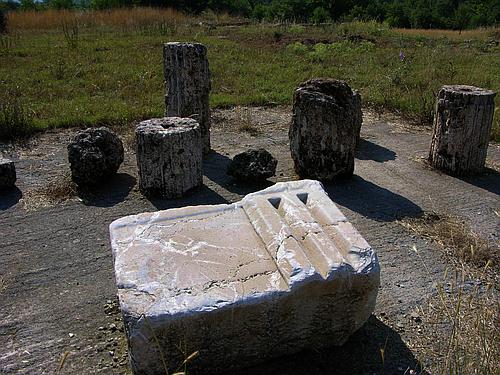
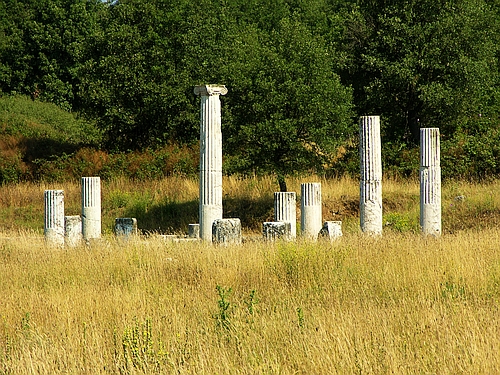
When you visit the site today you are very likely to be alone, save perhaps for the custodian at the theatre (free admission). The area of the ancient city lies next to the modern road between modern Megalopoli and the power plant. It is bisected by the Helisson river, which flows through it from east to west. On the north bank were municipal and private buildings grouped on a magnificent scale round the square agora. Here you can wander over a vast area, and with a little imagination make out the foundations of walls and towers, temples, gymnasiums and markets.