GREECE
 MACEDONIA
PIERIA
DION
PARK
MACEDONIA
PIERIA
DION
PARK

2025-10-19
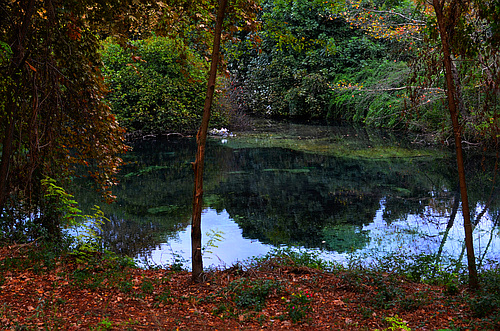
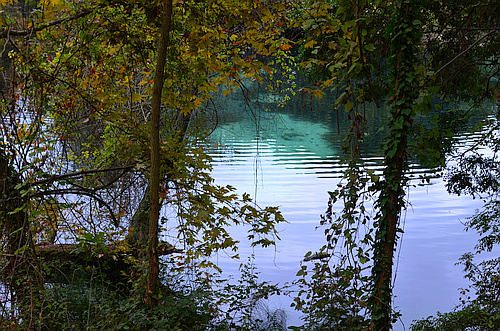
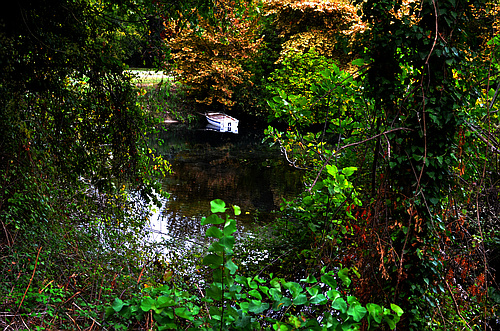
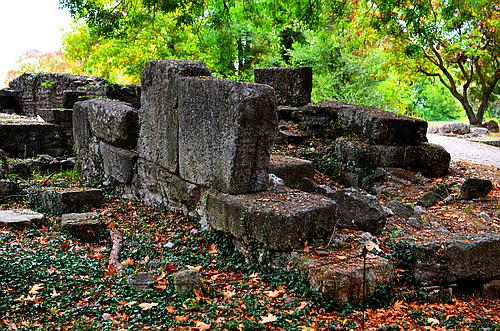
Dion, once the most important sacred city of the Macedonians, lies in the eastern foothills of Mount Olympos. Its archaeological park covers a large area of some 700,000 square meters and really deserves its name: it is a park with woods, a stream, small lakes and now and then ancient architectural remains of the Hellenistic, Roman and Early Byzantine periods. To visit the site you will need hours - and since the signage is quite poor you risk to go astray.
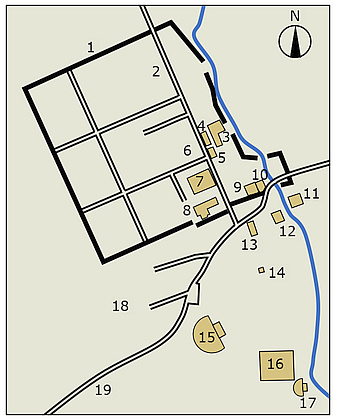
Plan of Dion Archaeological Park
1. City wall
2. Cardo Maximus (main road)
3. House of Dionysos
4. Hydraulis sector
5. Praetorium
6. Polygonal building
7. Forum
8. Great Roman baths
9. House of Zosas
10. House of Leda
11. Sanctuary of Isis
12. Sanctuary of Zeus Hypsistos
13. Sanctuary Demeter
14. Sanctuary of Asklepios
15. Hellenistic theatre
16. Sanctuary of Zeus Olympios
17. Roman theatre
18. Stadion
19. Modern road
Because of cultic and practical reasons the sanctuaries of Dion were founded outside the fortification walls (extra muros). Sacred signs from Zeus, such as towering oak trees and abundant springs, signified the location (locus sanctus) of the age-old cult of Zeus Olympios and the muses. The institution of the Olympic Games of Macedonia, "Olympia ta en Dion", by King Archelaos (413 - 399 BC), played a decisive role in planning the layout of the area, requiring plenty of space for a multitude of Macedonian pilgrims.
The precinct (temenos) of Zeus Olympios was surrounded by sanctuaries of various deities, which constituted an organized ensemble. A central thoroughfare linked the sacred grove of the muses, which was most probably located outside the south wall of the city, with the revered sanctuary of Zeus Olympios. To the west of the road was a flat tract of land, delimited by the embankments of the Hellenistic theatre and the stadium. Along the east side of the road extended the sanctuaries of Demeter, Asklepios and Athena. Further east, along the south wall, the sanctuaries of Isis and Zeus Hypsistos were built in Roman Imperial times. In this same period the second theatre was constructed to the south of the sanctuary of Zeus Olympios.
In the late 18th century, when the French consul Felix de Beaujour visited the area, he found it deserted and littered with the architectural remains of an unknown city. This city was identified in December 1806, when the British office W. M. Leake recognized the ruins of the stadium and the theatre next to the sources of the Vaphyras river. The site of Dion was confirmed in 1855 by the French archaeologist L. Heuzey.
Mounds covered with trees and bushes concealed the ruins of the buildings, when G. Sotiriadis, Professor of Archaeology and Rector of the Aristotle University of Thessaloniki, conducted the first excavations in the period 1928 - 1931. Thirty years later, the excavations were resumed by Professor G. Bakalakis. In 1973 the most important period of archaeological research commenced under the directorship of Professor D. Pandermalis and the participation of the faculty and the student body of the Aristotle University of Thessaloniki.
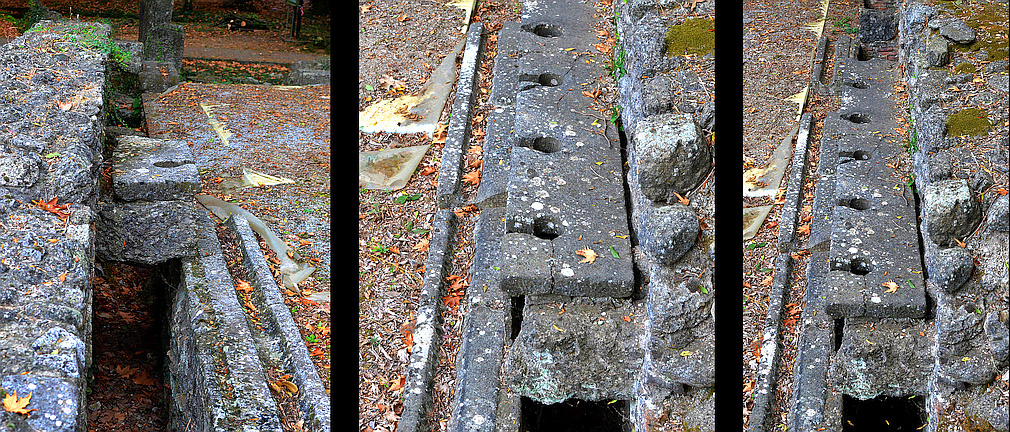
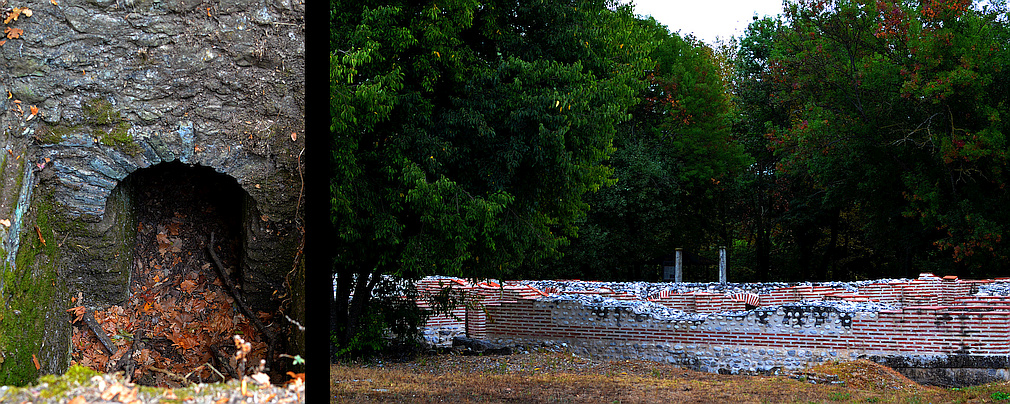
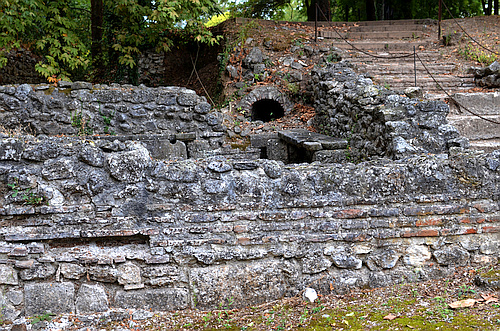
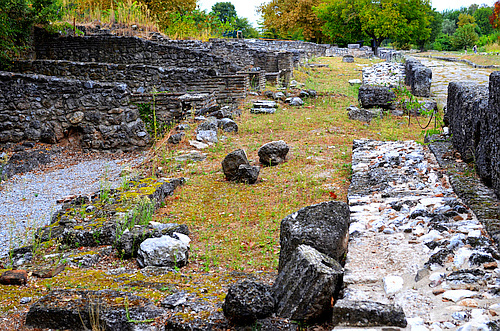
Above: Public latrines (not recognized by most visitors). - Below left: Waste water channel. - Below right: View to the Great Roman baths.