GREECE
 CRETE
LASITHI
KAVOUSI
VRONDA
CRETE
LASITHI
KAVOUSI
VRONDA

2024-10-28

Vronda was first explored by Harriet Boyd (Hawes), who found a large building with a forecourt and storerooms on top of the ridge, a massive wall along the East, and eight tholoi (beehive-shaped corbelled tombs) to the North and Northwest dating to the Subminoan period (1025-1000 BC).
Excavations were renewed in 1987 and continued through 1992 under the auspices of the American School of Classical Studies at Athens. They revealed a small settlement of the Late Minoan IIIC period (1200-1025 BC) on the summit with a large mansion on top (building A/B), a shirne on the SW (building G), and at least five house complexes. A Late Minoan IIIC potter's kiln west of the shrine has been reburied for protection. Also uncovered were 36 graves of the Late Geometric and Early Orientalizing periods (745-680 BC), containing cremation burials. [Text as provided on information tables at the site.]
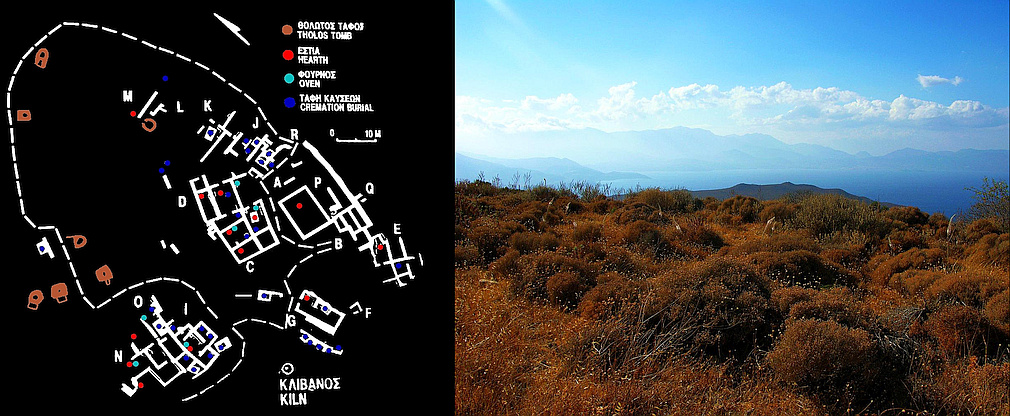
Prior to the Late Minoan IIIC settlement, the site was used in the Early and Middle Bronze Ages (Early Minoan II - Middle Minoan II periods, 2650-1750 BC). After the settlement was abandoned and long after its use as a cemetery in the Subminoan and Geometric periods, the site was reused in Venetian times for sporadic settlement (buildings F and R).
Above left: Plan of the site. - Above right: View from Vronda to Tholos and the island Psira. - Below: Another view to Psira island and a view from the remains of a tholos tomb of Vronda towards the Gulf of Mirambello.
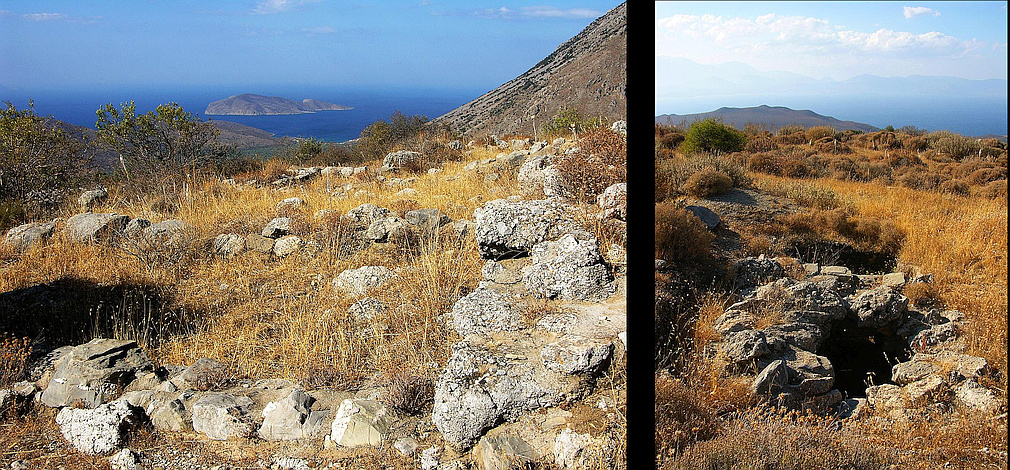
Above left: The shrine of the goddess with up-raised hands, serving as the religious center for the Late Minoan IIIC (1200-1025 BC) settlement. Found in and around this building were over 4,000 fragments of clay statues representing the goddess with up-raised hands, a Minoan nature goddess, and her ritual equipment - snake tubes, kalathoi, and plaques. Room G1, probably the main sanctuary, was badly disturbed by a Late Geomentric (745-710 BC) cist grave. Some sherds remained in this room, but most were found in the area to the South and West of the room where they had been thrown by the builders of the grave. Six snake tubes (tube-shaped vessel with snake-like handles), 11 kalathoi, 5 plaques, and part of a statue were found in room G2. The statues would have been displayed on the benches in rooms G1 and G2 with the snake tubes serving as stands holding the kalathoi (or offering bowls) on the floor in front of them. The plaques would have been hanging on the walls. Some statues and ritual equipment might have been displayed on the bench along the outside of room G1 for outdoor group rituals. Parts of over 26 statues, 30 snake tubes, 30 kalathoi, and 26 plaques have been identified.
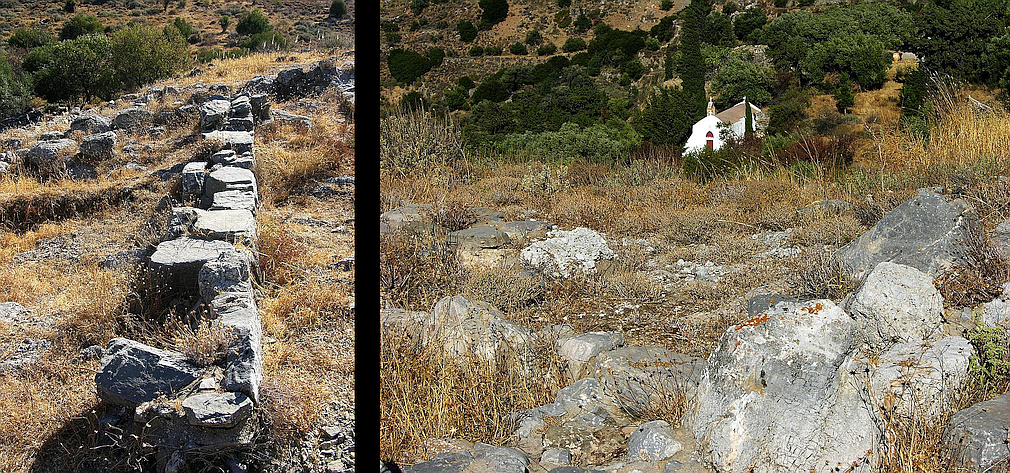
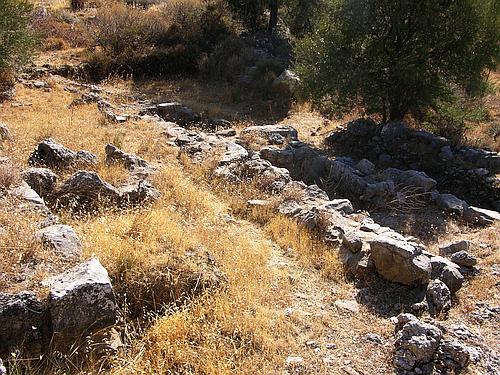
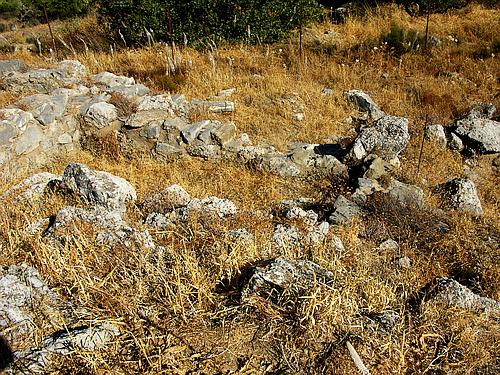
As the largest Late Minoan IIIC (1200-1025 BC) building on the site, building A/B (above right) gives ample evidence of belonging to the ruler or most important persons on the site. The large room with central hearth was cleared by Boyd, but already had suffered from erosion and human activity. Storerooms to the Southeast, however, were still untouched. The long, narrow magazines have no doorways and were entered from a second story above. They contained the largest storage jars found on the site. Fine kylikes and bowls were also found. Fragments of a large terracotta window frame discovered in and around these rooms may have been set in the East wall. - The massive terrace wall (below left) along the East was built to increase the space available for the mansion.
Below right: The chapel of Agia Paraskevi behind fundaments of building J/K (Late Minoan IIIC, 1200-1025 BC) that was badly disturbed by later grave activity.