>> BACK TO GREECE <<
 TURKEY
TROY
TURKEY
TROY

2025-01-20
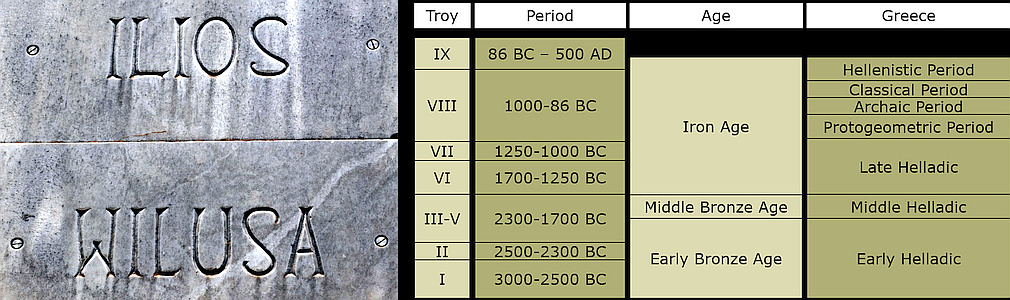
Troy (Ancient Greek: Ilion, Ilios, Troia; Latin: Troia, Ilium; Hittite: Wilusa, Truwisa; Turkish: Truva; German: Troja) is located near the southwest end of the Dardanelles at Hisarlik. It is best known as the setting of the Trojan War described by Homer especially in the Iliad. - The site was still known in Roman Imperial times when Emperor Augustus founded a new capital there called Ilium. It gradually declined during the Byzantine era and by the 19th century the location of this famous site was altogether forgotten.
In 1865, Frank Calvert, an English consular official and amateur archaeologist, whose family owned part of the hill of Hisarlik, excavated trial trenches there and was convinced to have found Troy. Heinrich Schliemann, after a chance meeting with Calvert, then made large-scale excavations on the site in 1870-1890 with the discovery of the "gold treasure of Priam" in 1873. Already Schliemann found out that the hill contains ruins of a series of ancient cities dating from the Bronze Age to the Roman period, meanwhile denoted Troy I - IX (above right). This was refined by Wilhelm Dörpfeld who followed Schliemann, later by Carl Blegen, the discoverer of Nestor's palace.
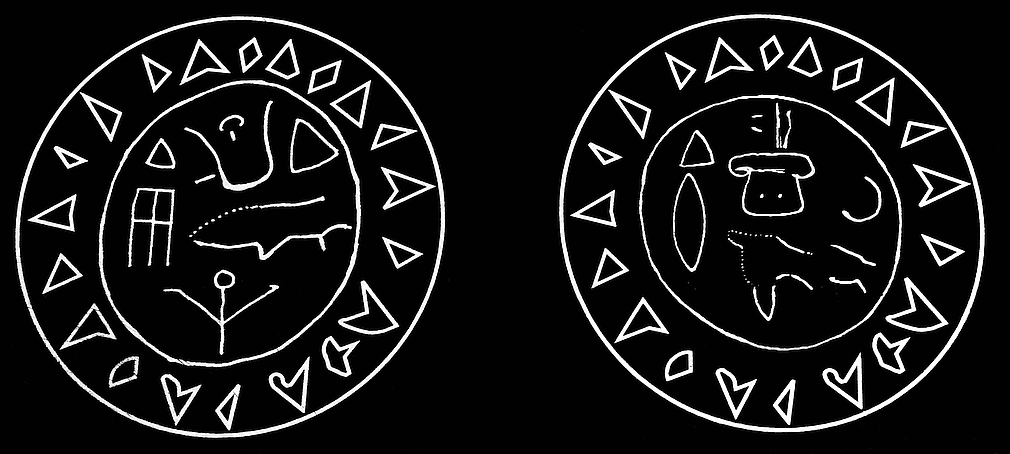
Until then the excavations concentrated on the acropolis, which was only the center of a much larger city. This was shown by the work of Professor Korfmann (Universität Tübingen) who carried out annual excavations with an international team since 1987. After his death in 2005, work was resumed until 2012 under the direction of Professor Pernicka (Universität Tübingen). The most important discoveries were that of a Luwian biconvex seal identifying Troy VII with Hittite Wilusa and of a deep ditch that may have once marked the outer defences of a much larger city than had previously been suspected. The latter city has been dated to about 1250 BC, and there is archeological evidence that this was indeed the Homeric city of Troy.
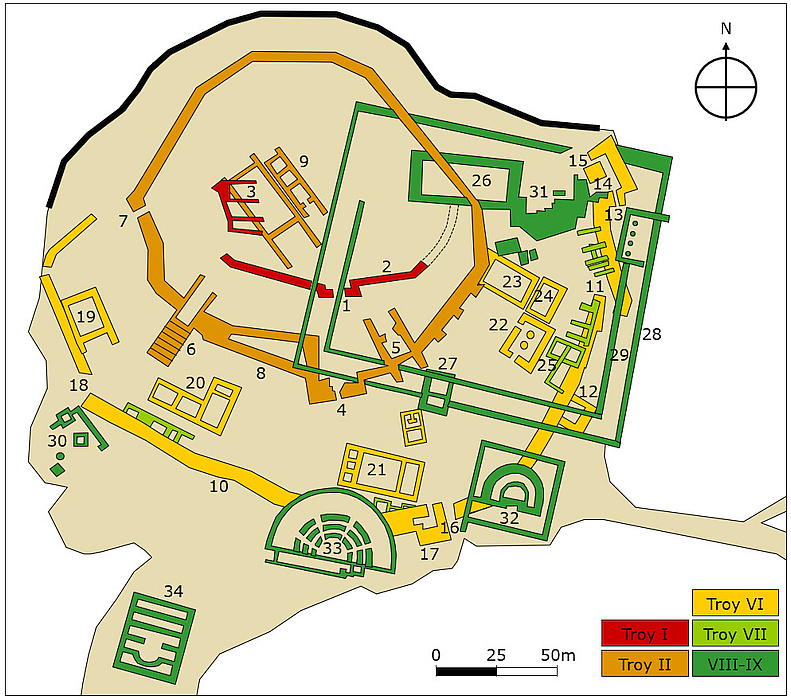
Plan of Troy:
| 1: Gate | 9: Megarons | 18: VI. U Gate | 27: Propylaeum |
| 2: City Wall | 10: City Wall | 19: VI. A House | 28: Outer Court Wall |
| 3: Megarons | 11: VI. S Gate | 20: VI. M Palace-Storage House | 29: Inner Court Wall |
| 4: FN Gate | 12: VI. H Tower | 21: Pillar House | 30: Sanctuary |
| 5: FO Gate | 13: VI. R Gate | 22: VI. F House with columns | 31: Water Work |
| 6: FM Gate and Ramp | 14: VI. G Tower | 23: VI. C House | 32: Bouleuterion |
| 7: FJ Gate | 15: Well-Cistern | 24: VI. E House | 33: Odeon |
| 8: City Wall | 16: VI. T Dardanos Gate | 25: VII. Storage | 34: Roman Bath |
| 17: VI. I Tower | 26: Temple of Athena |
Below: Drawing of the bronze biconvex seal discovered in 1995, the first Bronze age inscription found at Troy.
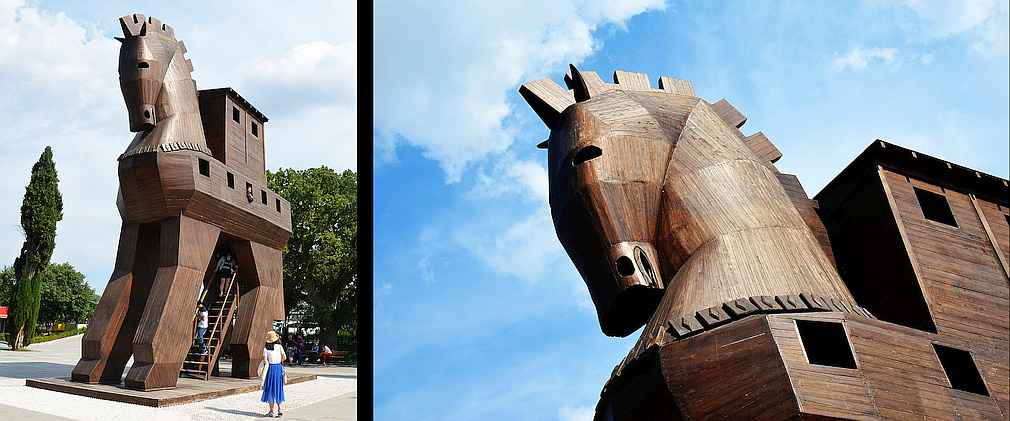
Above: The wooden horse placed near the entrance of the site is of course not historic (not even part of the Iliad) but nevertheless a major attraction for tourists. - Below: The monumental eastern gateway of Troy VI / VII from the time of the Trojan War (ca. 1180 BC).
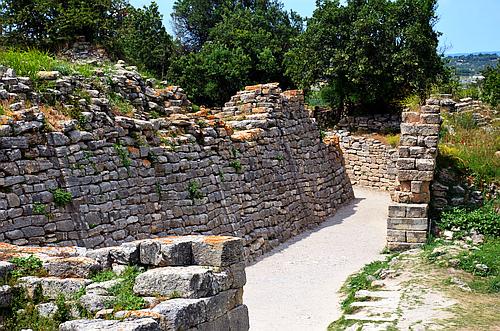
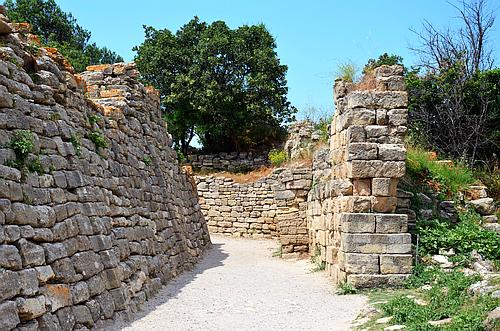
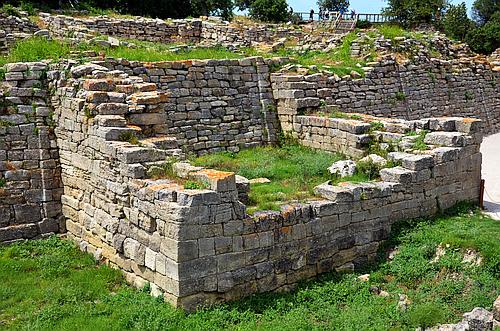
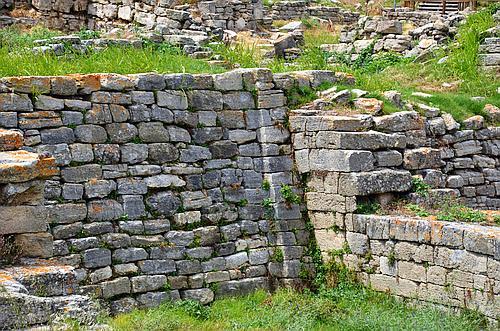
Above and below: A tower in front of the eastern gate with "saw tooth construction" of the inclined walls.
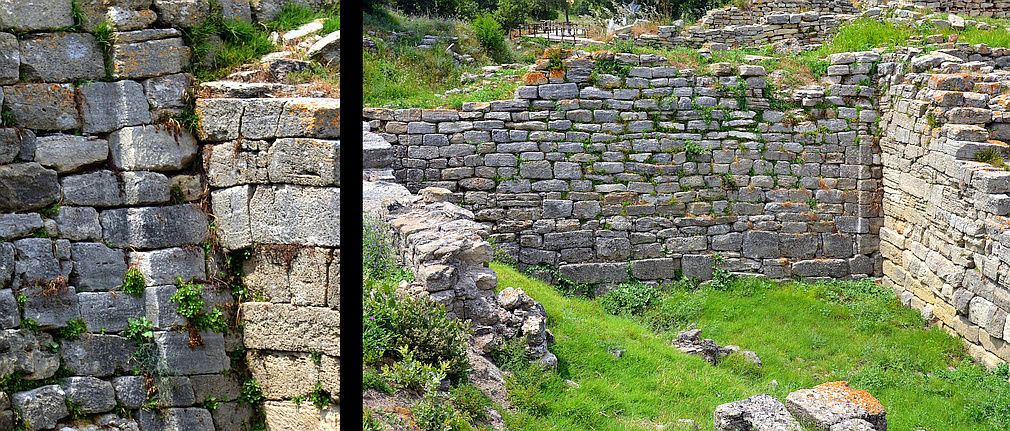
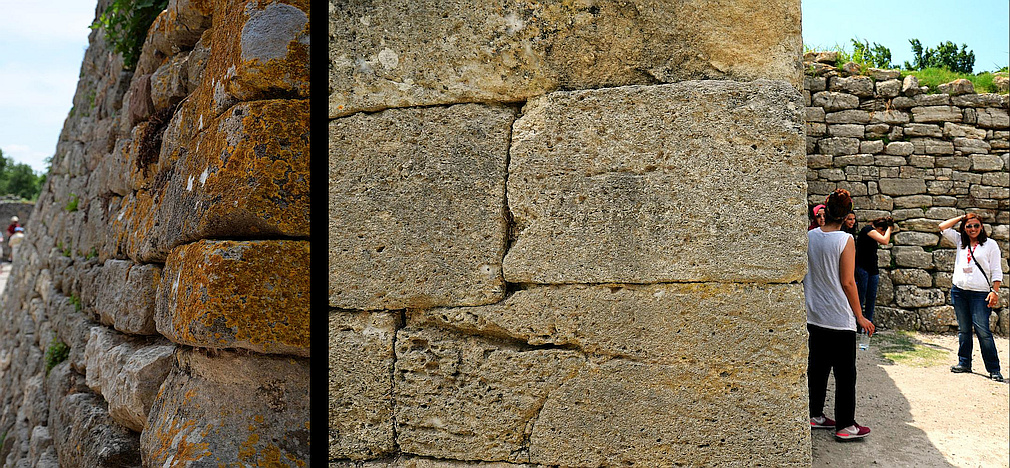
The fortification walls of Troy VI / VII were 5 m thick and up to 8 m high constructed from large limestone blocks, including several rectangular towers as in Hittite fortifications. The walls were once topped by a superstructure of mud brick and wood.
Below: The passage of the eastern gateway has a 90° bend to prevent long battering rams being employed.