GR
 PELOPONNESE
ARGOLIS
AG. TRIADA
AGIA TRIADA
PELOPONNESE
ARGOLIS
AG. TRIADA
AGIA TRIADA

2024-11-19
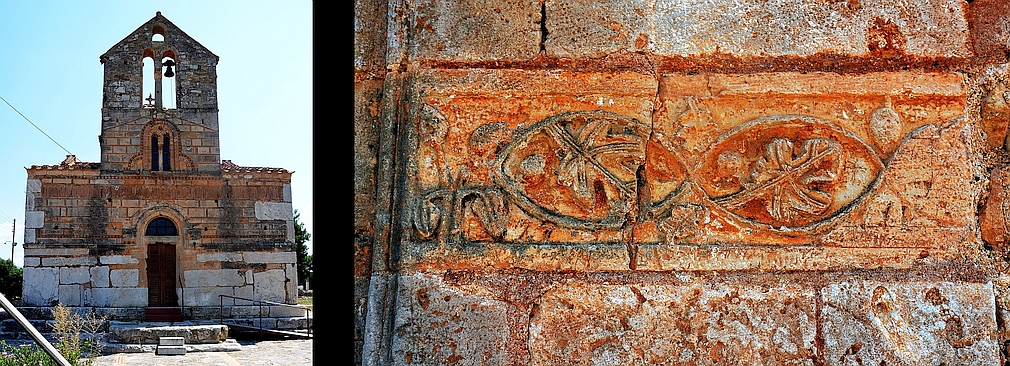
Above left: View of the church of Agia Triada from the West, just outside the village that was known as Merbakas. This name was probably derived from the Flemish village of Moerbeke which happens to be the place of origin of William of Moerbeke, Latin archbishop of Corinth, a Dominican and a pretty illustrious classical scholar of his time, who may have also founded the village of Merbakas.
The church, truely a Byzantine jewel and to me the most interesting church in the Argolid, is dedicated to the dormition of the Virgin. Architecturally it belongs to the domed, cross-in-square church of the composite four-column type. The bell tower seen on the photograph above left is actually just a vertical extension of the façade.
The church was probably built at the end of the 12th or the first half of the 13th century. However, the actual dating remains one of the great mysteries of the building as it rests on some doubtful written evidence of another nearby church and on the uncertain dating of the immured ceramics, also much debated by scholars.

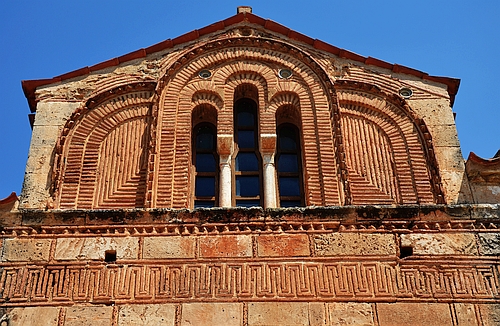
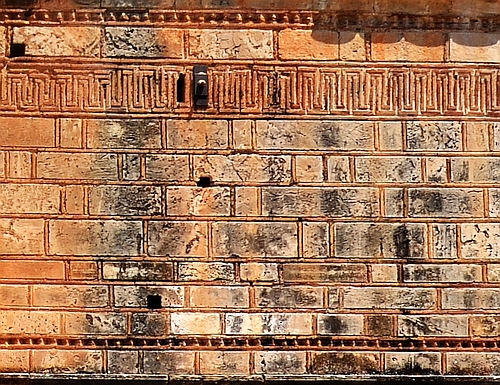
The church stands on three steps (photo above) reminiscent of an ancient stylobate which may hint to christianity triumphing over the old religion. The next courses (below left), nearly 2 m high, use building blocks taken from the Argive Heraion a few kilometers distant, while the blocks in the higher courses were brought from Corinth, presumably quarried fresh from local stone. The higher courses (below right) are in cloisonné style with decorative brick-work at the top made to look like a Greek key meander.
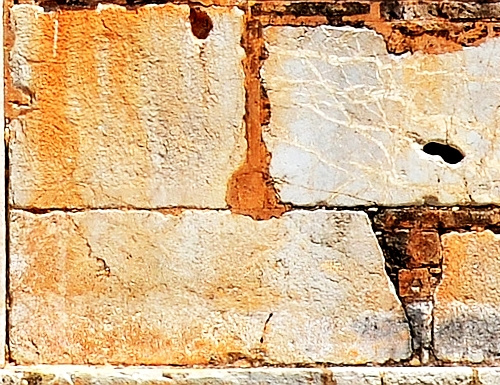
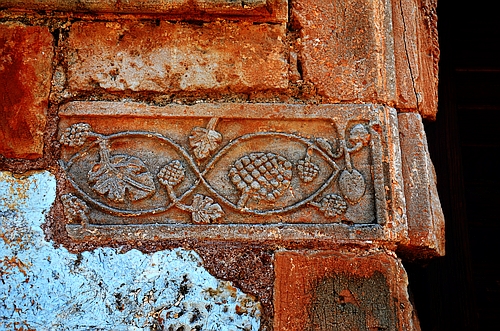
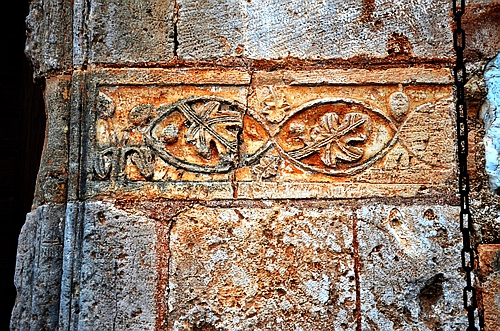
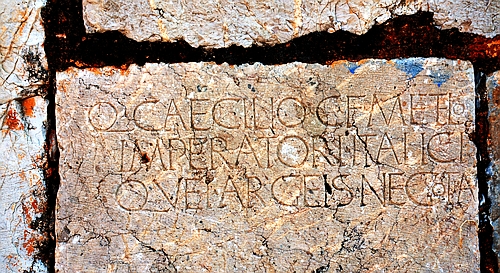
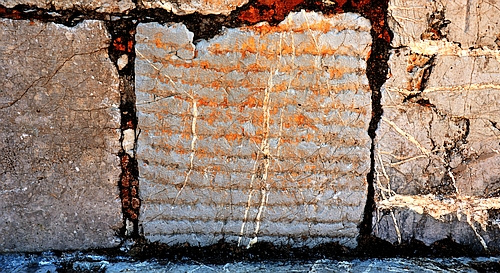
Above: Beautiful reliefs on the west façade. - Below left: The latin inscription on this block reads: Q(UINTO) CAECILIO C(AII) F(ILIO) METELO | IMPERATORI ITALICI | QVEI ARGEIS NEGOTIA(NTUR). The mentioned Metelus conquered Crete around 67 BC, thereby clearing this part of the Mediterranean of piracy. It has been suggested that the founder of the church thought to link this with the second council of Lyon in 1274 which amongst other things sought to suppress piracy. - Below right: A weathered and hardly discernible Greek inscription on a spolion near the west door.
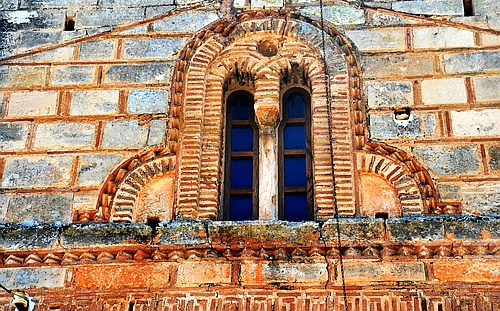
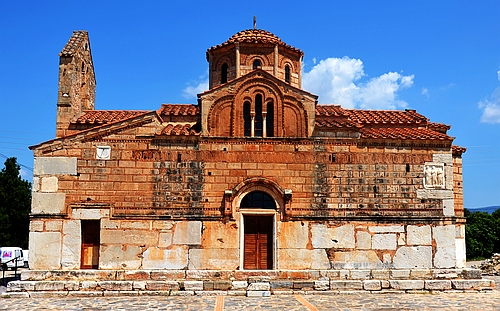
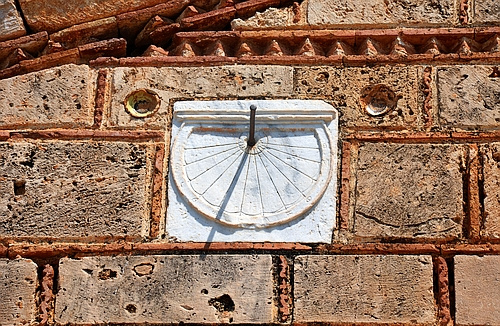
Above left: Window with cloisonné decoration below the bell tower in the West. - Above right: The southern side of the church with the tripartite construction of the façade and the octagonal dome. - Below left: A classical sundial incorporated into the south wall. - Below right: The central apse, with its Gothic engaged columns in the trilobed window, and more Greek key decorative brickwork. A meander is also visible running horizontally in the marble under the windows. Above the windows are immured ceramic bowls, called Grid Iron Protomaiolica bowls, from an Italian workshop. Some bowls are missing, leaving only their cavities.